Monday, April 13th 2026

Valve Engineer Improves Linux Memory Management for GPUs with 8 GB VRAM or Less
Valve's Linux developer, Natalie Vock, has introduced a new method for handling memory management on GPUs with 8 GB or less VRAM. Since a large part of the gaming community uses systems with limited resources, improving performance and VRAM allocation is an excellent way to maximize frames per second. According to Vock's solution, GPUs with 8 GB of VRAM or less on Linux will now benefit from better background VRAM management, allowing more free space for games. Several Linux kernel patches have been submitted to guide how Linux manages resources when a game is loaded. Previously, when a game used too much VRAM on a low-VRAM GPU, the Linux Graphics Translation Table (GTT) would move data to system RAM to prevent the game from crashing. Since Linux doesn't prioritize programs, it could sometimes move the actual game from VRAM to system RAM to make space for something like a browser or another third-party app.
In Vock's testing before these new patches, running Cyberpunk 2077 resulted in the system using only 6 GB of the 8 GB of available GPU VRAM, with about 1.37 GB spilling over to GTT and being allocated in system RAM. This could lead to game stuttering and frame-pacing issues. Now, Vock has developed a real-time dmemcg-booster, which stands for Device Memory Control Groups, to inform Linux when a program running on the GPU VRAM needs to stay there without being moved to GTT and then to system RAM. With the new patch, running Cyberpunk 2077 now uses almost the entire available system VRAM, reaching 7.4 GB, while GTT allocation has been reduced to 650 MB, cutting usage by more than half. In the picture below, you can check the "GameThread" behavior before and after the patch is applied.
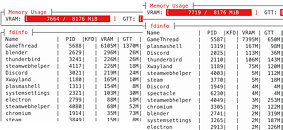 This patch comes just in time for Valve's Steam Machine arrival, which also has 8 GB of GDDR6 memory as VRAM. Valve probably intended to make these enhancements for its own hardware found in the Steam Machine and any future hardware releases. However, as there are millions of gamers using a GPU with 8 GB VRAM or less, everyone will get the added benefit. We still need to see more detailed performance testing, but the good thing is that many Linux distributions are already in the process of integrating these patches into their releases. Finally, the KDE desktop environment also received a patch to be aware of which window is in the front and active, so the system gets an idea of where to push the GPU VRAM.
Sources:
Natalie Vock, via Tom's Hardware
In Vock's testing before these new patches, running Cyberpunk 2077 resulted in the system using only 6 GB of the 8 GB of available GPU VRAM, with about 1.37 GB spilling over to GTT and being allocated in system RAM. This could lead to game stuttering and frame-pacing issues. Now, Vock has developed a real-time dmemcg-booster, which stands for Device Memory Control Groups, to inform Linux when a program running on the GPU VRAM needs to stay there without being moved to GTT and then to system RAM. With the new patch, running Cyberpunk 2077 now uses almost the entire available system VRAM, reaching 7.4 GB, while GTT allocation has been reduced to 650 MB, cutting usage by more than half. In the picture below, you can check the "GameThread" behavior before and after the patch is applied.


53 Comments on Valve Engineer Improves Linux Memory Management for GPUs with 8 GB VRAM or Less
That type of info gives Me better credibility from Valve.
But I'm happy that there is development for better optimization of operating system for games, but as it can be done for games, it implicates it can be utilized for other stuff :)
Or you could've just delivered a machine that isn't already choking on the basics.
Still though, progress. Now get that RDNA4 support done and you'll have something worth a sale.
their devs are really doing an amazing job of enhancing the Linux kernel and making amazing purpose made packages for us to enjoy! Gamescope was already incredible and we've seen some really good kernel patches (see the one from a couple months back where they really strongly improved RT performance on Linux) but this one really takes the cake!this is a Linux kernel patch, every machine running Linux had the same choke, that's entirely unrelated to the Steam Machine...RDNA4 support has been around for a looong while now, I made an RDNA4 DIY Machine in December...
-- kinda old knowledge. do not run bloatware.
i consider qt bloated. a few hours ago i had to compile qt again and check out why qml is now needed.
do not run systemd, kde or gnome when you want performance on weak hardare as this topic suggests. that topic also suggests that 8gib VRAM is a bad limiting factor. i am a very surprised as many nvidia and amd fanboys explained me over and over again 8gib vram is enough. whataboutism 2: i am surprised that 12gib vram is not considered a negative point etc.
-- kinda old knowledge do not have anything open while gaming. the text refers to having a browser open in the tab. it is the desktop environment fault to store stuff in the graphic card memory, even worse store lots of bloat which others can do better. the text refers to kde. the fix / patch is another fact and proof how bloated and bad kde and qt is.
some browsers also got fixes to make tabs inactive. there wereeven google chrome related browser plugins to set inactivy of not used tabs. the issue is badly choosen microslop windows 95 style software and behaviour and not gaming optimised usage.
make a new script which starts a plain x server with st or similar small terminal which calls your game binary when you really have issues with your 8gib vram. the 8gib vram are not an issue on the vram, they are an issue of the chosen software and money not well spend on the right components.
st (suckless terminal) vs mate-terminal speaks volume that gtk is also badly coded.
i3wm bloated vs gentoo live cd with kdethat text block is badly worded. i struggle with the passage that linux is informed. so ubuntu is informed? usally people talk about linux as ubuntu. or is it inform the kernel? which process is informed?
a tech article should not be vague in its information
that stuff is most likely not only kernel related. it mentions kde. and kde is also bad
i compiled over 40 crap kde realated packages, and even more in past months. the information is too generic and therefore speculations and not fact based.as this forum also not use linux correctly the passage should be phrased as kernel patches. that it is clear what is meant. a git change on kernel.org
-- at the end i do not know which packages are improved and which package version. mesa is not mentioned, etc. i have more questions as answers after quick reading and searching for the core points.
-- at some point we shall draw the line. i still have below 120gb storage for my root file system since 2006. we should draw the line that 8gib vram should be enough for core gaming and 16gib dram is enough for most basic tasks. just doubling every time the cpu frequencies, cache sizes, storage and memory is not a fix for badly witten code.
valve does a good job. i assume the fix also applies for 16gib and 12gib and 11gib and 10gib vram graphic cards. -- that is another open question. is it only 8gib vram card related? i highyl doubt. it is a generic benefit for anyone which the unknown software version a b c d e f g which introduce this fix by enabling j k l m n o p.
Valve has good market analisys and always bet on two things: Market penetration and the unlikely horse. (Not boot licking, just a conclusion of watching their progress since 2008 [in my case].)
Combine those two and you'll understand every step that just kept them
Some devs have not that info and their games did not fit into 8GB (before FG came and ate some more VRAM)
Or have you already forgot that wave of games crashing at 8GB cards before they were patched?
In any case, those who can not afford GPU with more VRAM should not expect to run games at Ultra. With all bells and whistles.
Not even at 1080p.
I meant to say exactly what I meant to say;
Valve chose this GPU, AMD didn't say they had to plonk 8GB in there, of a last gen architecture no less.
I also didn't say nor meant that I think the Steam Machine becomes sellable because all RDNA 3 GPUs get support. Typo notwithstanding; but yeah, FSR4 support obviously. The RDNA3 support for FSR4 is another chapter - Valve can invest here to get this done in one way or another; whereas the FSR support for say my 7900XT is an AMD story 100%.
The way the Steam Machine is positioned is all on Valve. AMD has no dice in this game. They just provide the chip. So, I'll proofread you this time and say you need to stay on topic ;)Yeah I mean FSR4 support on Steam Machine :P
Its mondaySure, but Valve needs to fix this because it torpedoes their gaming plans on 8GB.
If only Windows could have 1/10th the agility of Linux for these things..
plus I don't see the problem with the Machine's hardware, it's functionally a PS5 with PC specs; they clearly are not looking to build and sell beasts, they're setting a baseline floor specs for devs to gun for the same way some games added a "SteamDeck" preset after realizing there was a public to catch the attention from with this device class
www.tweaktown.com/news/108952/fsr-4-support-comes-to-steamos-and-proton-hinting-at-steam-machine-support/index.html