News Posts matching #Intel

Return to Keyword Browsing

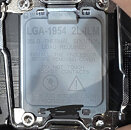
Intel Socket LGA1954 for "Nova Lake" Pictured in the Flesh, Confirms 2L ILM Design

Here is the first picture of Intel's next-generation desktop Socket LGA1954. We had only seen concept renders of the socket, until now. A successor to the current LGA1851, LGA1954 will seat Core Ultra "Nova Lake" desktop processors that introduce significantly higher CPU core counts and cache sizes to the desktop platform, dialing up compute power available to the segment. A key design change with LGA1954 over LGA1851 is its 2-lever ILM (independent loading mechanism), similar to Intel's HEDT and server sockets. Also, LGA1954 appears to be more squarish than rectangular, which is probably how Intel achieved the higher pin counts. The 2L ILM design allows for a more uniform retention of the ILM brace against the processor package.

Despite the significant change in socket design, LGA1954 is expected to retain cooler compatibility with the current LGA1851 and previous LGA1700, which means your CPU coolers purchased way back in 2021 could be reused for the next-generation processors. This is similar to how AMD managed to retain cooler compatibility between sockets AM4 and AM5, which are fundamentally different socket types—one is a PGA ZIF socket, the other is an LGA. We could expect a long string of leaks leading up its debut. There could be some limitations—the retention module of the cooler should apply at least 35 lbs (15.8 kg) of load.

Einarex Shows New HALOX AIO CPU Cooler, Wood-Style CPU Air Coolers, and New Fans at Computex 2026

Einarex also brought several new cooling products to the Computex 2026 show, including the new HALOX AIO CPU cooler, Wood-series Glide G300 and Ventus V300 CPU air coolers, as well as a couple of new fans, including the new ED12 with a modular 2-inch display.

The star of the show is the new HALOX AIO CPU cooler with support for Intel's latest LGA 1851 and AMD AM5 CPUs, a copper cold plate, and a hefty 27 mm-thick 360 mm or 240 mm radiator. It uses hydraulic bearing 120 mm fans, spinning between 600 and 2,600 RPM and producing up to 82.9 CFM of airflow and up to 40.7 dBA of noise. What makes the HALOX special is the hollow pump block that gives it a certain depth. Such open construction allows the RGB to be inside the structure of the pump block, giving it a nice visual effect.

Thermal Grizzly Shows New DeltaMate CPU Blocks and First DeltaMate Purrformate Fan Series at Computex 2026

Thermal Grizzly had a lot to show at the Computex 2026 show in Taipei, including a couple of new DeltaMate products, like the matching DeltaMate CPU water blocks for Intel LGA 1851 and AMD AM5 platforms, new DeltaMate GPU block models, and its first DeltaMate Purrformante Series fans.

Due to the success of its DeltaMate GPU blocks, Thermal Grizzly is introducing matching CPU water blocks for Intel LGA 1851 and AMD AM5 platforms. Same as the DeltaMate GPU blocks, these new DeltaMate CPU Block - MPII, as Thermal Grizzly is naming them, will have a nickel-plated copper cold plate with hybrid structure high-performance micro-fins, RGB-illuminated glass window, brass threading with standard G1/4" ports, optional magnetic aluminium cover, and bundled high-performance Thermal Grizzly Duronaut thermal paste. Thermal Grizzly is also expanding its DeltaMate GPU water block lineup to include models that will support ASUS ROG Matrix RTX 5090, Suprim RTX 5090, and Palit's RTX 5090 graphics cards. These will be available in Q3 and Q4 this year.

Cougar's New Mid-Tower Gaming PC Cases Hide Airflow in Aesthetic Cutouts

Alongside its new AI workstation-oriented NU-series cases, Cougar has also debuted new additions to its line-up of airflow-focused gaming PC cases at Computex 2026. The new CVF220 and Duoair RGB cases feature large cutouts and overhangs that not only serve to generate visual interest, but are also meant to increase airflow and cooling capacity, because they separate the PSU from the main system components and create more room for fresh air intake. The new Cougar CVF220 RGB case is a slightly more compact version of the existing CVF235, and it moves the PSU to the front of the case and has a fan intake cutout between the PSU and the rear of the case. Both CVF cases feature fan intakes on the bottom panel, right above the intake cutouts, in order to bring in fresh air from the outside of the case via that cutout. The older CFV235 has three fan mounts on the top and bottom intake panels, along with a pre-installed Cougar Unity 240 PWM fan kit (dual 120 mm fans in one frame), next to the motherboard. The CVF220, on the other hand, keeps the space in front of the motherboard completely clear, with tempered glass on all three sides of the case until the motherboard tray, instead relying only on two bottom intakes that draw air in via the cutout in front of the PSU compartment and three top fan mounts, where it can mount up to a 360 mm radiator.

The Duoair takes a more conservative approach with the chamber separation, but it makes up for that with two 140 mm intake fans behind a mesh front panel, as opposed to the motherboard-adjacent option. That mesh front panel can also be replaced with a tempered glass front panel for those more concerned with aesthetics. There are still two fan mounts above an empty space behind the PSU compartment in the front portion of the case, where the case fans can still draw in fresh air from the outside of the case to feed the GPU directly. The Duoair supports GPUs up to 410 mm long, while the CVF220 can fit longer 420 mm GPUs. Both the CFV220 and Duoair will also receive their own pre-built PC options. The Duoair A1 will feature up to an Intel Core i7-14700F, 16 GB of G.Skill Ripjaw DDR4-3200 memory, and an NVIDIA GeForce RTX 5060 GPU, with a mix of 2× 140 mm ARGB and 3x 120 mm non-RGB PWM fans handling airflow. Meanwhile the CVF220 will be powered by an AMD Ryzen 7 9800X3D, 32 GB of G.Skill Ripjaw DDR5 memory, and an AMD Radeon RX 9070 XT GPU. The Duoair X1 will launch at $1,499, while the CVF220 X1 will launch at $2,599.

ECS at Computex 2026: "Wildcat Lake" and "Panther Lake" Make their Way to LIVA Mini PCs

ECS at Computex 2026 showed off its latest advancements in compact and scalable hardware under the theme of Power AI Computing. This includes a new crop of LIVA Mini PCs, with an emphasis on practical implementations for AI Agent workloads, edge processing, smart healthcare, and embedded deployments.A major highlight of the ECS booth is the practical demonstration of Openclaw AI Agent applications running on an AMD-powered mini PC. This setup showcases how local AI agents can streamline user interactions by handling routine scenarios such as system status queries, rapid information retrieval, and intelligent content summarization.

ECS is extending edge AI into specialized environments with the LIVA Z11 Plus. Powered by Intel Core Ultra "Panther Lake" processors and equipped with dual networking alongside USB4 connectivity, the Z11 Plus is shown running a complex healthcare application. The newly introduced LIVA Z15 Plus is built on the Core Series 3 "Wildcat Lake" processor. For users requiring upgradeable architectures, the LIVA One H810 introduces support for the socketed LGA1851 "Arrow Lake-S" processors. The fanless LIVA Z4F designed for silent, reliable embedded operation, alongside the ultra-compact LIVA Q4, which utilizes a flexible 45 W USB Type-C power input for severely space-constrained environments.

Supermicro Launches New Server Solutions with Intel Xeon 6+ Processors

Super Micro Computer, Inc (NASDAQ: SMCI), an AI, Enterprise, Storage, 5G/Edge total solution provider featuring Data Center Building Block Solutions (DCBBS), today announced the launch of 12 new server platforms optimized for new Intel Xeon 6+ processors. Featuring up to 288 efficiency cores per socket and delivering improved performance-per-watt, the new systems are designed for high-density cloud, virtualization, 5G analytics, and other throughput-intensive workloads.

"By working closely with Intel, we have optimized our DCBBS with the new Xeon 6+ processors to deliver breakthrough core density and efficiency," said Charles Liang, president and CEO of Supermicro. "These new X14 platforms, with up to 576 E-cores per server, dramatically improve performance-per-watt and help customers shorten time-to-deployment while lowering TCO and energy consumption in large-scale cloud and enterprise data centers."

The Intel Arc G3 Series Inside Story: How Intel Created a Purpose-built Gaming Handheld Silicon That Isn't a Hamstrung U-Segment Chip

During the Q&A session with Intel detailing its new Arc G3 series processors for handheld game consoles, we've learned some of the interesting design choices Intel had to make in order to create the perfect chip for the form-factor that doesn't compromise in areas where it's most needed to shine in. For starters, Intel doesn't believe that the Arc G3 is a "processor with integrated graphics," but rather a "GPU with an integrated CPU." Such a philosophy was needed to serve as a bedrock for this chip. Beyond the marketing shift, the session revealed fascinating, previously under-the-radar engineering workarounds Intel is using to challenge AMD's dominance in the portable space.

Fitting Panther Lake into a handheld thermal design power (TDP) required more than just tweaking clock speeds. Intel is employing an aggressive silicon harvesting strategy, utilizing "fallout" dies that don't validate for the full Panther Lake specification. To hit the required power and thermal constraints of a handheld device, Intel has systematically disabled key IP blocks. The Arc G3 cuts the P-core count from four down to just two, drops the number of display engines from three to two, and halves the Thunderbolt capability from four ports to two. This surgical reduction brings the die into a manageable TDP, prioritizing GPU performance and securing supply for the burgeoning handheld market.

Arc G3 Processor Series Detailed: Purpose-built for Gaming Handhelds, Packs the Best of Intel

Intel today formally launched the Arc G3 series, a series of fully-integrated SoCs for gaming handhelds out to compete with AMD Ryzen Z-series. Intel felt the need for such a product line when it observed OEMs using U-segment mobile processors for handheld consoles. The Arc G3 features a tailored balance of CPU compute, and graphics muscle, generally favoring the latter, with power management that's fine-tuned for typical handheld gaming use-cases. This time around, Intel also made the effort to co-engineer devices with OEMs so their battery-life and thermals have knowhow from Intel.

Intel tapped into its latest "Panther Lake" microarchitecture to create the Arc G3 series. The company claims performance up to 42% higher than the competition (being AMD Ryzen Z2 Extreme based on "Strix Point"); with as much as 11 hours of gameplay on battery, and support for XBOX mode. It also brings the full stack of Intel Arc innovations such as XeSS 3 upscaling, frame-generation, and low-latency, the GPU provides full DirectX 12 Ultimate acceleration. Also on the software side, the console gets day-0 game optimization from Intel, along with pre-compiled shaders. Intel also brings segment-first connectivity features such as Thunderbolt 4 and Wi-Fi 7.

Intel Showcases first Gaming Handhelds Powered by Arc G3 SoCs

Intel at Computex 2026 showcased some of the first partner-branded gaming handhelds powered by its new Arc G3 series processors that are purpose-built for devices of this form-factor. These chips are derivatives of the "Panther Lake" microarchitecture, and feature the latest "Coyote Cove" and "Darkmont" CPU core types. The Arc G3 Extreme features a 2P+8E+4LPE CPU core configuration along with a powerful iGPU based on the Xe3 "Celestial" graphics architecture that has 12 Xe cores. There's also the full suite of XeSS, XeLL, and XeFG software-side readiness. Among the models we've seen are a OneXPlayer 3 handheld powered by the Arc G3 Extreme, MSI Claw 8 EX AI+, and Acer Predator Atlas 8.

MSI Claw 8 EX AI+
Acer Predator Atlas 8

Intel Makes "Bartlett Lake" More Accessible to End-users as a Xeon 6300 Series Server CPU

Intel debuted "Bartlett Lake" last year as exclusive to the IoT and Embedded markets. Today, it launched the silicon as a Xeon 6300 series entry-level server processor. The series now offers "Bartlett Lake" with all 12 "Raptor Cove" P-cores, and 36 MB of cache, along with support for ECC memory. The chip is drop-in compatible with all Xeon 6300 series LGA1700 server platforms, with a firmware update. The company hasn't detailed processor model numbers, yet. Its availability as a server processor makes it more accessible to end-users to buy one and toy with the elusive processor.

Intel Puts Agentic AI to Work with Xeon 6+, Networking, and AI Systems

Intel today announced a series of data center advancements, including new Intel Xeon 6+ processors, an expanded 800 Series Ethernet portfolio featuring the Intel Ethernet E835 controllers and network adapters, and continued progress on its AI accelerator roadmap, including updates on Crescent Island. Together, these developments highlight a clear industry shift: as AI becomes more agentic, the CPU is re-emerging at the center of modern AI infrastructure. With Xeon serving as the control plane, Intel is taking a systems-level approach to performance and efficiency at scale—delivering platforms designed for increasingly agentic AI workloads, where orchestration, data movement, and sustained inference are critical across data center and network environments.

"AI doesn't scale as a collection of parts—it scales as a coordinated system," said Kevork Kechichan, executive vice president and general manager of Intel Data Center Group. "As AI becomes more agentic, the constraints shift to orchestration, concurrency, and data movement. That shift reinforces a core reality: the CPU remains the control plane for the modern AI infrastructure. With Xeon 6+ and Ethernet E835, we're tightly coupling compute and networking to reduce bottlenecks and enable efficient, secure scaling of real-world agentic workflows."

Intel Readies ATX12VO V3 PSU Standard With Efficiency Increases

Intel originally introduced the ATX12VO (ATX 12 Volt Only) standard in 2020, promising simplified PSU designs and efficiency improvements over the standard ATX standard, with the ATX12VO V2 standard arriving in 2022 with further efficiency improvements, especially when it comes to idle power draw. According to a recent leak by @momomo_us on X, ATX12VO appears to be getting yet another revision with further improvements to efficiency. It's not clear when Intel will officially announce the standard update, but the proximity to Computex suggests that a Computex 2026 launch may be possible.

The key takeaways for ATX12VO V3 appear to be that the update will introduce a new 8-pin connector, with the new standard eliminating the standby rail in the name of efficiency. Intel will also introduce new Low Power and High Power modes, which is meant to improve safety and efficiency. According to benchmark results from the leaked presentation slides, ATX12VO V3 is up to 29% more efficient than regular multi-rail ATX PSUs at idle and as much as 12% more efficient during load benchmarks. The new PSU standard also brings over PMBUS from the server world, which adds four optional motherboard connector pins, for a total of 12, and allows PSU-to-system communication for more advanced digital power management.

Intel Launches Thunderbolt Share for PC-to-PC File and Peripheral Sharing on Windows 11

Following the recent release of the Intel USB4Stream protocol enabling direct PC-to-PC file and peripheral sharing on Linux, Intel has officially released Thunderbolt Share for Windows, which accomplishes the same thing on Windows over a Thunderbolt 4 or 5 connection. Thunderbolt Share allows the same peripheral and file sharing, backup, and migration capabilities as the Linux USB4 protocol, but with an official GUI and somewhat more limited compatibility thanks to a required Thunderbolt Share certification. The software is currently available to download from Intel directly.

Thunderbolt Share works with a direct PC-to-PC connection as well as in cases where two systems are connected via an accessory, like a dock, hub, or monitor. Additionally, only one device in the chain needs to be Thunderbolt Share licensed. There is a list of Thunderbolt Share licensed products on a website hosted by Intel, although it currently appears to be limited to a handful of MSI laptops, nine ASUS, HP, and Lenovo pre-built desktops and DIY motherboards, a smattering of Thunderbolt docks and hubs, an ASUS Thunderbolt 5 expansion card, and a Sparkle Thunderbolt 5 eGPU dock.

More Leaks Reveal MSI Claw 8 Gaming Handheld With Arc G3 Update

Intel recently announced the new Arc G3 and G3 Extreme CPUs designed for the gaming handheld market, with both Acer and OneXPlayer announcing new gaming handhelds based on the updated Panther Lake CPUs. Intel has confirmed the existence of a new "MSI Claw 8 EX AI+" handheld with the new Arc G3 Extreme CPU. Previous retail leaks of the Claw 8 EX AI+ hinted at pricing in the region of €1,500 in Europe, although we likely won't know actual retail or US pricing until the official launch. Those prior leaks also tipped an 8-inch, 500-nit, 120 Hz, 1080p display, 32 GB of RAM, and an 80 Wh battery.

Following the announcement, alleged leaked images of the gaming handheld appeared on Reddit, showing off a refreshed design language. The supposed image leak reveals a design more akin to the current ASUS ROG Xbox Ally, with the lower portion of the grips separated from the screen, with the display slightly jutting out from the rest of the body along the bottom edge—likely a design choice to achieve more ergonomic grips without losing a large display. The images only reveal the front of the device, which has a usual Xbox controller layout and two sizeable front-facing speaker grilles, so it's unclear where the ports will be, but based on the small glimpse of the bottom edge of the device, it seems as though all of the I/O will be on the top edge of the handheld. VideoCardz also shared an image of the device that it obtained from its own sources, which appears to corroborate the top I/O position.

G.Skill Showcases DDR5-9200 1.1 V 2×16 GB High-Speed CU-DIMM Memory Kit

G.SKILL International Enterprise Co., Ltd, the world's leading brand of performance overclock memory, is showcasing an ultra-high speed DDR5 CU-DIMM 32 GB (2× 16 GB) memory kit operating at an impressive DDR5-9200 CL74-74-74-148 speed with only 1.1 V DRAM voltage, validated on the flagship MSI MEG Z890 GODLIKE motherboard platform.

As memory performance continues to advance, balancing high frequency and operation voltage has become increasingly important. Demonstrating the quality of G.SKILL's memory engineering and IC selection process, this DDR5-9200 32 GB (2× 16 GB) CU-DIMM kit is able to achieve an extreme memory frequency while operating at the standard JEDEC voltage level of just 1.1 V. This demonstration highlights the potential of next-generation DDR5 memory technology, where users can benefit from higher bandwidth while maintaining lower power consumption and thermal output.

Beelink Expands ME Pro Storage PC Lineup for the AI Era

As data-intensive AI workloads reshape computing, demand for systems that combine performance with massive local storage is accelerating. Beelink, renowned for its innovations, has expanded the ME Pro series with new 2-bay and 4-bay models powered by Intel Core i5-13420H, AMD Ryzen 7 H 255, and Ryzen AI 9 HX 370. The launch elevates ME Pro into a compact platform for AI computing, content creation, and high-capacity data workflows.

Since the ME Pro debuted, its drawer-style design and modular motherboard architecture have stood out for both aesthetics and practicality. Beelink confirms that motherboard modules are fully interchangeable within each chassis category, allowing users to upgrade processors without replacing the entire system. Future modules with different processors will continue to be released, turning the ME Pro into a long-term, evolving platform rather than a one-time purchase.

ASRock iBox Fanless Mini PCs Get Intel Panther Lake Upgrade

ASRock has officially announced an update to its fanless iBox mini PC line-up designed for industrial applications. The updated versions of the iBox mini PCs are available with either the Intel Core Ultra X7 358H and the Intel Core Ultra 5 325 CPUs. The Core Ultra X7 CPU variant will be available with dual-channel DDR5-7200 RAM, while the Ultra 5 325 SKU comes with dual-channel DDR5-6400 memory, both are available with up to 128 GB of memory, and all SKUs support in-band ECC. The mini PCs do not ship with storage, but they feature both an M.2 2242 and 2280 slot (M key).

The chassis of the ASRock iBox is made of aluminium and weighs in at 3 kg, with the aluminium housing aiding in cooling the Panther Lake internals. Given its industrial intentions, the iBox fanless PC is quite pragmatic, with a number of high-speed connectivity options. The iBox mini PC's front I/O consists of a single USB 3.2 Gen2 Type-A port, a Thunderbolt 4/USB4 port with DP 2.1 support, a USB 3.2 Gen2 ×2 Type-C port with DP 1.4a support, two USB 2.0 Type-A ports, a 3.5 mm audio jack, and a COM port. On the rear, there are dual HDMI 2.1 ports, two 2.5 Gb Ethernet LAN ports, two USB 3.2 Gen2 Type-A ports, and an OOB port for remote power on/off/reset functionality. Pricing is subject to inquiry on ASRock's product page.

Intel Arc G3 CPU Family Officially Released for Handheld Gaming PCs

Following a series of leaks about an upcoming Intel Panther Lake CPU for gaming handhelds, the hardware giant has officially announced the Intel Arc G3 CPU series, which features the powerful Arc B390 iGPU and optimizations for the Windows Xbox mode that started rolling out to gaming handhelds and Windows PCs alike not too long ago. Both new CPUs are based on the same 14-core CPU design—with 2 P-Cores, 8 E-Cores, and 4 LP E-Cores—but the Arc G3 CPU has a 100 MHz lower max Turbo frequency and a less powerful Arc B370 iGPU. The Arc G3 Extreme and the Arc G3 have already been confirmed as coming to the new Acer Predator Atlas 8 gaming handheld, slated to launch in October 2026.

The Arc G3 Extreme tops out at 4.7 GHz, while the Arc G3 is capable of 4.6 GHz max Turbo frequency. The base frequencies on both CPUs are the same 1.9 GHz on the P-Cores and 1.5 GHz on the E-Cores and LP E-Cores. The Arc B370 iGPU is built on the same Xe3 architecture as the B390, but it features 10 Xe cores instead of the 12 in the B390 iGPU. The cores in the Arc B370 iGPU are clocked at 2.2 GHz, and Intel claims the cut-back iGPU is capable of 90 TOPs of Int8 performance, compared to 113 TOPs on the G3 Extreme. In TechPowerUp's prior testing of the Arc B390, the iGPU was significantly faster than the AMD Radeon 890M that has become ubiquitous in so many gaming handhelds, suggesting that the B370 should at least be on-par with the 890M, if not slightly faster. Both new CPUs also have the same 25 W base power, with a maximum turbo TDP of 80 W and a minimum assured power of 15 W.

Acer Expands Gaming Portfolio with Predator Atlas 8 Handheld Powered by Intel

Acer today announced the Predator Atlas 8 (PA08-I51) gaming handheld, broadening the portfolio of high-performance solutions under the Predator brand. The device is powered by up to the new Intel Arc G3 Extreme processor, delivering breakthrough handheld performance and battery efficiency for serious PC gamers to take on the go. Offering the full Windows 11 experience combined with XBOX Game Pass, the Predator Atlas 8 provides faster access to gaming, system tools, and settings, keeping every session moving with less friction.

Jerry Kao, Chief Operating Officer at Acer, commented: "With the Predator Atlas 8, we are combining the Predator design philosophy with the power of the new Intel Arc G-Series processors to blur the lines between gaming PC and handheld performance. From the Predator AeroBlade cooling system to PredatorSense to the adaptive trigger controls, every element of this handheld is curated to give gamers maximum control over their own experiences, wherever they choose to play."

GIGABYTE Debuts New BRIX Mini PC Powered by Panther Lake to Scale Enterprise AI

As edge AI adoption accelerates across the commercial market, GIGABYTE Technology, a global leader in high-performance computing, today announced the new GB-BRU9-386H for its BRIX Mainstream ultra-compact mini PC series—expanding its enterprise on-premises AI portfolio. Powered by Intel Core Ultra Series 3 processors and manufactured on the Intel 18A process node technology, the new system delivers up to 75% higher NPU performance than the previous generation, reaching up to 50 TOPS to accelerate AI inference and improve overall computing efficiency.

Staying true to BRIX's compact design, the latest BRIX Mainstream packs a 0.46-liter chassis with an ultra-slim 35 mm profile for easy deployment in space-constrained environments. Built for real-world business needs—from retail and industrial automation to surveillance and medical imaging—it delivers high performance, low latency, and privacy-preserving on-site computing at edge, helping organizations turn AI use cases into operational outcomes faster.

Kubb Fanless Mini PC Gets Intel Panther Lake Update with High Price

French computer manufacturer, Bleu Jour, has officially updated its Kubb Fanless mini PC with Intel's Panther Lake, equipping the mini PC with an Intel Core Ultra X7 358H CPU with its Arc B390 iGPU. Alongside the new CPU option, however, the mini PC has also received a price update, now coming in at a premium €1,850, which is a €355 increase over the previous Intel Core Ultra 5 225H CPU. That starting price gets you Windows 11 Pro, 16 GB of DDR5-5600 RAM in dual channel, and a 1 TB M.2 NVMe Gen4 SSD, but the mini PC is also available with up to 64 GB of DDR5-6400 for €545.90 extra, while a 4 TB SSD upgrade carries a €526 upcharge, coming to €2,921.90 for a maxed-out build. That pricing is starting well into the territory of mini PCs powered by the AMD Ryzen AI 395 Max+ APUs, although a compact passively cooled mini PC appeals to a very niche market.

The Kubb Fanless is a passively cooled mini PC, with the cooling coming from the fins machined directly into the aluminium chassis, but despite the fanless design, the PC fits into a footprint of just 12 × 12 cm. Kubb claims that the chassis design is optimized for thermal performance, and it weighs in at 2.3 kg, so there's a decent amount of aluminium in the passive radiator setup. The port selection is also healthy, with front I/O consisting of 1× USB 3.2 Gen 2, 1× Thunderbolt 4 with DP 2.1, 1× USB 3.2 Type-C with DP 1.4a alt mode, and a 3.5 mm audio combo jack. The rear I/O has 2× USB 3.2 Gen 2, 2× HDMI 2.1, and 2× RJ45 ports.

Intel Arc GPU Graphics Drivers 101.8824 Beta Released

Intel today released the latest version of Arc GPU Graphics Drivers. Version 101.8824 Beta comes with Game On optimization for "007: First Light." The drivers also fix issues where "Call of Duty: Black Ops 7," "Call of Duty: Warzone," and "Call of Duty: Black Ops 6" exhibit corruption or crash during gameplay, with Arc B-series discrete GPUs, A-series discrete GPUs, and integrated graphics solutions of Core Ultra Series 3, Series 2, and Series 1 processors.

The drivers also address bugs that cause display corruption during gameplay with "Pragmata," "Resident Evil: Requiem," "Monster Hunter Wilds," "HITMAN: World of Assassination," and "Street Fighter 6" across its entire range of discrete and integrated graphics solutions. A bug related to an intermittent crash with "The Finals" has been addressed for Core Ultra Series 3. Grab the driver from the link below.

DOWNLOAD: Intel Arc GPU Graphics Drivers 101.8824 Beta

New Intel USB4Stream Driver and Protocol Enables Low-Latency Device-to-Device File Sharing in Linux Kernel 7.2

A new Linux driver developed by Intel maintainer, Mika Westerberg, has been revealed to be merging in the Linux kernel version 7.2, which is slated to launch in June 2026. The new driver will enable users to more easily share files over USB4 while bypassing the network driver. The developer pitches the new protocol as a way to easily back up, transfer, and access files across two or more connected systems, or even share hardware, like a webcam or input peripherals. For now, the protocol requires some setup, currently requiring users to set up devices using the ConfigFS interface, and the developer details a number of examples and commands to configure them. More importantly, because the stream is controlled by the receiving side, it seems as though after a little setup, the protocol could be used by app developers to create apps with similar functionality to LocalSend without the need for a network connection. The upstream request reads:
Introduce USB4STREAM protocol and Linux implementation. This allows two (or more) hosts to transfer data directly over Thunderbolt/USB4 cable through a character device without need to go through the network stack.

Any application that supports read(2) and write(2) in some form should be able to use the device without changes. The data is sent out to the other side over a tunnel inside Thunderbolt/USB4 fabric. The character device is called /dev/tbstreamX where X is the minor number starting from 0.

Inno3D Announces NVIDIA MGX 4U GPU Server

INNO3D proudly announces the launch of its latest enterprise solution, the INNO3D NVIDIA MGX 4U GPU Server with NVIDIA ConnectX 8 SuperNIC - AGS-4UMGX-R1, engineered to empower businesses and institutions with cutting-edge performance for the most demanding workloads. The INNO3D NVIDIA MGX 4U GPU Server leverages the parallel processing power of NVIDIA GPUs to accelerate capabilities across High-Performance Computing (HPC), data analysis, genomics, 3D modeling and imaging, machine learning, simulations, deep learning, and AI training. Designed for professionals, this server is ideal for Large Language Model (LLM) training, cloud AI deployments, and enterprise-scale innovation.

Helldivers 2 Gets FSR 4, DLSS 4.5, and XeSS 3.0 Upscaling and Performance Optimizations in Upcoming Update

Much to the chagrin of Arrowhead and PlayStation Publishing, Helldivers 2 fans have been clamoring for resolution upscaling tech for a long time, and it seems like they're about to get what they want, according to an announcement on the game's Steam Store page. On May 27, Helldivers 2 will be getting upscaling support on all platforms where the game is available. This means that PC players will get DLSS 4.5, FSR 4.0.3, and XeSS 3.0, while Xbox Series X|S and PS5 players will be able to use FSR 3.1, and PS5 Pro players get PSSR 1 support.

Furthermore, the announcement reveals that there are other optimizations and features coming to the game to address image quality, frame pacing, and hardware utilization. For starters, the PS5 and PS5 Pro will get VRR to smooth over stuttering and frame rate dips. Variable Rate Shading will also be coming to the game to reduce GPU load, and Dynamic Resolution Scaling for PC, PS5, and Xbox Series X will drop the resolution scale in demanding scenes to maintain a stable frame rate. Lastly, Helldivers 2 will get AMD Anti-Lag 2 and NVIDIA Reflex for decreased latency on relevant PC hardware.
Return to Keyword Browsing
Nov 17th, 2026 14:49 CST change timezone

New Forum Posts

Popular Reviews

TPU on YouTube

Controversial News Posts