Saturday, May 30th 2026

Intel Readies ATX12VO V3 PSU Standard With Efficiency Increases

Intel originally introduced the ATX12VO (ATX 12 Volt Only) standard in 2020, promising simplified PSU designs and efficiency improvements over the standard ATX standard, with the ATX12VO V2 standard arriving in 2022 with further efficiency improvements, especially when it comes to idle power draw. According to a recent leak by @momomo_us on X, ATX12VO appears to be getting yet another revision with further improvements to efficiency. It's not clear when Intel will officially announce the standard update, but the proximity to Computex suggests that a Computex 2026 launch may be possible.

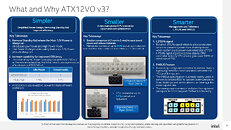
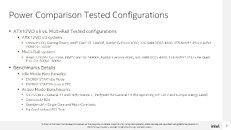
The key takeaways for ATX12VO V3 appear to be that the update will introduce a new 8-pin connector, with the new standard eliminating the standby rail in the name of efficiency. Intel will also introduce new Low Power and High Power modes, which is meant to improve safety and efficiency. According to benchmark results from the leaked presentation slides, ATX12VO V3 is up to 29% more efficient than regular multi-rail ATX PSUs at idle and as much as 12% more efficient during load benchmarks. The new PSU standard also brings over PMBUS from the server world, which adds four optional motherboard connector pins, for a total of 12, and allows PSU-to-system communication for more advanced digital power management.
Source: momomo_us on X
Add your own comment

73 Comments on Intel Readies ATX12VO V3 PSU Standard With Efficiency Increases

#1
Sol_Badguy
Intel can take a hike. :slap::nutkick:

While ATX12VO is useful there are other more useful changes that have yet to be implemented.

PSU pinout standardisation so people can swap cables freely between PSUs. It would be great if the EU enforced this.

Intel voted for 12V-2x6 connector. When are they going to make the right thing and take their vote back? Or is nVidia's sponsorship holding them back?

Also the ATX 3.1 standard is inferior to ATX 3.0 regarding hold-up time which was reduced, thus instead of stimulating PSU makers to make progressively better products it allows them to be lazy and make progressively worse ones.
Posted on Reply
#2
_roman_
I want to see those efficiency claims

Especially for the range of 1mW to 1200 Watts in the temperature range of -40°C to 120°C without active cooling.
Posted on Reply
#3
zenlessyank
So Intel created this madness. Yet no Intel power supplies for sale. Hmmmm.
Posted on Reply
#4
Toothless
Tech, Games, and TPU!
zenlessyankSo Intel created this madness. Yet no Intel power supplies for sale. Hmmmm.
Enermax has some, though the standard isn't really enforced.
Posted on Reply
#5
Event Horizon
Sadly it seems that melty 12V is here for the foreseeable future.
Posted on Reply
#6
Onasi
Event HorizonSadly it seems that melty 12V is here for the foreseeable future.
It’s not about the PCI-e connector standard. 12VO is a potential replacement for the MoBo and CPU power connectors, roughly speaking.
Posted on Reply
#7
azrael
OnasiIt’s not about the PCI-e connector standard. 12VO is a potential replacement for the MoBo and CPU power connectors, roughly speaking.
Actually, the idea is for there to be only one cable from the PSU to the motherboard, that being the 12V one. Then you're apparently going to have the connectors, which would usually come from the PSU, directly on the motherboard. Apart from taking up space valuable space on the board, what could *possibly* go wrong...
Posted on Reply
#8
Onasi
@azrael
I mean, if we are being completely pedantic, it’s strictly about abandoning 3.3V and 5V rails and just having 12V while converting everything on the motherboard. That’s the crux of the standard. I don’t believe it actually mandates MoBo connectors to anything.
Posted on Reply
#9
Dammeron
I'm all in for removing the 3,3V and 5V lines from the PSU. Less calbes for ATX plug - yes. However making the plug pins smaller - please don't!
Posted on Reply
#10
azrael
Onasi@azrael
I mean, if we are being completely pedantic, it’s strictly about abandoning 3.3V and 5V rails and just having 12V while converting everything on the motherboard. That’s the crux of the standard. I don’t believe it actually mandates MoBo connectors to anything.
You're correct, but converting the 12V to 5V and 3.3V on the motherboard pretty much means the 5V and 3.3V connectors also are on the motherboard.

@Dammeron Completely agree on the smaller plug size. The 12V-2x6 (or whatever it's called these days) is just such an amazing piece of innovation (sarcasm may be implied).
Posted on Reply
#11
cucol
OMG ty Intel, i just hate the actual mb connector
Posted on Reply
#12
Kwadratowicz
Trrrryt
So maybe screw terminals on mobo with that You could use just any 12v psu .

That thing here just shows how everyone is making stuff that is only connected cause it is needed to work as pc. PC is chimera and in my opinion not great one.
Posted on Reply
#13
Chrispy_
Event HorizonSadly it seems that melty 12V is here for the foreseeable future.
There's nothing wrong with the connector itself, only the bird-brained decision to allow 600W over it. The same goes for the smaller pin size on the 10-pin ATX12VO motherboard and CPU connectors - they were designed for compact, low-power, efficient systems, so the smaller connector is welcome there. Whoever decided that "smaller connector can have more current" is the moron here.

ATX12VO has no place in a system with 350W CPUs and factory overclocked GPUs pulling sometimes over 600W. We still need a suitable replacement for that and since manufacturers can't be trusted to perform any current-monitoring on multi-rail power, the replacement should use thicker wires, larger connectors, and fewer of them.
Posted on Reply
#14
Battler624
Sol_BadguyIntel voted for 12V-2x6 connector. When are they going to make the right thing and take their vote back? Or is nVidia's sponsorship holding them back?
Why should they? 12V-2x6 is great. The issue if a lack of load balancing, why do you think the 3090 Ti didn't have a single issue with 12VHPWR while literally every other card had issues? even on AMD side? Just 3 shunts vs 1 shunt, the 3090 ti is the only card with 12vhpwr that is equipped with 3 shunts (1 for every 2 live wires) while literally every other card only has 1 shunt.
Posted on Reply
#15
Sol_Badguy
Battler624Why should they?
Making things right has to start somewhere.
Battler62412V-2x6 is great.
Congratulations, you have wonderful taste.
Battler624The issue if a lack of load balancing, why do you think the 3090 Ti didn't have a single issue with 12VHPWR while literally every other card had issues? even on AMD side? Just 3 shunts vs 1 shunt, the 3090 ti is the only card with 12vhpwr that is equipped with 3 shunts (1 for every 2 live wires) while literally every other card only has 1 shunt.
Precisely.
This additional requirement is the key, or the lens through which the "connector" should be viewed.
If this element (the load balancing circuitry) is not enforced on GPUs then allowing 600 W through the connector is unwise as the margin of error is slim.

Thus to make things safer in the absence of load balancing is to downgrade the rating to 300 W.
And when they voted in favor Intel knew that load balancing was not enforced, as such the only way through which things could have been made safer was to rate this at 300 W.

Instead this mess now leads to PSUs being questioned for not implementing OCP per pin and whatever else to protect the GPU from itself.
The end result is GPUs with trash tier PCBs being sold for a premium even though high quality components on the PCB are few and far between so that GPU makers can save money and increase profit.
Meanwhile PSUs will become more expensive because they will start incorporating all sorts of stuff to make things safe again.

All of this just so people like yourself can be happy for not having to deal with a "ton" of cables coming out of your GPU and making a "mess" inside your case.
Posted on Reply
#16
N/A
Everything should be 8-pin, even the video card. Give me 2 or 3 8-pin for the video card.
Posted on Reply
#17
Panther_Seraphin
Hmmm yes lets reduce the CPU connector by nearly 50%, no where have we seen an issue with thin pins and high wattages.............


TBH I am not averse from moving everything over to a 12V main bus? Simplifies PSU designs etc and there is plenty of solutions to gain any other voltage specs as neeed (3.3/5V etc)


But why arent they moving from 12V to say 24/48V on this change as its such a halfway house of a standard. Lets reduce pins/motherboard complexity by removing non necessary voltages but keep everything at max 12V when we have already reached the limits of it in the server space many years ago and are repeatedly hitting those limits on the desktop as well.
Posted on Reply
#18
0xE1
We already have standard ESP connector, which is also already used for CPU power, put two more and we're done, what the heck is wrong with the industry
Posted on Reply
#19
R-T-B
zenlessyankSo Intel created this madness. Yet no Intel power supplies for sale. Hmmmm.
Chrispy_There's nothing wrong with the connector itself, only the bird-brained decision to allow 600W over it. The same goes for the smaller pin size on the 10-pin ATX12VO motherboard and CPU connectors - they were designed for compact, low-power, efficient systems, so the smaller connector is welcome there. Whoever decided that "smaller connector can have more current" is the moron here.
N/AEverything should be 8-pin, even the video card. Give me 2 or 3 8-pin for the video card.
Guys, the subject of this thread is NOT the 12V-2x6 connector, kthx.
Posted on Reply
#20
Wirko
Panther_SeraphinHmmm yes lets reduce the CPU connector by nearly 50%, no where have we seen an issue with thin pins and high wattages.............


TBH I am not averse from moving everything over to a 12V main bus? Simplifies PSU designs etc and there is plenty of solutions to gain any other voltage specs as neeed (3.3/5V etc)


But why arent they moving from 12V to say 24/48V on this change as its such a halfway house of a standard. Lets reduce pins/motherboard complexity by removing non necessary voltages but keep everything at max 12V when we have already reached the limits of it in the server space many years ago and are repeatedly hitting those limits on the desktop as well.
I fully agree, I just think that the voltage should be made variable. 12 volts as the basic standard that all mobos can take and all PSUs can produce, and a higher voltage if both can negotiate on it. 48 V seems a good choice as it's widely used in servers, so some MOSFETs and driver ICs optimised for it might already be easily available. Optional 19 V could also be integrated into the standard because it is very common in mini PCs.

The big obstacle here aren't the 3.3 V and 5 V lines but the 12 V supply for the PCIe slots because those need significant power.
Posted on Reply
#21
fec32a4de
Oh for the love of....

Don't make the connectors smaller. Wire sizes/connector sizes are the way they are because of basic electric engineering. If you're gonna use low voltage, you need thicker cables (smaller AWG size - great system btw "smaller number=thicker cable).

Anyone over at Intel or anywhere wonder why for example North America uses 14AWG for 125V 15A and 12AWG for 125V 20A?

Additionally, having the circuitry to convert 12V to 5V and 3.3V on the Mobo just consumes space. ITX boards aren't gonna like that.
Posted on Reply
#22
Battler624
Sol_BadguyPrecisely.
This additional requirement is the key, or the lens through which the "connector" should be viewed.
If this element (the load balancing circuitry) is not enforced on GPUs then allowing 600 W through the connector is unwise as the margin of error is slim.

Thus to make things safer in the absence of load balancing is to downgrade the rating to 300 W.
And when they voted in favor Intel knew that load balancing was not enforced, as such the only way through which things could have been made safer was to rate this at 300 W.

Instead this mess now leads to PSUs being questioned for not implementing OCP per pin and whatever else to protect the GPU from itself.
The end result is GPUs with trash tier PCBs being sold for a premium even though high quality components on the PCB are few and far between so that GPU makers can save money and increase profit.
Meanwhile PSUs will become more expensive because they will start incorporating all sorts of stuff to make things safe again.

All of this just so people like yourself can be happy for not having to deal with a "ton" of cables coming out of your GPU and making a "mess" inside your case.
No idea why you started attacking me there at the end but whatever makes you happy I guess.

Eitherway, If the same people that designed the current GPUs circuitry decided to use 8 pins instead of 16 pin we would have had burn 8 pin cables. because at the end there is literally 1 shunt for all live wires.

This is an issue of failure in GPU power design and not a failure of cable.
Posted on Reply
#23
Chrispy_
R-T-BGuys, the subject of this thread is NOT the 12V-2x6 connector, kthx.
Well it kind of is. They've shrunk the main CPU and motherboard connectors down to the same size pin as 12V-2X6, without reducing the max power rating of the connector - look how well that turned out for all those melted/burned GPUs.


Physically smaller connectors are welcome for low-power mini-PCs and OEM ITX/mATX style motherboards but Intel are still rating this 8-pin CPU connector size at the exact same 75W per wire pair as the much larger connector -75W per wire pair matches the current draw of all those melted 450W 5090 GPUs and exceeds the current draw of all those melted 5080s. Enough of these have melted or burned to tarnish the safety reputation of this size of connector.

Once again, it's a good idea to make a smaller connector for a low-power, compact form factor but HOLY SHIT PLEASE ADJUST THE CURRENT RATING WHEN YOU SHRINK THE GODDAMN PINS, INTEL.
Posted on Reply
#24
zenlessyank
R-T-BGuys, the subject of this thread is NOT the 12V-2x6 connector, kthx.
I didn't say shit about the connector. I said this 'madness'. I am referring to the excessive voltage and melting issue. I don't give two shits about the connector. It is the resistance across the metal connectors when the current flows.
Posted on Reply
#25
EsaT
WirkoI fully agree, I just think that the voltage should be made variable. 12 volts as the basic standard that all mobos can take and all PSUs can produce, and a higher voltage if both can negotiate on it. 48 V seems a good choice as it's widely used in servers, so some MOSFETs and driver ICs optimised for it might already be easily available. Optional 19 V could also be integrated into the standard because it is very common in mini PCs.
Didn't you "let's scrap ATX PSU compatibility"-people want to make PSU simpler?
Pretty darn sure such variable voltage would add complexity and cost... To both ends of the cable.
And because of tiny contacts/pins PSU is already going to need more protection circuitry.

Also variable voltage would demand more from design of DC-DC modules producing 3.3V and 5V.
Which already adds complexity and cost outside PSU in this 12V only scheme.
Panther_SeraphinBut why arent they moving from 12V to say 24/48V on this change as its such a halfway house of a standard. Lets reduce pins/motherboard complexity by removing non necessary voltages but keep everything at max 12V when we have already reached the limits of it in the server space many years ago and are repeatedly hitting those limits on the desktop as well.
We don't need higher power consumptions, we need return to prioritizing improvements to power efficiency!
Posted on Reply
Add your own comment
Nov 11th, 2026 02:25 CST change timezone

New Forum Posts

Popular Reviews

TPU on YouTube

Controversial News Posts