News Posts matching #Intel

Return to Keyword Browsing

Intel Core Ultra X Series Reportedly Arriving with Panther Lake Launch

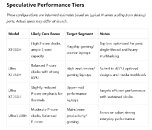
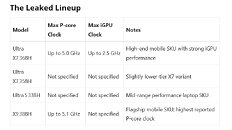
A new leak seems to confirm previous rumors on Intel's upcoming high-performance mobile processors under the Core Ultra brand—including Ultra X7 368H, Ultra X7 358H, Ultra 5 338H, and X9 388H. With P-core clocks reportedly hitting 5.0-5.1 GHz and integrated GPU speeds up to 2.5 GHz, these chips could be Intel's biggest mobile performance jump in years. Intel is bringing in a new "Ultra X" tier alongside its standard Ultra branding. Hardware leaker HXL confirmed the naming, while former IThome editor @realVictor_M noted the Core Ultra 7 358H features 4 Performance cores, 8 Efficient cores, 4 Low-Power Efficient cores, and 12 Xe3 GPU cores. The Ultra X7 368H tops out at 5.0 GHz with 2.5 GHz iGPU clocks, while the X9 388H hits 5.1 GHz as the flagship. The Ultra 5 338H targets mid-range laptops.

Although early talk linked these parts to Panther Lake, the specs line up more with Intel's high-TDP Nova Lake-H roadmap for 2026. The high clocks match Nova Lake-H targets, not Panther Lake's efficiency focus. "H"-class chips power gaming laptops and workstations, while Panther Lake targets thin-and-light systems. There's no info yet on what "X" stands for—it could indicate GPU variants, NPU differences, or premium power tiers. Full Panther Lake details arrive when Intel's Tech Tour embargo lifts on October 9.


Intel Reaffirms $28 Billion Ohio Expansion Despite Delay to 2030

Intel reiterated this week that its long-planned Ohio semiconductor campus remains a core part of its manufacturing strategy after Republican Senator Bernie Moreno demanded clearer answers about delays and potential costs to local taxpayers. In a brief response to Moreno, the company stated that it is coordinating with Ohio officials, the state's congressional delegation, and local stakeholders as it revises the schedule, and emphasized that the site "remains an important part of our long-term plans to expand leading-edge manufacturing on U.S. soil." Intel acknowledged that the timeline has shifted—commercial production is now not expected until at least 2030—and said it will maintain the flexibility to adjust construction and ramping based on customer demand. Moreno's letter highlighted roughly $2 billion in public incentives and nearly $700 million in infrastructure commitments, and he pressed the company for specifics on economic impact and any steps to limit costs to Ohio taxpayers. However, the company's public reply did not answer those questions in detail.

Leadership changes, rounds of workforce reductions and the challenge of attracting outside foundry customers have slowed momentum for Intel, while new private investments and a recent federal equity stake have altered financial and strategic calculations. The government involvement has added a national-security angle to the debate and increased scrutiny from state officials and residents who had expected faster job and supply-chain benefits. Intel insists the Ohio campus remains strategic and says it will keep working with stakeholders to align build-out with market realities. For now, the ambitious proposal survives as a long-term bet. Meanwhile, TrendForce reports citing Commercial Times that says Intel started limited 18A node shipments to U.S. customers in Q3, with 18A wafers already in production and initial output of its own CPUs expected in Q4. At least some parts of the manufacturing roadmap remain according to schedule, meaning that the $28 billion Ohio plant project is safe for now.

Intel Reportedly Begins 18A Production in Arizona, Panther Lake Reveal Set for Oct. 9

Intel kicked off its first Tech Tour in Arizona with big news about its 18A process node, TrendForce reports citing Commercial Times that says Intel started limited shipments to U.S. customers in Q3, with 18A wafers already in production and initial output of its own CPUs expected in Q4. TweakTown reports that Intel will show off its first in-house 18A processor, Panther Lake, on October 9 during the tour. The Economic Daily News notes that the Panther Lake AI PC chip should ship by year-end, with the 18A rollout backing Intel's next three CPU generations. By starting 18A mass production, Intel became the first among foundry competitors to bring backside power delivery to market, while its Arizona fabs becomes the first in the U.S. to hit 2 nm-class mass production.

Intel's Arizona expansion—Fab 52 and Fab 62—comes from a $32 billion investment launched in 2021. Fab 52 alone should reach 1,000-5,000 wafers per month by year-end, ramp to 15,000 in 2026, and eventually hit 30,000. Industry sources cited by Commercial Times say that, alongside U.S. chip tariff policies, Intel's Arizona fabs are becoming a key option for chipmakers. While 18A still falls behind in transistor density, its backside power delivery cuts routing congestion and boosts frequency performance, drawing interest from global tech giants.

MSI Pushes Afterburner 4.6.6 Stable Update After Years of Beta

MSI has quietly pushed a long-awaited stable update for its Afterburner utility, turning years of beta evolution into an official v4.6.6 stable release that many in the PC community have been waiting for. The new build bundles a refreshed RivaTuner Statistics Server and folds a large number of previously experimental features into the supported release, bringing broader GPU compatibility, more flexible fan and power controls, and several important security fixes. Users will notice official handling for the newest GeForce RTX 50 series desktop cards, support for more complex multi-fan layouts, and added hooks for advanced voltage management on boards that expose those rails. Because some of the deeper hardware controls depend on how a card's firmware and driver behave, a subset of functionality will be most useful on partner designs engineered for overclocking. Additionally, unofficial RDNA 4 support is added, and since MSI doesn't offer RDNA 4 cards, it will remain unofficial.

Beyond device compatibility, the update modernizes the toolchain and usability, as the app now targets the current Visual C++ runtime, and older systems, such as Windows XP, are no longer supported. The installer approach minimizes bloat by fetching required runtime components when needed. The release also introduces UI polish, featuring new skins, localization improvements, and a simplified method for hiding integrated GPUs from the interface, along with an expanded voltage and frequency editor and increased on-screen telemetry capacity. The bundled statistics server gains many behind-the-scenes enhancements and security patches that improve stability and reduce risk.

MAINGEAR Releases Two New APEX Liquid Cooled Desktop Gaming PCs

MAINGEAR, the leader in premium-quality, high-performance gaming PCs, just dropped two groundbreaking additions to its APEX line: the all-new APEX FORCE and the upgraded fourth-generation APEX RUSH. These state-of-the-art gaming PCs redefine performance, cooling, and customization for the most discerning gamers.

APEX FORCE: There's No Replacement for Displacement (Starting at $7,469)
APEX FORCE features a full-tower chassis design based on the popular Phanteks NV9, concealed rear external cable management, and panoramic tempered glass panels trimmed with a diffused illuminated edge, that maximizes the premium aesthetics of the FORCE. Inside, it's immediately noticeable that MAINGEAR spent countless hours precisely engineering the revolutionary dual-loop APEX hardline cooling system with 10-degree offset tubing to perfectly align with the chassis' unique design language, making the FORCE a masterpiece of functional design and engineering. Upgradable RGB lighting accentuates the cooling components and premium hardware perfectly.

GMKtec Launches the M2 Pro S Mini PC With Intel Core i7-1185G7

GMKtec, a leading innovator in high-performance mini PCs, today announced the official launch of the M2 Pro S, its third-generation Super Workstation. Powered by the Intel Core i7-1185G7 processor, the M2 Pro S combines exceptional performance, portability, and design to deliver a next-level experience for professionals and creators alike.

Performance Meets Portability
At the heart of the M2 Pro S is the 11th Gen Intel Core i7-1185G7, a 4-core, 8-thread processor with a turbo frequency of up to 4.8 GHz and integrated Intel Iris Xe Graphics. With benchmark scores reaching nearly 900,000+ in Ludashi, this compact powerhouse rivals traditional desktops at just 1/50th the size and 1/25th the weight. Users can choose between three customizable power modes—Silent (28 W), Balanced (35 W), and Performance (40 W, peak 45 W)—to optimize for different workloads, from light office tasks to heavy content creation.

Intel "Granite Rapids-WS" Appears with 86 Cores and 172 Threads Built for HEDT

According to listing on OpenBenchmark.org, spotted by @momomo_us on X, appears to show a "Granite Rapids-WS" engineering sample running with 86 cores and 172 threads. The entry lists peak core speeds near 4.8 GHz, which likely reflects a turboboost on a few cores rather than a sustained all-core clock. Several important fields are empty in the submission, including power figures and other platform metrics, so the entry should be viewed as an early leak rather than a finished specification. The Granite Rapids-WS is a design built from Intel's XCC server compute dies, featuring two compute tiles that deliver 86 cores and two I/O tiles that handle connectivity, including PCIe and memory controllers. To go beyond 86, Intel would probably need to move to the larger UCC die and a bigger package.

Memory support for a workstation SKU remains unclear, although the server XCC family supports DDR5-6400 and can achieve higher effective speeds with MR-DIMMs. For a workstation, Intel is likely to choose an eight-channel memory configuration to balance capacity and board complexity. Thermal envelope and base clock frequencies are not reported, leaving questions about cooling and real-world expectations unanswered. If the entry is accurate, a Granite Rapids-WS part built from a server die could give Intel a quicker path to higher core counts for workstations. Intel has recently promoted Arrow Lake as a workstation option, while professional users have been left with a choice of an older workstation platform or AMD Threadripper, as Intel has recently scaled back its involvement in HEDT. For professionals and OEMs, the decisive factors will be validated core counts, power efficiency, memory and I/O capabilities, and how well software scales on the new hardware.

Intel "Panther Lake" B0_3 Stepping Surfaces in Firmware Patches

A new set of patches has hit the "coreboot" project, an open-source UEFI/BIOS alternative, adding another Intel "Panther Lake" stepping to our portfolio of leaks. This time, it is the PTL_B0_3 C06C3 stepping, a new version Intel could be preparing for shipment to clients. Silicon revisions typically begin at A0 and increment as the design evolves. It is rare to see any silicon shipping with the A0 stepping, as later modifications and refinements are made to meet the original specification. Hence, this B0 stepping indicates that this is likely the final revision Intel has prepared for Panther Lake, which is expected to start shipping by the end of 2025, with more SKUs in 2026.

As a reminder, the low-power PTL-U models are designed for a 15 W TDP and are expected to come in 6-core and 8-core versions. Some SKUs will feature four high-performance P-cores paired with four LPE-cores, while others will have only two LPE-cores complementing four P-cores. Both families will utilize Xe3-based integrated graphics, with entry models featuring four GPU cores. The more powerful PTL-H line will scale up to around 16 CPU cores, comprising four P-Cores, eight E-cores, and four LPE-cores. Some H-series parts might include up to 12 GPU Xe3 cores for integrated graphics, but the final configurations will be revealed when Intel officially launches the Panther Lake product family.

U.S. Could Impose 100% Semiconductor Tariff If Chips Are Not "Made in America"

The U.S. government is considering imposing massive tariffs on semiconductor products unless manufacturers can match those volumes with chips produced in the United States. Under the current draft, companies that do not match foreign-sourced chip volumes with domestic output over time could face tariffs that, in some versions, reach 100%. The idea is an act of forceful action to speed up onshore capacity and reduce strategic dependence on overseas foundries, but they also admit that the plan faces serious practical hurdles. The core concept is simple to draft on paper, but hard to implement. For every unit brought into the U.S. from an overseas plant, such as TSMC in Taiwan and Samsung in South Korea, a corresponding unit would need to be produced domestically within a specified timeframe, or tariffs would be applied. This means that for every batch of chips NVIDIA, AMD, Intel, or Apple produce overseas, the same chip would need to be produced in the U.S.

Counting and comparing chip "units" is extremely complicated. Every semiconductor design differs wildly by complexity, cost, and function, and the typical semiconductor supply chain moves wafers, packages, and finished devices across several countries before a product reaches consumers. Even TSMC, the very maker of the chip, sometimes has a hard time confirming if the designs it makes are on the U.S. sanctions list. Like it experienced with Huawei, TSMC couldn't determine that a third-party shell company was ordering Ascend accelerator IP on behalf of Huawei—which sits on the U.S. blacklist—even with advanced detection tools. Officials are reportedly considering transitional credits and carve-outs for companies that commit to building U.S. fabs, which would allow them to import while new plants come online. Even with those credits, a question arises about how to compare a million small mobile processors against a million high-performance data center accelerators.

Biostar Introduces BITWL-150 Industrial Motherboard

BIOSTAR, a leading manufacturer of edge computing solutions, industrial motherboards, graphics cards, and storage devices, is proud to introduce the BITWL-150 industrial motherboard, a versatile industrial platform designed for modern system integration. Powered by the latest Intel Twin Lake N150 processor, the BITWL-150 delivers dependable performance, flexible connectivity, and long-term stability, ensuring seamless operation across industrial automation projects, edge computing, HMI systems, and digital signage solutions.

Engineered with versatility at its core, the BITWL-150 is purpose-built to support a broad spectrum of industrial applications. Its ultra-compact 10x10cm design makes it easy to deploy in space-constrained environments while maintaining the performance and reliability required for critical tasks. For system integrators, it provides a reliable platform to simplify complex workflows and ensure efficient business process management. Factory automation specialists benefit from its processor compatibility, which enables precise, real-time control and seamless device communication.

Intel Updates First-Party Performance Claims of Core Ultra "Arrow Lake-S," How They Stack Up Against AMD

Intel this month released a presentation updating its channel partners and end-users how its Core Ultra 200-series "Arrow Lake-S" desktop processors stack up against AMD Ryzen 9000 series "Zen 5" processors, including the latest 9000X3D series chips with 3D V-Cache. The company claims a superior balance of gaming and productivity performance at comparable prices. These performance claims take into account the various software and microcode updates the platform received since its October 2024 debut—nearing a year in the market—particularly taking into account advances Intel made to its APO (application performance optimization) software in this time.

Intel begins its presentation by layout out its entire Socket LGA1851 desktop processor lineup. The maxed-out Core Ultra 9 8P+16E processors are shown as being competitive to the entire Ryzen 9 9000 series high core-count processors. The Core Ultra 7 265K/KF 8P+12E chips are compared to the Ryzen 7 9800X3D, which remains the fastest processor for PC gaming. The non-K Core Ultra 7 265 and 265F are compared to the Ryzen 7 9700X. And then the bulk of the Core Ultra 5 6P+8E and 6P+4E lineup is compared to the Ryzen 5 9600X and 9600.

Intel Approaches Apple for Investment Talks as Foundry Partnership Explored

Intel has initiated early-stage discussions with Apple regarding potential investment and collaboration, Bloomberg reports citing industry sources. Team Blue has also approached other companies for similar partnership deals, though no agreements are guaranteed. The Business Korea article suggests that Apple will continue with its custom silicon rather than returning to Intel's processor lineup. The report highlights Apple's reliance on TSMC for chip fabrication and Foxconn for assembly operations in Taiwan, China, and India—things that could pose challenges if U.S. tariffs are reintroduced and if domestic manufacturing demands intensify. MarketWatch analysts suggest Apple's interest focuses primarily on Intel's foundry services as an alternative production source. Given Apple's substantial U.S. manufacturing commitments, supporting Intel could improve the company's relationship with Washington policymakers, the outlet indicates.

Apple recently expanded its domestic investment pledge to $600 billion over four years, up from the previous $500 billion commitment announced at a White House event in August, according to Bloomberg. Intel's investment quest has already attracted significant backing. The U.S. government has taken close to a 10% stake in Intel via $10 billion in CHIPS Act funding, while NVIDIA invested $5 billion for a 4% share. Japan's SoftBank contributed $2 billion through its Stargate partnership with OpenAI and Oracle, securing roughly 2%. According to Investopedia, any potential partnership with Apple, particularly one involving foundry investments would reinforce Intel's efforts to reinvigorate its business.

Intel to Hike 13th Generation "Raptor Lake" CPU Pricing by 10%

Intel plans to raise prices on some 13th Generation "Raptor Lake" desktop processors by around 10%, according to DigiTimes. In the fourth quarter, Intel will reportedly adjust contracts to account for the increase. Standard RPL-S SKUs that have traded near $150 to $160 could move to about $170 to $180, driven by tight inventories and rising upstream costs for Intel to maintain older and multiple product portfolios. OEMs claim that constrained inventory ahead of major shopping events leaves them unable to stock competitive holiday deals, forcing hard choices between protecting margins and offering discounts. Even if Intel does not formally announce a hike, limited RPL-S availability combined with surging memory costs is squeezing PC makers. Some top brands report component shortages and reluctance to place long-term orders amid volatile pricing.

Older Raptor Lake parts are benefiting from buyers seeking value, while the latest Core Ultra processors have not created strong consumer demand for AI-enabled PCs. The Core Ultra 200S series has shown slowed market adoption due to its worse initial performance compared to Raptor Lake and Raptor Lake Refresh. Some vendors favor cost-effective prior-generation chips to hit aggressive price points, keeping Raptor Lake supply tight despite the parts aging in calendar years. The role of third-party foundries, which continue to support older process nodes, has also extended the lifespan of previous-generation CPUs, altering historical upgrade cycles. Reportedly, some Raptor Lake SKUs cost over $200 less than the latest SKUs, excluding the cost of a new motherboard and the transition from DDR4 to DDR5 memory. With the end of Windows 10 support and the upcoming holiday season, it will be interesting to see how PC makers respond with pricing.

ASML Schedules Delivery of 56 Low-NA and 10 High-NA EUV Tools in 2027

ASML is about to manufacture significantly more Low-NA EUV and High-NA EUV machines than it originally anticipated. As you may be aware, acquiring an EUV scanner is a year-long process, during which companies make commitments that can span several years to procure these tools. According to ASML, the company estimates that in 2027, based on current order information and demand, it will deliver 56 Low-NA EUV scanners. This includes five units for Intel, seven units for Samsung, and as many as 20 units for SK Hynix. According to South Korean media, SK Hynix plans to install 20 Low-NA EUV units in the next two years, all designed for HBM memory and advanced storage solutions.

For High-NA, ASML plans to deliver 10 High-NA EUV scanners, each costing around $380 million. Intel will add to its facilities manufacturing the 14A node, and SK Hynix is expected to use two of those as well for its memory operations. Intel is betting big on its next-generation 14A node, adding additional EUV tools to its already existing High-NA portfolio. In the past, Intel disclosed that it processed over 30,000 wafers within a single quarter while achieving simplified manufacturing by cutting the required steps for a particular layer from 40 to fewer than 10, which naturally led to much faster cycle times. Similarly, Samsung has seen impressive results in its operations, documenting a 60% reduction in cycle time for one of its specific applications.

Intel Releases Arc GPU Graphics Drivers 101.8132 WHQL

Intel has released the latest 101.8132 WHQL version of its Arc GPU Graphics Drivers, adding Game On support for Silent Hill f game as well as fixing some issues on Intel Core Ultra Series 2 CPUs with Intel Arc GPUs. According to the release notes, the latest Intel Arc 101.8132 WHQL drivers update only fix issues with Intel Core Ultra Series 2 CPUs, including application crash in NBA 2K26, an application crash while using audio enhancement features in Adobe Premiere Pro, application crash while running benchmark in both PugetBench Photoshop and Lightroom, and application hang issue while loading certain scenes for rendering in Blender. The new drivers also fix with Intel Graphics Software, where Enhanced Power Savings option might not be available for certain systems.

DOWNLOAD: Intel Arc GPU Graphics Drivers 101.8132 WHQL

AAEON Releases New GENE-ARH6 3.5-inch SubCompact Board With Intel Core Ultra 200U/H Series

AAEON, an industry-leading provider of embedded solutions, has announced the latest addition to its 3.5" SubCompact Board product line, the GENE-ARH6. Available with a selection of CPUs from the Intel Core Ultra 200U and 200H Series Processors for the Edge, up to 96 GB DDR5, and a full lineup of industrial communication interfaces, the GENE-ARH6 is well-equipped to utilize its Intel Arc 140T GPU and integrated Intel AI Boost to bring advanced industrial robots and inference-based safety monitoring solutions to market.

While the standout improvements over previous generations of AAEON's 3.5" SubCompact board range are its integrated Intel Arc 140T GPU and Intel AI Boost NPU, which with the board's range of CPU SKUs grant it up to 96 TOPs of AI performance, the GENE-ARH6's robust I/O is key to its market utility. This consists of four COM headers (two RS-232/422/485, two RS-232), an 8-bit GPIO, and a choice of SMBus or I2C, as well as four USB 2.0 headers.

Intel Preparing XeSS Multi-Frame Generation Technology for Its GPU Stack

Intel's Arc has been a hot topic of debate over the past few days, particularly in the context of the NVIDIA-Intel deal. As Intel confirmed that Arc will live on, and job listings hinting at more high-end designs, we may be in for a surprise on the software side of the story. Intel's Xe Super Sampling (XeSS) upscaling technology may be undergoing a multi-frame generation makeover, according to leaked code found on the r/IntelArc subreddit. At its current state, Intel XeSS uses reconstructing subpixel details from neighboring pixels to deliver a performance boost of up to 2x. However, that is done only on a single frame. However, there are technologies like NVIDIA's multi-frame generation, exclusive to GeForce RTX 50 series GPUs, that use two rendered frames and analyze them for correlations by multiple models. This process generates three additional frames for every two frames that are rendered. Overall, 15 out of every 16 displayed pixels are generated, resulting in a 8x increase in rendering efficiency.

Intel could bring this technology to its own XeSS software stack, potentially improving the efficiency of its frame generation by up to 8x. What is interesting about MFG is that NVIDIA's implementation proved to be quite performant, allowing gamers to reach a very high frame rate on higher resolutions, sacrificing little to no visual fidelity. While NVIDIA's secret weapon was a supercomputer that ran for six years to improve DLSS, Intel, with its engineering team, could match what NVIDIA has achieved. There are no official guidelines on when and how Intel plans to launch the MFG-enhanced XeSS, but we could expect it to arrive with the higher-end Arc B770 "Battlemage" GPU sometime during this year's holiday season.

Microsoft Etches Microfluidic Channels Into Silicon for 3x Better Cooling

When you have hundreds of thousands of AI accelerators in your datacenters, like Microsoft, problems easily build up, especially with cooling. Today, Microsoft showcased its custom cooling plates, which utilize microfluidics to carry liquid coolant into microscopic channels etched directly into the back of silicon chips, promising to pull heat away far more effectively than today's standard cold-plate systems. In internal tests, the approach removed heat up to three times more efficiently than conventional cold plates and cut the peak temperature rise inside a GPU by roughly two-thirds. The company sees these results as a path to allow data centers to squeeze more performance from the same hardware while using less energy for cooling.

Instead of relying on a metal cold plate that sits above a packaged chip, Microsoft's design carves tiny microchannels into the silicon itself so coolant can flow much closer to the actual heat sources, the actual transistor network. The channels are hair-thin and follow a unique pattern inspired by nature, resembling leaf veins more than straight pipes. Microsoft used AI to direct fluid toward hotspots and map each chip's thermal fingerprint, improving efficiency over standardized channel layouts.

High-End Intel Arc GPUs See Another Lifeline as Intel Hires More Engineers

Intel's higher-end Arc GPUs—whether the current Xe2 "Battlemage" or the previous Xe "Alchemist"—typically arrive later, as the new Arc product family launches with lower-end and mid-range SKUs first. This has historically created rumors that Intel is retreating from the higher-end play, much like AMD did with its current RDNA 4 portfolio. However, Intel's newest job listing suggests that these rumors couldn't be further from the truth, as Intel is now hiring more engineers to work on these high-end GPUs. The job listing notes: "In this role, you will have the opportunity to work on cutting-edge technology, and you will be responsible for optimizing and validating the Gaming performance of our High-end Desktop System-on-Chip (SoC) designs focusing on dGFX Gaming performance." The focus here lies on gaming high-end dGFX SoCs, which are actually higher-end discrete GPUs.

Additionally, the company spokesperson recently confirmed that "Intel will continue to have GPU product offerings," despite NVIDIA's $5 billion investment. This has given current and potential future users of Arc a good indication that Intel will continue to invest in its GPU platform for gamers. As a reminder, Intel currently ships Arc "Battlemage" GPU generation, with the higher-end Arc B770 reportedly planned for the holiday season. The company plans to use a part of its Xe3 "Celestial" for graphics rendering and Xe4 "Druid" for media and display duties in its upcoming "Nova Lake" SoCs scheduled for 2026. We are yet to see if Intel's upcoming high-end GPUs are a match for current and next-generation offerings from AMD and NVIDIA.

Intel Splits iGPU Drivers: 11th-14th Gen Core Processors Now on Separate Branch

Intel has reportedly split its driver branches for its older processors, with the 11th-14th Gen Core processors now on a separate iGPU driver branch compared to the newer CPU models. According to the latest driver release dated September 19th, Intel supplies Intel Graphics Driver 32.0.101.7076 for 11th-14th Gen Intel Core processor graphics, separating the support for integrated graphics into "Arc"-based and non-Arc-based models. The 11th Gen Intel "Rocket Lake" Core processors feature UHD Graphics 750, while the 12th Gen "Alder Lake", 13th Gen "Raptor Lake", and 14th Gen "Raptor Lake Refresh" Core processors feature UHD Graphics 770 GPU, all based on Intel's older "Iris" architecture. Hence, Intel decided to separate these older "Iris" variations from its newest "Arc" driver support branch, possibly assigning different support teams to the iGPU driver support.

The current cross-architecture package, v32.0.101.7029, continues to support Intel "Arc" as well as "Iris Xe" integrated designs while listing compatibility with 11th-Gen CPUs and newer. Separately, Intel published a slightly newer iGPU-focused release, v32.0.101.7076, that targets the non-Arc integrated graphics used on 11th-14th-Gen Core processors (the Iris/UHD variants). The existence of a dedicated v7076 branch implies Intel consolidated a set of iGPU-specific tweaks—performance and power/frequency profiles, accumulated bug fixes and platform adjustments—into a parallel maintenance stream before rolling broader Arc/Iris Xe updates through the v7029 line.

Update September 23, 07:00 UTC: Intel has confirmed that the iGPU driver is splitting into two branches. Intel 11th-14th Gen iGPUs will now get only quarterly updates for critical fixes and security vulnerabilities. Additionally, day zero game support will be no longer be a priority for these models. Instead, Intel is focusing on its Arc-based stack.

MSI Unveils Next-Gen AI Products at TGS 2025

As a global leader in gaming and high-performance computing, MSI will showcase its latest AI-powered product lineup at Tokyo Game Show (TGS) 2025. The portfolio spans gaming laptops, desktops, monitors, graphics cards, motherboards, components, and peripherals—delivering breakthroughs in performance, design, and cross-cultural innovation. Since its inception in 1996, Tokyo Game Show has become one of the world's most influential gaming events, serving as a vital stage for MSI to demonstrate its technological strength and brand value to a global audience. In 2025, MSI will highlight not only top-tier performance but also the fusion of technology and culture, exemplified by the Prestige 13 AI+ Ukiyo-e Edition and the MLG Series, showcasing the brand's innovative drive.

Sam Chern, Vice President of Marketing at MSI, stated: "As a leader in gaming and high-performance computing, MSI is dedicated to delivering cutting-edge technology to gamers. At this year's Tokyo Game Show, we are unveiling our new generation of AI-powered products while also paying tribute to Japanese culture—from the timeless artistry of Ukiyo-e to the MLG character universe. We want gamers to experience not just performance and design, but also the cultural connections that make each product unique. Every product showcased at TGS represents a chapter co-created with our global gaming community."

Intel Arc Pro B60 Workstation GPU Spotted at $599, Suggests Non-OEM Availability

US retailer Central Computers listed the ASRock-branded Intel Arc Pro B60 "Battlemage" GPU with 24 GB of GDDR6 memory at a surprisingly low $599, cancelling previous rumors of a four-figure price and OEM-only availability. This retail sighting matters because it frames the B60 as a rare workstation GPU that pairs high memory capacity with an approachable street price, a combination attractive to creatives and engineers working with large models, complex renders, and memory-heavy data sets. The listing also confirms the B60's rumored OEM-only approach is not true, and that we will see broader retail availability, although Intel has not confirmed MSRP or distribution plans publicly. A single retailer listing can be an early indicator rather than proof of wide release. Still, seeing a Battlemage-based card with 24 GB at this price reshapes expectations and invites fresh conversations about how Intel positions the Arc Pro line.

The ASRock Arc Pro B60 Creator features a blower-style cooler, a quoted boost clock of around 2,400 MHz, a 192-bit memory interface that feeds 24 GB of GDDR6 at a bandwidth of 456 GB/s, and a reported 160 XMX AI engines that enhance its INT8 and FP32 capabilities. Compared with the Arc Pro B50, which attracts attention for bringing 16 GB VRAM to a sub-$400 bracket, the B60 expands the viable options for users who need larger frame buffers for complex scenes, high-resolution texture sets, large language model inference, and memory-intensive simulation tasks. If the $599 listing reflects reality and availability broadens, the B60 could become the most accessible 24 GB workstation card, making Intel's entry into the workstation space worthwhile.

NVIDIA Confirms N1 Laptop Processor is a Variant of GB10 "Grace Blackwell" Superchip

During yesterday's Q&A with Intel and NVIDIA CEOs, NVIDIA CEO Jensen Huang confirmed that the current GB10 "Grace Blackwell" Superchip is the base design of the upcoming N1 laptop processor. "We also have a new Arm product that's called N1. And that product is—that processor is going to go into the DGX Spark and many other versions of products like that. And so we're super excited about the Arm road map, and this doesn't affect any of that," said Jensen Huang. This means that the GB10 Superchip is the blueprint for the design of N1, and we can already create a rough performance tier based on the previous information about the GB10.

At Hot Chips 2025, NVIDIA gave more details about GB10. The chip pairs a MediaTek-sourced Arm CPU die with a Blackwell GPU die in a 2.5D package built on TSMC's 3 nm process. The CPU side implements 20 Arm v9.2 cores split into two clusters of ten, each cluster backed by a 16 MB shared L3 (32 MB total) while each core retains private L2 storage. The memory subsystem is a unified LPDDR5X-9400 fabric on a 256-bit bus, supporting up to 128 GB and delivering roughly 301 GB/s of raw bandwidth to the package. For consumer laptops, we need to see if this memory capacity remains an option. High-speed I/O is concentrated on the CPU die, while NVMe storage and peripherals ride PCIe 5.0 lanes there. The package is rated at approximately 140 W TDP and exposes multi-display outputs (DisplayPort alt-mode plus HDMI 2.1a options) alongside security and virtualization features intended for professional workloads.

NVIDIA-Intel Collaboration Evaluates Intel 18A and 14A Nodes, Both Remain TSMC Customers

Yesterday, NVIDIA's $5 billion investment in Intel and joint partnership to develop customized x86 processors made waves, as the biggest semiconductor names are teaming up to create the ultimate high-performance products for every segment. However, we were left wondering how the manufacturing side of things will work out, especially since Intel operates its own fabs and manufactures a great chunk of its products in-house. Intel also uses TSMC for some of its production. On the other hand, NVIDIA uses TSMC exclusively for its contract manufacturing services. That will continue to be the case with the new NVIDIA-Intel venture. During the press conference, Jensen Huang stated, "NVIDIA and Intel are both successful customers of TSMC. They are a world-class foundry and support customers of diverse needs. You can't overstate the magic that is TSMC. But today, our partnership is 100% focused on the custom CPUs we are building for data centers that can connect to the NVIDIA AI ecosystem."

Intel's CEO Lip-Bu Tan also reiterated the message: "We both still have a lot of respect for TSMC, and we will continue to work with them." Additionally, the Intel CEO mentioned its own 18A and 14A nodes, stating, "We will still work on 14A and 18A and see if that can be used at some point in the future." Rumors from early August seem to be correct, as NVIDIA was indeed evaluating the 14A node for trial production. While trial production differs from high-volume production as a customer, the approach to Intel 14A involves collaboration with customers. Hence, NVIDIA is likely conducting early testing and providing feedback to Intel engineers, who can then enhance the node before volume production. This doesn't affect any NVIDIA product roadmap for datacenters, which are firmly committed to TSMC nodes for the next year or two. However, it might make an impact in the coming quarters on consumer products or components, such as networking ASICs.

NVIDIA's $5B Intel Investment Reveals x86-GPU NVLink Project

NVIDIA's surprise $5 billion investment in Intel today came with an unexpected revelation - the two companies have been quietly working together for almost a year on fusing x86 CPUs with RTX and data center GPUs through NVLink. The result? Actual system-on-chip designs that could finally break the PCIe bottleneck that's been holding back AI servers. NVIDIA will handle the heavy lifting on design and manufacturing of these hybrid chips, integrating NVIDIA's NVLink directly into Intel's x86 silicon. It's basically the same approach NVIDIA already uses with their Vera processors (Arm + Blackwell GPUs), except now they're doing it with Intel's x86 cores instead of custom Arm designs. Anyone who's worked with current GPU servers knows the pain points. PCIe connections between CPUs and GPUs create bandwidth choke points, add latency, and make memory management a nightmare for AI workloads. These new chips bypass all that with direct GPU-CPU communication and shared memory pools.

The target market isn't just data centers either. Intel mentioned both server and client applications, which suggests we might see this tech trickle down to gaming laptops and workstations eventually. For now though, the focus is clearly on machine learning clusters and HPC installations where PCIe bandwidth is already maxed out. AMD won't be thrilled about this development. They've been pushing their own CPU-GPU integration story, but this Intel-NVIDIA combo could leapfrog their efforts entirely. The manufacturing question remains murky though. When pressed about using Intel's fabs for production, Intel CEO Lip-Bu Tan gave a diplomatic non-answer about "perfecting the process" first. Reading between the lines, TSMC will probably keep making the actual chips for both companies, at least initially. Jensen said that basically for the start, NVIDIA will buy a CPU chip then sell a unified CPU plus GPU chiplet.
Return to Keyword Browsing
Nov 17th, 2026 13:45 CST change timezone

New Forum Posts

Popular Reviews

TPU on YouTube

Controversial News Posts