News Posts matching #NVIDIA

Return to Keyword Browsing

Manli Intros Nebula GeForce RTX 5090 Graphic Cards

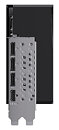
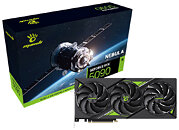
Manli introduced its newest high-end graphics card, the Nebula GeForce RTX 5090 powered by the NVIDIA Blackwell architecture. This card is Manli's fourth RTX 5090 version and the first time a flagship GPU model has joined Manli's Nebula lineup alongside the Gallardo and Stellar RTX 5090 series. The Nebula RTX 5090 runs at base and boost clock speeds of 2017 MHz and 2407 MHz respectively. The card has 32 GB of GDDR7 memory with a 512-bit interface providing memory speeds of 28.0 Gbps and bandwidth up to 1,792 GB/s.

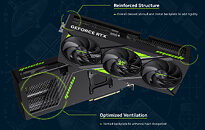
The graphics card needs 575 W of power and keeps its GPU temperature at a maximum of 90°C. In terms of cooling it features a large heatsink with a triple cooler setup. This includes three 100 mm fans (which stop spinning during idle states) and nine 6 mm heat pipes. For enhanced aesthetics and structural rigidity Manli's Nebula GeForce RTX 5090 features a die-cast cover and a metal backplate. Connectivity-wise, the graphics card offers three DisplayPort outputs and one HDMI port. It measures 345 x 150 x 65 mm and takes up 3.5 slots. It's worth noting that this model is intended for international markets, unlike the 5090 D variants that Manli offers specifically to the Chinese market. Exact pricing and availability are yet to be known.

TSMC Gets 300,000 H20 Chip Order from NVIDIA Amid China Market Boom

Reuters reports that according to two sources with knowledge of the situation, NVIDIA has placed orders for 300,000 H20 Blackwell chipsets to TSMC. The order shows high Chinese demand that pushed the U.S. chip giant to go beyond its current stock. The Trump administration gave NVIDIA permission to start selling H20 graphics processing units to China again changing an April ban meant to stop advanced AI chips from reaching Chinese markets because of national security worries. NVIDIA made the H20 chip just for the Chinese market after U.S. export limits targeted its other AI chipsets in late 2023. The H20 has less computing power than NVIDIA's H100 or newer Blackwell series sold in other places.

The new TSMC orders would add to NVIDIA's current H20 stock of 600,000 to 700,000 chips, sources said. To put this in perspective, NVIDIA sold about one million H20 chips in 2024, based on research from SemiAnalysis. After April's sales ban, NVIDIA warned of potential $5.5 billion inventory write-offs and $15 billion in foregone sales. During a trip to Beijing this month, NVIDIA CEO Jensen Huang said H20 order numbers would decide if production would start again pointing out that getting the supply chain going would take nine months. After his visit, reports suggested NVIDIA told customers it had limited H20 stocks with no plans to start wafer production again soon. The company has requested that Chinese buyers submit new documentation including order volume forecasts from clients. Despite competition from Huawei's less powerful alternatives, NVIDIA products remain popular in China, evidenced by increased repair demand for banned GPUs, many smuggled into the country.

NVIDIA N1X Processor Surfaces in Furmark OpenGL Benchmark

NVIDIA N1X, the company's upcoming PC processor being designed for a slice of the Windows 11 Arm with Copilot+ pie, just hit the Furmark OpenGL graphics benchmark database. Over the past few weeks, the chip has been popping up on various online benchmark databases, signaling that PC OEMs have started validating test platforms based on the N1X, and depending on what they see, they can embark on product development.

The Furmark 1.39 Donut test result sees the N1X iGPU score 4286 points or 71 FPS at 720p. The app also detects the graphics driver version as 590.22. The score is rather low, with 4286 points indicating performance levels barely half those of the GeForce RTX 5060. Either this particular chip has an entry-level iGPU model, or there's still some way to go before NVIDIA optimizes the software stack for the N1X. A recent report covered a Geekbench database submission where the benchmark detected 48 SM for the N1X, a count comparable to the desktop RTX 5070, however, this performance result is nowhere near.

NVIDIA to Debut GeForce RTX 50-series SUPER GPUs by Christmas

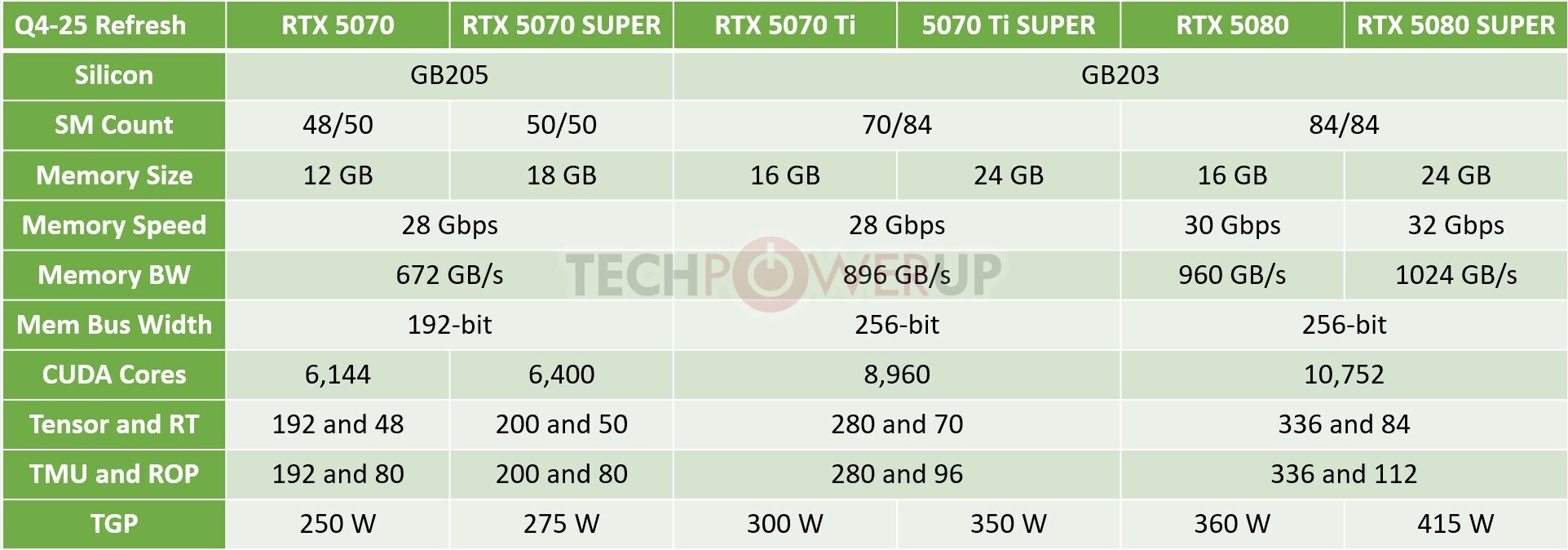
NVIDIA is planning to update its GeForce RTX 50-series SUPER line of graphics cards by Christmas 2025, says a report by TweakTown. The company will look to bolster the memory sizes of key performance-segment and high-end graphics card SKUs in a bit to boost their performance in higher resolutions, particularly with ray tracing and neural rendering enabled. In particular, NVIDIA is expected to leverage new 24 Gbit density GDDR7 memory chips that allow it to create memory sizes such as 18 GB over a 192-bit wide memory bus, or 24 GB across a 256-bit wide memory bus. Besides the added memory, NVIDIA is expected to marginally increase shader counts and GPU clock speeds.

The TweakTown article also sheds light on possible specs of the RTX 50-series SUPER lineup. Only the RTX 5070 SUPER sees an increase in SM counts over its non-SUPER predecessor, with the card maxing out the "GB205" silicon, enabling all 50 SM, for 6,400 CUDA cores, 200 Tensor cores, and 50 RT cores. The RTX 5070 Ti SUPER sees no increase in SM count over the RTX 5070 Ti despite being based on the "GB203" chip that the two share with the RTX 5080, and there being a rather large gap in SM count between the two (70 vs. 84). The RTX 5080 SUPER, much like the RTX 5080, maxes out the "GB203." What the RTX 5070 Ti SUPER and RTX 5080 SUPER have going for them is a 50% increase in memory size to 24 GB. The RTX 5070 Ti SUPER holds onto the same 28 Gbps memory speed as RTX 5070 Ti, while the RTX 5080 SUPER gets a marginal increase in speed to 32 Gbps. There are fairly good increases in TGP across the board for the RTX 50-series SUPER.

Wuchang: Fallen Feathers Dev Seemingly Disabled Native Render Resolution on Certain Hardware To Fix Performance Issues

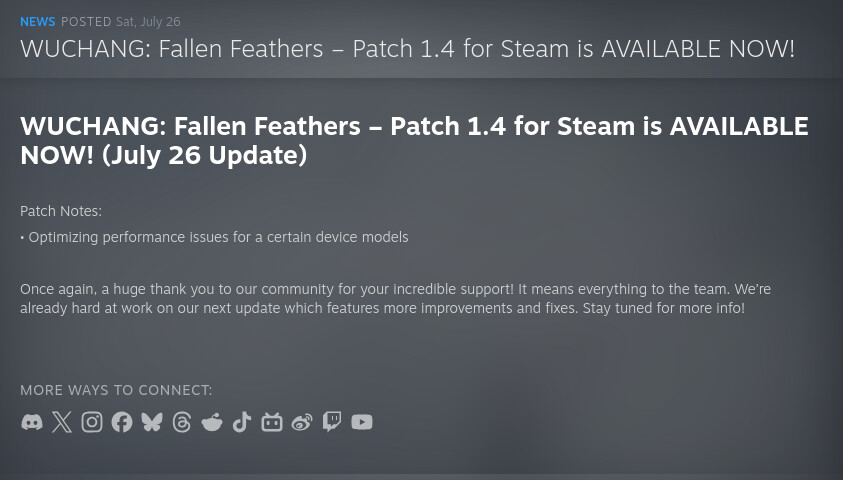
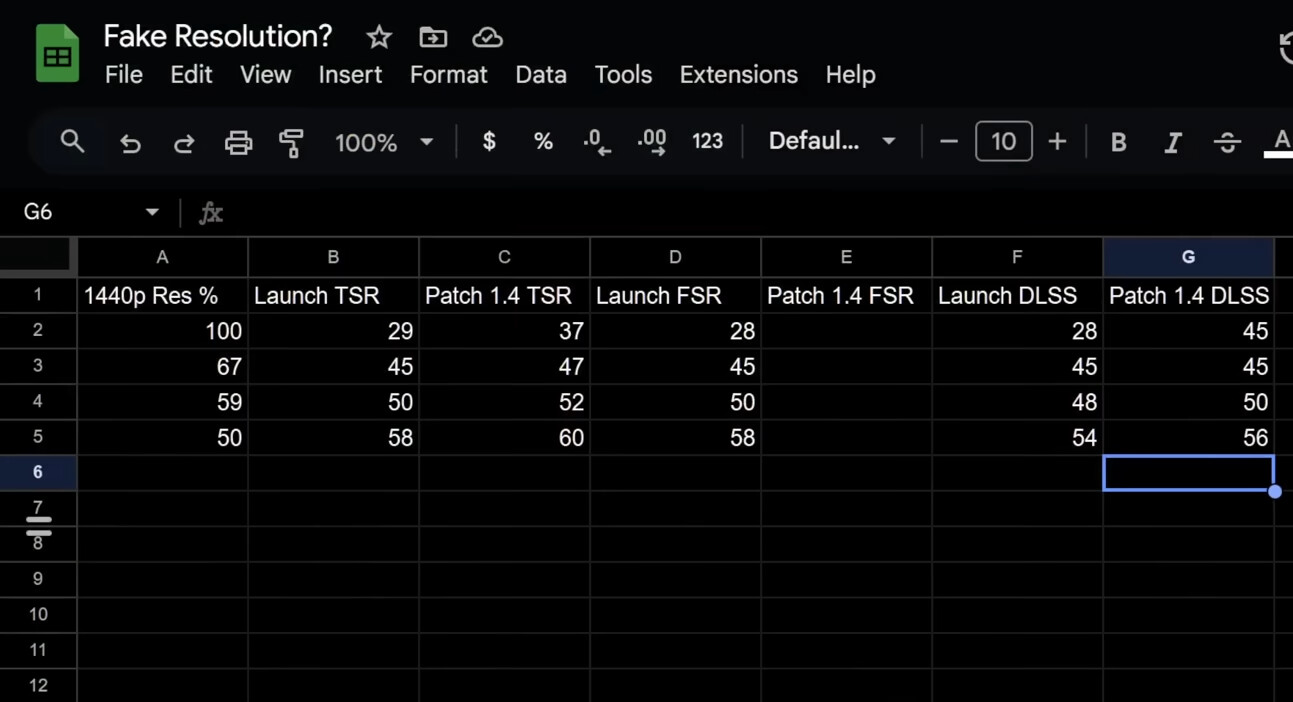
Last week, we reported on Wuchang: Fallen Feathers and its launch that was ruined by poor optimization and abysmal performance on even high-end PCs. In response to the plummeting Steam review score, 505 Games put out a patch that was supposed to improve performance by reducing RAM and VRAM usage, optimizing performance on low-end GPUs, and addressing performance and stability bugs. This patch was followed by Patch 1.4, which supposedly addressed performance on "certain hardware models." A recent analysis by Daniel Owen on YouTube has revealed that the Wuchang: Fallen Feathers 1.4 patch may have removed native rendering from the game entirely, effectively forcing players to use upscaling, even when the resolution scale is set to 100%.

As Owen demonstrates in his YouTube video, the only change in the patch notes that mentions sampling resolutions reads: "Supersampling resolution limits have been adjusted on select GPU models to prevent unintended performance degradation." This seems to imply that the option to enable higher resolution scaling options was removed for lower-end GPUs, but that may not be the case. As Owen demonstrates, before the 1.4 update, performance scales predictably with the oversampling resolution slider—if you drop the resolution below 100%, the performance increases, regardless of whether the game is using FSR, DLSS, or TSR. After updating the game to the 1.4 patch, there is a significant performance boost at the same 100% resolution scale, and the running theory is that the developers are simply capping the render resolution at somewhere below native, regardless of which settings the player enables in the graphics options. This is demonstrated when Owen drops the resolution scale to similar levels as he tested prior, and performance is just 2 FPS higher than what was observed before the update on TSR and FSR, with DLSS getting identical performance in one instance.

NVIDIA N1X PC Processor Features 20 Arm CPU Cores and 48 iGPU Streaming Multiprocessors

NVIDIA is looking to hit the PC processor market with shock and awe, suggests the CPU core counts and iGPU CU counts. Having seen the success of Qualcomm in this market, NVIDIA is designing its new N1X PC processor in anticipation of Microsoft opening up the Windows 11 Arm Copilot+ AI PC ecosystem, letting in new players such as NVIDIA and MediaTek. A new Geekbench online database submission sheds light on what is under the hood.

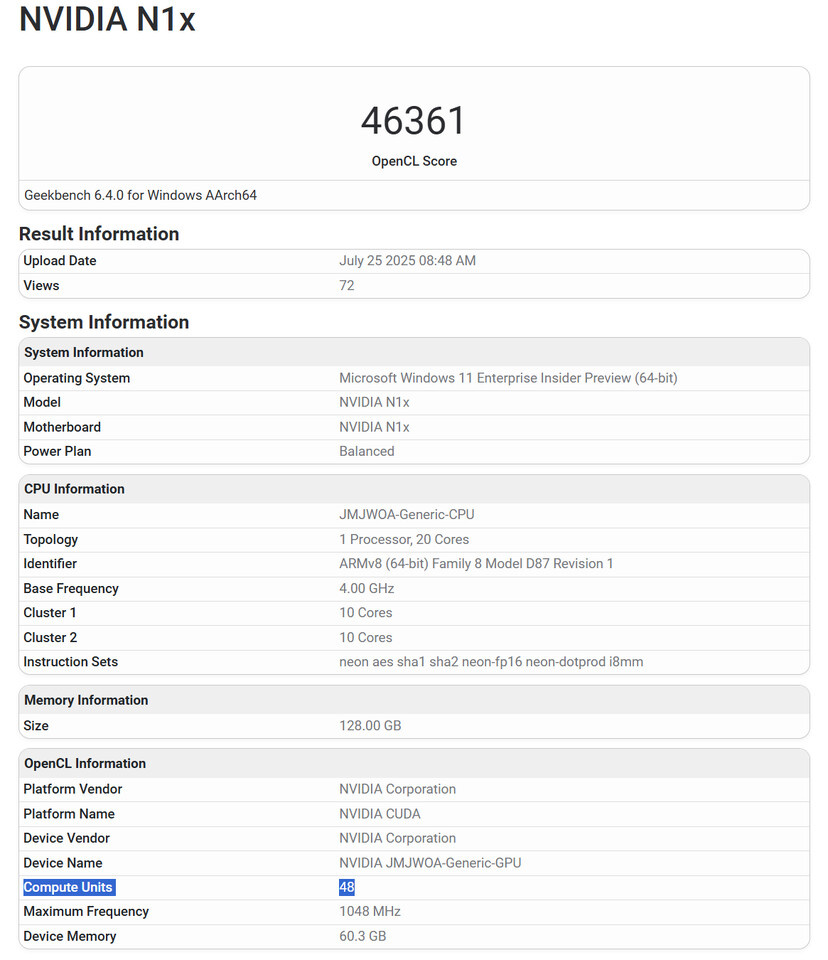
Geekbench is able to detect the number of CPU cores and GPU OpenCL compute units it is able to address. A user with access to an N1X test machine ran Geekbench 6.4.0, and the benchmark yielded a score of 46361 points in the OpenCL test. The chip is detected having 20 CPU cores, and exposes 48 compute units (OpenCL terminology) to the GPU compute benchmark. The N1X is expected to implement a heterogenous multicore CPU complex, and while it has 20 cores, these are not all the same. The processor is expected to pack a powerful iGPU based on the Blackwell graphics architecture, with 48 SM (streaming multiprocessors), The idea behind such a chip would be to compute with Apple's M-Pro and M-Max series SoCs powering its latest MacBook Pros, as well as x86-based PC chips such as the Ryzen AI Max "Strix Halo." 48 Blackwell streaming multiprocessors is identical to that of the desktop GeForce RTX 5070, but the iGPU, making it possibly the fastest iGPU at launch.

Inno3D Announces GeForce RTX 5090 and RTX 5080 Frostbite Pro: 1-Slot Design

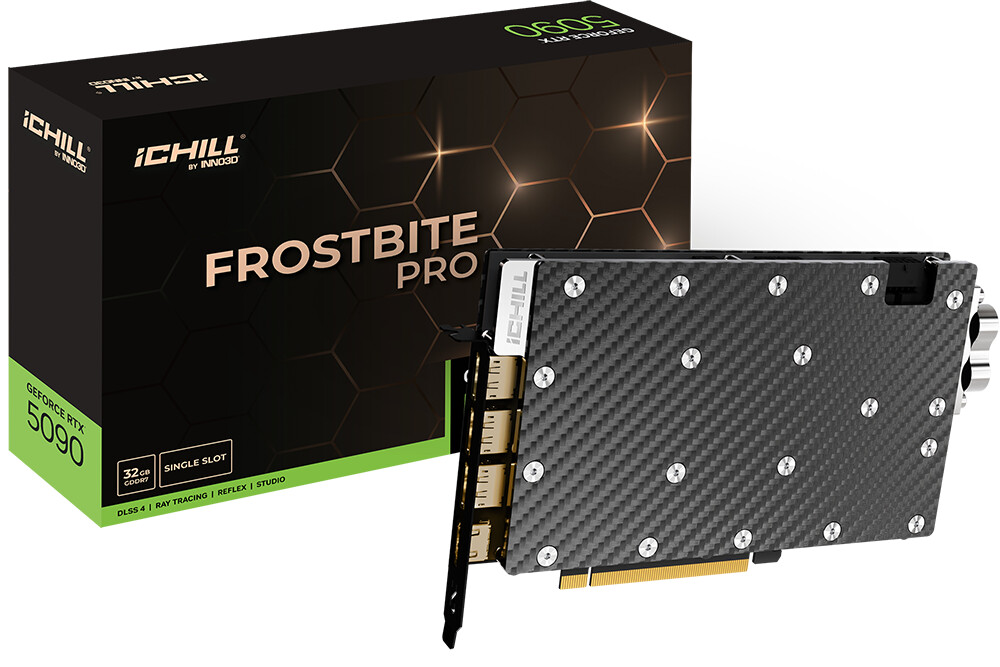
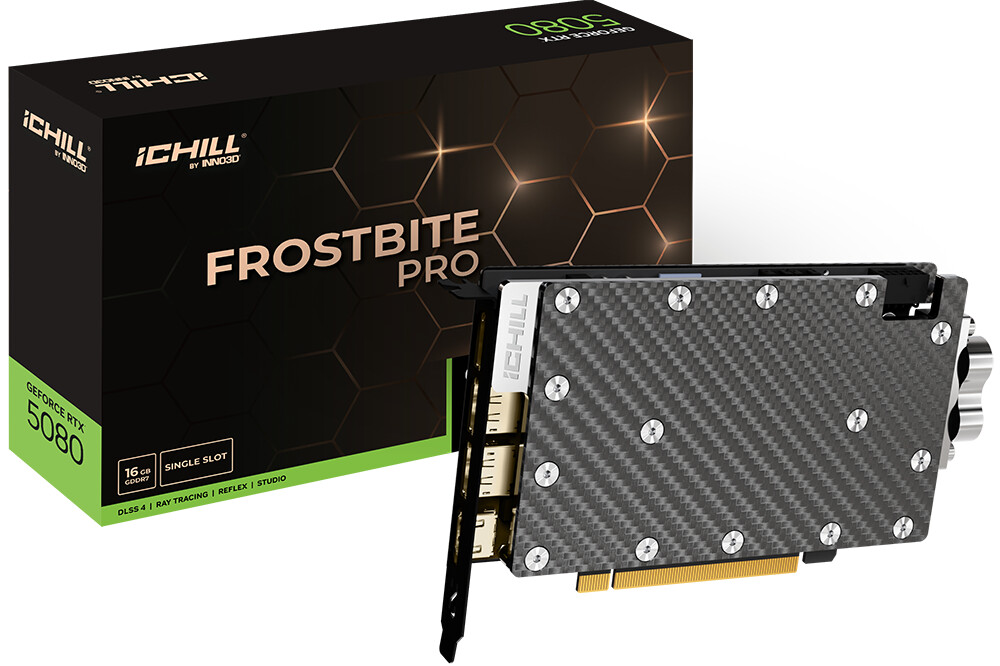
INNO3D, a leading manufacturer of high-end multimedia components and innovations proudly announces the new additions to the GeForce RTX 50 Series, the GeForce RTX 5090 & RTX 5080 Frostbite Pro, featuring Alphacool's 1-Slot-Design with backplate for high-performance liquid cooling. Founded in 1998 with the vision of developing pioneering computer hardware products on a global scale. Fast-forward to the present day, INNO3D is now well-established in the gaming community known for our innovative and daring approach to design and technology. We are Brutal by Nature in everything we do and are 201% committed to you for the best gaming experience in the world.

Designed for enthusiast gamers, overclockers, and workstation professionals, the Frostbite Pro takes unparalleled thermal efficiency to the next level with Alphacool's enterprise-grade 1-slot water cooler. Its chrome-plated copper cooling block ensures maximum heat dissipation, while carbon and brass components deliver durability and seamless integration into high-density environments.

AMD Radeon RX 9060 XT Leads TechPowerUp Frontpage Poll for its Price-Performance

The mainstream gaming GPU market segment is a jungle, with dozens of graphics card models from NVIDIA, AMD, and Intel fighting for a share of the largest segment of the market. With products priced between $250 and $450, these graphics cards are competing with value-ended gaming consoles such as the Xbox Series S. We drew up a list of graphics cards available in the market, and threw the question up to our readers on which card they'd buy given their pricing. The results are fascinating, and point to AMD getting the price-performance of its Radeon RX 9060 XT 16 GB graphics card just right. Our survey sample size is 16,333 responses.

Three key products emerge from our survey, with the rest being minor or academic choices. AMD Radeon RX 9060 XT 16 GB at $370 is a simple-majority winner, with 52.4% or 8.552 responses backing it. NVIDIA GeForce RTX 5060 Ti 16 GB at $440 is a distant second, with 21.6% or 3,520 votes in its favor. Intel Arc B580 12 GB at $250 is an interesting third place, with 10.1% or 1,648 votes backing it. The rest of the poll options are marginal choices, with none of the entries crossing 3.1%. The results highlight that there are three price-bands driving the 1080p gaming GPU segment—$250, $350, and $450.

505 Games Apologizes for Messy Wuchang: Fallen Feathers Launch

Wuchang: Fallen Feathers initially looked like quite a promising Soulslike, with early critic reviews praising it for its solid combat and level design, and peak player counts on SteamDB reaching as high as 131,000 players. However, shortly after the game launched on Steam, it became clear that there were severe issues with optimization and performance. Despite the minimum system requirements only calling for an NVIDIA GeForce GTX 1060 6 GB and recommended system requirements bumping that up to an RTX 2070, even players with much more powerful setups, like the NVIDIA GeForce RTX 4070 Super, have been having issues with performance. Most of the complaints stem from stuttering, low framerates, and crippling screen tearing at higher framerates, and the issues have resulted in the game's Steam review score dropping to a "Mostly Negative" 32% positive, despite the game's narrative and gameplay successes.

The game's developer, Leenzee, and its publisher, 505 Games have now attempted to address some of these player concerns with a somewhat confusing statement and apology on Steam. The developer-publisher duo starting off strong, acknowledging the performance issues and apologizing for the inconvenience, "We have received reports regarding issues such as the game's optimization not meeting expectations, errors in distributing pre-order rewards, and some abnormal pricing. These problems should never have occurred, and we deeply regret the inconvenience and negative experience some players are currently facing." But then continues to say that "We are confident in the game's performance within our recommended spec, but we're working on optimization. We are looking to issue a patch as soon as we can," and then directs players to a support thread on optimization that directs them to reduce the in-game graphics settings, update drivers, and install the game on an SSD in order to optimize the experience.

ASUS 30th Anniversary Gamescom Giveaways Hint at New Astral RTX 5080 Launching on August 19

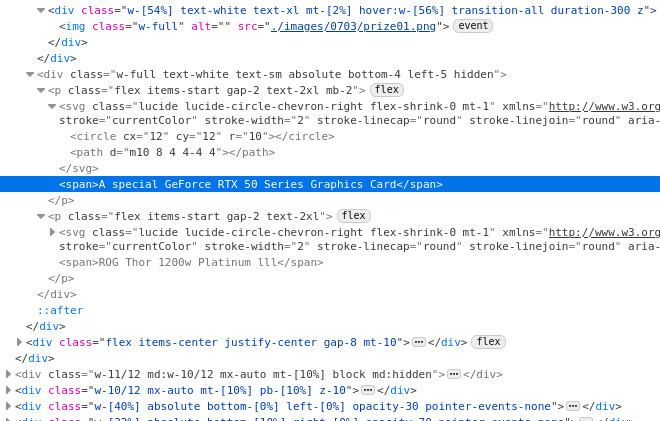
In the lead-up to Gamescom 2025, which is slated to kick off on August 20, with a press event on August 19, ASUS is teasing a new product launch and a series of giveaways for the event. Information obtained by VideoCardz points to a 30th Anniversary Edition ASUS NVIDIA GeForce RTX 5080, however, the website HTML code suggests that the "new ROG graphics card" in question may simply be in reference to the ASUS ROG Astral RTX 5080 Hatsune Miku Edition. As VideoCardz points out, this might simply be a placeholder link, because ASUS hinted in a post on X that it has "got something really special cooking" for Gamescom 2025.

ASUS is also planning giveaways for a host of its gaming components and peripherals, including an AMD Ryzen 7 9800X3D bundle with an ROG Crosshair x870E motherboard as well as the aforementioned GPU and TUF Gaming Hatsune Miku Edition peripherals, an ASUS ROG Strix OLED gaming monitor, ROG Falcata split Hall-effect gaming keyboard, ROG Harpe II Ace gaming mouse, the ROG Strix GS-BE18000 gaming router, and an ROG Ryuo IV 360 AIO CPU cooler. More information on the ASUS 30th Anniversary giveaway page supports the idea that a new RTX 5080 Astral GPU is coming on August 19.

NVIDIA GeForce NOW Gets WUCHANG: Fallen Feathers, Tony Hawk's Pro Skater, Killing Floor 3, and More

Sharpen the blade and brace for a journey steeped in myth and mystery. WUCHANG: Fallen Feathers has launched in the cloud. Ride in style with skateboarding legends in Tony Hawk's Pro Skater 1 + 2, now just a grind away. Or team up with friends to fend off relentless Zed hordes in the pulse-pounding action of Killing Floor 3. The adventures begin now with nine new games on GeForce NOW this week.

Rise From Ruin
Dive into the hauntingly beautiful world of Ming Dynasty China in WUCHANG: Fallen Feathers, where supernatural forces and corrupted souls lurk around every corner. Step into the shoes of Wuchang, a fierce warrior battling monstrous enemies and the curse of the feathering phenomenon. Every decision and weapon swing carves a path through a world that's as treacherous as it is breathtaking. The game's rich lore and atmospheric storytelling pull players into a dark, soulslike adventure where danger and discovery go hand in hand. Stream the game in all its gothic glory with GeForce NOW, no legendary hardware needed. Powered by a GeForce RTX gaming rig in the cloud, GeForce NOW enables members to stream instantly across devices and immerse themselves in epic combat and stunning visuals. Ultimate members can soar to new heights and stream at up to 4K resolution 120 frames per second or 240 FPS for even smoother frame rates - all at ultralow latency.

ZOTAC to Release GeForce RTX 5090 ArcticStorm AIO and GeForce RTX 5060 Low Profile

ZOTAC Technology PTE. Limited is pleased to announce the launch of the ZOTAC GAMING GeForce RTX 5090 ARCTICSTORM AIO and the ZOTAC GAMING GeForce RTX 5060 Low Profile. Two models on the opposing ends of the size spectrum, the ARCTICSTORM AIO is the first ever high-end graphics card by ZOTAC GAMING to utilize a full-sized 360 mm Liquid Cooling AIO, for the ultimate cooling performance, pure speed and exceptional temperatures. The ZOTAC GAMING GeForce RTX 5060 Low Profile, on the other hand, is a half-height, ultra-compact card made for Small Form Factor Enthusiasts.

The ZOTAC GAMING GeForce RTX 50 Series is powered by the NVIDIA Blackwell architecture, bringing game-changing capabilities to gamers and creators. Equipped with a massive level of AI horsepower, the RTX 50 Series enables new experiences and next-level graphics fidelity. Multiply performance with NVIDIA DLSS 4, generate images at unprecedented speed, and unleash creativity with NVIDIA Studio. Plus, access NVIDIA NIM microservices - state-of-the-art AI models that let enthusiasts and developers build AI assistants, agents, and workflows with peak performance on NIM-ready systems.

MAINGEAR Drops Retro95: A 90s Throwback with 2025 Firepower

MAINGEAR, the leader in premium-quality, high-performance gaming PCs, today announced Retro95, a limited-edition PC drop that brings back the unmistakable style of a '90s-era horizontal desktop, now supercharged with cutting-edge hardware. Built for gamers who remember LAN parties, floppy disks, dial-up, and CD-based drivers, Retro95 is a nostalgic love letter to the golden age of PC gaming, reimagined for today's most demanding titles.

With its beige finish, boxy profile, and horizontal layout, Retro95 looks like it booted straight out of 1995, but don't let the exterior fool you. Inside, it can be configured with some of today's most powerful components, including CPU options from AMD and Intel, up to the Ryzen 7 9800X3D, NVIDIA GeForce RTX 5080 graphics card, 96 GB of DDR5 memory, 8 TB of Gen 4 NVMe storage, Noctua fans and an 850 W PSU. Retro95 may flaunt '90s flair, but it's also engineered with modern thermals and whisper-quiet air cooling for high performance with low noise.

NVIDIA Selects Micron for Large-Scale SOCAMM Deployment

NVIDIA has revealed last week its plan to roll out 600,000 to 800,000 SOCAMM memory modules in 2025. This move puts SOCAMM technology in a position to replace current high-bandwidth memory (HBM) options. NVIDIA aims to use these modules in its upcoming AI products such as the GB300 "Blackwell" platform and AI PC Digits system, which it showed off at GTC 2025. Industry reports indicate that NVIDIA has communicated projected order quantities to memory and substrate suppliers. NVIDIA engaged three major memory manufacturers: Samsung Electronics, SK Hynix, and Micron Technology for SOCAMM co-development. As Digitimes Asia reports citing ET News and Wccftech, Micron has secured approval for volume production ahead of its competitors.

The System on Chip Advanced Memory Module (SOCAMM) technology uses LPDDR DRAM to boost performance for low-power high-bandwidth AI computing tasks. Micron says SOCAMM gives 2.5 times more bandwidth while reducing size and power use by a third compared to standard server RDIMM modules. The planned SOCAMM rollout though smaller than NVIDIA's expected 9 million HBM unit buy for 2025, marks a key market shift. Industry experts see this as a possible game-changer for memory and substrate fields. SOCAMM's rollout covers business and consumer markets first aiming at AI servers and workstations before moving to personal computers. The technology links cost-effective growth with high-performance AI workload needs.

NVIDIA DLSS 4 Coming to Killing Floor 3 and WUCHANG: Fallen Feathers On July 24

More than 800 games and applications feature RTX technologies, and each week new games integrating NVIDIA DLSS, NVIDIA Reflex, and advanced ray-traced effects are released or announced, delivering the definitive PC experience for GeForce RTX players. Following the addition of DLSS 4 with Multi Frame Generation to even more games last week, this week sees our performance multiplying tech launch in Killing Floor 3 and WUCHANG: Fallen Feathers, and it will be added to The First Descendant. And Wildgate launches today with DLSS Super Resolution.

Killing Floor 3 Launches July 24th, Featuring DLSS 4 With Multi Frame Generation
Tripwire Interactive's Killing Floor 3 is the next installment in the legendary co-op action-horror FPS series. The year is 2091, 70 years after the events in Killing Floor 2, and megacorp Horzine has produced the ultimate army: an obedient horde of bio-engineered monstrosities called Zeds. Now, the only thing standing between these infernal creations and the future of humanity is the rebel rogue group known as Nightfall. This intense first-person shooter puts players in the role of a Nightfall specialist, joining forces with up to five teammates as they battle through a war-ravaged, dystopian future, surviving unrelenting waves of Zeds, unlocking new skills, and building the ultimate arsenal.

DDR6 Memory Arrives in 2027 with 8,800-17,600 MT/s Speeds

The semiconductor industry has officially accelerated its next-generation memory development, with DDR6 standard now coming soon. Although enthusiasts won't find these modules available until 2027, key players, Samsung, Micron, and SK Hynix, have already moved past prototype stages and embarked on rigorous validation cycles. In partnership with Intel, AMD, and NVIDIA, they're targeting an initial throughput of 8,800 MT/s, with plans to scale up to a staggering 17,600 MT/s, almost doubling the ceiling of today's DDR5. This increase is driven by DDR6's 4×24-bit sub-channel architecture, which requires entirely new approaches to signal integrity. Additionally, it also differs from DDR5's current 2x32-bit sub-channel structure. To overcome the physical limits that DIMM form factors faced at higher speeds, the industry is betting on CAMM2. Early indication is that server platforms will lead the change, with high-end notebooks following suit once manufacturing ramps up.

Behind the scenes, timelines are being mapped: platform validation is slated for 2026, server deployments in 2027, and broader consumer availability thereafter. This phased rollout mirrors the DDR5 journey; however, analysts predict that DDR6's architectural leap could accelerate adoption in AI and high-performance computing environments. Of course, cutting-edge technology comes with a premium: initial DDR6 modules are expected to carry price tags reminiscent of DDR5's 2021 debut, potentially limiting early adoption to hyperscale data centers and AI research labs. Yet with HPC and AI appetite for bandwidth, memory makers are targeting launch as soon as possible to satisfy the massive deployment of compute. By 2027, CAMM2-based modules running at DDR6 speeds may well define the new standard for high-performance systems.

Corsair Launches VENGEANCE 7000 AIR Series Gaming PC

Corsair, maker of award-winning prebuilt gaming PCs, is proud to launch the VENGEANCE 7000 AIR Series Gaming PCs, a high-powered prebuilt gaming PC designed for gamers and creators who demand next-gen power, precision engineering, and stunning aesthetics. Housed in the FRAME 4000D case, the VENGEANCE 7000 AIR Series redefines what you can expect from a plug-and-play PC, delivering optimized performance, expert craftsmanship, and a future-ready platform. Built around the modular and upgrade-friendly FRAME 4000D case, the VENGEANCE 7000 AIR Series leverages the latest components to power everything from 4K gaming to demanding content creation workflows. Featuring GPU options up to the NVIDIA GeForce RTX 5090, and processor configurations that include up to the AMD Ryzen 9 9950X3D or Intel Core Ultra 9, this powerhouse delivers uncompromising speed and multi-threaded performance to tackle any task with ease.

At the heart of the VENGEANCE 7000 AIR Series is the FRAME 4000D case, giving a significant edge in both form and function. With three radiator mounting locations—front, roof, and side—and a 3D Y-Pattern front airflow panel, the case ensures efficient cooling to keep components running smoothly to maximize the efficiency of high-performance GPUs and CPUs under heavy workloads. The front I/O panel features two USB 3.2 Gen 1 Type-A ports and a USB 3.2 Gen 2 Type-C port, offering versatile connectivity for peripherals and accessories.

OpenAI and Oracle Commit 4.5 GW Data Center Expansion to Stargate Network

OpenAI and Oracle today announced a binding agreement to add 4.5 gigawatts of power-dense data center capacity to the Stargate network, pushing the project past the 5 GW milestone and keeping it on track to house over two million AI chips. While SoftBank remains a name on Stargate's January press release, the Japanese conglomerate is not contributing capital to this specific tranche, leaving Oracle as the primary financier and operator for now. The new build-out will join Stargate I in Abilene, where Oracle delivered the first NVIDIA GB200 racks last month and where OpenAI is already running frontier model training workloads. Construction crews from more than twenty states are on site, and OpenAI projects that the expanded footprint will generate over 100,000 US jobs, spanning electricians, mechanical technicians, and indirect manufacturing roles, within the next four years.

The announcement arrives less than a week after the Wall Street Journal characterized Stargate as a "stalled" venture, a claim OpenAI CEO Sam Altman swiftly rebutted on X, affirming that total investment will "significantly exceed" the originally pledged $500 billion and that GPU counts are on pace to break the two-million-chip barrier this year. Site selection for the 4.5 GW increment remains under review, with Texas, Michigan, Wisconsin, and Wyoming under consideration. Oracle has reportedly placed a $40 billion order for additional NVIDIA silicon, showing the scale of its commitment. Power availability remains the critical constraint, as 4.5 GW equals the average draw of 3.5 million homes, prompting parallel negotiations with utilities for on-site generation and dedicated transmission lines. Abilene's H-shaped halls, each designed to hold 50,000 GB200s, serve as a live prototype, and lessons learned there, including liquid-cooling loops and modular substations, will be replicated across future campuses.

NVIDIA Releases GeForce 577.00 WHQL Game Ready Drivers

NVIDIA today released the latest version of GeForce software. Version 577.00 WHQL comes with Game Ready optimization for "Wuchang: Fallen Feathers," including support for DLSS 4. The drivers also come with optimization for the latest Unreal Engine 5 update of "Valorant." The driver also adds DLSS Overrides, or the ability to override DLSS settings in NVIDIA App, for 11 new titles. This feature lets you take control of settings such as multi frame-generation overrides, upscaler models, frame-generation models, DLAA, and ultra-performance modes. NVIDIA App optimal settings have been added for three new titles, including Broken Arrow, Mecha Break, and PEAK. Among the issues fixed with this release are a bug with Counter-Strike 2 that causes black screens on 4:3 resolutions on the ASUS ROG PG27AQN monitor; and stability issues with Naraka Bladepoint on a specific map when using the DirectX 11 renderer and DLSS.

DOWNLOAD: NVIDIA GeForce 577.00 WHQL

Eurocom Unveils Raptor X18 Supercomputer and Launches Forensic Lab on-the-Go

Eurocom, a leader in high-performance mobile computing, today announced the launch of the Raptor X18, a mobile supercomputer engineered to serve as a complete "forensic lab on the go." Designed for the intense demands of digital forensics, corporate incident response, and intelligence operations, the Raptor X18 gives investigators the power to acquire, process, and analyze massive datasets directly in the field, eliminating critical delays and accelerating time-to-insight. Eurocom redefines mobile forensics with Raptor X18 Supercomputer, delivering full Lab capabilities to the field. New flagship 'Lab-on-the-Go' platform empowers forensic teams to conquer massive datasets, break through encryption, and slash investigation times directly at the source.

The mounting challenge in modern investigations is that today's investigators face a crisis of scale and complexity. Data volumes are exploding into petabytes, fragmented across countless devices, cloud platforms, and IoT networks. Simultaneously, adversaries are using sophisticated encryption and anti-forensic techniques to hide their tracks. This forces forensic teams into a reactive posture, where critical evidence is transported back to a centralized lab, creating bottlenecks that can last days or weeks—a delay that can be catastrophic in a fast-moving corporate breach or time-sensitive criminal investigation.

ASUS Packs NVIDIA GB300 "Blackwell Ultra" in a Desktop PC

What if NVIDIA's most powerful symbiosis of CPU and GPU design, originally intended for server infrastructure, is put inside a desktop form factor? That is exactly the question ASUS asked and decided to do. In its ExpertCenter Pro ET900N G3, ASUS utilized the NVIDIA GB300 Grace Blackwell Ultra desktop superchip, delivering 20 PetaFLOPS of FP4 precision compute, alongside 784 GB of unified cache-coherent memory, 288 GB of which are attributed to HBM3E on the GPU itself, and the remaining 496 GB to LPDDR5X embedded around the Grace CPU. With the GB300 "Blackwell Ultra," NVIDIA allows OEM partners to utilize its DGX blueprint and design their own desktops, so ASUS is undertaking a custom implementation here. To connect the monstrous compute to the outside world, ASUS embeds ConnectX-8 SuperNIC, which runs at 800 Gb/s, and installs NVIDIA's DGX OS, a Ubuntu fork with NVIDIA-specific kernel tweaks, optimizations, and additional drivers.

The motherboard powering the system is designed for serious expandability, offering three full-length PCIe x16 slots that allow you to stack multiple GPUs or specialized accelerators, including extra RTX cards for maximum compute performance, and three M.2 expansion slots for high-speed SSDs. Power delivery is interesting as it includes the standard ATX and EPS12V connectors for the CPU and system, plus three dedicated 12V-2×6 GPU power connectors capable of supplying up to 1,800 Watts. Pricing and availability are unknown, but expect to pay $30,000+ for a system of this caliber, which is specifically aimed at AI researchers running these boxes as part of their larger infrastructure.

NVIDIA Ports CUDA to RISC-V, Betting Big on Open-Source ISA

During the RISC-V Summit in China, NVIDIA's Frans Sijstermans, vice president of hardware engineering, officially announced that NVIDIA has ported its massive CUDA software library to RISC-V ISA, signaling that the company sees RISC-V adoption accelerating in every aspect of the hardware stack, and that it could be a perfect match for NVIDIA GPUs. Historically, NVIDIA ported its CUDA platform to every major instruction set, including x86, Arm, PowerPC, and even Sun's SPARC. This is done to ensure that if any platform takes off in the enterprise or any segment, NVIDIA is there from the start to support it and allow its GPUs to run at full speed. Now, the $4 trillion company is making a bet that RISC-V will be the next desirable ISA to bring full support for.

NVIDIA envisions systems where its GPUs are the center of any acceleration, and supplementary RISC-V CPUs oversee CUDA drivers, application logic, and the operating system, orchestrating parallel workloads entirely within the CUDA ecosystem. The diagram shown at the summit highlights a DPU handling networking tasks, creating a cohesive trio of compute, control, and data-movement elements. If you recall, NVIDIA already uses NV-RISC-V CPU inside its GPUs for handling control logic on the GPU itself. That demonstrates NVIDIA's strategy to build heterogeneous platforms that combine RISC-V controllers with its GPUs, DPUs, and networking silicon. Now that CUDA is fully supported on RISC-V, NVIDIA could look into alternatives for its Grace CPU to be built on the RISC-V ISA. As the open-source ISA slowly breaks into the server space with the RVA23 specification, which NVIDIA mandates for CUDA support, we could see some interesting heterogeneous designs.

NVIDIA Brings Reasoning Models to Consumers Ranging from 1.5B to 32B Parameters

Today, NVIDIA unveiled OpenReasoning-Nemotron, a quartet of distilled reasoning models with 1.5B, 7B, 14B, and 32B parameters, all derived from the 671B-parameter DeepSeek R1 0528. By compressing that massive teacher into four leaner Qwen-2.5-based students, NVIDIA is making advanced reasoning experiments accessible even on standard gaming rigs, without the need to worry about hefty GPU bills and cloud usage. The key is not some elaborate trick but raw data. Using the NeMo Skills pipeline, NVIDIA generated five million math, science, and code solutions, and then fine-tuned each one purely with supervised learning. Already, the 32B model hits an 89.2 on AIME24 and 73.8 on the HMMT February contest, while even the 1.5B variant manages a solid 55.5 and 31.5.

NVIDIA envisions these models serving as a powerful research toolkit. All four checkpoints will be available for download on Hugging Face, providing a strong baseline for exploring reinforcement-learning-driven reasoning or customizing the models for specific tasks. With GenSelect mode (which takes multiple passes for each question), you can spawn multiple parallel generations and pick the best answer, pushing the 32B model to outstanding performance that rivals or even exceeds OpenAI's o3-high performance on several math and coding benchmarks. Since NVIDIA trained these models with supervised fine-tuning only, without reinforcement learning, the community has clean, state-of-the-art starting points for future RL experiments. For gamers and at-home enthusiasts, we get a model that can be very close to the state-of-the-art, entirely locally, if you have a more powerful gaming GPU.

2,001 W XOC BIOS for GALAX GeForce RTX 5090D HOF Appears

If you remember GALAX's last overclocking triumph, it was thanks to Team OGS and their custom Extreme OC (XOC) BIOS for the RTX 5090D HOF. Now, this special XOC BIOS has surfaced online, courtesy of an eagle-eyed post by OCNet user digitaljack3t. This firmware unlocks a default power limit of 2,001 W, which exceeds NVIDIA's official cap, and even allows you to adjust the TDP down to 400 W if you need to keep temperatures in check. It only works on the 5090D variant, so don't bother trying to flash it onto the regular 5090. That exclusivity makes sense given GALAX's decision to release just one non-D HOF card globally, and it shows that true overclocking headroom is reserved for the 5090D platform.

Using liquid nitrogen cooling and finely tuned voltages, they pushed the core clock up to an astonishing 3,650 MHz and achieved a record time of 39.434 seconds on the GPUPI 32B benchmark. OC momentum carried over into graphics tests as well, where 3DMark Port Royal saw the GPU running at 3,570 MHz on its core and 2,250 MHz on GDDR7 memory, resulting in a score of 47,469 points. Meanwhile, the Unigine Superposition 1080p Extreme preset achieved 38,237 points, nearly 29% above the card's standard performance target. Extreme overclocking is not a dead end, and with this XOC BIOS, another overclocking lab could give it a try and potentially set a new world record.
GALAX GeForce RTX 5090D HOF

Axiomtek Unlocks New Frontiers in Real-Time AI at the Edge with NVIDIA Jetson Orin Super Mode

Axiomtek—a world-renowned leader relentlessly devoted to the research, development, and manufacture of innovative, highly efficient, and reliable industrial computer products—is proud to announce Super Mode support on its NVIDIA Jetson Orin -based AIE series, including the compact and rugged AIE100-ONA and AIE110-ONA. Designed for real-time, high-throughput AI workloads in intelligent transportation and smart parking applications, the system now delivers unprecedented AI inference performance thanks to NVIDIA's latest high-performance operating mode.

As demand for smarter, more responsive traffic and parking systems rises, system integrators are challenged to deploy edge AI solutions capable of simultaneously handling multi-stream video analytics, license plate recognition, object detection, and predictive insights—all with strict latency constraints. With the Super Mode feature enabled on NVIDIA Jetson Orin Nano, Axiomtek's AIE100-ONA and AIE110-ONA now provide a significant performance leap to address these real-world deployment needs.
Return to Keyword Browsing
Nov 27th, 2026 19:31 CST change timezone

New Forum Posts

Popular Reviews

TPU on YouTube

Controversial News Posts