
News Posts matching #NVIDIA

Return to Keyword Browsing

Noctua Blames GPU Supply Issues for Lack of Beige and Brown RTX 5090 "At the Moment"

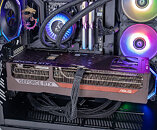
ASUS and Noctua recently released the pricey NVIDIA GeForce RTX 5080 Noctua Edition graphics card, which comes Noctua's classic beige and brown color scheme, three noise-optimized NF-A12x25 G2 fans, and a whopping $1,500 MSRP, putting it squarely in flagship price territory. According to a report by KitGuru, however, Noctua wants to make an even more premium RTX 5090 Noctua Edition, but the current supply issues relating to the RTX 5090 are getting in the way.

In our review of the RTX 5080 Noctua OC, the Noctua OC put out the most impressive noise-normalized results we've recorded so far for the class, suggesting that Noctua might be able to tame the RTX 5090 equally well. Jakob Dellinger, Noctua PR and Product Manager, told KitGuru that even if the company would "love to do a 5090," there isn't enough supply of 5090 chips to be able to pursue a 5090 version. Likely as a result of these shortages, the prices for RTX 5090 cards have been sky-high, which has caused a drop in demand, as we previously reported. That said, the door isn't completely closed on a Noctua RTX 5090, with Dellinger specifically saying that the supply limitations make the graphics card impossible "at the moment."
NVIDIA Links Data Centers into a Unified Supercomputer with Spectrum-XGS Ethernet

Data center networking is one of the most overlooked factors by the public, which is in fact responsible for all communication between nodes. However, NVIDIA knows that data centers with millions of GPUs are on the horizon, and for the fastest AI models, they need to be interconnected, even across multiple facilites. That is why NVIDIA today unveiled Spectrum-XGS Ethernet, an extension of the Spectrum-X networking platform engineered to interconnect multiple, geographically separated data centers into a single, giga-scale AI super-factory. The company states that Spectrum-XGS eliminates the capacity limits of single facilities by introducing distance-aware networking, which delivers predictable, low-latency performance across campuses, cities, and continents.

The technology is mainly delivered through software and firmware updates to existing Spectrum-X switches and ConnectX SuperNICs rather than new silicon. Spectrum-XGS offers auto-adjusted congestion control optimized for long-haul links, precise latency management to minimize jitter, and comprehensive end-to-end telemetry, which allows operators to visualize and control network traffic across multiple sites. NVIDIA reports that these changes nearly double the NCCL (Collective Communications Library) throughput for multi-GPU, multi-node training jobs and large-scale experiments, thereby improving efficiency for distributed AI workloads. NVIDIA framed Spectrum-XGS as a new axis of growth for AI infrastructure: after scaling up inside servers and scaling out inside data centers, scale-across connects facilities into unified compute fabrics.

NVIDIA "Rubin" Platform Enters Trial Production at TSMC, CEO Jensen Huang Confirms

NVIDIA confirmed today that it has taped out six distinct "Rubin" chips, which signals something more than a typical product refresh. Company CEO Jensen Huang, speaking during a visit to Taiwan, said NVIDIA already handed multiple Rubin designs to TSMC and that those dies are now entering fab qualification ahead of trial production. Rubin is intended to be a platform-level upgrade, rather than a simple GPU update, with changes extending across processors, networking gear, and interconnect silicon. Customers and cloud operators will be watching closely as NVIDIA prepares what it describes as the next major compute platform. According to Jensen, the taped designs include a dedicated CPU, new GPU variants, a scale-up NVLink switch, and a silicon photonics processor aimed at improving rack-scale connectivity and off-chip optics.

Rubin will adopt chiplet partitioning for the first time in NVIDIA's product line and is planned for TSMC's N3P process with CoWoS-L packaging. Memory is expected to transition to next-generation HBM4 stacks to sustain higher bandwidth, featuring a custom base die. The physical compute die layout will utilize a larger reticle area compared to the current generation. NVIDIA says it is coordinating hardware changes with software updates, including compiler and runtime improvements that will leverage the new topology. The company projects market introductions around 2026 for Rubin and 2027 for Rubin Ultra, depending on trial production and yields. Early validation is already underway, covering thermal, power, and interconnect scenarios. The Rubin transition from Blackwell is shaping up to be a big step, and in the new generation of AI token factories, we need more powerful chips with million-scale data centers.

RIKEN Partners With Fujitsu and NVIDIA for "FugakuNEXT" Supercomputer

RIKEN is collaborating with Fujitsu Limited (Fujitsu) and NVIDIA to launch an international initiative for the development of Japan's new flagship supercomputer - the next-generation successor to the current "Fugaku" supercomputer - (development codename: "FugakuNEXT"). For the first time in Japan's flagship supercomputing systems, GPUs will be adopted as accelerators, with NVIDIA leading the design for the GPU infrastructure. Fujitsu, which has already been working with RIKEN, will lead the basic design of the overall system, compute nodes, and CPUs. As a foundation for high-performance computing (HPC) infrastructure, the three organizations will work together to build an "AI-HPC platform" to solve challenges through computation.

Aiming for operation around 2030, FugakuNEXT is envisioned to deliver not only the simulation performance pursued by previous supercomputers, but also world-leading capabilities in both simulation and AI, with the two working in close integration as a unified "AI-HPC platform". To this end, FugakuNEXT will extend the CPU technologies developed for Fugaku, while incorporating GPUs as accelerators, aiming to maximize execution performance for both simulation and AI applications. At the same time, to continuously generate scientific achievements through the use of next-generation computing infrastructure, it is becoming increasingly important to pursue not only advances in hardware technology, but also comprehensive innovations in software and algorithms.

NVIDIA Reportedly Ends H20 GPU Production, Makes Room for B30A

According to sources close to The Information, NVIDIA has reportedly halted manufacturing of the H20 "Hopper" GPU for the Chinese market. NVIDIA has instructed its key suppliers, including Samsung Electronics and Amkor Technology of Arizona, to halt production of their components required for the H20 chip. Team green is preparing a transition to a more powerful "Blackwell" series for the Chinese market. NVIDIA has designed a new SKU called B30A, based on the B300 "Blackwell Ultra." Designed as a single-die design, it utilizes the same base die as the dual-die B300 and embeds a single one into the package, achieving half the performance to comply with export regulations.

The H20 chip was under scrutiny from the Chinese government, which urged domestic companies not to use it. Chinese authorities, including the nation's internet watchdog, reportedly raised national security concerns, suggesting the chips could contain hidden "backdoor" vulnerabilities that pose an information security risk. NVIDIA CEO Jensen Huang has publicly addressed the concerns, stating the company's chips do not contain backdoors. However, we are yet to see if Chinese authorities will allow domestic firms like ByteDance, Alibaba, and Tencent to purchase the new B30A GPUs and use them in the most critical infrastructure, or if the damage has already been done and domestic alternatives, such as Huawei Ascend accelerators, prevail. Both can coexist, as NVIDIA chips are valued for their software stack, while Huawei chips are valued for their lower cost. The ultimate endgame of accelerators is wait and see, as Chinese AI labs need all the compute they can get.

Liquid Cooling to Scale in AI Data Centers, Penetration to Surpass 30% in 2025

TrendForce's latest research on the liquid cooling industry reveals that the rollout of NVIDIA's GB200 NVL72 rack servers in 2025 will accelerate AI data center upgrades, driving liquid cooling adoption from early pilot projects to large-scale deployment. Penetration in AI data centers is projected to surge from 14% in 2024 to 33% in 2025, with continued growth in the following years.

TrendForce notes that power consumption for GPUs and ASIC chips in AI servers has risen sharply. For example, NVIDIA's GB200/GB300 NVL72 systems have a TDP of 130-140 kW per rack, far exceeding the limits of traditional air-cooling systems. This has prompted the early adoption of liquid-to-air (L2A) cooling technologies.

NVIDIA Teases DLSS in Blender for Smoother Render and Materials Previews

Since NVIDIA introduced its ray tracing and other AI-enhanced tech with its RTX graphics cards, Blender has been using the tech to enhance 3D rendering and modelling workloads, with NVIDIA OptiX bringing massive improvements to previews in Blender's Cycles Engine. Apparently, DLSS will be the next big NVIDIA technology that Blender will integrate into its Cycles engine to make render previews quicker, more accurate, and less resource-intensive. It effectively uses the same methods as DLSS in gaming applications, reducing the load on the system by rendering a lower resolution version of the scene and then approximating and upscaling the image after the fact. It likely won't have the necessary fidelity to do production-quality renders, but it will almost certainly help preview renders more quickly and with higher precision than the current Eevee and OptiX solutions.

At Siggraph, NVIDIA gave Blender artists and creators hands-on time with a testing build of Blender 5.0 featuring DLSS upscaling and denoising in the viewport, effectively combining the speed and efficiency of Blender's Eevee rendering system with the improved realism and accuracy of the Cycles engine. Blender's upcoming DLSS implementation in Cycles was shown off in comparison clips by Andrew Price on Instagram and Jonathan Lampel on X, and, while it still looks like there is a lot of work to be done, DLSS certainly appears to help generate more realistic render previews much more quickly than Cycles alone. It also doesn't seem to suffer from the same hard limitations on certain materials and transparency effects as Eevee does—although DLSS does still create some artifacts on glass, other transmissive surfaces, and there was some ghosting present, but it is not relying on screen-space techniques to approximate transparency, like Eevee does, so there will conceivably improvements to this ahead of the official Blender 5.0 launch.

MSI Teases WoW "Midnight Edition" GeForce RTX 50 SUPER GPU

MSI will release a limited World of Warcraft Midnight edition GeForce RTX graphics card in 2026, the company previewed at Gamescom in Cologne. Blizzard confirmed at the show that the Midnight expansion is due on or before June 30, 2026, and MSI's prototype borrows the expansion's palette with black, white, and blue accents applied to its Gaming Trio design. The collaboration is clearly meant to marry hardware and game lore, with Midnight itself focused on the clash between the Void and the forces of Light, an assault on the Sunwell, and the long-requested addition of player housing.

Given the timing of the WoW update for mid-2026, MSI's special edition is likely destined to arrive alongside NVIDIA's rumored GeForce RTX 50 SUPER refresh also rumored for the next year, which is expected to feature higher core counts, larger memory configurations, and increased power limits for several SKUs. There are already rumors of models with roughly 10,752 CUDA cores and 24 GB of next-generation GDDR7 for an RTX 5080 SUPER, although MSI has not confirmed any technical details for its Midnight card, and the Cologne sample was shown as a concept rather than a final product. Details on pricing, exact specifications, and preorder dates are expected to arrive from the companies closer to the release.

Borderlands 4 To Rely on NVIDIA DLSS 4 and FrameGen To Hit High Framerates

NVIDIA has officially shown off Borderlands 4 running with DLSS 4, MFG, and RTX enabled in a YouTube video, although fans of the game's franchise have some concerns that the game will depend entirely on generated frame to hit high frame rates. In the trailer, the POV character is facing off against a boss, and the on-screen frame counter reads "262 FPS, 4K DLSS 4," and RTX is enabled. In theory, this means that the game is running at around 65 FPS with MFG disabled, since MFG can insert three generated frames for every rendered frame. The community response to this has been lukewarm, to put it mildly, with many lamenting the implications for the perceived input latency, even if the motion smoothing technology does help make the game look smoother at higher detail levels. Others see it as a sign to come for what to expect for the future of game optimization, now that developers have frame generation technology to lean on.

Assuming NVIDIA is using its best and brightest for this test, this would mean Borderlands 4 could potentially see some very noticeable frame rate issues on lower-end video cards, especially since the minimum specifications call for an NVIDIA GeForce RTX 2070. Meanwhile, the recommended specifications call for an RTX 3080. Previously, concerns were also raised when it was revealed that Borderlands 4 on the Nintendo Switch 2 would target 30 FPS, with some frame rate dips in heavy action scenes and multiplayer.

NVIDIA Releases GeForce 581.08 WHQL Game Ready Drivers

NVIDIA has released the latest version of its GeForce drivers, the GeForce 581.08 WHQL Game Ready. The latest version comes with Game Ready optimizations by adding support for Global DLSS Overrides and NVIDIA Smooth Motion support for GeForce RTX 40 Series GPUs, which was announced during the NVIDIA Gamescom showcase. In addition, the newest GeForce 581.08 WHQL drivers also fix some gaming and general bugs and issues.

According to the release notes, the new GeForce drivers fix issue with Cyberpunk 2077 crashing when using Photo Mode to take a screenshot with path tracing enabled, fixes performance issues in Marvel Rivals, fixes game crash issue in Forza Motorsport if using Smooth Motion while bringing up NVIDIA App overlay statistics, and fixes game stability issues for Gray Zone Warfare and ARK: Survival Ascended games. It also fixes some general bugs like potential memory leak when using NVENC hardware encoding, monitor flickering issues when power cycling monitor with NVIDIA App is installed, and NVIDIA App game filter issues.

DOWNLOAD: NVIDIA GeForce 581.08 WHQL

NVIDIA Prepares Cut-Down B30A "Blackwell" AI Accelerator for Chinese Market

NVIDIA's China-specific accelerators are not unknown by now, and the last export-modified accelerator the company prepared was H20, which recently got an export license. However, Chinese AI labs are on the lookout for a more performant design, and NVIDIA is here to deliver. According to Reuters, NVIDIA has designed a new SKU called B30A, based on the B300 "Blackwell Ultra." Designed as a single-die design, it takes the same base die from the dual-die B300, and just embeds a single one onto the package for half the performance to comply with export regulations.

As the Blackwell Ultra, in its B300 dual-die configuration, features 15 PetaFLOPS of FP4, 7.5 PetaFLOPS at FP6/FP8, 3.75 PetaFLOPS at FP16/BF16, and 1.88 PetaFLOPS at TF32 precision, we can expect the single-die B30A to halve these numbers. This yields roughly 7.5 PetaFLOPS FP4, 3.75 PetaFLOPS FP6/FP8, 1.875 PetaFLOPS FP16/BF16, and 0.94 PetaFLOPS at TF32. Additionally, NVIDIA will not skimp on the mission-critical features like HBM and NVLink, which enable AI training and inference in a much easier way. These chips may be sufficient to counter any current Chinese-designed AI accelerator with a superior software stack and higher performance. As the U.S. administration decided to grant NVIDIA access to the export license, NVIDIA is again serving the Chinese market with a high-performance accelerator for their domestic needs and AI labs.

NVIDIA GeForce RTX 50-series Gets 10% Price-Cut in Europe Thanks to Stronger Euro and Lower Tariffs

NVIDIA and its GeForce add-in card (AIC) partners have instituted price-cuts to the tune of 10% for their GeForce RTX 50-series "Blackwell" gaming graphics cards in the EU, as revealed by price trackers and NVIDIA's first-party online store for Germany. The GeForce RTX 5090, which launched at €2,329 (including VAT), is now down to €2,099, which is a 9.9% reduction. The RTX 5080 launched at €1,169, but is now down to €1,059 (-9.4%). The RTX 5070 Ti remains at €879. The RTX 5070, meanwhile, sees its price drop from €649 to €589 (-9.2%). The RTX 5060 Ti 16 GB and RTX 5060 remain at €399 and €319, respectively. All prices include VAT. The price cuts can be attributed to two key factors—currency, and import tariffs. The Euro has gained 11.87% on the US Dollar in the last 6 months. The other big factor is the relatively lower import tariffs on computer hardware in the EU compared to the US.

NVIDIA Updates GeForce NOW with RTX 5080, Cinematic Streaming, New Low-Latency Tech, and More

NVIDIA today at Gamescom 2025 announced a slew of updates to the GeForce NOW cloud gaming platform. The company eyes GeForce NOW as the future of PC gaming, especially given the rising costs of gaming graphics cards. With games being rendered on cloud machines instead of locally, gamers have the ability to turn pretty much any platform with a screen and a suitable set of input devices into a premium gaming PC, from thousands of games across PC gaming platforms such as Steam, Epic Games, GOG, Xbox, and Ubisoft, can be accessed. Today, the platform is being updated with new features and technology.

To begin with, NVIDIA is bringing GeForce RTX 5080 to GeForce NOW as the new Ultimate tier, replacing the current one powered by the RTX 4080. This service lets you play games with the eye-candy and performance comparable to a gaming PC powered by an RTX 5080 GPU, with up to 4K Ultra HD resolution, and up to 240 FPS to be had, and gaming sessions as long as 8 hours. Ultimate RTX 5080 should also give you options such as DLSS 4 Multi Frame Generation, and be ready for games implementing new features such as ray tracing with Mega Geometry, and Neural Rendering—something not available on the RTX 4080. Thanks to Multi Frame Generation, the Ultimate RTX 5080 tier now offers up to 2.8x higher frame-rates than the previous Ultimate RTX 4080 tier.

NVIDIA ACE Gets its Big Break with "The Oversight Bureau," RTX Remix Evolves

NVIDIA ACE, the generative AI suite behind lifelike NPC interactions in games like Krafton's "INZOI," now powers Iconic Interactive's "The Oversight Bureau," a dark-comedy, voice-driven puzzle game where players can speak naturally to characters through ACE's speech-to-text, with Iconic's Narrative Engine interpreting the input and selecting pre-recorded dialogue that best advances the story; this approach keeps developers firmly in creative control while giving players real agency, all with sub-second latency on RTX AI PCs, and the game will launch later this year with a playable demo at NVIDIA's Gamescom B2B press suite.

NVIDIA RTX Remix, the open-source platform for remastering classics with path tracing and neural rendering, continues to thrive thanks to its modding community. Using large language models, modders have expanded its capabilities—one created a plug-in linking RTX Remix to Adobe Substance 3D for advanced texturing, while another enabled instant particle emissive effects from classic game data. The community has also broadened compatibility, making it possible to remaster titles such as "Call of Duty 4: Modern Warfare," "Knights of the Old Republic," "Doom 3," "Half-Life: Black Mesa," and "Bioshock."

NVIDIA Updates Project G-Assist with New Lightweight AI Model, VRAM Requirement Halved

NVIDIA at Gamescom 2025 announced a major update to Project G-Assist, its locally accelerated AI chatbot and utility. The company developed a new lighter AI model for G-Assist, which can make do with as little as 6 GB of video memory. It earlier needed 12 GB or higher. The move to lower video memory requirement opens the doors to 11 GB cards such as the RTX 2080 Ti, 10 GB cards such as the RTX 3080, a plethora of cards with 8 GB, and also 6 GB ones such as the RTX 2060.

This is achieved from a combination of the AI model having 40% lower memory footprint, and improved tool-calling intelligence. This should prove particularly useful for certain laptop GPU models that come with lower video memory sizes than their desktop counterparts. G-Assist can be invoked by gamers in game to run diagnostics or optimize game performance, provide graphics sub-system information and monitoring, and adjust GPU or gaming peripheral settings, using simple natural language prompts. NVIDIA also announced the G-Assist plug-in hub in collaboration with Mod.io, which lets users add plug-ins for things such as game peripherals. The company recently ran the G-Assist plug-in hackathon, and put out some winning project examples, such as Omniplay, Launchpad, and Flux NIM microservice for G-Assist.

AI Token Factory is the New Unit of Computing

First, it was the CPU; after came the GPU; then all parallel workloads started running on GPUs, integrated or hyperscale. Similarly, the large language models we use today have adapted to the parallel nature of data processing on the GPU. The scale at which AI workloads operate is much larger than most of us can comprehend, and today we are exploring the new computing unit that was established as a byproduct of the need for much faster systems: the AI token factory. The AI token factory is a system or a combination of systems that work in tandem for a single purpose—the maximum throughput of AI tokens per second.

When large-scale AI systems are designed for training runs and later inference, the amount of compute resources is extensive. For example, xAI's Colossus 1 system has 100,000 NVIDIA H100 GPUs, while the next-generation Colossus 2 will utilize over 550,000 NVIDIA GB200 and GB300 GPUs. This is an insane amount of compute all for a single purpose: training and inferencing next-generation AI models. The "currency" of these AI models is tokens, and pumping out as many tokens as possible is what gives these data centers their core specifications. This includes the final token/s throughput that they are able to achieve on any hardware. First, it was inferencing on CPUs, then GPUs, then entire systems like NVIDIA NVL72, and now the latest unit of computing is an entire AI token factory. The AI token factory is the final form of AI systems, designed from the ground up for maximum efficiency in token creation, with a primary focus on throughput.

PALIT Unveils NVIDIA GeForce RTX 5060 Infinity 2 OC Graphics Card

As a leading innovator in graphics card technology, Palit Microsystems Ltd. is excited to unveil its latest GeForce RTX 5060 Infinity 2 OC graphics card. This new addition to the Palit lineup delivers streamlined aesthetics alongside robust thermal performance and enhanced capabilities for gamers and creators.

Affordable Power, Overclocked Performance
The GeForce RTX 5060 Infinity 2 OC comes factory-overclocked, offering higher performance straight out of the box—ideal for users who want an edge without manual tuning. The Infinity 2 OC embodies a philosophy of simplicity and power. Its design, highlighted by the Infinity symbol (∞), not only offers a visually clean aesthetic but also represents smooth airflow, allowing users to game and create without limits. Designed without any lighting effects, and built with a compact 2-slot form factor, it offers a focused aesthetic that fits seamlessly into a wide range of builds.

NVIDIA Could Target 2027 for 3nm HBM Base Die Production

According to market reports, NVIDIA is planning to develop its own High Bandwidth Memory (HBM) Base Die design, with production targeting 3 nm process technology and trial manufacturing expected to begin in late 2027. TrendForce, citing Commercial Times, sees this as a strategic move that would allow NVIDIA to control the underlying logic components of HBM modules regardless of which memory manufacturer supplies the stacked memory layers. The news disrupted the HBM industry, where SK Hynix currently dominates. While SK Hynix uses primarily in-house Base Die solutions, it relies on advanced manufacturing processes from companies like TSMC to achieve speeds above 10 Gbps. Memory manufacturers typically lack the complex design capabilities needed for sophisticated Base Die and ASIC development.

NVIDIA's plan seems to aim at tightening its grip on its ecosystem through the NVLink Fusion platform giving customers more mix-and-match choices. However, cloud service providers might push back against NVIDIA's Base Die solutions, as many first went for ASIC development to cut their reliance on NVIDIA. At the same time, SK Hynix keeps pushing its HBM4 technology forward. The company just recently shipped 12-layer samples with 36 GB capacity and speed over 2 TB per second (60% faster than HBM3E). HBM4 is expected to deliver higher speeds and stacking with more complex packaging integration. As we previously reported, NVIDIA and AMD will deploy customized HBM4 memory in their upcoming AI accelerators. Combined with NVIDIA's plans to manufacture its own HBM Base Die and SK Hynix's accelerated HBM4 production timeline, the HBM market is about to enter a new phase of competition and change.

SK hynix Surpasses Samsung as Leading DRAM Manufacturer

SK hynix has taken the lead from Samsung Electronics as the top DRAM maker worldwide signaling the first change in leadership in over three decades. The main reason for this market shift is high bandwidth memory (HBM) where SK hynix has an exclusive deal to supply NVIDIA while Samsung hasn't yet secured this partnership (it does however supply HBM3E to AMD and Broadcom). Samsung's slice of the global DRAM market dropped significantly from 41.5% at the end of 2024 to 32.7% in the first half of 2025. This 8.8% drop is Samsung's biggest market share loss since they started keeping track in 1999. The company's market position has gone back to levels not seen since 2014.

SK hynix grabbed a 36.3% market share in the first half of 2025 beating Samsung for the first time since 1992. SK hynix DRAM market share has been growing from 27.7% in 2022 to its current top spot. A key component for this growth was also SK hynix's U.S. subsidiary which reported sales of $17.79 billion in the first half of 2025, representing a 103 percent increase from the previous year. Industry analysts expect SK hynix to maintain its competitive advantage in the HBM market despite anticipated increased competition from other manufacturers.

NVIDIA GeForce NOW Gets Warhammer 40,000: Dawn of War - Definitive Edition, Heretic + Hexen, and More

Warhammer 40,000: Dawn of War - Definitive Edition is marching onto GeForce NOW, expanding the cloud gaming platform's library to over 2,300 supported titles. Battle is just a click away, as the iconic real-time strategy game joins seven new releases this week. Commanders can prepare their squads and steel their nerves on any device - including laptops, Macs, Steam Decks and NVIDIA SHIELD TVs. Microsoft's surprise announcement at Quakecon is now available in the cloud: legendary fantasy shooters Heretic + Hexen have been conjured out of the shadows and are streaming on GeForce NOW. And don't miss out on in-game rewards for the popular, free-to-play, massively multiplayer online game World of Tanks as publisher Wargaming celebrates the title's 15-year anniversary. GeForce NOW will be at Gamescom 2025 - the world's largest gaming tradeshow - starting Wednesday, Aug. 20. Stay tuned to GFN Thursday for all the latest updates.

The Emperor's Call
The grimdark future calls. Warhammer 40,000: Dawn of War - Definitive Edition storms onto the battlefield with ferocious, squad-based real-time strategy. Command the Space Marines, Orks, Chaos, Eldar and more across four legendary campaigns and nine playable armies. From bolter roars to Waaagh! cries, battles erupt with uncompromising brutality, tactical depth and a healthy dose of swagger.

TechPowerUp Releases GPU-Z v2.68.0

TechPowerUp today released the latest version of TechPowerUp GPU-Z, the graphics sub-system information and diagnostic utility for gamers and PC enthusiasts. Version 2.68.0 comes with several updates and fixes. To begin with, support is added for NVIDIA GeForce RTX 5050, RTX Pro 2000 Blackwell Laptop, and RTX 3050 A Laptop. Support is also added for Moore Threads S3000E.

With this latest version, TechPowerUp GPU-Z includes a security update for the way the application unpacks its kernel-mode driver. In theory, a timing-based attack could swap the GPU-Z KMD file with a malware driver if timed properly. This replacement file would still need to be digitally signed, so this is not a critical issue, however its fix is nice to have. Next up, is a crash we identified with GPU-Z after running the installer. Lastly, the "Monster Notebook" vendor name has been corrected to Monster Computer. Grab GPU-Z from the link below.

DOWNLOAD: TechPowerUp GPU-Z v2.68.0
The change-log follows.

Senua's Saga: Hellblade II Enhanced Is Out Now, Patch Brings NVIDIA DLSS 4, Performance Improvements, and Bug Fixes

Ninja Theory has released Senua's Saga: Hellblade II Enhanced, with Enhanced Update for PC bringing NVIDIA DLSS 4 with Multi Frame Generation, new Very High graphics preset, support for Dolby Atmos and DualSense controller, Steam Deck verification with performance improvements, and plenty of other improvements and bug fixes.

The new Enhanced Update also adds the new Dark Rot game mode, new Enhanced Photo mode, fixes various bugs with graphics and gameplay, and more. The Senua's Saga: Hellblade II Enhanced is also launched for PlayStation 5. Ninja Theory was also keen to note that the team has been working hard on optimizing the game for the Steam Deck, getting the Steam Deck Verified badge.

Samsung Launches World's First 500 Hz OLED Gaming Monitor and New Odyssey G7 Lineup

Samsung Electronics America today announced the launch of the Odyssey OLED G6, the world's first 500 Hz OLED gaming monitor, and two new form factors, the 37-inch Odyssey G7 and the 40-inch Odyssey G7, to its gaming lineup. All three monitors are available for purchase in the US starting today. Building on its three-year leadership in the US gaming monitor market plus its leadership in OLED gaming displays, Samsung is once again expanding the boundaries of gaming performance with the Odyssey OLED G6 (G60SF) and Odyssey G7 (G75F) monitors.

"At Samsung, we pride ourselves on pushing the boundaries of gaming monitor innovation," said David Phelps, Head of Display at Samsung Electronics America. "With the world's first 500 Hz OLED monitor and dynamic new G7 form factors, we're delivering enhanced levels of competitive and immersive gaming and setting a new benchmark for monitor performance and design in the market."

NVIDIA DLSS 4 Comes To Grand Theft Auto V Enhanced, Senua's Saga: Hellblade II, Supraworld & Titan Quest 2

More than 800 games and applications feature RTX technologies, and each week new games integrating NVIDIA DLSS, NVIDIA Reflex, and advanced ray-traced effects are released or announced, delivering the definitive PC experience for GeForce RTX players. Last week, Death Relives and The First Descendant joined the ever-growing list of DLSS 4 with Multi Frame Generation games, multiplying frame rates for GeForce RTX 50 Series users, and introducing support for DLSS Frame Generation and DLSS Super Resolution for previous-generation gamers.

This week, DLSS 4 with Multi Frame Generation comes to Grand Theft Auto V Enhanced, Senua's Saga: Hellblade II, Supraworld, and Titan Quest II.

NVIDIA Releases GeForce RTX 5090D v2: Similar Gaming, Lower AI Performance

NVIDIA has quietly replaced the China-bound RTX 5090D on its product pages with a new GeForce RTX 5090D v2 and set the suggested retail price at ¥16,499, the same sticker as the outgoing D model. The new RTX 5090D v2 keeps the GB202 family's compute muscle intact, with 21,760 CUDA cores, Blackwell architecture and a 575 W TGP, but trims the memory to 24 GB of GDDR7 on a 384-bit bus instead of the previous 32 GB on 512 bits. That change appears aimed at preserving a high-end gaming SKU for Chinese buyers while adapting memory and routing to regional supply and compliance realities. Retail listings and product pages from partners show the V2 already replacing prior entries, which suggests NVIDIA will, or has already, phased out the original D variant in that market.

According to EXPreview, hands-on testing suggest a split picture for buyers. In pure gaming, the RTX 5090D and RTX 5090D v2 cards are often virtually tied, with frame rate differences usually within a percent or two, so most current 4K titles will not noticeably feel the missing 8 GB. For AI workloads and model inference, the gap is more apparent, with single-digit to low-double-digit performance drops where extra memory matters. Partners are preparing custom builds with larger coolers and multi-fan designs that will likely sell above the stated price, given tight supply and demand. For gamers who want local warranty and service in China, the RTX 5090D v2 is now the top-tier choice. For teams and shops that rely on the fuller-memory D models for large-scale AI work, procurement strategies may shift, or premiums will have to be paid to secure the remaining 32 GB inventory.
Return to Keyword Browsing
Nov 27th, 2026 19:31 CST change timezone

New Forum Posts

Popular Reviews

TPU on YouTube

Controversial News Posts