Wednesday, July 23rd 2025
DDR6 Memory Arrives in 2027 with 8,800-17,600 MT/s Speeds
The semiconductor industry has officially accelerated its next-generation memory development, with DDR6 standard now coming soon. Although enthusiasts won't find these modules available until 2027, key players, Samsung, Micron, and SK Hynix, have already moved past prototype stages and embarked on rigorous validation cycles. In partnership with Intel, AMD, and NVIDIA, they're targeting an initial throughput of 8,800 MT/s, with plans to scale up to a staggering 17,600 MT/s, almost doubling the ceiling of today's DDR5. This increase is driven by DDR6's 4×24-bit sub-channel architecture, which requires entirely new approaches to signal integrity. Additionally, it also differs from DDR5's current 2x32-bit sub-channel structure. To overcome the physical limits that DIMM form factors faced at higher speeds, the industry is betting on CAMM2. Early indication is that server platforms will lead the change, with high-end notebooks following suit once manufacturing ramps up.
Behind the scenes, timelines are being mapped: platform validation is slated for 2026, server deployments in 2027, and broader consumer availability thereafter. This phased rollout mirrors the DDR5 journey; however, analysts predict that DDR6's architectural leap could accelerate adoption in AI and high-performance computing environments. Of course, cutting-edge technology comes with a premium: initial DDR6 modules are expected to carry price tags reminiscent of DDR5's 2021 debut, potentially limiting early adoption to hyperscale data centers and AI research labs. Yet with HPC and AI appetite for bandwidth, memory makers are targeting launch as soon as possible to satisfy the massive deployment of compute. By 2027, CAMM2-based modules running at DDR6 speeds may well define the new standard for high-performance systems.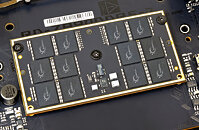
Source:
CTEE
Behind the scenes, timelines are being mapped: platform validation is slated for 2026, server deployments in 2027, and broader consumer availability thereafter. This phased rollout mirrors the DDR5 journey; however, analysts predict that DDR6's architectural leap could accelerate adoption in AI and high-performance computing environments. Of course, cutting-edge technology comes with a premium: initial DDR6 modules are expected to carry price tags reminiscent of DDR5's 2021 debut, potentially limiting early adoption to hyperscale data centers and AI research labs. Yet with HPC and AI appetite for bandwidth, memory makers are targeting launch as soon as possible to satisfy the massive deployment of compute. By 2027, CAMM2-based modules running at DDR6 speeds may well define the new standard for high-performance systems.

196 Comments on DDR6 Memory Arrives in 2027 with 8,800-17,600 MT/s Speeds
Unless motherboards only supports single channel CAMM2 modules, the current design only allows for a single module.
I guess CPU memory controllers could change and support two modules, maybe one on each side of the motherboard?
there is plenty of room without extra clock driver. Just improve the timings first.
Also the RGB potential on them is huge, I bet all the gaming brands are already counting the profits.
I hope this CAMM2 standard doesn't get established for desktop and server. It's takes up far too much space with anything more than 2 channels.
Not even the massive operational fires in cutthroat companies, just this pompous idea that engineers are obsolete and we need this hardware.
Hardware has been evolving in very weird directions for a while now. It's obvious corners are being cut to get around stumbling blocks and quotas.
I'm currently on: 2GB DDR2, 16GB DDR3, 64GB DDR4. I'm skipping DDR5.
Whatever the job, I have all the memory that I need to be productive from an entry level Ryzen, FX or Athlon.
We are users first and main small general purpose computers to get through the day. AI inference isn't a priority.
The push for bigger and faster memory at this moment in time is constant hamfisting of AI in places nobody asked.
In fact, stripping out such features is the main question that ordinary users have whenever this is all forced on them.
If CAMM2 gets adopted on server and desktop, those better be some big honkin chonkin 256GB octo-rank modules.
You want to romance adoption? Do that and fix stability.
The one saving grace on the cpu/mobo/ram side is at least the components at the mid-low end of the curve are pretty powerful in respect to software.
A used 12600k system or a 76000 (non-x) setup still slaps hard and can do everything -- great for the money whereas GPUs are completely the opposite, anything below a 4070 and you're in menus in settings to try and get things to run things smoothly.
Clock drivers help achieve higher clocks, but still doesn't allow for 2DPC at those clocks.
Workstation and server platforms uses RDIMMs, which already have clock drivers. The "replacement" for 2DPC is MRDIMM, which allows for even higher bandwidth and higher capacity.
The big disadvantage of only one DIMM per channel is that if you want to upgrade memory, you basically have to replace all of it.
And soon cases needs to be twice as large to have enough airflow on both sides…
Just because the idea isn't new, doesn't change the fact that it's a terrible idea.
It's going to be hard to get the right pressure on the "shim" that goes between the motherboard and the CAMM2 module though and it might even require the right torque, as to not damage the pins on the shim.As I said, single channel CAMM2 modules can be stacked. This will likely cause some issues though, unless it just means getting two "shims" at different heights, vs a single, wider shim for dual channel CAMM2 memory. Not sure how the mounting will work though, as the single channel setup looks like it would need additional supports.
I'm against CAMM2 on desktop, I don't see any real benefit.