News Posts matching #NVIDIA

Return to Keyword Browsing

LG's "Hybrid AI" gram Laptops Offer the Best Of Both Worlds With On-Device and Cloud AI Services

LG Electronics (LG) is set to unveil its 2025 LG gram lineup, the company's first on-device AI-powered laptops, at CES 2025 in January. The new lineup includes innovative models such as the gram Pro, gram Pro 2-in-1, gram and gram Book. Leveraging LG's gram AI technology, the latest grams deliver state-of-the-art capabilities and stellar performance, harnessing large language models and personalized AI features to elevate the user experience - all while preserving the series' iconic slim and lightweight design.

Enhancing Productivity and Personalization with LG gram AI
The 2025 gram laptops present a smarter, more secure and highly-personalized user experience through LG's innovative gram AI. With gram chat On-Device, these laptops utilize AI algorithms to process and analyze data locally without requiring a network connection. At the same time, they provide convenient access to cloud-based AI services via gram chat Cloud, powered by GPT-4o. This subscription-based service, which uses GPT-4o, is offered free of charge for the first year. The integration of on-device and cloud-based AI creates a hybrid AI solution that enhances productivity by delivering personalized insights, a comprehensive knowledge base and an intuitive, ever-evolving experience that adapts to users' needs.

LG Unveils World's First Bendable 5K2K Gaming Monitor With Dual Mode Support and DP 2.1

LG Electronics (LG) is reinforcing its leadership in premium OLED gaming monitors with the LG UltraGear GX9 series, set to be unveiled at CES 2025 this January. The new lineup includes the 45GX990A - winner of three CES 2025 Innovation Awards, including the prestigious 'Best of Innovation' - and an all-in-one smart gaming monitor powered by LG webOS. These accolades underscore LG's commitment to delivering advanced, high-quality gaming solutions. With the GX9 series, LG continues to demonstrate its leadership in cutting-edge technology and gaming monitor innovation.

To ensure maximum gaming immersion, all UltraGear GX9 series models feature curved display panels employing LG's advanced WOLED technology. These screens offer high brightness, true blacks, stunning colors and optimized curvature; a combination that brings games to life and draws users deeper into the exhilarating action of their favorite titles. Certified for low blue light emissions, the GX9 series provides a more comfortable experience, reducing eye strain during extended gaming sessions. In addition, LG's Anti-Glare & Low Reflection (AGLR) coating minimizes screen reflections and glare, making it easier for gamers to see everything that's happening on screen, even in brighter rooms.

Potential RTX 5090 and RTX 5080 Pricing in China Leaks

What we've all been waiting for, might just have appeared and what we're talking about is of course the pricing of NVIDIA's upcoming graphics cards. @wxnod has posted a single screenshot on X/Twitter of what could be the MSRP of the RTX 5090 and RTX 5080 in China. The MSRP of the RTX 4080 was 9,499 RMB and the RTX 5080 appears to be not that much higher, at 9,999 RMB, but this still equates to about US$1,370, although do note that there's 13 percent sales tax/VAT in China.

Now as for the RTX 5090, things won't be as rosy. The RTX 4090 had an MSRP of 12,999 RMB in China and the RTX 5090 comes in at an insane 18,999 RMB or US$2,600. That's a price hike of a not insignificant 46 percent over the RTX 4090 and this might make it the most expensive consumer graphics card ever released. We'd suggest taking these prices with a helping of NaCl just to be on the safe side. The cards are expected to be available some time in January according to the screenshot.

Update 15:34 UTC: A second picture was posted in the same thread on X/Twitter that shows the expected launch months of the lower-tier RTX 5000-series cards as well and it appears to be taken from a video.

NVIDIA GeForce RTX 5090 Features 16+6+7 Phase Power Delivery on 14-Layer PCB

Fresh details have surfaced about NVIDIA's upcoming flagship "Blackwell" graphics card, the GeForce RTX 5090, suggesting power delivery and board design changes compared to its predecessors. According to Benchlife, the new Blackwell-based GPU will feature a new 16+6+7 power stage design, departing from the RTX 4090's 20+3 phase configuration. The report confirms earlier speculation about the card's power requirements, indicating a TGP of 600 watts. This specification refers to the complete power allocation for the graphics subsystem, though the actual TDP of the GB202 chip might be lower. The RTX 5090 will ship with 32 GB of next-generation GDDR7 memory and utilize a 14-layer PCB, possibly due to the increased complexity of GDDR7 memory modules and power delivery. Usually, GPUs max out at 12 layers for high-end overclocking designs.

The upcoming GPU will fully embrace modern connectivity standards, featuring PCI Express 5.0 x16 interface compatibility and implementing a 12V-2×6 power connector design. We spotted an early PNY RTX 5090 model with 40 capacitors but an unclear power delivery setup. With additional power phases and more PCB layers, NVIDIA is pushing the power delivery and signal integrity boundaries for its next-generation flagship. While these specifications paint a picture of a powerful gaming and professional graphics solution, questions remain about the broader RTX 50 series lineup. The implementation of the 12V-2×6 connector across different models, particularly those below 200 W, remains unclear, so we have to wait for the CES-rumored launch.

NVIDIA and AMD Rush to Ship Next-Generation GPUs Ahead of Trump Administration Tariffs

NVIDIA and AMD have launched an acceleration of their next-generation GPU production and shipping schedules, racing to beat impending Trump administration tariffs that could inflate prices by up to 60%. The companies are prioritizing delivery to US warehouses before January 20, when the new trade measures are supposed to take effect. This aggressive timeline represents a significant departure from traditional GPU rollout strategies, which typically maintain controlled production rates during initial manufacturing phases. The urgent push aims to protect both consumer prices and profit margins, with manufacturers breaking from their usual conservative supply approach to ensure maximum inventory reaches American shores before the tariff deadline. NVIDIA is boosting shipments of its next-gen GeForce RTX 50 series, while AMD is busy with Radeon RX 9000 series.

The impact of these tariffs could reshape the GPU market prices, with flagship products like NVIDIA's GeForce RTX 5090 potentially seeing price increases from the rumored $1,799 to approximately $2,500. Following similar moves by Microsoft, Dell, and HP, this strategic rush to beat tariff implementation shows the technology sector's response to evolving trade policies. These price hikes could trigger a surge in the secondary GPU market as consumers seek more affordable options. While manufacturers work to shield customers from immediate price impacts through pre-tariff stockpiling, the long-term outlook for GPU pricing and availability remains uncertain as the industry adapts to these new trade dynamics. Increasing the prices dramatically will result in a rapid fall in demand, so the supply chain is working overtime to assess and address the potential tariff issue.

NVIDIA GeForce NOW Gets Three New Games

This GFN Thursday wraps up another incredible year for cloud gaming. Take a look back at the top games and new features that made 2024 a standout for GeForce NOW members. Enjoy it all with three new games to close the year. Remember to mark the calendar for the CES opening keynote, to be delivered by NVIDIA founder and CEO Jensen Huang on Monday, Jan. 6.

That's a Wrap
In another ultimate year of high-performance cloud gaming, GeForce NOW introduced new features for cloud gamers and reached a significant milestone by surpassing 2,000 games in its library, thanks to strong collaborations with celebrated publishers. GeForce NOW also launched new data centers in Japan and Poland this year, bringing GeForce RTX 4080-powered servers to gamers in the regions. Day Passes were introduced to offer gamers more flexible ways to access the cloud, with the ability to enjoy premium benefits of Ultimate and Performance memberships for 24 hours at a time.

NVIDIA GeForce RTX 5090 Powered by "GB202" Silicon, 512-bit GDDR7, ASIC Pictured

Here is the first picture of what is very likely the GeForce RTX 5090 "Blackwell," the successor to the RTX 4090 "Ada." The picture, its massive GPU, and layout appear to confirm the weekend's bare PCB leak. The RTX 5090 is powered by the "GB202" silicon, the largest gaming GPU based on the "Blackwell" graphics architecture. The silicon in the picture has the ASIC code "GB202-300-A1." From this ASIC code, we can deduce that the RTX 5090 may not max out the silicon (i.e. enable all SM present on it), as maxed-out NVIDIA ASICs tend to have the variant designation "450."

The "GB202" ASIC is surrounded by sixteen GDDR7 memory chips, which reportedly make the 32 GB memory size of the RTX 5090. The chip count, coupled with the large GPU package size (high pin-count), confirm that the "GB202" features a 512-bit wide memory bus. Assuming a memory speed of 28 Gbps, this memory bus should yield a stellar memory bandwidth of 1,792 GB/s. The GPU and memory are surrounded by the card's 24-phase VRM solution. This draws power from a single 16-pin 12V-2x6 power connector. NVIDIA will likely max out the 600 W continuous power-delivery capability of the connector, and give the card a TGP of around 500-550 W, if not more.

Frore Systems Unveils AirJet Cooling for NVIDIA Jetson Orin Nano Super

NVIDIA's brand new 25 Watt "little tiny Jetson Nano" - the Jetson Orin Nano Super - capable of 67 trillion operations per second (TOPS) of AI performance, is going to generate a lot of heat that could limit its performance if the device isn't supported by adequate cooling. Thanks to the high AI performance of the Jetson Orin Nano Super, breakthrough AI models such as NVIDIA Isaac for robotics, NVIDIA Metropolis for vision AI, and NVIDIA Holoscan for sensor processing, NVIDIA Omniverse Replicator for synthetic data generation (SDG) and NVIDIA TAO Toolkit for fine-tuning pretrained AI models may now run at the Edge, delivering compute efficiency, reduced latency and data privacy. But without adequate heat dissipation, the Jetson Orin Nano Super will be forced to throttle, significantly reducing its performance and diminishing the capabilities of Edge AI applications supported including robotics, industrial automation, smart cities, healthcare, and retail analytics.

AirJet PAK 5C-25 from Frore Systems, can provide the full 25 Watts of cooling NVIDIA's Jetson Orin Nano Super needs. The AirJet PAK 5C-25 is a fully self-contained, autonomous, plug and play, solid-state active cooling thermal module, that is thin, silent, dustproof, water resistant, and enables the full performance of the Jetson Nano Super, even in the toughest operating conditions. The AirJet PAK 5C-25 can be combined with the Jetson Orin Nano Super to remove 25 Watts of heat, even in industrial grade casings that are ultra compact, silent, vibration free, dustproof and water-resistant. These industrial grade casings, enabled by the AirJet PAK, are massively smaller and lighter than comparable fanless casings that require large, heavy heat sinks to dissipate heat.

NVIDIA GeForce RTX 5070 and RTX 5070 Ti Final Specifications Seemingly Confirmed

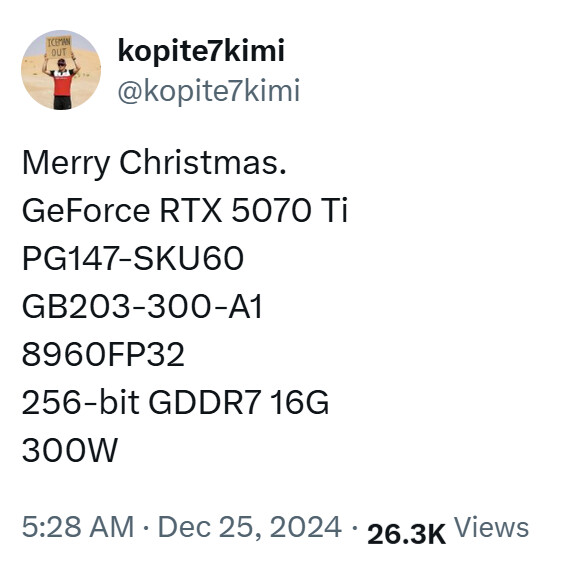
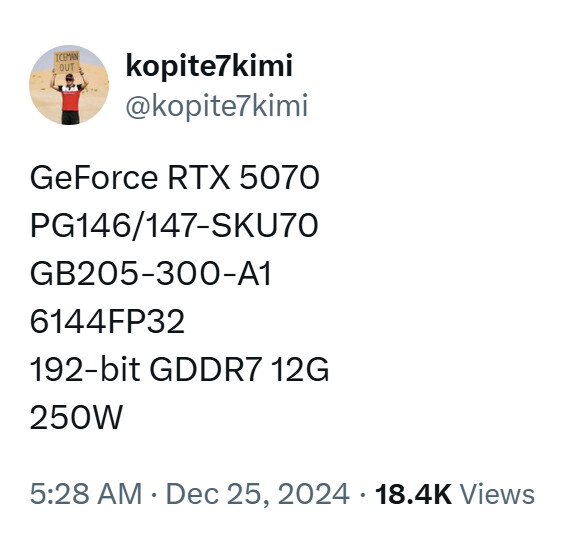
Thanks to kopite7kimi, we are able to finalize the leaked specifications of NVIDIA's upcoming GeForce RTX 5070 and RTX 5070 Ti graphics cards.
Starting off with RTX 5070 Ti, it will feature 8,960 CUDA cores and come equipped with 16 GB GDDR7 memory on a 256-bit memory bus, offering 896 GB/s bandwidth. The card is reportedly designed with a total board power (TBP) of 300 W. The Ti variant appears to use the PG147-SKU60 board design with a GB203-300-A1 GPU. The standard RTX 5070 is positioned as a more power-efficient option, with specifications pointing to 6,144 CUDA cores and 12 GB of GDDR7 memory on a 192-bit bus, with 627 GB/s memory bandwidth. This model is expected to operate at a slightly lower 250 W TBP.

Interestingly, the non-Ti RTX 5070 card will be available in two board variants, PG146 and PG147, both utilizing the GB205-300-A1 GPU. While we don't know what the pricing structure looks like, we see that NVIDIA has chosen to make more considerable differentiating factors between its SKUs. The Ti variant not only gets an extra four GB of GDDR7 memory, but it also gets a whopping 45% increase in CUDA core count, going from 6,144 to 8,960 cores. While we wait for the CES to see the initial wave of GeForce RTX 50 series cards, the GeForce RTX 5070 and RTX 5070 Ti are expected to arrive later, possibly after RTX 5080 and RTX 5090 GPUs.

NVIDIA GeForce RTX 5090 PCB Pictured, Massive GPU Die and 16-Chip Memory Configuration

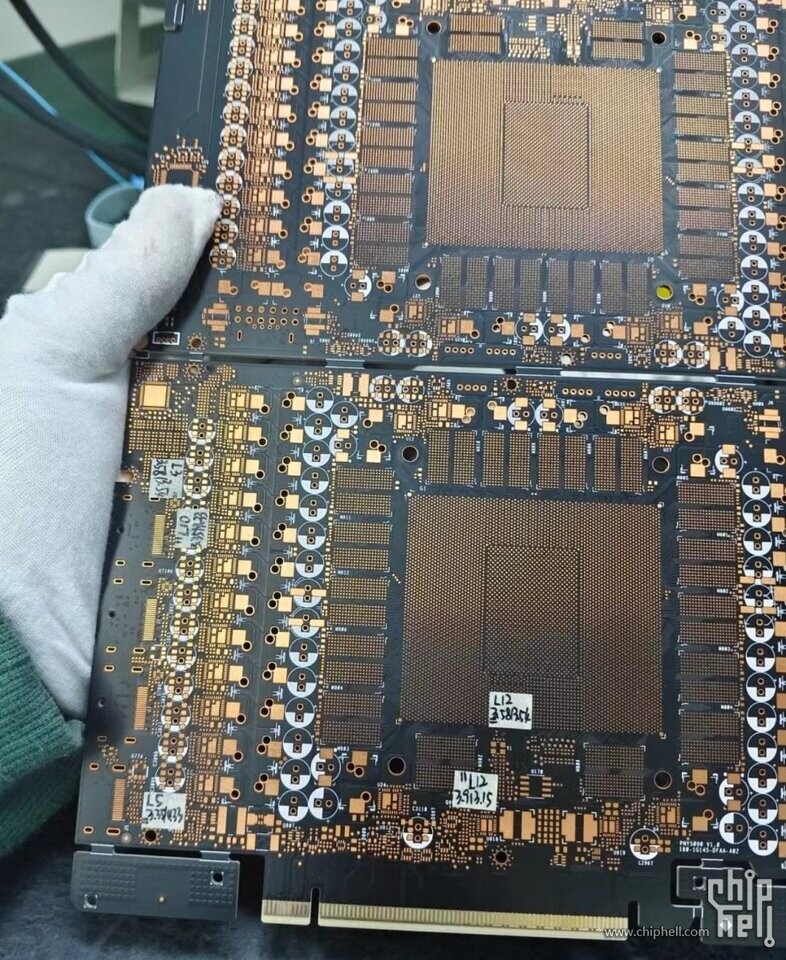
NVIDIA's GeForce RTX 5090 graphics card printed circuit board has allegedly been shown in the flesh, showing the memory layout and some interesting engineering choices. The custom PCB variant (non-Founders Edition) houses more than 40 capacitors, which is perhaps not standard on the FE reference board, and 16 GDDR7 memory modules. The leaked PCB, which extends beyond standard dimensions and traditional display connector configurations, is reportedly based on NVIDIA's PG145 reference design. The memory modules are distributed systematically: five on the left, two below, five on the right, and four above the GPU die. The interface is PCIe 5.0 x16.

As NVIDIA has reportedly designated 32 GB GDDR7 memory capacity for these cards, this roughly translates into 16 x 2 GB GDDR7 memory modules. At the heart of the card lies what sources claim to be the GB202 GPU, measuring 24×31 mm within a 63×56 mm package. Power delivery uses a 16-pin 12V-6x2 power connector, as expected. The entire PCB features only a single power connector, so the 16-pin 12V-2x6, but with an updated PCIe 6.0 CEM specification, is the logical choice.

Alleged GALAX GeForce RTX 5080 "Blackwell" Box-art Drops Big Clue About Neural Rendering

The box-art of upcoming GALAX GeForce RTX 5080 "Blackwell" graphics card has much to say about the graphics architecture, without dropping any explicit mentions. The front-face of the box features a hooded human face—nothing fancy, until you begin to pay attention to the details. Half the face is composed of triangles streaming toward the face, while the other half is composed in place by a blue stream of light, as if to denote that it's being drawn by a fundamentally different method than "triangles."

The triangles here represent classic raster 3D graphics, while the other spirit-like half denotes neural rendering. Here's where it gets interesting. Both kinds of rendering are being applied to the same frame, and so neural rendering is fundamentally different from DLSS 3 Frame Generation, a technology that draws alternate frames using optical flow, motion vectors, and AI. Neural rendering appears to be, at least from this GALAX box-art, a technology that runs in real-time, where some elements, portions, or details of a frame are rendered by a generative AI, and others by raster 3D graphics.

NVIDIA App Gets v11.0.1 Update, Disables Game Filters by Default

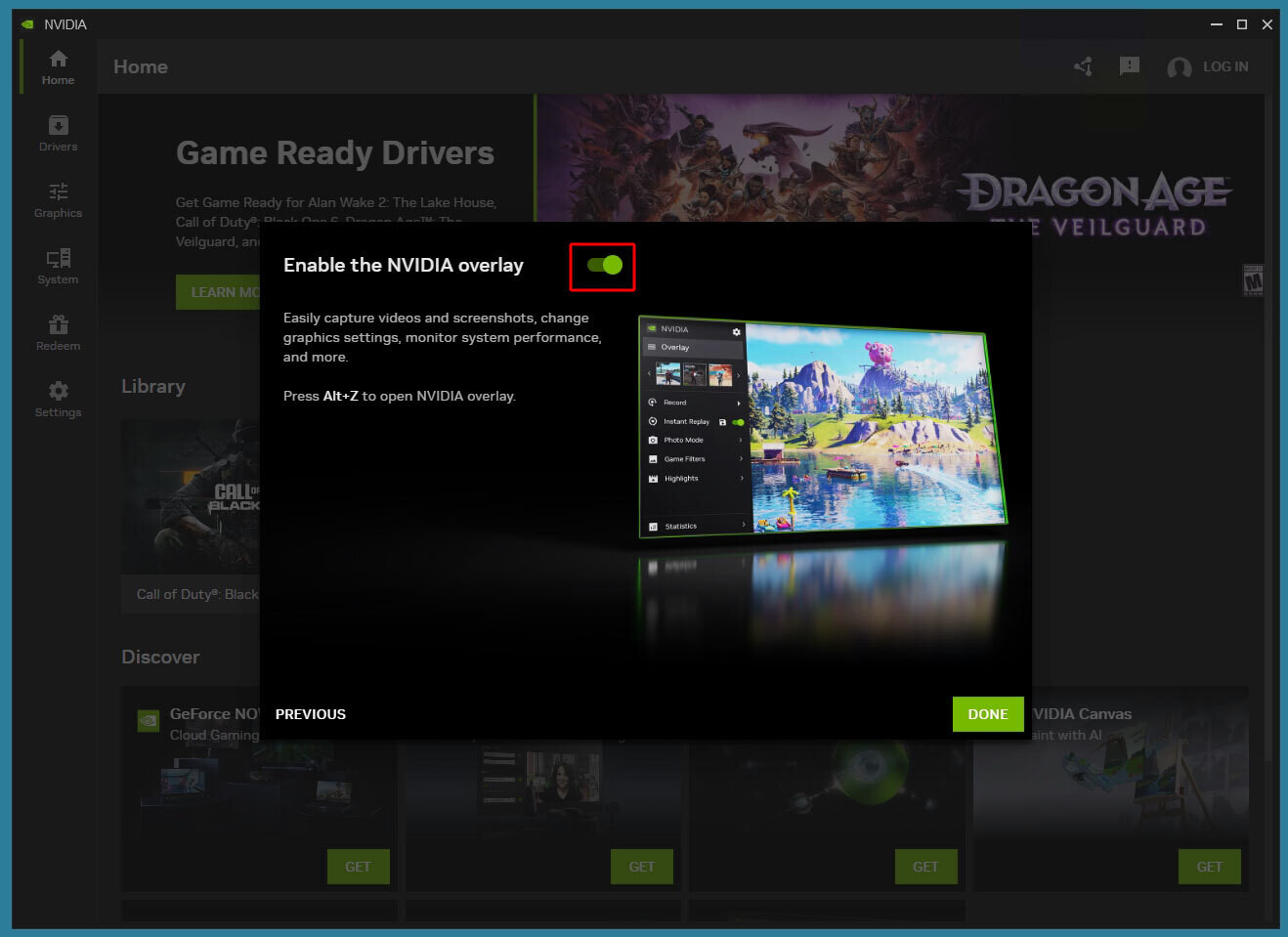
NVIDIA has released the newest v11.0.1 update for its NVIDIA App, and according to the release notes, it comes with a single new update that disables Game Filter by default. Previously, NVIDIA has released an official statement looking into reported performance issues related to Game Filter options in the NVIDIA App.

The NVIDIA app comes as a replacement for GeForce Experience software, which went out of the beta phase and became the default NVIDIA software application since the GeForce 566.33 driver update. Before the update, users were left with an option to manually disable Game Filter options in Settings > Features > Overlay > Game Filters and Photo Mode. Now, users are left with an option to manually enable the option in the same settings menu.

NVIDIA Releases GeForce Hotfix Driver Version 566.45 WHQL

NVIDIA has released a new hotfix driver version 566.45 WHQL, built upon the recent Game Ready Driver 566.36. This targeted update addresses specific issues affecting gaming performance and stability. The hotfix primarily focuses on resolving micro-stuttering issues reported by players in Indiana Jones and the Great Circle, along with improving overall stability for Ubisoft titles running on the Snowdrop engine.

The previous driver release brought optimizations for S.T.A.L.K.E.R 2: Heart of Chornobyl and Microsoft Flight Simulator 2024, including DLSS 3 support. It also expanded GeForce Experience optimal settings for several titles including Call of Duty: Black Ops 6, Delta Force, Dragon Age: The Veilguard, Horizon Zero Dawn Remastered, and Red Dead Redemption. With this latest hotfix update, NVIDIA has managed to iron out stability issues. However, there are no words about the overlay feature that reportedly brought 15% performance reduction while using NVIDIA App. While we don't host hotfix drivers, you can grab it from NVIDIA here.

AMD's Pain Point is ROCm Software, NVIDIA's CUDA Software is Still Superior for AI Development: Report

The battle of AI acceleration in the data center is, as most readers are aware, insanely competitive, with NVIDIA offering a top-tier software stack. However, AMD has tried in recent years to capture a part of the revenue that hyperscalers and OEMs are willing to spend with its Instinct MI300X accelerator lineup for AI and HPC. Despite having decent hardware, the company is not close to bridging the gap software-wise with its competitor, NVIDIA. According to the latest report from SemiAnalysis, a research and consultancy firm, they have run a five-month experiment using Instinct MI300X for training and benchmark runs. And the findings were surprising: even with better hardware, AMD's software stack, including ROCm, has massively degraded AMD's performance.

"When comparing NVIDIA's GPUs to AMD's MI300X, we found that the potential on paper advantage of the MI300X was not realized due to a lack within AMD public release software stack and the lack of testing from AMD," noted SemiAnalysis, breaking down arguments in the report further, adding that "AMD's software experience is riddled with bugs rendering out of the box training with AMD is impossible. We were hopeful that AMD could emerge as a strong competitor to NVIDIA in training workloads, but, as of today, this is unfortunately not the case. The CUDA moat has yet to be crossed by AMD due to AMD's weaker-than-expected software Quality Assurance (QA) culture and its challenging out-of-the-box experience."

NVIDIA GB300 "Blackwell Ultra" Will Feature 288 GB HBM3E Memory, 1400 W TDP

NVIDIA "Blackwell" series is barely out with B100, B200, and GB200 chips shipping to OEMs and hyperscalers, but the company is already setting in its upgraded "Blackwell Ultra" plans with its upcoming GB300 AI server. According to UDN, the next generation NVIDIA system will be powered by the B300 GPU chip, operating at 1400 W and delivering a remarkable 1.5x improvement in FP4 performance per card compared to its B200 predecessor. One of the most notable upgrades is the memory configuration, with each GPU now sporting 288 GB of HBM3e memory, a substantial increase from the previous 192 GB of GB200. The new design implements a 12-layer stack architecture, advancing from the GB200's 8-layer configuration. The system's cooling infrastructure has been completely reimagined, incorporating advanced water cooling plates and enhanced quick disconnects in the liquid cooling system.

Networking capabilities have also seen a substantial upgrade, with the implementation of ConnectX 8 network cards replacing the previous ConnectX 7 generation, while optical modules have been upgraded from 800G to 1.6T, ensuring faster data transmission. Regarding power management and reliability, the GB300 NVL72 cabinet will standardize capacitor tray implementation, with an optional Battery Backup Unit (BBU) system. Each BBU module costs approximately $300 to manufacture, with a complete GB300 system's BBU configuration totaling around $1,500. The system's supercapacitor requirements are equally substantial, with each NVL72 rack requiring over 300 units, priced between $20-25 per unit during production due to its high-power nature. The GB300, carrying Grace CPU and Blackwell Ultra GPU, also introduces the implementation of LPCAMM on its computing boards, indicating that the LPCAMM memory standard is about to take over servers, not just laptops and desktops. We have to wait for the official launch before seeing LPCAMM memory configurations.

ASUS Reveals the V16 Gaming Laptop

Today marks the debut of the brand-new ASUS V16 (V3607), an entry-level 16-inch gaming laptop that broadens the appeal of the innovative ASUS laptop portfolio. Featuring futuristic uber-cool design details and unparalleled performance from its up to Intel Core 7 processor and NVIDIA GeForce RTX 40 Series Laptop GPU, ASUS V16 is built to win—or create—in distinctive style.

Its fast 16-inch 16:10 144 Hz FHD IPS display, with an impressive 89% screen-to-body ratio, ensures fluid gaming visuals, while Dirac audio technology and ASUS Audio Booster provide powerful and immersive sound. Offering an outstanding user experience, the laptop also includes a large touchpad and a comfortable ASUS ErgoSense keyboard, along with AI noise-cancelation technology and 3DNR for enhanced video conferencing.

ASUS Teases Next-generation RTX 50-powered Gaming Laptops For CES 2025

Last week, we reported on a massive leak that gave us a glimpse at a surfeit of upcoming ROG gaming laptops from ASUS boasting Arrow Lake-HX and Strix Halo processors, along with RTX 50-series Laptop GPUs. The company has now gone ahead and officially teased its ROG Flow Z13 laptop and the ROG Strix 18 laptop, the videos for which were obtained by VideoCardz. Considering that these were just teasers, the details shared were sparse, but undoubtedly intriguing regardless.

The ROG Strix 18, will likely boast the Core Ultra 9 285HX and Core Ultra 9 275HX CPUs along with NVIDIA "Blackwell" Laptop GPUs, with up to an 175-watt RTX 5090 Laptop with 16 GB of GDDR7 VRAM. Multiple other GPU options will also be available, with the RTX 5070 Ti Laptop GPU being the entry-point as per the leaked listings. Clearly, the Strix 18 is poised to be a powerful and power-hungry desktop replacement-class laptop, along with a massive 18-inch mini LED screen with a speedy 240 Hz refresh rate. Needless to say, the G18 has no intention of being affordable.

NVIDIA RTX 5080 Laptop GPU Might Be Up to 60% Faster Than RTX 4080 Laptop

Moore's Law is Dead, a prominent YouTube channel specializing in computer hardware leaks, has revealed its expectations for the RTX 50-series Laptop GPUs. We have already reported on a massive product listing leak shedding light on almost every single "Blackwell" laptop GPU, but needless to say, more information is always welcome. According to Moore's Law is Dead, the RTX 5090 Laptop GPU, and this has been hinted at by the aforementioned prior leak, will only sport 16 GB of GDDR7 VRAM - the same as the RTX 5080 Laptop.

Moreover, his sources indicate that the RTX 5080 will drop with a 175-watt TGP and 7,680 CUDA cores, which is shockingly only a hair more than the 7,424 found in its predecessor. However, the source did state that the RTX 5080 will be around 40 to 60% faster than the RTX 4080, which is a massive generational leap in performance. It is not clear at this point how this number was arrived at, but it sure does seem rather utopian. Yet another source has also indicated that an RTX 5090 Laptop card with a whopping 24 GB of VRAM is also in the works which might launch down the line, but there is little else to be said about it. As MLID notes, NVIDIA has very little to no competition in the high-end laptop segment, which inevitably makes things worse for the end-user.

NVIDIA GeForce NOW Gets NieR:Automata, NieR Replicant, and More Games

Stuck in a gaming rut? Get out of the loop this GFN Thursday with four new games joining the GeForce NOW library of over 2,000 supported games. Dive into Square Enix's mind-bending action role-playing games (RPGs) NieR:Automata and NieR Replicant ver.1.22474487139…, now streaming in the cloud. Plus, explore HoYoverse's Zenless Zone Zero for an adrenaline-packed adventure, just in time for its 1.4 update.

Check out GeForce Greats, which offers a look back at the biggest and best moments of PC gaming, from the launch of the GeForce 256 graphics card to the modern era. Follow the GeForce, GeForce NOW, NVIDIA Studio and NVIDIA AI PC channels on X, as well as #GeForceGreats, to join in on the nostalgic journey. Plus, participate in the GeForce LAN Missions from the cloud with GeForce NOW starting on Saturday, Jan. 4, for a chance to win in-game rewards, first come, first served. GeForce NOW members will also be able to launch a virtual stadium for a front-row seat to the CES opening keynote, to be delivered by NVIDIA founder and CEO Jensen Huang on Monday, Jan. 6. Stay tuned to GFN Thursday for more details.

Microsoft Acquired Nearly 500,000 NVIDIA "Hopper" GPUs This Year

Microsoft is heavily investing in enabling its company and cloud infrastructure to support the massive AI expansion. The Redmond giant has acquired nearly half a million of the NVIDIA "Hopper" family of GPUs to support this effort. According to market research company Omdia, Microsoft was the biggest hyperscaler, with data center CapEx and GPU expenditure reaching a record high. The company acquired precisely 485,000 NVIDIA "Hopper" GPUs, including H100, H200, and H20, resulting in more than $30 billion spent on servers alone. To put things into perspective, this is about double that of the next-biggest GPU purchaser, Chinese ByteDance, who acquired about 230,000 sanction-abiding H800 GPUs and regular H100s sources from third parties.

Regarding US-based companies, the only ones that have come close to the GPU acquisition rate are Meta, Tesla/xAI, Amazon, and Google. They have acquired around 200,000 GPUs on average while significantly boosting their in-house chip design efforts. "NVIDIA GPUs claimed a tremendously high share of the server capex," Vlad Galabov, director of cloud and data center research at Omdia, noted, adding, "We're close to the peak." Hyperscalers like Amazon, Google, and Meta have been working on their custom solutions for AI training and inference. For example, Google has its TPU, Amazon has its Trainium and Inferentia chips, and Meta has its MTIA. Hyperscalers are eager to develop their in-house solutions, but NVIDIA's grip on the software stack paired with timely product updates seems hard to break. The latest "Blackwell" chips are projected to get even bigger orders, so only the sky (and the local power plant) is the limit.

YEYIAN Gaming to Showcase Groundbreaking Gaming PCs, Monitors, Desks, and Accessories at CES 2025

YEYIAN Gaming, a trailblazing leader in high-performance gaming desktop PCs, computer hardware, and accessories, is thrilled to announce its participation at CES 2025, which will take place from January 7 to 10, 2025, at The Venetian Resort in Las Vegas. YEYIAN GAMING will present an impressive lineup of cutting-edge gaming products, including next-generation gaming PCs, high-performance 40-inch curved monitors, advanced mechanical keyboards, and innovative gaming accessories crafted to inspire gamers and creators alike. Visitors, media, influencers, and content creators are invited to experience YEYIAN GAMING's latest innovations firsthand. The showcase, open from 9:00 AM to 5:00 PM, provides an exclusive opportunity to explore next-level hardware engineered for exceptional performance, bold designs, and unmatched versatility.

At CES 2025, YEYIAN Gaming will unveil an exciting array of new products tailored for professional gamers, streamers, and PC enthusiasts. Here's a detailed preview of the lineup:

Indiana Jones and the Great Circle Gets New Patch 2 Update

Bethesda has released the big Update 2 for Indiana Jones and the Great Circle game with additional fixes, including the big fix where the Game Slot appears damaged or completely missing, as this issue was apparently plaguing many users. Update 2 also reduces stutter from duplicated frames during cutscenes, as well as fixes to prevent "double vision" getting stuck on screen when Indy has almost drowned.

There are also several PC specific fixes including the one for where NVIDIA Frame Generation wasn't activated properly with HDR, a fix for NVIDIA Low Latency Mode performance issues when used with Frame Generation, a fix for global illumination being completely disabled on graphics cards below minimum VRAM requirement, issues with Lighting when Path Tracing is set to Medium or High Quality, and more. The Update 2 should also fix major performance issues when NVIDIA DLSS is enabled. There are several gameplay fixes which you can check out below. All of these NVIDIA-specific issues are still somewhat present and some users over at Reddit are still experiencing issues. Some users are reporting several workarounds, including a clean installation of drivers, or enabling and disabling Frame Generation, DLSS, HDR, and other settings.

Acer Leaks GeForce RTX 5090 and RTX 5080 GPU, Memory Sizes Confirmed

Acer has jumped the gun and listed its ACER Predator Orion 7000 systems with the upcoming NVIDIA RTX 50 series graphics cards, namely the GeForce RTX 5080 and the GeForce RTX 5090. In addition, the listing confirms that the GeForce RTX 5080 will come with 16 GB of GDDR7 memory, while the GeForce RTX 5090 will get 32 GB of GDDR7 memory.

The ACER Predator Orion 7000 gaming PC was announced back in September, together with Intel's Core Ultra 200 series, and it does not come as a surprise that this high-end pre-built system will now be getting NVIDIA's new GeForce RTX 50 series graphics cards. In case you missed previous rumors, the GeForce RTX 5080 is expected to use the GB203-400 GPU with 10,752 CUDA cores, and come with 16 GB of GDDR7 memory on a 256-bit memory interface. The GeForce RTX 5090, on the other hand, gets the GB202-300 GPU with 21,760 CUDA cores and packs 32 GB of GDDR7 memory.

NVIDIA DLSS Comes to EVE Frontier, PANICORE, Ready or Not, and More Games

More than 600 games and applications feature RTX technologies, and each week new games integrating NVIDIA DLSS, NVIDIA Reflex and advanced ray-traced effects are released or announced, delivering the definitive PC experience for GeForce RTX players. This week, jump back into Night City for Cyberpunk 2077's latest Update 2.2, featuring Full Ray Tracing and NVIDIA DLSS 3.5. Additionally, EVE Frontier and PANICORE are available now with DLSS 3, and Hitman World of Assassination and Ready or Not drop new DLCs.

Cyberpunk 2077, Featuring DLSS 3.5 & Full Ray Tracing, Launches Update 2.2
There's always something new to discover in Night City, and developer CD PROJEKT RED, has even more goodies in store for Cyberpunk 2077. Available now in Update 2.2, game owners have a bunch of new content to enjoy, including new open world missions and customization options. Cyberpunk 2077 features DLSS 3.5 with Ray Reconstruction, Frame Generation, and Super Resolution, and includes Full Ray Tracing via the Ray Tracing: Overdrive Mode, enabling GeForce RTX 40 Series gamers to crank up their settings for incredible performance and image quality.

NVIDIA App Allegedly Degrades Gaming Performance by Up to 15%, But There Is a Fix

Recent testing has revealed that latest NVIDIA App v1.0 software utility may significantly impact gaming performance, with benchmarks from Tom's Hardware showing frame rate drops of up to 15% in certain games when the new NVIDIA App is installed alongside graphics drivers. The performance issues appear to be linked to the application's overlay features, particularly its game filters and photo mode capabilities, which seem to affect system resources regardless of whether users actively engage with them. Gamers primarily interested in the app's video capture and optimization features can restore regular performance levels by disabling these problematic overlay functions. In the meantime, NVIDIA issued the following statement on its GeForce forums in the "Game Filters and Performance in NVIDIA App" thread:
NVIDIA Official StatementWe are aware of a reported performance issue related to Game Filters and are actively looking into it. You can turn off Game Filters from the NVIDIA App Settings > Features > Overlay > Game Filters and Photo Mode, and then relaunch your game.
Return to Keyword Browsing
Nov 27th, 2026 19:09 CST change timezone

New Forum Posts

Popular Reviews

TPU on YouTube

Controversial News Posts