News Posts matching #NVMe

Return to Keyword Browsing

Silicon Power Intros P34M85 M.2 NVMe SSD

Silicon Power today introduced the P34M85 solid-state drive. Built in the M.2-2280 form-factor, this drive features PCI-Express 3.0 x4 interface, and takes advantage of the NVMe 1.2 protocol. The company didn't drop any hints as to what combination of controller and NAND flash is under its heatspreader. It comes in capacities of 240 GB, 480 GB, and 960 GB. It could be DRAM-less, given its HMB (host memory buffer) support, wherein the drive uses a small portion of your system memory. The P34M85 offers sequential transfer rates of up to 2,700 MB/s reads, with up to 1,400 MB/s writes. The drive is backed by a 5-year warranty. The company didn't reveal pricing.

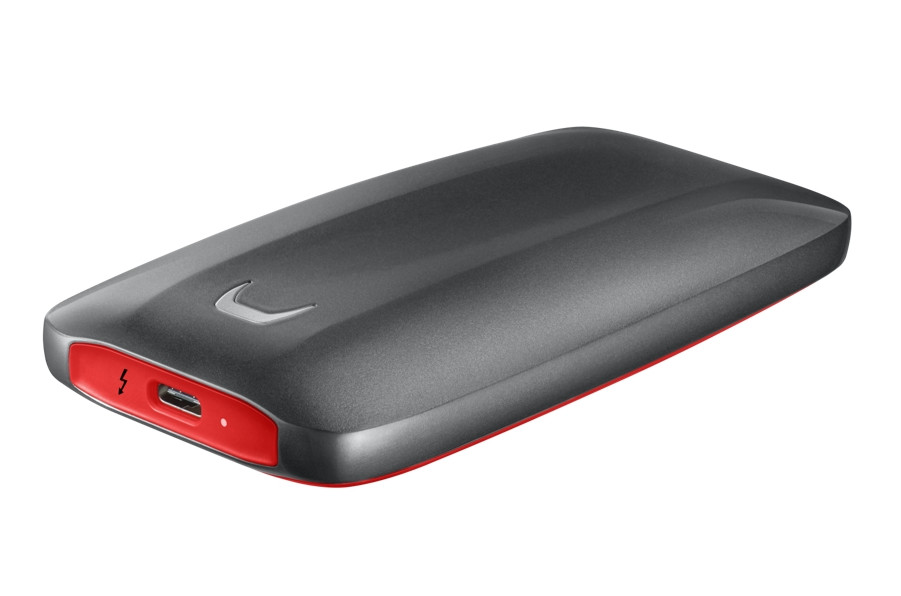
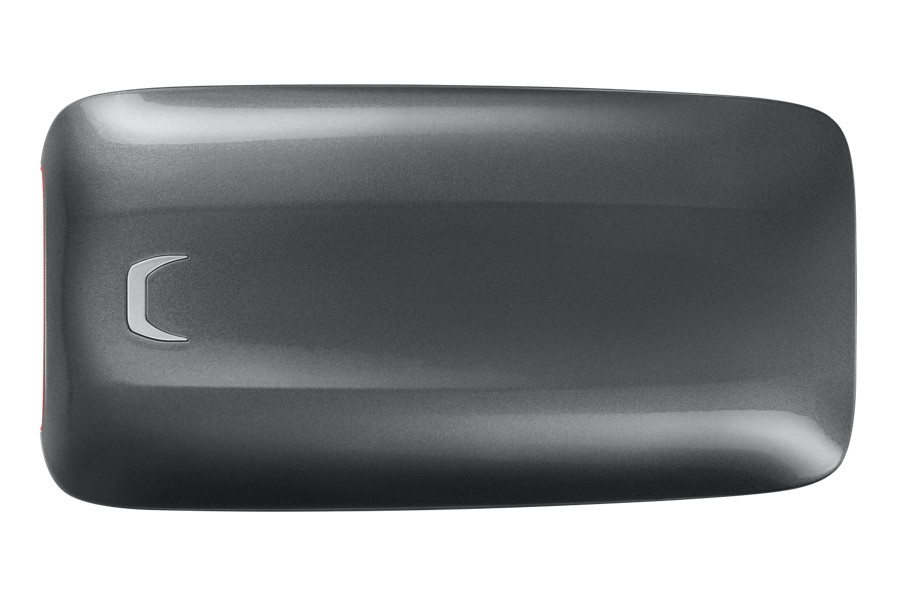
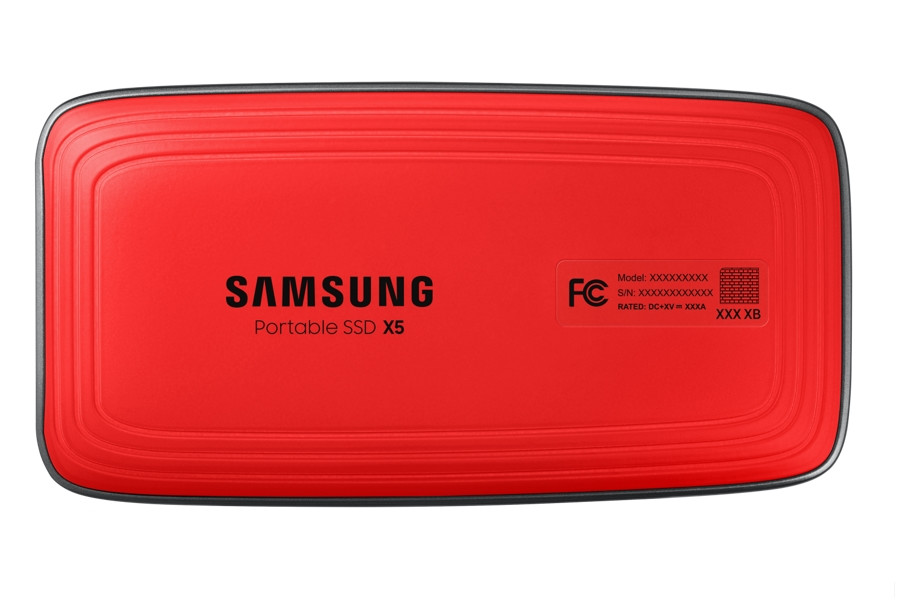
Samsung Announces Portable SSD X5

Samsung Electronics today unveiled its first NVMe-based portable solid state drive (SSD) - the Samsung Portable SSD X5 - achieving new levels of performance and reliability for external storage solutions. Based on the cutting-edge Thunderbolt 3 technology, the new X5 features exceptional speeds in a compact and durable form factor, making it an ideal portable storage for content creators and IT professionals on the go.

"As a leader in high-performance and reliable storage solutions, we are thrilled to continue to advance the external SSD market with the introduction of our first Thunderbolt 3 portable SSD," said Dr. Mike Mang, vice president of Brand Product Marketing, Memory Business at Samsung Electronics. "The X5 is yet another testament to Samsung's commitment to providing innovative portable storage solutions that enable faster transfer of large data files, saving users' valuable time."

ADATA Launches XPG SX6000 Pro PCIe Gen3x4 M.2- 2280 SSDs

ADATA Technology, a leading manufacturer of high-performance DRAM modules and NAND Flash products, today announces the launch of XPG SX6000 Pro PCIe Gen3x4 M.2 2280 SSDs. With NVMe 1.3 technology and 3D NAND Flash, they sport excellent speeds and up to 1TB of capacity, making them a viable alternative to SATA SSDs. In addition, SX6000 Pro SSDs are slimmer than standard M.2 2280 SSDs for a higher level of compatibility thanks to a single-sided design.

ADATA produces the SX6000 Pro in 256GB, 512GB, and 1TB. For PC users looking at tangible performance enhancements, the SX6000 Pro makes complete sense as a SATA successor. The principal advantage of the SX6000 Pro is embodied in its superb cost-performance ratio. Using 3D TLC NAND, NVMe 1.3 technology, and a PCIe Gen3x4 interface, it reaches up to 2100 MB/s read and 1500 MB/s write and random performance of up to 250K/240K IOPS. This means up to four times the speed of typical SATA SSDs.

Lite-On Unveils Powerful New SSD for Enterprise Workloads

At the Flash Memory Summit (FMS) 2018, LITE-ON Storage previewed the first EDSFF 1U solid-state drive (SSD) to emerge from its work with CNEX Labs. The revolutionary drive gained great interest among storage advocates.

In collaboration with such partners, LITE-ON delivers an innovative and highly efficient storage solution for scalable computing that aligns to Open Compute Project (OCP) specifications. The resulting EDSFF (Enterprise and Datacenter SSD Form Factor) SSD will provide a more cost-effective solution for enterprise and hyperscale cloud environments.

"Standard SSD solutions are great at handling many typical business workloads, but the complexity of storing information in both cloud and data center infrastructure requires SSD firmware to be flexible and adaptable," said Charlie Tseng, CEO of LITE-ON Storage. "LITE-ON's expertise in SSD firmware is perfect for the varying needs of customers."

Shuttle Announces Compact 11.6-inch AIO PC with Multi-touch Display

All-in-one PCs with a touchscreen are clever: They take up a minimum of space, avoid cable clutter, are quick to set up and, as a result, are comparatively mobile. The 15.6" fanless "X50" models have proven this for many years. Shuttle's range of models is now being expanded to include another fanless, but considerably smaller, 11.6" (29.5 cm) version.

Wherever larger all-in-one PCs are out of place, the XPC all-in-one P20U is right at home. Its external dimensions are just 29.9 x 27.1 x 5.0 cm (D x W x H). If tidied cable routing can be dispensed with, the height can be reduced by an additional 6.8 cm by removing the cable collector box on the bottom of the unit which is new with this model.

MSI Announces the MEG X399 Creation Motherboard

MSI today announced the MEG X399 Creation, its flagship socket TR4 motherboard, with out of the box support for 2nd generation AMD Ryzen Threadripper 2000 processors. The company showed off this board at the 2018 Computex, held this June. Although built in the ATX form-factor, this board is recommended only for EATX-capable cases. The highlight of this board is its gargantuan 19-phase CPU VRM that's optimized for overclocking event the 32-core Threadripper 2990WX. The board draws power from a combination of 24-pin ATX, two 8-pin EPS, and an optional 4-pin Molex. Heat drawn from the CPU VRM MOSFETS is dissipated not just by a large heatsink that spans almost the entire width of the board, but also a secondary heatsink cooling the SoC phases, via a heat-pipe. The huge chipset heatsink cools not just the X399 chipset, but also three M.2-NVMe slots (two M.2-22110 and one M.2-2280). You get 4 more M.2-2280 slots over the new M.2-Xpander Aero, which is a PCI-Express 3.0 x16 riser card that converts the slot to four M.2-2280 slots with x4 wiring, ventilating them with a 100 mm fan. It ends up looking like a graphics card in doing so.

Expansion includes eight DDR4 DIMM slots supporting up to 2048 GB of DDR4 ECC memory; four PCI-Express 3.0 x16 slots (full-time x16/x8/x16/x4), and an x1. Storage connectivity includes 7 M.2-NVMe slots (3 onboard, 4 via the included M.2-Xpander Aero accessory); and eight SATA 6 Gbps ports. Connectivity includes MSI's highest-grade onboard audio solution combining an ALC1220 with a headphones amplifier, and audio-grade capacitors; and two 1 GbE interfaces driven by Intel i219-V controllers (10 GbE is a notable absentee); and 802.11ac + BT 5.0 WLAN. You get 10 USB 3.1 ports on the rear panel (including a type-C port), and four USB 3.1 ports via front-panel headers). RGB LED diffusers dot the rear I/O shroud, the chipset heatsink, and the reverse side of the PCB. The board is expected to be priced around $500.

Marvell Introduces Industry's First NVMe-over-Fabric SSD Converter Controller

Marvell today announced the industry's first NVMe over Fabric (NVMe-oF) SSD converter controller, the 88SN2400 designed and optimized to convert an NVMe SSD into an NVMe-oF SSD.

By bringing low latency access over the fabric and exposing the entire SSD bandwidth to the network, the Marvell controller supports true scalable, high-performance disaggregation of storage from compute. The 88SN2400 utilizes a simple, low-power and compute-less Ethernet fabric instead of a traditional PCIe fabric controlled and managed by an enterprise-class server SoC with integrated 100GE controllers.

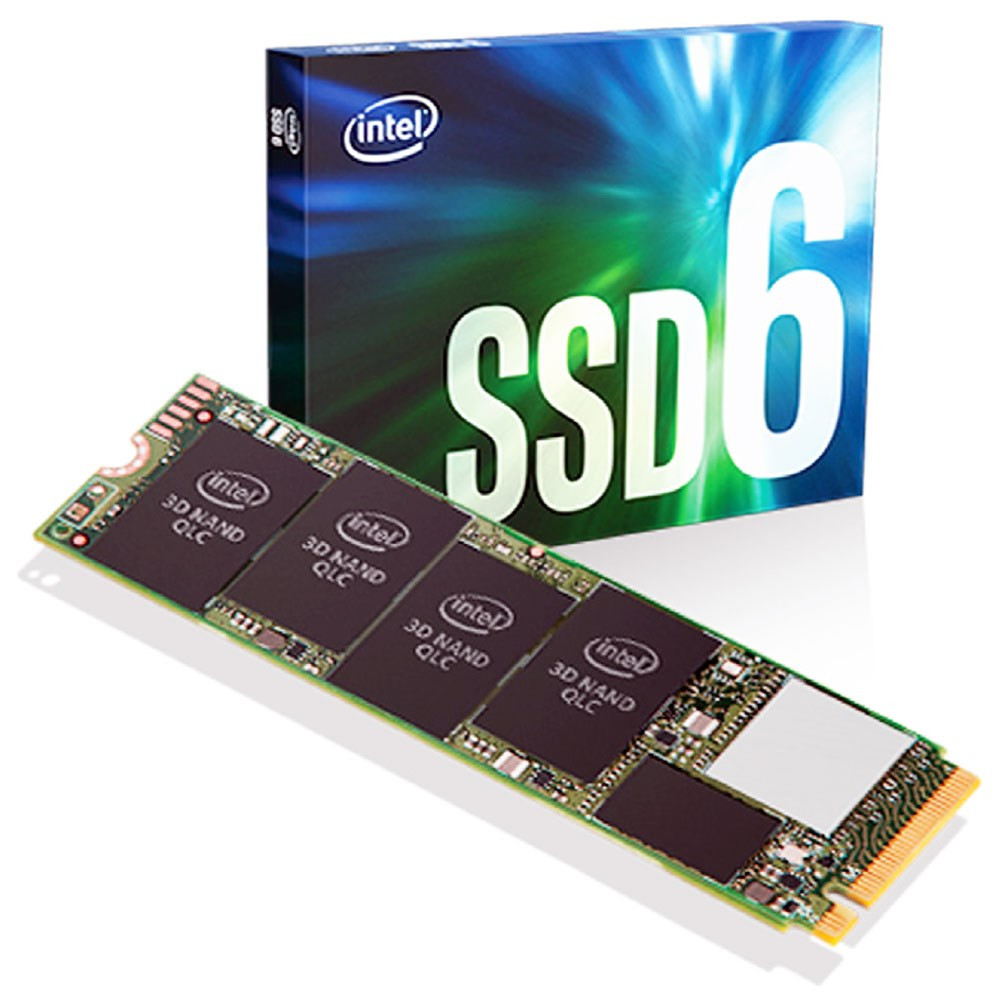
Intel Intros 660p Series M.2 NVMe SSDs with QLC NAND Flash

Intel Tuesday introduced the new SSD 660p series M.2 NVMe solid state drives. At the heart of these drives is the new 64-layer 3D QLC (quadruple level cell, or 4 bits per cell) NAND flash memory by IMFlash Technology (an Intel and Micron joint-venture). This memory is mated with a SIlicon Motion SMI 2263 controller. This chip is a derivative of the popular SMI2262EN, built on a newer process, with support for QLC NAND flash, compacted to have a smaller PCB footprint, and is driven by a custom firmware by Intel. The drives use over 10% of the QLC NAND flash area as SLC cache. The 660p series comes in three variants based on size - 512 GB, 1 TB, and 2 TB. The prices are the biggest dividend of QLC: the 512 GB variant goes for USD $99.99, the 1 TB variant at $199.99, and the 2 TB variant for $399.99.

Built in the M.2-2280 form-factor, the SSD 660p series drives feature PCI-Express 3.0 x4 interface. Intel's pricing puts these drives close to competing drives with PCIe x2 interface, but offering higher transfer rates thanks to the wider bus. It's also interesting to note here that the controller is cushioned by a DRAM cache (something PCIe x2 drives tend to lack, to keep costs down). Performance numbers differ by variant, and the 512 GB drive is the slowest, sequentially reading at speeds of up to 1500 MB/s, with up to 1000 MB/s sequential writes; up to 90,000 4K random reads, and up to 220,000 IOPS 4K random writes. The 1 TB and 2 TB variants both sequentially read and write at up to 1800 MB/s. The 1 TB variant offers 150,000 IOPS 4K random reads, and up to 220,000 IOPS random writes; while the 2 TB variant has 4K random reads/writes numbers of 220,000 IOPS.

Shuttle Announces 1.3-litre PC for 8th-gen Intel Core processors

Following the launch of the first XPC cube for Intel's latest processor generation, now the product family of XPC slim Mini-PCs in a 1.3-litre format welcomes a new member. Based on the Intel H310 chipset from which it also derives its name, the XPC Barebone DH310 supports Intel Core processors of the "Coffee Lake" generation with a TDP of up to 65 Watt. This even includes the versions with 6 cores and 12 threads. Reflecting this, two SO-DIMM slots permit the installation of 32 GB of DDR4 memory modules.

For the first time in this range, it is possible to support two monitors in 4K resolution with 60 Hz. For this purpose, an HDMI 2.0 and a DisplayPort 1.2 connector are available in each case. If required, despite the highly modern features, an analogue VGA connector can also be routed from the mainboard to the back of the device. Two of the three connectors can be used at the same time.

QLC NAND Flash Based Intel SSD 660p Could Lower Prices of PCIe x4 NVMe SSDs

Intel debuted its 3D QLC NAND flash memory on new SSD DC series 2.5-inch U.2 PCIe drives. Its technology partner Micron, too gave its 3D QLC an enterprise debut with the 5120 ION. The first client-segment debut from the IMFlash combine could be the Intel SSD 660p series of M.2 NVMe SSDs. Slotted between the 700p and the 600p, the new 660p implements homebrew 64-layer QLC NAND flash memory, and a new controller. It comes in sizes of 512 GB, 1 TB, and 2 TB.

The best part about the 660p is its performance numbers. The drive takes advantage of PCI-Express 3.0 x4, and offers (at least on paper), performance numbers identical to those of the pricier 700p. The drives read at speeds of up to 1800 MB/s, with up to 1100 MB/s writes. The 600p, in comparison, capped out at 560 MB/s sequential writes, while the 700p is only slightly higher, at 1200 MB/s. Random access speeds are up to 150,000 IOPS (both reads and writes). QLC pays off rich dividends to consumers by way of price/GB. The 660p 512 GB is expected to be priced at 113.90€ (0.22€/GB), the 1 TB variant at 197.75€ (0.20€/GB), and the 2 TB variant at 391.43€ (0.20€/GB). Not bad for launch prices, considering these are PCIe NVMe drives priced competitively with SATA SSDs.

AMD Announces the B450 Chipset

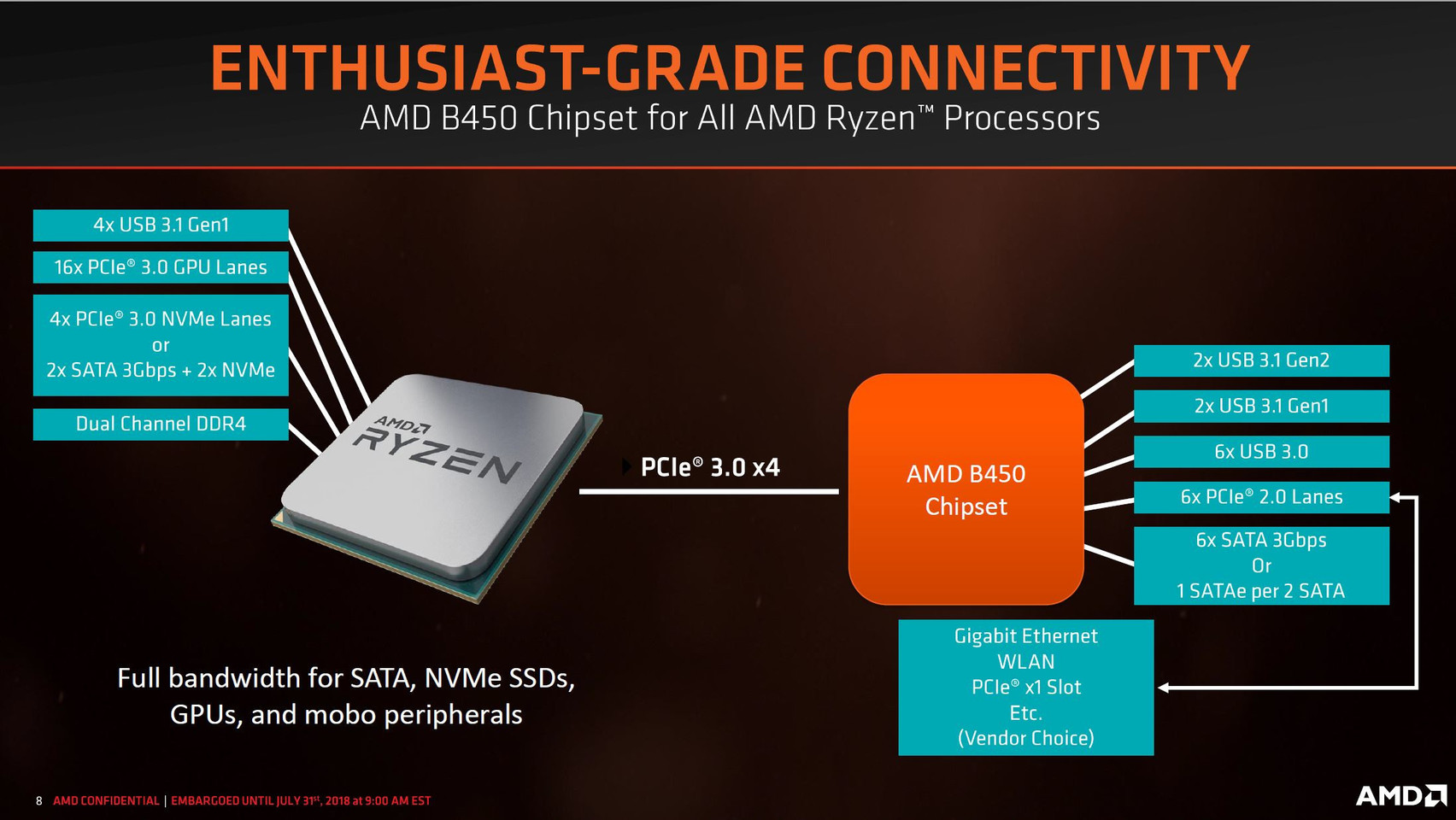
AMD today announced the B450 motherboard chipset for socket AM4 processors and APUs. Positioned as the mid-range option from AMD's 400-series chipset family, the B450 will power motherboards priced anywhere between $70 to $160, and packs certain high-end features that could let you save money over choosing pricier X470-powered boards. To begin with, the B450, like the X470, has a lower TDP and power-draw, so it runs cooler, and can make do with lighter heatsinks. It comes with slightly improved reference CPU VRM and memory wiring specifications that AMD introduced with the X470. The B450, like the X470, also supports XFR 2 "Enhanced" and Precision Boost Overdrive (that lets you tinker with boost frequencies without arbitrarily setting a high clock speed).

The B450 is recommended by AMD for both Ryzen 5 series and Ryzen 7 series, provided you don't need multi-GPU, as motherboards based on B450 aren't allowed to have PEG lane bifurcation. You still get multiplier-unlocked CPU overclocking support (something the competing Intel B360 platform lacks), as well as memory overclocking. The B450 packs out of the box support for AMD StoreMI, a storage virtualization feature that stripes a portion of your memory, your fast SSD, and slower HDD, into a single volume, and juggles hot data in and out of the faster media in the background. You can have any brand of drives to use StoreMI. B350 motherboards support StoreMI through BIOS updates.

Western Digital Introduces Ultrastar DC SS530 Dual-port SAS SSD

Western Digital Corporation, a data technology leader, today introduced the new Ultrastar DC SS530 SAS SSD, the company's highest-density drive and the fastest dual-port SAS SSD in the market¹, enabling server and storage array manufacturers to offer customers substantially lower data center TCO for Fast Data applications. By doubling maximum capacity of the previous generation to 15.36TB within the same 2.5-inch 15-mm form factor, drive storage density also doubles, giving IT managers the potential to reduce the number of drives deployed, consolidate servers and open up valuable rack space for improved CapEx and OpEx costs.

Developed in partnership with Intel , the Ultrastar DC SS530 is based on a trusted third-generation platform that has been previously qualified at most major OEMs worldwide. It offers consistent performance and reliability to meet the rigorous demands of today's toughest data center workloads. Designed with a 12Gb/s SAS interface, and available in capacities from 400GB to 15.36TB, the Ultrastar DC SS530 delivers up to 440,000 random read and 320,000 random write IOPS - providing rapid access to "hot" enterprise data for higher productivity and operational efficiency.

Toshiba Intros XG6 Series M.2 NVMe SSDs

Toshiba today introduced the XG6 series SSDs. Built in the M.2-2280 form-factor with PCI-Express 3.0 x4 interface, the drives take advantage of the NVMe 1.3a protocol, and succeed the XG5 series from 2017. The drives implement Toshiba's new 96-layer 3D TLC NAND flash dubbed BiCS Flash, which went into mass-production in Q1-2018. Available in 256 GB, 512 GB, and 1 TB capacities, the drives offer sequential transfer rates of up to 3,180 MB/s reads, with up to 2,960 MB/s writes. Also on offer are 4K random access transfer rates of up to 355,000 IOPS reads, with up to 365,000 IOPS writes. The drives are expected to be backed by 5-year warranties, when they go on sale at prices competitive with the likes of Samsung's 970 EVO series.

ATP Miniature Storage Powerhouses Take Center Stage at FMS 2018

The volume of data traffic is growing by the minute, and ATP Electronics, a leading manufacturer of high-performance industrial memory and storage solutions, is meeting colossal storage demands with its latest portfolio built for space-restricted embedded, industrial, and automotive systems. ATP shows off its extensive array of flash memory and storage products at the Flash Memory Summit 2018 in Sta. Clara, USA from August 7 to 9.

"We are seeing data propelling the transformation of cities and nations, and we need effective solutions of handling, storing and analyzing data to deliver rapid, actionable insights that will improve the way we live and do business," noted Marco Mezger, ATP Vice President of Global Marketing. "As the Internet of Things (IoT) adoption gains momentum, systems are diminishing in size so memory and storage solutions have to adapt. ATP is thoroughly amplifying reliability, endurance, performance and capacity in its embedded and removable flash products while keeping them compact and portable," he added.

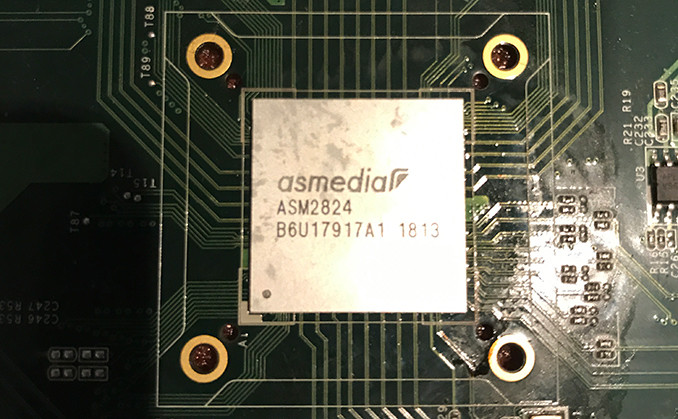
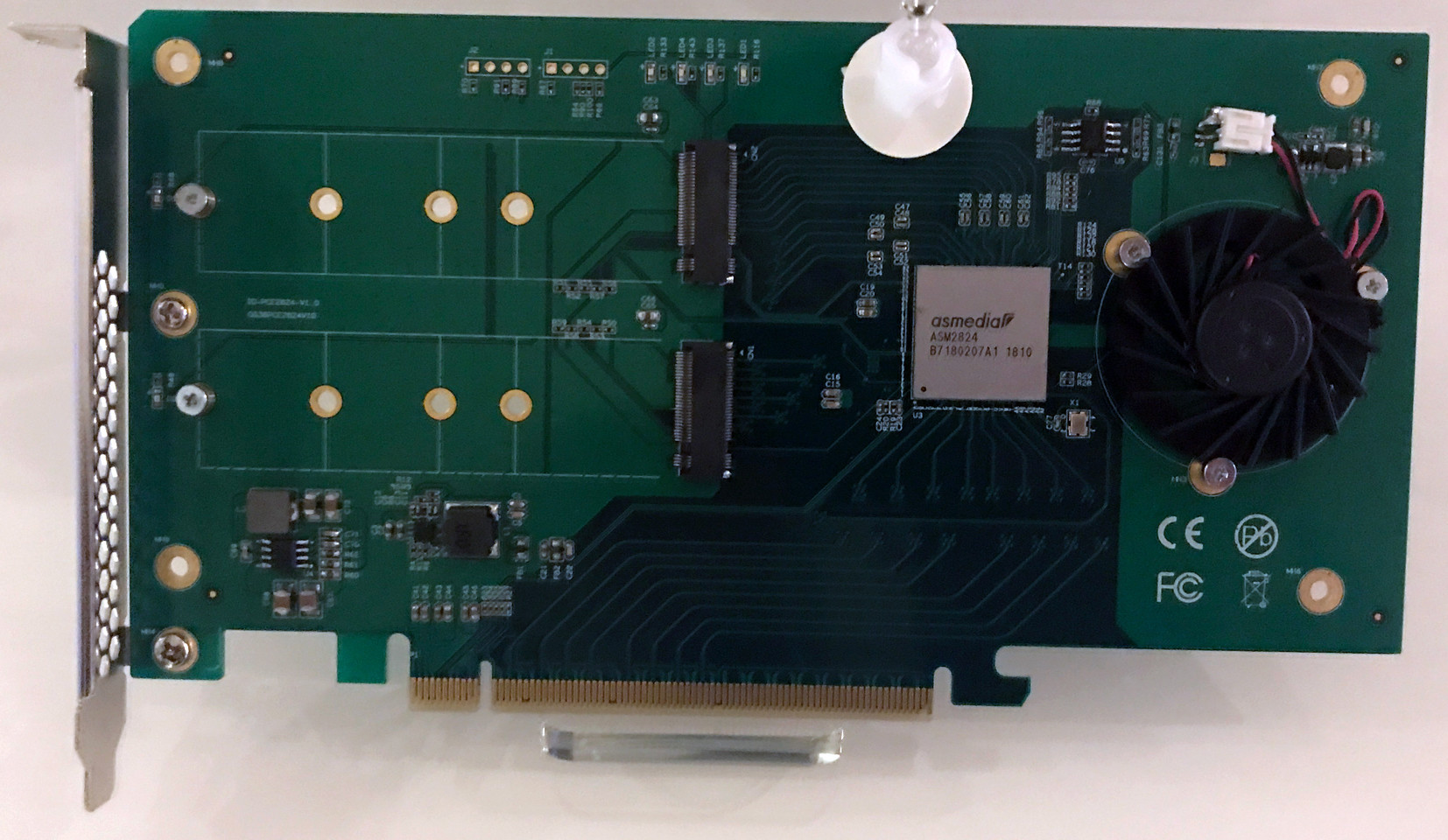
ASMedia Readies ASM2824 PCIe Switch Anticipating a Rise in M.2 Slots

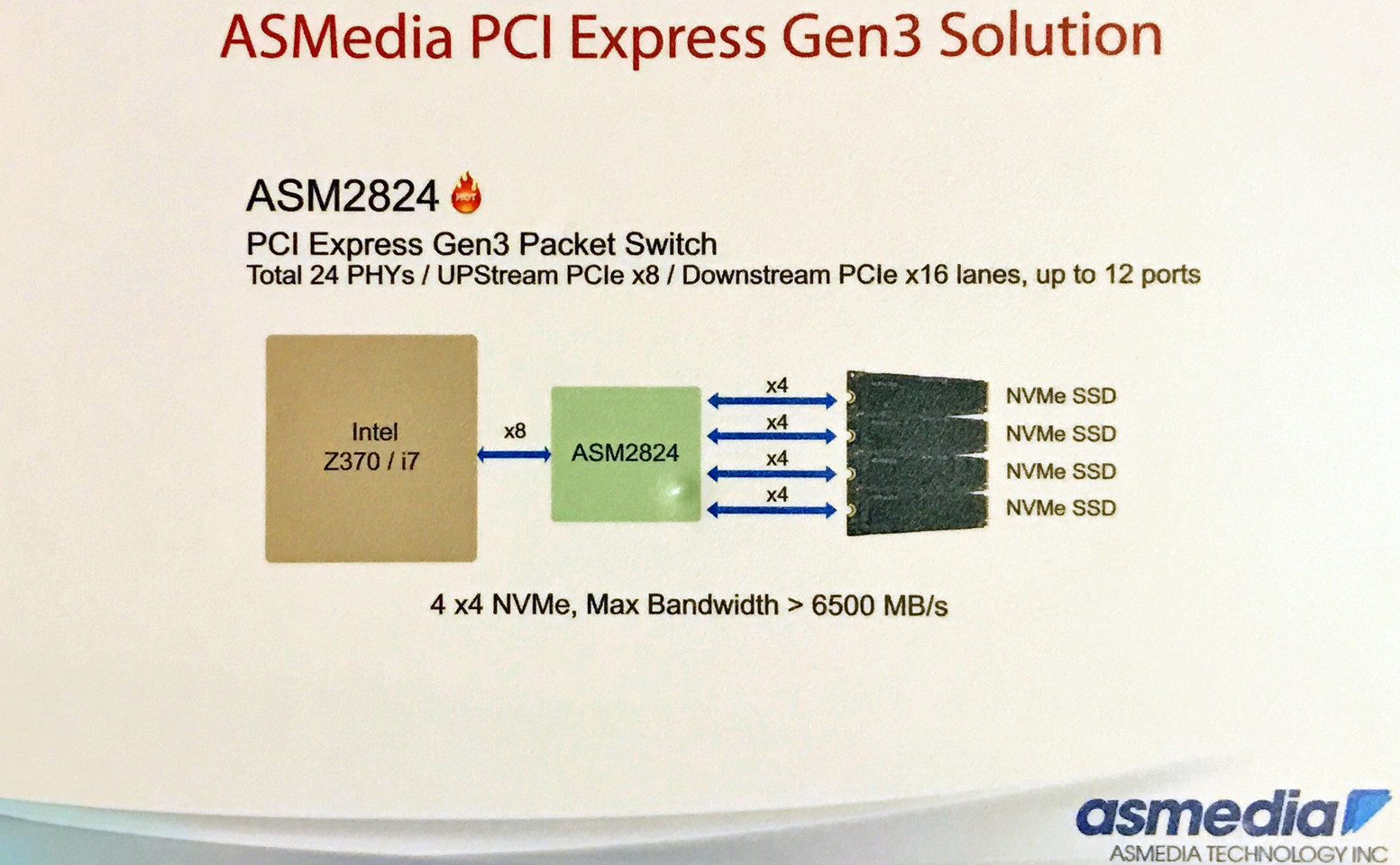
ASMedia is giving finishing touches to the ASM2824 PCI-Express gen 3.0 x24 switch. With half the fabric as the PLX PEX8747, the chip takes in PCI-Express 3.0 x8, and puts out four PCI-Express 3.0 x4 connections. In theory, this would let a motherboard designer create four M.2 PCIe 3.0 x4 slots from 8 downstream PCIe lanes of the Intel Z390 chipset, saving the remaining PCIe lanes for onboard USB 3.1 controllers (preferably sourced from ASMedia itself), since Intel canned the older 14 nm version of the Z390, which was supposed to put out six 10 Gbps USB 3.1 gen 2 and ten 5 Gbps USB 3.1 gen 1 ports directly from the PCH.

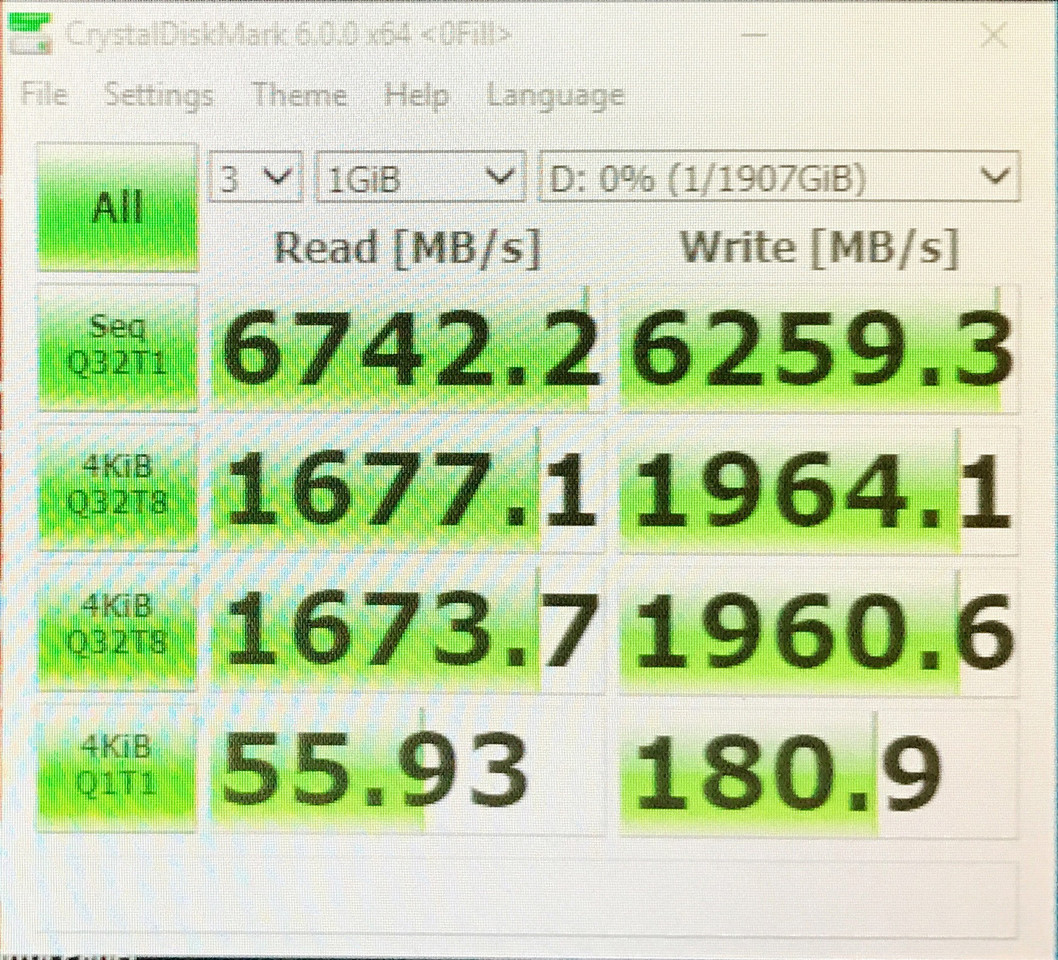
With all four downstream slots populated, ASMedia promises NVMe RAID bandwidths of up to 6,500 MB/s, with some CDM numbers even crossing 6,700 MB/s. Then again, one has to take into account that the test platform probably had the ASM2824 wired to the CPU's PCIe root-complex, and not that of the chipset. Intel is yet to modernize the lousy DMI 3.0 chipset-bus between its latest processors and chipset, and is physically PCI-Express 3.0 x4, which is fundamentally outdated for the bandwidth-heavy interfaces of this generation, such as USB 3.1, M.2 NVMe, and even the upcoming SD Express. The ASM2824 is also a godsend for the AMD AM4 platform, which not only has the same PCI-Express 3.0 x4 chipset bus between the AM4 SoC and the X470 chipset, but also a poor downstream PCIe feature-set of the X470, with just 8 gen 2.0 lanes. Motherboard designers can wire out all of those lanes to an ASM2824 for up to 24 downstream lanes.

Icy Dock Announces NVMe Removable Drive Enclosure for HPC

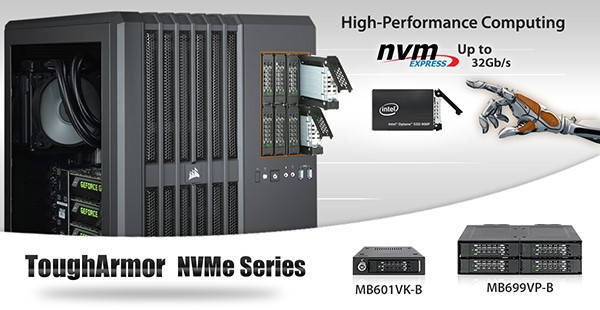
High-performance computing (HPC) has been the new trend in our recent times. The applications for HPC range from big data, IOT (internet of things), AI (artificial intelligence), deep learning and blockchains, requires advanced computer hardware to perform their intended functions. From time to time, the performance of HPC has been limited by data storage hardware due to its slow transfer speed, which caps the I/O intensive requirements for these applications. The evolution of data storage from mechanical hard drives to NVMe (non-volatile memory express) SSDs have eventually unleashed the next level of high-performance computing and its applications.

It's clear that installing NVMe U.2 drives requires not only a whole system upgrade but also a system that allows for easy maintenance. Enabling hot-swap functions on NVMe U.2 SSDs and finding the proper equipment in a computer or rackmount system has become a new challenge for many companies, as the current computer chassis are not optimized for NVMe U.2 SSDs. With more than 20 years of expertise, ICY DOCK, who specializes in enterprise data storage enclosures, has already implemented to this drastic change in data storage technology and created the world first NVMe removable drive enclosure, the ToughArmor NVMe series. The ToughArmor's removable drive caddy allows for easy NVMe drive installation and system maintenance for any companies who wish to utilize the benefits of using the next-generation NVMe U.2 SSDs.

Realtek Intros RTS5762 NVMe SSD Controller Capable of 3500 MB/s Reads

Realtek, known more for its cheap Ethernet PHYs and audio CODECs, entered the SSD controller market in 2017, with mainstream SSD controllers. This year, the company plans to take on giants such as Silicon Motion, Phison, Intel, and Samsung, with its own high-performance controller, the RTS5762. The PCI-Express 3.0 x4 interface provides 4,000 MB/s of raw bandwidth per direction, and while it's technically impossible for any device to transfer its payload data at that speed (on account of various protocol overheads), very few PCI-Express 3.0 x4 SSDs get within 80th percentile of it (3200 MB/s per direction transfers). It's only recently that 3400 MB/s became the gold-standard of high-end M.2 NVMe SSDs, but Realtek plans to change that.

The RTS5762 is capable of up to 3,500 MB/s reads, or 87.5% saturation of the PCI-Experss 3.0 x4 bus. It supports up to 8 NAND flash channels, 3D TLC and 3D QLC NAND flash memory, and takes advantage of the newer NVMe 1.3 protocol. The only other controller right now that's capable of 3,500 MB/s reads is Samsung "Phoenix," found exclusively on the 970 Pro series (and no other brand's products). Sequential write performance is where this Realtek chip edges past Samsung, with the company showing CDM performance of up to 3,000 MB/s writes, whereas the 970 Pro is only specified to write up to 2,700 MB/s. Realtek also beefed up its mainstream NVMe controller portfolio with the new RTS5763DL. If drives based on this chip are priced right, it could carve out a new market segment between cheaper PCIe 3.0 x2 drives, and "upper mainstream" x4 drives such as the Samsung 970 EVO. Armed with just 4 NAND flash channels and no DRAM to cushion it, the RTS5763DL reads at up to 2150 MB/s, and writes at up to 1475 MB/s (as tested on CDM), making it faster than PCIe 3.0 x2 drives, at least in the sequential reads test.
BIOSTAR Unveils M500 M.2 2280 PCI-Express NVMe SSD

BIOSTAR unveils its newest solid-state drive featuring 3D TLC NAND flash - the M500 M.2 PCIe NVMe SSD. The BIOSTAR M500 uses the compact M.2 2280 form factor that is compatible with latest-generation motherboards, laptops, and mini PCs. It supports the ultra-speed PCI-express Gen3x2 interface which offers builders greater compatibility. The BIOSTAR M500 SSD is NVMe (Non-Volatile Memory Express) 1.2 compliant delivering high-performance speeds of up to 1700MB/s sequential read and 1100MB/s sequential write and random read/write IOPS of up to 200K/180K.

Smart Temperature Display
The BIOSTAR M500 Series SSD features visible smart LED indicators on its heatsink cover for temperature and data activity. The LED Smart Temperature display delivers real-time temperature status of the solid-state drive in three different levels: green for temperature below 50°C, yellow for temperature between 50°C to 65°C, and red for temperature above 65°C. The LED Data Transmission display data transmission status: blue light for access status and a green light for PCIe transmission mode (Gen 2 / Gen 3).

Transcend Releases JetDrive 855/850 PCIe NVMe SSD Upgrade Kit for Mac Computers

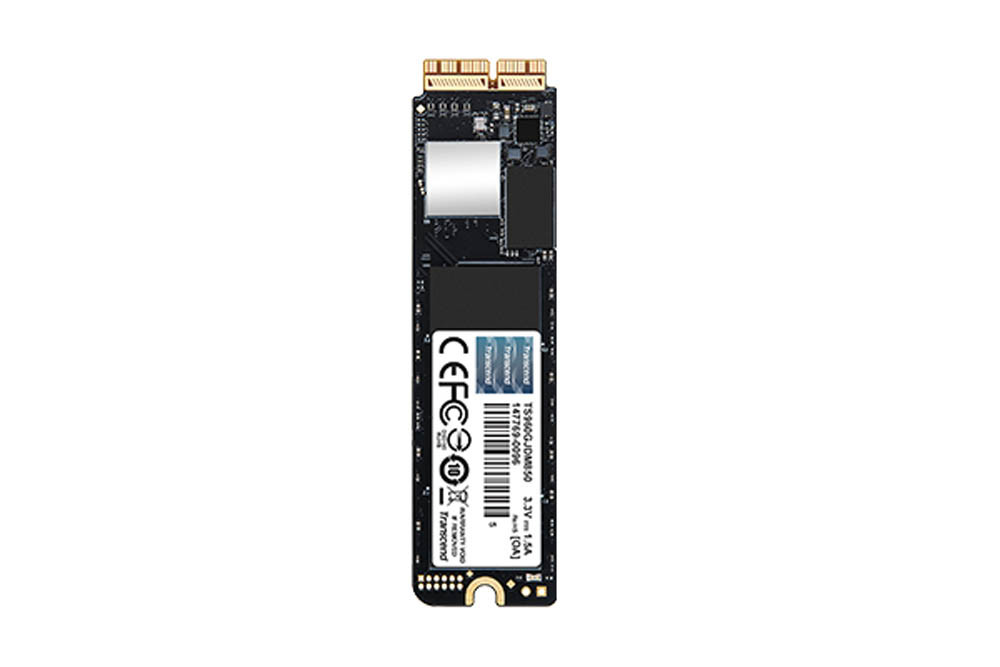
Transcend Information Inc. (Transcend ), a leading manufacturer of storage and multimedia products, is proud to announce the release of the JetDrive 855/850 PCIe Gen3 x4 NVMe solid-state drive (SSD) upgrade kit for Mac computers. The JetDrive 850 features read and write speeds of up to 1,600MB/s and 1,300MB/s, and is made of the latest 3D NAND flash. The JetDrive 855 includes a sleek aluminum Thunderbolt enclosure for a simple upgrade experience. Both models are the perfect upgrade for a MacBook Pro , MacBook Air , Mac mini , or Mac Pro .

PCIe Gen3 x4 NVMe interface allows transfer speeds of up to 1,600MB/s
Transcend's JetDrive 850 features the PCIe Gen3 x4 NVMe interface, meaning four lanes are used to transmit and receive data simultaneously. The result is compelling performance of up to 1,600MB/s read and 1,300MB/s write. Crafted of 3D NAND flash memory, the JetDrive 850 is reliable, highly compatible, and brings a whole new level of performance to Mac computers.

Samsung Introduces 8 TB NVMe SSD For Data Centers

Samsung Electronics, the world leader in advanced memory technology, today announced that it has launched the industry's highest capacity NVMe solid state drive (SSD) based on the incredibly small Next-generation Small Form Factor (NGSFF) - an eight-terabyte (TB) NF1 SSD. The new 8TB NVMe NF1 SSD has been optimized for data-intensive analytics and virtualization applications in next-generation data centers and enterprise server systems.

"By introducing the first NF1 NVMe SSD, Samsung is taking the investment efficiency in data centers to new heights," said Sewon Chun, senior vice president of Memory Marketing at Samsung Electronics. "We will continue to lead the trend toward enabling ultra-high density data centers and enterprise systems by delivering storage solutions with unparalleled performance and density levels."

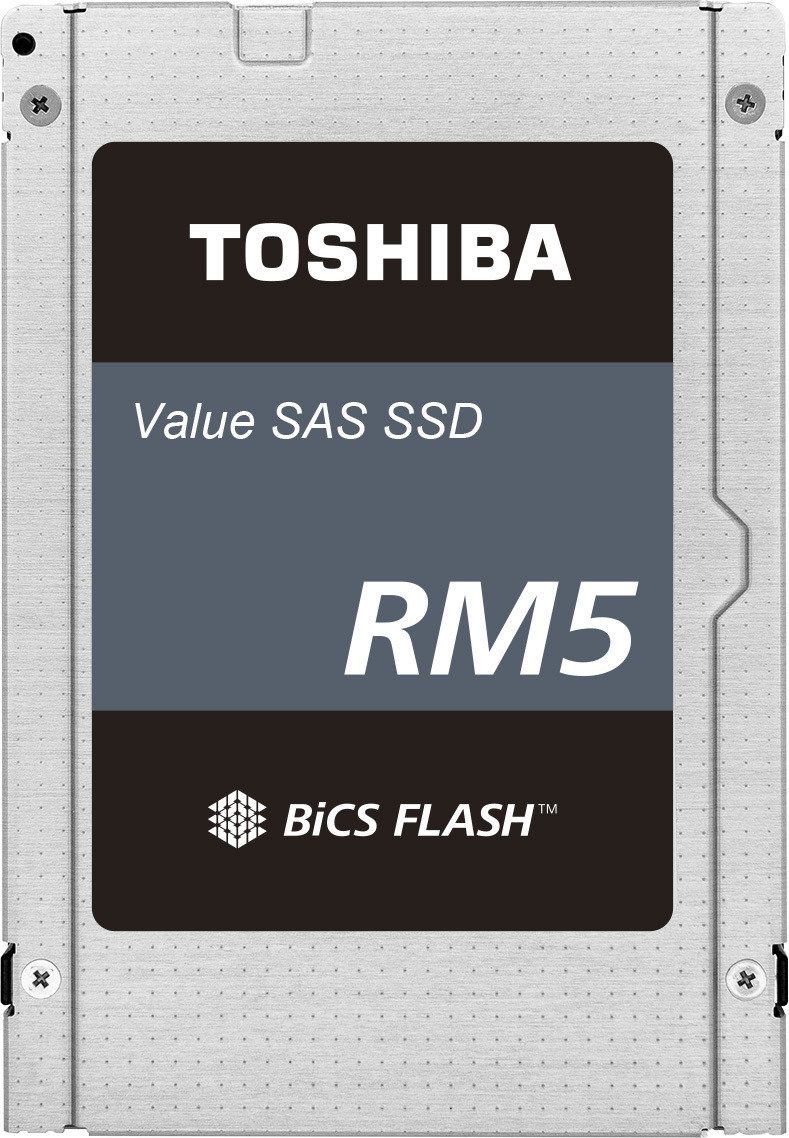
Toshiba First to Deliver Value SAS SSDs Targeting SATA Applications

Today Toshiba Memory America, Inc., the U.S.-based subsidiary of Toshiba Memory Corporation, unveiled a new, game-changing category of SAS SSDs expected to replace SATA SSDs in server applications. The RM5 12Gbit/s value SAS (vSAS) series features capacity, performance, reliability, manageability and data security advantages - at a price that obsoletes SATA SSDs.

A homogeneous SAS environment has long been the gold standard for enterprise server and storage systems. With vertical integration expertise in flash technology, firmware and controller design, Toshiba leveraged its leading position as the world's leading SAS SSD line optimizing RM5 to close the cost gap with SATA - and usher in a new class of SSD. SATA simply cannot compete with SAS, falling well short in terms of performance, robustness and encryption options.

Plextor Unveils Latest M9Pe Extreme Ultra Hi-Speed NVMe SSD

PLEXTOR, a leading developer of award-winning solid-state drives (SSDs) and other high-performance digital storage devices, showcased the new M9Pe Extreme at COMPUTEX 2018, Taipei, Taiwan. Breaking consumer SSD speed barriers, the new M9Pe Extreme delivers astonishing sequential read/write speeds of up to 6,500 / 5,000 MB/s. The next-generation M9Pe Extreme combines technologically advanced components and the Marvell 88NR2241 intelligent NVMe switch along with PLEXTOR exclusive technologies to deliver high level performance required by prosumers, professional PC gamers and other application-intensive users such as animation editors, audio-visual drafting personnel, and film-making companies. Not only does M9Pe Extreme provide greatly enhanced data transmission performance, it also offers RAID functionalities for data redundancy and performance improvements making it a great choice for office or workspace environments.

Fay Ho, Senior Director for Brand Division, LITE-ON Technology Corporation, said, "Continuing Plextor's outstanding capability in the high-speed storage devices, the M9Pe Extreme, as the name states, delivers unprecedented extreme high-speed performance, making a new record in consumer SSD read/write speeds. With high quality components and excellent performance boosting technologies, PC gaming experience, for one, will never be the same."

Memblaze Launches New PBlaze5 Series NVMe SSDs

Beijing Memblaze Technology Co., Ltd. newly released high-performance PBlaze5 910/916 and low-power 510/516 series NVMe SSD. They adopt the 64-layer enterprise-level 3D-NAND and support NVMe standard protocol with a user capacity up to 15.36TB.

The PBlaze5 910/916 series NVMe SSD features 6GB/s sequential read bandwidth, 1 million IOPS read performance and 89/11microsecond read/write latency. With the high performance shared by PBlaze series products, PBlaze5 910/916 series boasts advanced features like High-speed TRIM and Multiple-namespace, with higher QoS and more flexible.

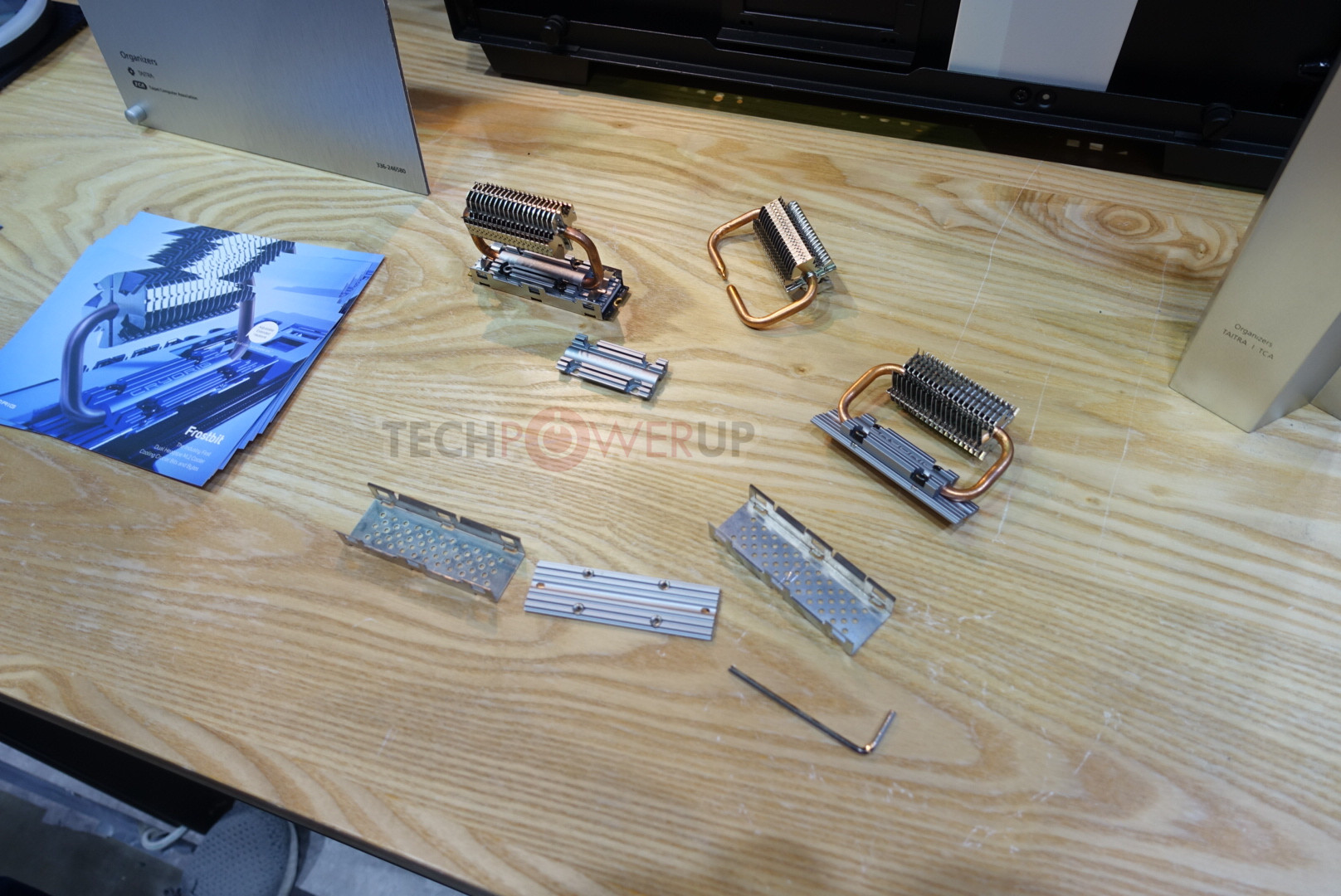
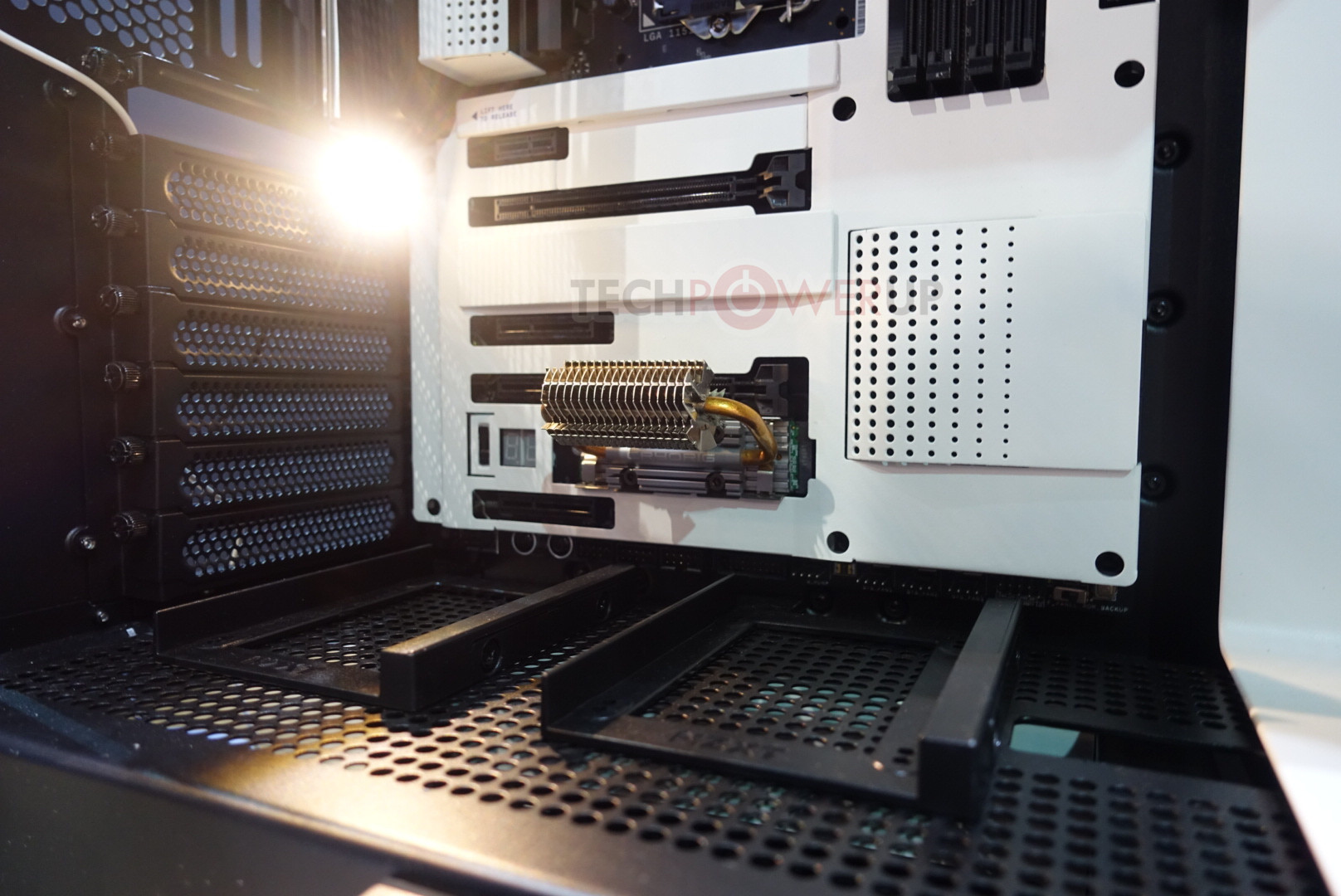
Cryorig Showcases Its Frostbit M.2 Cooling Solution at COMPUTEX 2018

Cryorig at COMPUTEX 2018 showed the most complex and impressive M.2 SSD cooling solution the market has ever seen with their Frosbit cooler. The Frostbit cooler, which the company had already teased going into the show, is the world's first M.2 cooling solution to feature heatpipe cooling technology - the heatpipe transfers heat from the M.2 SSD through its heatpipe loop and dissipates it in a large volume heatsink. This should alleviate any thermal throttling issues which some NVMe, M.2 SSDs are plagued with with inefficient airflow setups. The secondary, heat-dissipating heatsink can be adjusted so as to avoid contact with other components. This design really brings memories of OCZ's Reaper memory kits, as well as some other after-market modding solutions for RAM memory sticks which featured similar heatpipe designs.

Toshiba's RC100 Series of Value-Optimized NVMe SSDs Now Available

Toshiba Memory America, Inc. (TMA), the U.S.-based subsidiary of Toshiba Memory Corporation, today announced that its RC100 Series of NVMe (NVM Express ) M.2 solid state drives (SSDs) is now available. First introduced earlier this year at CES 2018, the new RC100 Series is geared toward the retail DIY market and features a powerful yet cost-effective design to make the benefits of NVMe storage accessible to more users than ever before. The Toshiba RC100 Series is well-suited to the entire spectrum of mainstream computing - from gaming desktops and notebooks to mini-PCs (NUCs) and everything in between. The new drives are available in capacities of 120, 240 and 480 gigabytes.

While the performance advantages of first-generation NVMe drives are well known, this high performance has come at an equally high cost - until now. By leveraging its state-of-the-art 64-layer, 3-bit-per-cell TLC (triple-level cell) BiCS FLASH technology and an in-house-developed controller, Toshiba Memory Corporation was able to fit an entire SSD within a single BGA package. The RC100 Series balances cost and performance and bridges the gap between SATA and enthusiast-grade NVMe SSDs. A compact design also enables the RC100 to fit onto an M.2 2242 (22x42mm) PCB, making it one of the smallest SSDs commercially available.
Return to Keyword Browsing
Nov 22nd, 2026 19:09 CST change timezone

New Forum Posts

Popular Reviews

TPU on YouTube

Controversial News Posts