News Posts matching #Xeon 6

Return to Keyword Browsing

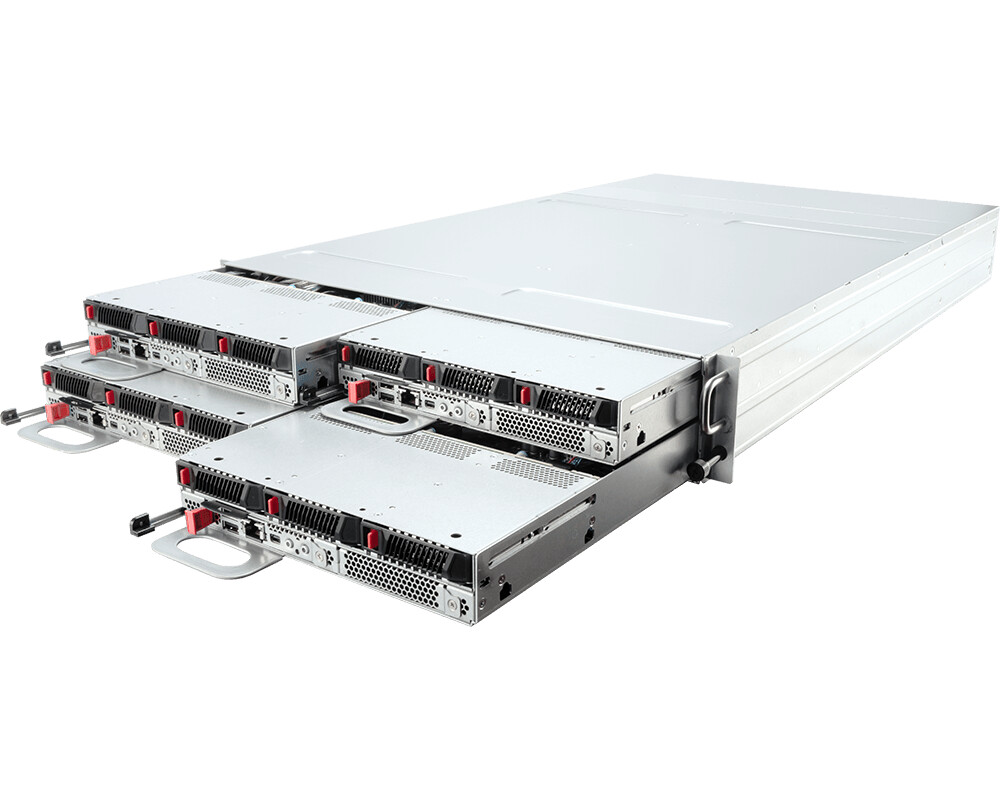
Supermicro Ships High-Performance 4-Socket X14 Servers Based on Intel Xeon 6 Processors

Super Micro Computer, Inc. (SMCI), a Total IT Solution Provider for AI/ML, HPC, Cloud, Storage, and 5G/Edge, is now shipping the industry's most advanced 4-socket servers for large-scale database and enterprise applications. Using the latest Intel Xeon 6 Processors with Performance-Cores (P-Cores), these new servers are CXL 2.0 ready and are ideal for HPC, mission-critical workloads, and in-memory databases. Other applications that will benefit from these systems are those that require a very large memory footprint with massive processing power, or scientific simulation applications that rely heavily on CPU computing with low latencies. As a critical component of Supermicro's Data Center Building Block Solutions (DCBBS), these new servers offer significantly higher performance than previous generations of 4-socket systems.

"These new 4-socket servers are addressing the needs of the most demanding enterprises worldwide, who require the simplicity and serviceability of a single system with up to 16 TB of memory, and up to 6 double-width GPUs," said Charles Liang, president and CEO of Supermicro. "With our DCBBS approach and worldwide production capabilities, Supermicro can now deliver complete data center solutions to customers in all geographies and is first-to-market for this segment. We are able to provide organizations with a wide variety of systems for all of their IT needs."


Giga Computing Unveils Liquid and Air-Cooled GIGABYTE AI Servers Accelerated by NVIDIA HGX B200 Platform

Giga Computing, an industry innovator and leader in enterprise hardware and advanced cooling solutions, today announced four new GIGABYTE servers built on the NVIDIA HGX B200 platform. This expansion of the GIGABYTE GPU server portfolio brings greater thermal design flexibility and support for the latest processors, including the new AI-optimized Intel Xeon 6 CPUs, giving customers more options as they tailor their systems for workloads and efficiency.

NVIDIA HGX B200 propels the data center into a new era of accelerating computing and generative AI. Built on NVIDIA Blackwell GPUs, the HGX B200 platform features 15X faster real-time inference on trillion-parameter models.

Intel "Jaguar Shores" Uses HBM4, "Diamond Rapids" Pairs with MRDIMM Gen 2 Memory

During the Intel AI Summit in Seoul, South Korea, Intel teased its upcoming product portfolio, featuring next-generation memory technologies. Being in Seoul, memory makers like SK Hynix are Intel's main partners for these products. Teased at the summit is Intel's upcoming AI accelerator, called "Jaguar Shores," which utilizes the next-generation HBM4 memory, offering 2.0 TB/s of bandwidth per module across 2,048 IO pins. SK Hynix plans to support this accelerator with its memory, ensuring that Intel's big data center-grade AI accelerator is equipped with the fastest memory on the market. Since the "Falcon Shores" accelerator is only intended for testing with external customers, we don't have an exact baseline to compare to, and Jaguar Shores specifications are scarce.

Next up, Intel confirmed that its upcoming seventh-generation "Diamond Rapids" Xeon processors will use the second generation of MRDIMMs (Multiplexer Rank Dual Inline Memory Modules), an upgrade from the first-generation MRDIMMs used in the Xeon 6 family. The upgrade to MRDIMMs Gen 2 will allow Intel to push transfer rates to 12,800 MT/s, up from 8,800 MT/s in Xeon 6 with MRDIMMs Gen 1. Alongside this 45% speed bump in raw transfer rates, the memory channels are jumping to 16, up from 12 in the current generation, yielding an additional bandwidth boost. Given that MRDIMMs operate by connecting more memory ranks using a multiplexer, and that these modules buffer data and commands, the increased data transfer rate comes without any additional signal degradation. As Intel is expected to pack more cores, this will be an essential piece in the toolbox to feed them and keep those cores busy on the Oak Stream platform, based on the LGA9324 socket.

Intel Xeon 6 Slashes Power Consumption for Nokia Core Network Customers

Intel and Nokia are expanding their long-standing and strategic collaboration to advance core network infrastructures with the deployment of Intel Xeon 6 processors with Efficient-cores (E-cores) in the Nokia NFVI v5.0 and Nokia Core Networks Applications. With breakthrough energy efficiency, capacity and scalability for 5G core workloads, this joint infrastructure initiative will provide Nokia customers with up to a 60% reduction in power consumption, a 60% smaller server footprint and a 150% performance boost compared to widely deployed previous-generation servers.

"The combination of Intel Xeon 6 E-core processors - engineered for power-efficient, high-density compute - and Intel Infrastructure Power Manager, which delivers stable run-time power savings, provides a robust foundation for the most energy-efficient 5G core networks. We're proud to see Nokia Core Networks continue to lead with Intel Xeon processors, helping communications service providers reduce both power use and infrastructure footprint at scale," said Alexander Quach, Intel vice president and general manager of the Wireline and Core Network Division.

Intel's Server Share Slips to 67% as AMD and Arm Widen the Gap

In just a few years, AMD has gone from the underdog to Intel's most serious challenger in the server world. Thanks to its EPYC processors, AMD now captures about a third of every dollar spent on server CPUs, up from essentially zero in 2017. Over that same period, Intel's share has slipped from nearly 100% to roughly 63%, signaling a significant shift in what companies choose to power their data centers. The real inflection point came with AMD's Zen architecture: by mid-2020, EPYC had already claimed more than 10% of server-CPU revenues. Meanwhile, Intel's rollout of Sapphire Rapids Xeons encountered delays and manufacturing issues, leaving customers to look elsewhere. By late 2022, AMD was over the 20% mark, and Intel found itself under 75% for the first time in years.

Looking ahead, analysts at IDC and Mercury Research, with data compiled by Bank of America, expect AMD's slice of the revenue pie to grow to about 36% by 2025, while Intel drops to around 55%. Arm-based server chips are also starting to make real inroads, forecast to account for roughly 9% of CPU revenue next year as major cloud providers seek more energy- and cost-efficient options. By 2027, AMD could approach a 40% revenue share, Intel may fall below half the market, and Arm designs could capture 10-12%. Remember that these figures track revenue rather than unit sales: AMD's gains come primarily from high-end, high-core-count processors, whereas Intel still shifts plenty of lower-priced models. With AMD poised to launch its Genoa and Bergamo EPYCs and Intel banking on the upcoming E-core Xeon 6 series to regain its footing, the fight for server-CPU supremacy is far from over. Still, Intel's once-unbeatable lead is clearly under threat.

Pegatron Unveils AI-Optimized Server Innovations at GTC Paris 2025

PEGATRON, a globally recognized Design, Manufacturing, and Service (DMS) provider, is showcasing its latest AI server solutions at GTC Paris 2025. Built on NVIDIA Blackwell architecture, PEGATRON's cutting-edge systems are tailored for AI training, reasoning, and enterprise-scale deployment.

NVIDIA GB300 NVL72
At the forefront is the RA4802-72N2, built on the NVIDIA GB300 NVL72 rack system, featuring 72 NVIDIA Blackwell Ultra GPUs and 36 NVIDIA Grace CPUs. Designed for AI factories, it boosts output by up to 50X. PEGATRON's in-house developed Coolant Distribution Unit (CDU) delivers 310 kW of cooling capacity with redundant hot-swappable pumps, ensuring performance and reliability for mission-critical workloads.

MSI Powers AI's Next Leap for Enterprises at ISC 2025

MSI, a global leader in high-performance server solutions, is showcasing its enterprise-grade, high-performance server platforms at ISC 2025, taking place June 10-12 at booth #E12. Built on standardized and modular architectures, MSI's AI servers are designed to power next-generation AI and accelerated computing workloads, enabling enterprises to rapidly advance their AI innovations.

"As AI workloads continue to grow and evolve toward inference-driven applications, we're seeing a significant shift in how enterprises approach AI deployment," said Danny Hsu, General Manager of Enterprise Platform Solutions at MSI. "With modular and standards-based architectures, enterprise data centers can now adopt AI technologies more quickly and cost-effectively than ever before. This marks a new era where AI is not only powerful but also increasingly accessible to businesses of all sizes.

Intel "Diamond Rapids" Xeon to Debut on 9,324-Pin LGA9324 Socket

Intel's upcoming "Diamond Rapids" Xeon processors are going to debut on a remarkably large new LGA9324 socket, according to a recently leaked photograph shared by hardware leaker HXL on X. The image appears to show a socket with 9,324 contact points, and when auxiliary debug pins are included, the total connection count may exceed 10,000. If this turns out to be accurate, it would surpass Intel's current flagship LGA7529 and AMD's SP5 sockets in raw pin density. Earlier reports indicated that Diamond Rapids will require Intel's next-generation Oak Stream platform, which in turn will use this upgraded socket. Within Intel's roadmap, the seventh-generation Xeon family is intended to replace the existing Granite Rapids lineup in both Advanced Performance (AP) and Scalable Performance (SP) segments. Prototype coolers from Dynatron suggest Intel plans to offer two sub-families: higher-end AP variants similar to the Xeon 6900P and a slightly less demanding SP series, potentially with a reduced pin count.

To put this evolution in context, the current LGA7529 platform supports up to 128 performance cores, 12 channels of DDR5 memory, and power envelopes up to 500 watts. A roughly 30 percent increase in pin count should allow Diamond Rapids to expand I/O bandwidth, add memory channels, increase thermal design power, and possibly accommodate more cores. Visually, the new socket appears to be nearly five times the size of Intel's LGA1851 socket, used by Arrow Lake desktop processors. Under the hood, Diamond Rapids is expected to use the Panther Cove-X core architecture, a server-optimized counterpart to the Coyote Cove design found in Nova Lake. These CPUs are reportedly being fabricated on Intel's 18A process node, with high-volume manufacturing anticipated by late 2025 or early 2026.

Bitspower at Computex 2025: RTX 50-series and RX 9000 Water Blocks, New Desktop and Workstation Blocks

Bitspower at the 2025 Computex shows off its latest DIY liquid cooling solutions. The water block expert began its showcase with full-coverage water blocks for the latest generation of NVIDIA GeForce RTX 50-series "Blackwell" and AMD Radeon RX 9000 RDNA 4 graphics cards. The Bitspower Nebula BPM-VG5090FE is designed for the GeForce RTX 5090 Founders Edition. There are additional custom-design vendor-specific full-coverage blocks under the Nebula series for other RTX 50-series GPUs.

For example, the Nebula BPM-VG5090ASA is designed for the ASUS ROG Astral RTX 5090. The BPM-VG5090ASF is for the ASUS TUF Gaming RTX 5090. The VG5080MT is designed for the MSI RTX 5080 Gaming Trio. The company also introduced water blocks for AMD Radeon RX 9070 XT custom-design graphics cards, such as the 2025 VGM-X9070XT for Radeon RX 9070 XT graphics cards designed close to the AMD reference design PCB; and the VGM-X9070X16 is designed for the XFX RX 9070 XT Mercury OC.

New Intel Xeon 6 CPUs to Maximize GPU-Accelerated AI Performance

Intel today unveiled three new additions to its Intel Xeon 6 series of central processing units (CPUs), designed specifically to manage the most advanced graphics processing unit (GPU)-powered AI systems. These new processors with Performance-cores (P-cores) include Intel's innovative Priority Core Turbo (PCT) technology and Intel Speed Select Technology - Turbo Frequency (Intel SST-TF), delivering customizable CPU core frequencies to boost GPU performance across demanding AI workloads. The new Xeon 6 processors are available today, with one of the three currently serving as the host CPU for the NVIDIA DGX B300, the company's latest generation of AI-accelerated systems. The NVIDIA DGX B300 integrates the Intel Xeon 6776P processor, which plays a vital role in managing, orchestrating and supporting the AI-accelerated system. With robust memory capacity and bandwidth, the Xeon 6776P supports the growing needs of AI models and datasets.

"These new Xeon SKUs demonstrate the unmatched performance of Intel Xeon 6, making it the ideal CPU for next-gen GPU-accelerated AI systems," said Karin Eibschitz Segal, corporate vice president and interim general manager of the Data Center Group at Intel. "We're thrilled to deepen our collaboration with NVIDIA to deliver one of the industry's highest-performing AI systems, helping accelerate AI adoption across industries."

MiTAC Computing Unveils Full Server Lineup for Data Centers and Enterprises with Intel Xeon 6 at Computex 2025

MiTAC Computing Technology Corporation, a leading server platform designer, manufacturer, and a subsidiary of MiTAC Holdings Corporation, has launched its full suite of next-generation servers for data centers and enterprises at COMPUTEX 2025 (Booth M1110). Powered by Intel Xeon 6 processors, including those with Performance-cores (P-cores), MiTAC's new platforms are purpose-built for AI, HPC, cloud, and enterprise applications.

"For over five decades, MiTAC and Intel have built a close, collaborative relationship that continues to push innovation forward. Our latest server lineup reflects this legacy—combining Intel's cutting-edge processing power with MiTAC Computing's deep expertise in system design to deliver scalable, high-efficiency solutions for modern data centers." - Rick Hwang, President of MiTAC Computing.

Supermicro Unveils DLC-2, the Next Generation Direct Liquid-Cooling Solutions for Data Centers

Super Micro Computer, Inc. (SMCI), a Total IT Solution Provider for AI/ML, HPC, Cloud, Storage, and 5G/Edge, is announcing several improvements to its Direct Liquid Cooling (DLC) solution that incorporate new technologies for cooling various server components, accommodate warmer liquid inflow temperatures, and introduce innovative mechanical designs that enhance AI per watt. The Supermicro DLC-2 solution reduces data center power consumption by up to 40% compared to air-cooled installations. These advanced technologies enable faster deployment and reduced time-to-online for cutting-edge liquid-cooled AI infrastructure. Additionally, the total cost of ownership decreases by up to 20%. The comprehensive cold plate coverage of components allows for lower fan speeds and fewer required fans, significantly reducing data center noise levels to approximately 50dB.

"With the expected demand for liquid-cooled data centers rising to 30% of all installations, we realized that current technologies were insufficient to cool these new AI-optimized systems," said Charles Liang, president and CEO of Supermicro. "Supermicro continues to remain committed to innovation, green computing, and improving the future of AI, by significantly reducing data center power and water consumption, noise, and space. Our latest liquid-cooling innovation, DLC-2, saves data center electricity costs by up to 40%."

MSI Presenting AI's Next Leap at Japan IT Week Spring 2025

MSI, a leading global provider of high-performance server solutions, is bringing AI-driven innovation to Japan IT Week Spring 2025 at Booth #21-2 with high-performance server platforms built for next-generation AI and cloud computing workloads. MSI's NVIDIA MGX AI Servers deliver modular GPU-accelerated computing to optimize AI training and inference, while the Core Compute line of Multi-Node Servers maximize compute density and efficiency for AI inference and cloud service provider workloads. MSI's Open Compute line of ORv3 Servers enhance scalability and thermal efficiency in hyperscale AI deployments. MSI's Enterprise Servers provide balanced compute, storage, and networking for seamless AI workloads across cloud and edge. With deep expertise in system integration and AI-driven infrastructure, MSI is advancing the next generation of intelligent computing solutions to power AI's next leap.

"AI's advancement hinges on performance efficiency, compute density, and workload scalability. MSI's server platforms are engineered to accelerate model training, optimize inference, and maximize resource utilization—ensuring enterprises have the processing power to turn AI potential into real-world impact," said Danny Hsu, General Manager of MSI Enterprise Platform Solutions.

Intel Xeon Remains Only Server CPU on MLPerf

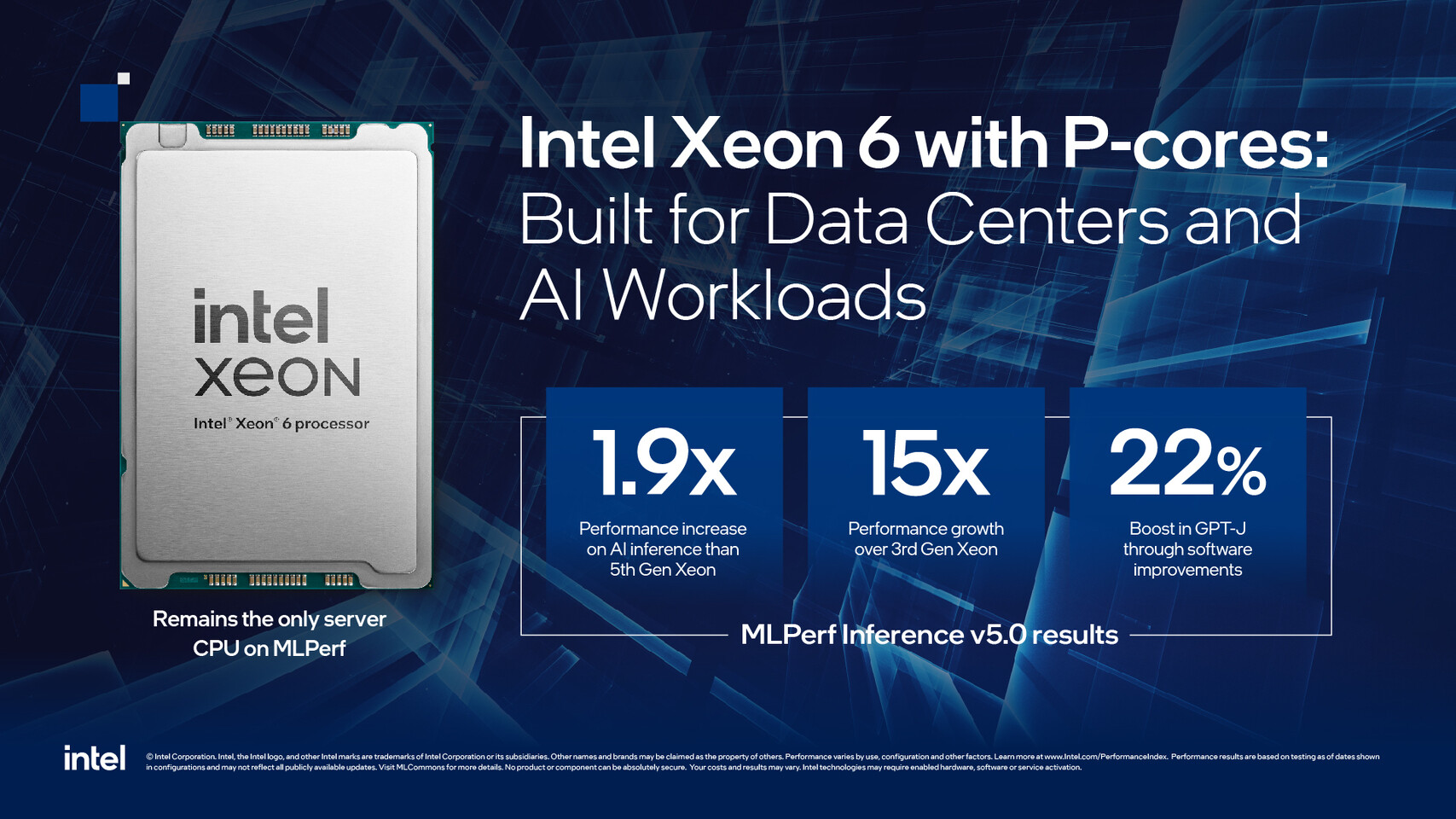
Today, MLCommons released its latest MLPerf Inference v5.0 benchmarks, showcasing Intel Xeon 6 with Performance-cores (P-cores) across six key benchmarks. The results reveal a remarkable 1.9x boost in AI performance over the previous generation of processors, affirming Xeon 6 as a top solution for modern AI systems.

"The latest MLPerf results demonstrate Intel Xeon 6 as the ideal CPU for AI workloads, offering a perfect balance of performance and energy efficiency. Intel Xeon remains the leading CPU for AI systems, with consistent gen-over-gen performance improvements across a variety of AI benchmarks." - Karin Eibschitz Segal, Intel corporate vice president and interim general manager of the Data Center and AI Group

MLCommons Releases New MLPerf Inference v5.0 Benchmark Results

Today, MLCommons announced new results for its industry-standard MLPerf Inference v5.0 benchmark suite, which delivers machine learning (ML) system performance benchmarking in an architecture-neutral, representative, and reproducible manner. The results highlight that the AI community is focusing much of its attention and efforts on generative AI scenarios, and that the combination of recent hardware and software advances optimized for generative AI have led to dramatic performance improvements over the past year.

The MLPerf Inference benchmark suite, which encompasses both datacenter and edge systems, is designed to measure how quickly systems can run AI and ML models across a variety of workloads. The open-source and peer-reviewed benchmark suite creates a level playing field for competition that drives innovation, performance, and energy efficiency for the entire industry. It also provides critical technical information for customers who are procuring and tuning AI systems. This round of MLPerf Inference results also includes tests for four new benchmarks: Llama 3.1 405B, Llama 2 70B Interactive for low-latency applications, RGAT, and Automotive PointPainting for 3D object detection.

Supermicro Ships Over 20 New Systems that Redefine Single-Socket Performance

Super Micro Computer, Inc., a Total IT Solution Provider for AI/ML, HPC, Cloud, Storage, and 5G/Edge, is announcing the availability of new single-socket servers capable of supporting applications that required dual-socket servers for a range of data center workloads. By leveraging a single-socket architecture, enterprises and data center operators can reduce initial acquisition costs, ongoing operational costs such as power and cooling, and reduce the physical footprint of server racks compared to previous generations of systems based on older processors.

"We are entering a new era of compute where energy-efficient and thermally optimized single-socket architectures are becoming a viable alternative to traditional dual-processor servers," said Charles Liang, president and CEO of Supermicro. "Our new single-socket servers support 100% more cores per system than previous generations and have been designed to maximize acceleration, networking, and storage flexibility. Supporting up to 500-watt TDP processors, these new systems can be configured to fulfill a wide range of workload requirements."

MSI Powers the Future of Cloud Computing at CloudFest 2025

MSI, a leading global provider of high-performance server solutions, unveiled its next-generation server platforms—ORv3 Servers, DC-MHS Servers, and NVIDIA MGX AI Servers—at CloudFest 2025, held from March 18-20 at booth H02. The ORv3 Servers focus on modularity and standardization to enable seamless integration and rapid scalability for hyperscale growth. Complementing this, the DC-MHS Servers emphasize modular flexibility, allowing quick reconfiguration to adapt to diverse data center requirements while maximizing rack density for sustainable operations. Together with NVIDIA MGX AI Servers, which deliver exceptional performance for AI and HPC workloads, MSI's comprehensive solutions empower enterprises and hyperscalers to redefine cloud infrastructure with unmatched flexibility and performance.

"We're excited to present MSI's vision for the future of cloud infrastructure." said Danny Hsu, General Manager of MSI's Enterprise Platform Solutions. "Our next-generation server platforms address the critical needs of scalability, efficiency, and sustainability. By offering modular flexibility, seamless integration, and exceptional performance, we empower businesses, hyperscalers, and enterprise data centers to innovate, scale, and lead in this cloud-powered era."

GIGABYTE Showcases Cutting-Edge AI and Cloud Computing Solutions at CloudFest 2025

Giga Computing, a subsidiary of GIGABYTE, a global leader in IT technology solutions, is thrilled to announce its participation at CloudFest 2025, the world's premier cloud, hosting, and internet infrastructure event. As a key exhibitor, Giga Computing will highlight its latest innovations in AI, cloud computing, and edge solutions at the GIGABYTE booth. In line with its commitment to shaping the future of AI development and deployment, the GIGABYTE booth will showcase its industry-leading hardware and platforms optimized for AI workloads, cloud applications, and edge computing. As cloud adoption continues to accelerate, Giga Computing solutions are designed to empower businesses with unparalleled performance, scalability, and efficiency.

At CloudFest 2025, Giga Computing invites attendees to visit booth #E03 to experience firsthand its cutting-edge cloud computing solutions. From state-of-the-art hardware to innovative total solutions, a comprehensive suite of products and services designed to meet the evolving needs of the cloud industry are being showcased.

AEWIN Unveils CB-1953 Series Network Appliance Powered by Intel Xeon 6 Processors

AEWIN is excited to unveil the SCB-1953 Series, 2U/1U performant network appliances powered by Intel's latest Xeon 6 processors built upon Intel 3. Equipped with a single Intel Xeon 6700/6500-series processor, it is a series of flagship products supporting up to 144 E-cores or 86 P-cores for high density and compute-intensive workloads pursued in the market. SCB-1953 series has multiple SKU with various PCIe slots options for exceptional scalability to fulfill customers' diverse solution requirements.

SCB-1953-2U is a 2U network computing platform with 8x DDR5 RDIMM up to 6400 MT/s or MRDIMM up to 8000 MT/s. The series of SCB-1953-2U has 4x 8038 fans with BMC control for optimized thermal management. One is SCB-1953A featuring 8x PCIe 5.0 expansion slots for AEWIN wide coverage NIC cards with 1G/10/25/40/100G/200G copper/fiber interfaces or other Accelerators & NVMe SSDs for flexible functionality enhancement. The other is SCB-1953C supporting 1x PCIe x16 slot by switching two PCIe slots to one standard PCIe form factor which can install off-the-shelf add-on card for expanded function required.

ASUS Showcases Servers Based on Intel Xeon 6, Intel Gaudi 3 at CloudFest 2025

ASUS today announced its showcase of comprehensive AI infrastructure solutions at CloudFest 2025, bringing together cutting-edge hardware powered by Intel Xeon 6 processors, NVIDIA GPUs and AMD EPYC processors. The company will also highlight its integrated software platforms, reinforcing its position as a total AI solution provider for enterprises seeking seamless AI deployments from edge to cloud.

Intel Xeon 6-based AI solutions and Gaudi 3 Acceleration for generative AI inferencing and fine tuning training
ASUS Intel Xeon 6-based servers leverage the Data Center Modular Hardware System (DC-MHS) architecture, providing unparalleled scalability, cost-efficiency and simplified maintenance. ASUS will showcase a comprehensive Intel Xeon 6 family of processors at CloudFest 2025, including the RS700-E12, RS720Q-E12. and ESC8000-E12P-series servers. The ESC800-E12P-series servers will debut the Intel Gaudi 3 AI accelerator PCIe card. This lineup underscores the ASUS commitment to delivering comprehensive AI solutions that integrate cutting-edge hardware with enterprise-grade software platforms for seamless, scalable AI deployments, highlighting Intel's latest innovations for high-performance AI training, inference, and cloud-native workloads.

Supermicro Intros New Systems Optimized for Edge and Embedded Workloads

Supermicro, Inc. a Total IT Solution Provider for AI/ML, HPC, Cloud, Storage, and 5G/Edge, is introducing a wide range of new systems which are fully optimized for edge and embedded workloads. Several of these new compact servers, which are based on the latest Intel Xeon 6 SoC processor family (formerly codenamed Granite Rapids-D), empower businesses to optimize real-time AI inferencing and enable smarter applications across many key industries.

"As the demand for Edge AI solutions grows, businesses need highly reliable, compact systems that can process data at the edge in real-time," said Charles Liang, president and CEO of Supermicro. "At Supermicro, we design and deploy the industry's broadest range of application optimized systems from the data center to the far edge. Our latest generation of edge servers deliver advanced AI capabilities for enhanced efficiency and decision-making close to where the data is generated. With up to 2.5 times core count increase at the edge with improved performance per watt and per core, these new Supermicro compact systems are fully optimized for workloads such as Edge AI, telecom, networking, and CDN."

Avalue Technology Unveils HPM-GNRDE High-Performance Server Motherboard

Avalue Technology introduces the HPM-GNRDE high-performance server motherboard, powered by the latest Intel Xeon 6 Processors (P-Core) 6500P & 6700P.

Designed to deliver quality computing performance, ultra-fast memory bandwidth, and advanced PCIe 5.0 expansion, the HPM-GNRDE is the ideal solution for AI workloads, high-performance computing (HPC), Cloud data centers, and enterprise applications. The HPM-GNRDE will make its debut at embedded world 2025, showcasing Avalue's innovation in high-performance computing.

Intel Showcases Foundational Network Infrastructure with Xeon 6 at MWC 2025

The telecommunications industry is undergoing a major transformation as AI and 5G technologies reshape networks and connectivity. While operators are eager to modernize infrastructure, challenges remain, such as high capital expenditures, security concerns and integration with legacy systems. At MWC 2025, Intel - alongside more than 50 partners and customers - will showcase groundbreaking solutions that deliver high capacity and high efficiency performance with built-in AI integration, eliminating the need for costly additional hardware and delivering optimized total cost of ownership (TCO).

"By leveraging cloud technologies and fostering close collaborations with partners, we are helping operators virtualize both 5G core and radio access networks - proving that the most demanding, mission-critical workloads can run efficiently on general-purpose silicon," said Sachin Katti, senior vice president and general manager of the Network and Edge Group at Intel Corporation. "Through our Xeon 6 processors, we are enabling the future of AI-powered network modernization."

ASUS Unveils All-New Intel Xeon 6 Server Lineup

ASUS today announced an all-new series of servers powered by the latest Intel Xeon 6 processors, including the Xeon 6900-series, 6500P/6700P-series and 6300-series processors. These powerhouse processors deliver exceptional performance, efficiency and scalability, featuring up to 128 Performance-cores (P-cores) or 288 Efficient-cores (E-cores) per socket, along with native support for PCI Express (PCIe 5.0) and DDR5 6400 MT/s memory speeds. The latest ASUS server solutions also incorporate the updated BMC module within the ASPEED 2600 chipset, providing improved manageability, security and compatibility with a wide range of remote management software - and coincide with the unveiling of the latest Intel Xeon 6 processors.

Redefining efficiency and scalability
Intel Xeon 6 processors are engineered to meet the needs of modern data centers, AI-driven workloads and enterprise computing. Offering a choice between P-core and E-core architectures, these processors provide flexibility for businesses to optimize performance and energy efficiency based on specific workloads.

AEWIN Unveils High Availability Storage Server Powered by Intel Xeon 6 Processors

AEWIN is excited to launch the MIS-5131-2U2, a cutting-edge 2U2N High Availability Storage Server powered by Intel's latest Xeon 6 processors. The horizontal placement enables optimized thermal dissipation to allow CPU running with high TDP of 350 W. Each node is equipped with a single Intel Xeon 6700/6500-series processor with P-cores (R1S), offering up to 80 performance cores, 136 PCIe 5.0 lanes, and 8x high-speed DDR5 RDIMMs with speeds of up to 6400 MT/s. Featuring rich I/O and 24x hot-swap dual port NVMe SSD bays, MIS-5131-2U2 is a high-performance and reliable storage solution for mission-critical applications.

The dual node architecture within a single chassis allows for seamless failover through with the NTB (Non-Transparent Bridge) interconnectivity, two BMC communication, and dual-port NVMe drives. The two nodes of MIS-5131 are linked via NTB running at PCIe Gen 5 speeds (32 GT/s) to enable high speed, redundant storage failover. With NTB, dual port NVMe drives, and sufficient PCIe lanes of Intel Xeon 6 R1S CPU, the system eliminates the need for an additional switch, delivering an optimized HA server solution with the best TCO for continuous operation.
Return to Keyword Browsing
Nov 11th, 2026 23:37 CST change timezone

New Forum Posts

Popular Reviews

TPU on YouTube

Controversial News Posts