News Posts matching #ssd

Return to Keyword Browsing

Micron 9650 PCIe Gen 6 SSDs Enters Mass Production

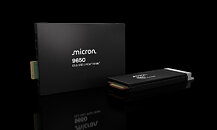
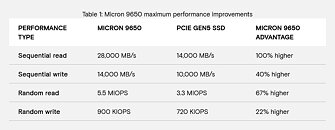
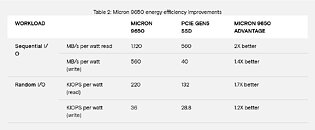
Micron announced its 9650 NVMe SSD has entered mass production, making it the first PCIe Gen 6 data center drive to reach this milestone. The series was first unveiled in July 2025, and it features Micron G9 TLC NAND, including Micron designed SSD controller ASIC, DRAM, and Micron produced and validated firmware. The Micron 9650 delivers up to 28 GB/s in sequential reads, double that of PCIe Gen 5 drives. The drive's sequential write speed reaches 14 GB/s, while its random read performance hits 5.5 million IOPS and its random write achieves 900,000 IOPS. These numbers show 100%, 40%, 67%, and 22% gains over Gen 5. At a 25-watt power state, the drive offers double the performance of PCIe Gen 5 options. It has a sequential read efficiency of 1,120 MB/s per watt (2× better than Gen 5), and its sequential write efficiency is 560 MB/s per watt (1.4 times better). The random read efficiency stands at 220 KIOPS per watt (1.7 times higher) and random write at 36 KIOPS per watt (1.2 times improved).

The Micron 9650 supports both air-cooled and liquid-cooled configurations to handle higher performance densities in modern data centers. Micron conducted 18 months of interoperability testing across the PCIe Gen 6 ecosystem, including validation with high-port switches, retimers, and demonstrations at industry events. The drive is now being qualified by OEM and AI data center customers for deployment in AI training and inference workloads, particularly those requiring high-throughput data access for large language models and retrieval-augmented generation pipelines. The Micron 9650 is available in E1.S and E3.S form factors with E1.S available for liquid cooling.
AI-Fueled Supercycle Propels Memory Market Revenue to More Than Twice That of Foundry Industry

The current AI surge is anticipated to boost both the memory and wafer foundry sectors to record-breaking revenues by 2026, based on TrendForce's recent data. Limited supply and rapidly increasing prices are likely to grow the memory market's total worth to $551.6 billion. Meanwhile, the global foundry market is also expected to reach a new peak of $218.7 billion, but the memory industry's scale will have more than doubled that of wafer foundries.

A new memory supercycle: Demand resilience and pricing power far stronger than in 2017
The previous memory supercycle from 2017 to 2019 was primarily driven by cloud data center expansions and resulted in a significant gap between memory and foundry revenues.

ASUS Announces ROG Strix Aiolos, 20 Gbps USB 3.2 Gen 2x2 SSD Enclosure

ASUS Republic of Gamers (ROG) today announced the ROG Strix Aiolos SSD Enclosure, a premium external SSD enclosure built for gamers and creators who demand top-tier performance, seamless device management. Engineered for next-generation NVMe M.2 storage, the ROG Strix Aiolos delivers lightning-fast transfer speeds, enhanced thermal efficiency, and an exclusive ROG SSD Dashboard, which provides real-time drive status updates. Designed for life on the move, it also incorporates a durable metal hook with a fabric tag to ensure convenient and secure portability.

Ultra-fast transfers and smarter storage management
The ROG Strix Aiolos delivers high-speed portable performance with USB-C 3.2 Gen 2x2 connectivity supporting transfer speeds of up to 20 Gbps, enabling users to move large media files or entire game libraries with ease. Its versatile dual M.2 interface, compatible with both NVMe PCIe (2242/2260/2280) and SATA SSDs, offers flexible upgrade and expansion options for a wide range of user needs. For effortless oversight, the enclosure features the exclusive ROG SSD Dashboard, which features a custom UI that provides users with a complete real-time overview of SSD status, performance, and other key metrics. Tailored for ROG enclosures, it makes storage management simple and intuitive.

Silicon Motion Announces Results for the Fourth Quarter and Year Ended December 31, 2025

Silicon Motion Technology Corporation (NasdaqGS: SIMO) ("Silicon Motion," the "Company," "we" or similar terms) today announced its financial results for the fourth quarter and year ended December 31, 2025. For the fourth quarter of 2025, net sales (GAAP) increased sequentially to $278.5 million from $242.0 million in the third quarter of 2025. Net income (GAAP) also increased sequentially to $47.7 million, or $1.41 per diluted American depositary share ("ADS") (GAAP), from net income (GAAP) of $39.1 million, or $1.16 per diluted ADS (GAAP), in the third quarter of 2025.

For the fourth quarter of 2025, net income (non-GAAP) increased sequentially to $42.7 million, or $1.26 per diluted ADS (non-GAAP), from net income (non-GAAP) of $33.8 million, or $1.00 per diluted ADS (non-GAAP), in the third quarter of 2025. All financial numbers are in U.S. dollars unless otherwise noted.

Memory Price Outlook for 1Q26 Sharply Upgraded; QoQ Increases of All Product Categories to Hit Record Highs

TrendForce's latest memory industry survey indicates that persistent AI and data center demands in 1Q26 are further worsening the global memory supply and demand imbalance, thereby increasing suppliers' pricing power. As a result, TrendForce has significantly raised its 1Q26 price forecasts for both DRAM and NAND Flash products. The quarter-over-quarter increase in conventional DRAM contract prices has been revised upward, from a previous estimate of 55-60% to now 90-95%. Similarly, NAND Flash contract prices are now expected to rise from 33-38% to 55-60%. Further upward adjustments may still occur.

TrendForce reports that PC shipments in 4Q25 exceeded expectations, resulting in a widespread shortage of PC DRAM. Even tier-1 PC OEMs with secured allocations from memory suppliers are experiencing declining inventory levels. In a market dominated by sellers, which is driving contract prices higher, PC DRAM prices in 1Q26 are projected to increase by over 100% QoQ, setting a new record for a quarterly surge.

Samsung Reveals More Details About the PM9E1 NVMe SSD

As AI processing capabilities continue to evolve toward on-device and desktop supercomputer applications, the need for ultra-fast yet space-efficient local storage becomes increasingly important. Samsung's recent innovation in AI-optimized storage devices drives this point home. Our PM9E1 SSD—the industry's first PCIe Gen 5 4 TB SSD in M.2 22x42 form factor—complements the NVIDIA GB10-powered NVIDIA DGX Spark desktop AI supercomputer.

While AI accelerators enable systems to harness the vast power of AI, only pairing them with performance-optimized, purpose-built storage technology like the Samsung PM9E1 can provide the massive capacity and blazing access speeds to unleash that power that may lead to the development of tomorrow's killer AI apps.

SK hynix Announces FY25 Financial Results, Posts Record-High Results and Delivers Highest Shareholder Returns

SK hynix Inc. announced today that it has achieved record financial results in 2025—97.1467 trillion won in revenue, 47.2063 trillion won in operating profit (with an operating margin of 49%), and 42.9479 trillion won in net profit (with a net margin of 44%). The results significantly exceeded the previous record set in 2024. The annual revenue increased by more than 30 trillion won while the annual operating profit nearly doubled year-on-year, marking the highest annual performance in the company's history.

Growth momentum accelerated further in the fourth quarter. In addition to HBM, demand on conventional memory solutions for servers increased sharply, to which SK hynix responded proactively. As a result, the company achieved record-high quarterly performance across all three indicators, with revenue rising 34% to 32.8267 trillion won, operating profit surging 68% to 19.1696 trillion won, and operating margin reaching 58% quarter-on-quarter.

Dual Pressure from Rising CPU and Memory Prices to Drive Global Notebook Shipments Down 14.8% QoQ in 1Q26

TrendForce's latest survey of the notebook industry reveals that global notebook brands have been grappling with sharp increases in memory prices since 2H25. Entering early 2026, they are now also facing a temporary CPU supply shortfall and price hikes. These challenges are compounded by rising costs for PCBs, batteries, and PMICs, which together are expected to drive global notebook shipments down 14.8% QoQ in 1Q26, falling below brands' original expectations.

TrendForce observes that, depending on the system setup, CPUs generally make up about 15-30% of a notebook's total BOM cost. Currently, most entry-level and mainstream notebooks mainly use Intel processors. However, Intel's recent price hikes on lower-end CPUs and ongoing supply shortages—expected to persist until after March—are adding pressure to product planning and shipment timing.

AI Architecture Evolution Set to Drive Memory Market Revenue to a New Peak in 2027, with Annual Growth Exceeding 50%

TrendForce's latest research indicates that AI innovation is causing a fundamental shift in the memory market. As data access volumes continue to grow, AI systems depend more on high-bandwidth, high-capacity, low-latency DRAM to handle large-scale model parameters, long-sequence inference, and multi-task parallel processing. Additionally, NAND Flash has become essential for fast data transfer, making memory a key component in AI infrastructure and a strategic focus for CSPs.

Memory prices have continuously increased due to limited capacity and rising demand for allocations, pushing industry revenue to new record levels. TrendForce projects the memory market to be worth $551.6 billion in 2026 and to surge to a peak of $842.7 billion in 2027, reflecting a 53% YoY growth.

TerraMaster Unveils D1 SSD Pro 80 Gbps Fanless Enclosure

TerraMaster today unveiled the D1 SSD Pro, a portable SSD enclosure that can turn M.2 NVMe SSDs to portable SSDs. This enclosure has a design focus on performance and reliability. It takes advantage of 80 Gbps Thunderbolt 5 and USB4 V2 interfaces, and internally supports M.2-2280, M.2-2242, and M.2-2230 SSDs with PCI-Express 4.0 x4 interface. It also supports Gen 5 SSDs, meeting their electrical specs, but the bandwidth is limited to Gen 4 x4 (64 Gbps per direction). The 80 Gbps upstream bandwidth is able to ensure maximum possible downstream bandwidth.

The TerraMaster D1 SSD Pro is a fanless enclosure, which is rare if not a first, for 80 Gbps-class enclosures. Its extruded aluminium body doubles up as a heatsink for the Thunderbolt 5 bridge chip and your M.2-2280 SSD, and the company includes thermal pads to transfer heat from your SSD to the enclosure's body. The company includes an 80 Gbps-certified USB type-C cable. Given that TerraMaster is primarily a NAS designer, the company includes its TPC Backupper software with the enclosure, which lets you back up your data, and create whole-volume, whole-disk, and whole-system images. Available from later today, the enclosure is normally priced at $250, but TerraMaster is offering it at in introductory price of $211.

HDD Prices Increase by an Average of 46% Over the Past Four Months

Hard Disk Drives are now in great demand, which has pushed their price premiums up by an average of 46% since mid-September. According to the ComputerBase tracker, HDDs have increased their prices over the past four months by anywhere from 23% to 66%, depending on the model. Standing at the lowest 23% increase is the Seagate IronWolf Pro NAS HDD + Rescue 16 TB HDD, while the highest price increase was observed in the Toshiba Cloud Scale Capacity MG10F AFA 22 TB model. The price tracker followed fluctuations of the 12 most popular HDD models based on their EUR listings and found that HDDs rose by an average of 46% across the four-month period, resulting in spinning rust being almost 50% more expensive, without any substantial supply chain shortage.

A month ago in December, DigiTimes reported that fourth-quarter 2025 contract negotiations concluded with traditional HDD prices rising about 4% quarter-over-quarter, the largest increase in the past eight quarters. This contributed to the overall 46% price increase observed today, as these single-digit contract changes accumulate and multiply by the time they reach consumers. Interestingly, HDDs contain almost no silicon for storage purposes, making their significant price increases a supply chain issue unrelated to the semiconductor industry. Apart from the controllers that use silicon, HDD platters are made from materials that are not currently in short supply. However, high demand is what keeps their prices elevated.

Netac Shows DDR5 Memory, Portable SSDs, and PCIe 5.0 M.2 NVMe Drives at CES 2026

At the Netac booth at CES 2026, we saw a fleet of memory and storage solutions that the company has prepared for the consumer market. Starting with its Basic memory lineup, it includes DDR5 memory running up to 4,800 MT/s with capacities of up to 32 GB per DIMM. On the other hand, its older DDR4 tops out at 3,200 MT/s with the same 32 GB max capacity (per kit). However, the company has prepared even more advanced DDR5 and DDR4 DIMMs that can reach much higher clock speeds. The Shadows series includes DDR5 running up to 6,400 MT/s, while DDR4 equivalents top out at 3,600 MT/s. Netac's highest-performing DDR5 kits come in the form of Z RGB series with 8,000 MT/s out-of-the-box speeds.

Alphacool at CES 2026: Waterblocks, Manifolds, and Massive Monoblocks

At CES 2026, the Alphacool booth was brimming with a wide array of water cooling products. Among their staple offerings was the Core GPU AIO, part of Alphacool's Core series, providing a comprehensive cooling solution for various GPU models, including those from AMD and NVIDIA. This system is built around the Core GPU cold plate and features two Core DC-LT 2 pumps. A 360 mm radiator is included, enabling significant overclocking potential even for high-performance cards like the RTX 5090. It is planned for Q2 release of ths year. In addition to this, Alphacool showcased single-slot water blocks for NVIDIA's RTX 6000 Pro "Blackwell" GPU. These are available with either a transparent acrylic finish or a sleek opaque design. The single-slot configuration allows for multiple GPUs to be stacked together in a custom loop, making them ideal for dense AI workstation deployments.

ASUS TUF Gaming TM500 Gaming Desktop With AMD Hawk Point CPU Spotted at CES

During CES 2026, ASUS announced the TUF Gaming TM500 Gaming PC, which in and of itself isn't a big deal and in fact, the TPU team on site grabbed a couple of quick snaps of it, without realising what sets it apart from your typical gaming PC. The TUF Gaming TM500 appears to be using leftover bits at ASUS, since it will be powered by either an AMD Ryzen 5 220 or a Ryzen 7 260, both of which are mobile CPUs based on AMD's Zen 4 processor architecture. These are obviously budget notebook chips with either six or eight cores, a Radeon 760M or 780M GPU and a total of 20 usable PCIe 4.0 lanes. ASUS decided that as this is a mobile CPU, the TM500 should use SO-DIMM memory. We're looking at a pair of DDR5 slots that support up to 64 GB of 5600 MT/s memory.

The motherboard itself appears to be microATX, but it has a custom layout and ASUS has even implemented a special heatpipe cooler that attaches to the rear of the chassis where the fan is located. As the TM500 is being sold as a gaming PC, it also comes with a choice of an AMD Radeon RX 9060 XT or an NVIDIA GeForce RTX 5060 graphics card. The motherboard also has room for a pair of SATA ports and a pair of PCIe 4.0 M.2 NVMe SSDs in the standard 2280 form factor. Connectivity wise, ASUS didn't seem to even have bothered, as the board only has a HDMI 2.1 port, one DP 1.4, one USB 3.2 Gen 1 (5 Gbps) Type-A port, two USB 2.0 ports, a Gigabit Ethernet port and three audio jacks around the back. The front of the chassis is home to a further two USB 3.2 Gen 1 (5 Gbps) Type-A ports and one Type-C port and a 3.5 mm combo headset jack. Considering the CPUs used have native USB4 support, as well as support for USB 3.2 Gen 2 (10 Gbps), this just feels cheap from ASUS. A Wi-Fi 6 module with Bluetooth 5.4 support and a 330 W PSU rounds off the package. There was no word on pricing, but it seems like there are competing mobile on desktop type systems out there that offer more features than the TUF Gaming TM500.

Satechi Launches Thunderbolt 5 CubeDock with SSD Enclosure at CES 2026

Satechi introduced at CES 2026 the CubeDock with SSD enclosure, its first Thunderbolt 5 docking station. The device is offering 80/120 Gbps bandwidth and integrated M.2 NVMe storage supporting 2230/2242/2260/2280 NVMe SSDs up to 8 TB with speeds up to 6,000 MB/s. The aluminium dock measures 127 x 127 x 52 mm and features one upstream Thunderbolt 5 port with support for up to 140 W of host charging. Connectivity includes three downstream Thunderbolt 5 ports (80 Gbps, 15 W each), two USB-C ports (10 Gbps), two USB-A ports (10 Gbps), UHS-II SD and microSD card readers (up to 312 MB/s), 2.5G Ethernet, and a 3.5 mm audio jack. Display support includes single 8K@144 Hz (Windows) or 6K@60 Hz (macOS), dual 8K@120 Hz (Windows) or 6K@60 Hz (macOS), and triple 8K@60 Hz on Windows only.

Satechi also launched the Thunderbolt 5 Pro Cable (1 meter, braided) supporting up to 120 Gbps uni-directional or 80 Gbps bidirectional transfers, 240 W power delivery, and dual 8K@60 Hz or triple 4K@144 Hz displays. Both products are available on the Satechi website. The CubeDock is priced at $399.99 (currently on pre-order, starts shipping at the end of March), and the Thunderbolt 5 Pro Cable at $39.99.

Biwin's New High-end Memory and SSDs at CES 2026

We've tracked the growth of Biwin's own channel brand for the past few years, and we are happy report that they've developed a large portfolio of premium PC memory and storage products under their own marquee. The company has traditionally been an OEM for major brands such as Acer and HP. We begin our tour with the RD510, an SSD enclosure that supports 40 Gbps USB4, which it wires to an internal M.2-2280 SSD via a PCIe Gen 3 x4 connection, offering sequential speeds of up to 3.3 GB/s reads with up to 3 GB/s writes. The enclosure features active cooling, and an aluminium alloy body.

Biwin CL100 is a single-package mini SSD that's designed to minimize PCB footprint in consumer electronics. It features an impressive PCIe Gen 4 x2 host interface for a device the size of a postage stamp, and comes in capacities of 512 GB, 1 TB, and 2 TB. It offers sequential speeds of up to 3.7 GB/s reads, with up to 3 GB/s writes. Biwin Amber ME300 is a microSDXC SD Express 7.x memory card that's compatible with Nintendo Switch 2. It features a PCIe Gen 3 x1 interface, and comes in 256 GB, 512 GB, and 1 TB sizes, offering speeds of up to 900 MB/s sequential reads, with up to 800 MB/s sequential writes.

KIOXIA Shows New BG7 Client and LC9 series 245.76 TB Enterprise SSDs at CES 2026

Kioxia showcased its latest BG7 line of client mainstream NVMe SSDs, which will be aimed mostly at PC OEMs and range in capacities from 256 GB to 2 TB. The Kioxia BG7 series is actually the first client SSD solution to use the latest BiCS Gen 8 3D flash memory with CBA (CMOS directly Bonded to Array) technology. Thanks to the new BiCS Gen 7 3D flash, the Kioxia BG7 series SSDs promise random read and write of up to 1,000,000 IOPS and sequential performance of up to 7,000 MB/s, which is up to 10 and 16 percent higher random and sequential performance compared to its BG6 series predecessor. These are PCIe 4.0 Gen 4 x4 NVMe SSDs that will be coming in various M.2 form factors, including 2230, 2242, and M.2 2280, that will probably find their way into many workstations, desktops, laptops, and all-in-one PCs.

In addition to the new BG7 SSD series, Kioxia also showcased its LC9 245.76 TB enterprise SSD, which we have seen at the FMS 2025 show and uses the same BiCS Flash Generation 8 QLC 3D flash memory. It features a 32-die stack of 2 terabit (Tb) 3D flash memory with the same CBA technology, which enables industry-first 8 TB capacity in a small 154 BGA package. The Kioxia LC9 comes in a 2.5-inch and Enterprise and Datacenter Standard Form Factor (EDSFF) E3.L form factor, and since it packs 245.76 TB in such a small package, we could not pass up the opportunity to take a picture of holding almost 1 PB in our hand.

Phison's New SSD Controllers Hands-on: E37T is the Fastest DRAMless Controller

At CES, we went hands on with Phison's latest innovations with consumer and enterprise SSDs. The star attraction is the new PS5037-E37T, a DRAM-less SSD controller for mainstream and performance segment SSDs. This chip can drive SSDs across M.2-2280, 2242 and 2230 form-factors, and features 4 NAND flash channels. It is energy-efficient, as it's built on the TSMC 6 nm foundry node. Phison claims astonishing performance figures for its reference-design drive based on the E37T, with up to 14.7 GB/s sequential reads, and up to 13 GB/s sequential writes, along with 2 million IOPS 4K reads/writes. That's not all, its peak power (during an R/W operation) is under 2.3 W, making it ideal for notebooks. A CDM session of the E37T reference SSD was shown with 14925 MB/s reads, 13115 MB/s writes, and 8676 MB/s mixed loads. Such figures put the controller on par with the E26 Max14um revision, a flagship controller from 2024.

Next up is Phison's new flagship client SSD controller, the PS5028-E28, with 8 flash channels allowing drive capacities of up to 8 TB. This controller uses a DDR4 DRAM cache, which should give it superior random write performance. A maxed-out reference 8 TB SSD was shown clocking 14919 MB/s sequential reads, 14008 MB/s sequential writes, and the company claims up to 2.6 million IOPS 4K random reads, with up to 3 million IOPS 4K random writes. This controller pushes performance to the very edge of what's possible with PCI-Express 5.0 x4, accounting for interface overheads. Perhaps the best piece of news with this controller is power, and its peak R/W controller power is shown to be 4.5 W, which should mean drives with even passive heatsinks should sustain advertised performance, without the need for active cooling. We've reviewed an E28 Engineering Sample previously, and also tested a retail drive (Corsair MP700 Pro XT).

Micron Launches New 3610 SSDs, World's First Gen 5 G9 QLC SSD for Client Computing

Micron Technology today announced the Micron 3610 NVMe SSD, the industry's first PCIe Gen 5 G9 QLC SSD for client computing - a breakthrough that redefines what's possible in performance, efficiency and capacity for mainstream PCs and ultra-thin laptops. Built on Micron's proven G9 NAND, the 3610 SSD achieves up to 11,000 MB/s sequential read speeds and 9,300 MB/s sequential write speeds. It offers the world's only 4 TB capacity in a compact single-sided M.2 2230 form factor, ideal for ultra-thin laptops and AI-capable devices. This innovation combines industry-leading Gen 5 speed with QLC economics, delivering next-level responsiveness without compromising battery life.

"The 3610 SSD combines cutting-edge PCIe Gen 5 technology, Micron's most-advanced G9 QLC NAND and a sleek, single-sided design to deliver premium performance, capacity and power efficiency," said Mark Montierth, senior vice president and general manager of Micron's Mobile and Client Business Unit. "The 3610 will enable ultra-thin devices that meet the growing demands of on-device AI, immersive streaming and performance-intensive workloads."

Acer Announces New Lineup of Premium Swift AI Copilot+ PCs

Acer today introduced its latest Swift AI laptop portfolio, a new generation of Copilot+ PCs on Windows 11 designed to deliver powerful on-device AI capabilities for creators, on-the-go-professionals, and tech-savvy users. The new lineup includes the Swift 16 AI, along with the Swift Edge AI, weighing as light as under 1 kg, and the versatile thin-and-light Swift Go AI in 14- and 16-inch variants.

Each model in the Swift AI series is purpose-built with cutting-edge hardware and complemented with Acer's suite of proprietary AI features. These include productivity enhancements like Acer PurifiedVoice, PurifiedView, and User Sensing, while additional tools for AI-enhanced creativity and entertainment can be downloaded via the Acer Intelligence Space hub. The customizable Acer My Key is a programmable hotkey for launching apps, websites, and Windows 11 features with a single press, providing additional convenience.

Patriot Memory Brings Swanky New SSDs to CES 2026, World's Fastest DRAMless SSD

We conclude our tour of the Patriot Memory booth at 2026 CES with a look at their latest internal SSDs. The Patriot Viper PV563H aims to be the world's fastest PCIe Gen 5 DRAM-less SSD. The drive features a 6 nm DRAM-less controller from SMI, comes in 1 TB, 2 TB, and 4 TB capacities, and offers sequential transfer rates of up to 14 GB/s reads, with up to 11 GB/s writes, both of which are the highest in the industry so far for DRAM-less Gen 5 SSDs. The drive features a passive aluminium heatsink, there's also a variant of this drive without the heatsink, called simply the Viper PV563. Next up, we have the Patriot Viper PV593, a flagship-segment drive based on the SMI SM2508 6 nm controller with DRAM cache. This drive comes in 1 TB, 2 TB, and 4 TB capacities, with sequential transfer speeds of up to 14 GB/s reads, and up to 13 GB/s writes.

Lexar Celebrates 30th Anniversary at CES, Bringing Several New Storage Products to the Show

As Lexar celebrates its 30th anniversary, the brand reflects on three decades of innovation, engineering excellence, and trusted performance. Since 1996, Lexar has evolved from a pioneer in memory card standards into a global brand shaping the workflows of creators, gamers, professionals, and next-generation smart devices. Building on this foundation, Lexar enters 2026 with a clear focus: continuing to meet evolving user needs while preparing for a future shaped by AI-enabled workflows, mobility, and real-time data.

Value Leadership-30 Years of Innovation, Reliability, and User-Centric Product Design
For 30 years, Lexar has built its reputation on three core values-Professionalism, Innovation, and Service-delivering storage solutions that evolve with the needs of photographers, filmmakers, gamers, and mobile creators.

KIOXIA Unveils the Next Generation BG7 Series SSDs for PC OEMs

Kioxia America, Inc. today announced BG7 Series solid state drives (SSDs) - the first client solution to feature Kioxia Corporation's latest BiCS FLASH generation 8 3D flash memory with innovative CBA (CMOS directly Bonded to Array) technology. Designed for PC OEM customers, the BG7 Series offers an excellent balance of performance, features, and efficiency for commercial/consumer notebooks and desktops.

KIOXIA BG7 Series SSDs pass on the optimized performance and power efficiency of BiCS FLASH generation 8 to everyday applications. With random read/write up to 1,000,000 IOPS and sequential read up to 7,000 MB/s, the KIOXIA BG7 Series subsequently delivers approximately 10% and 16% performance improvement respectively compared to its BG6 Series predecessor. When it comes to power consumption, the BG7 Series optimizes power efficiency with approximately 67% improvement in sequential write operations compared to previous models, thanks to the adoption of CBA technology.

WD Black Drives Now Called SANDISK Optimus

Today at the Consumer Electronics Show (CES 2026), Sandisk announced Sandisk Optimus as the new name for its renowned internal SSD lineup for gamers, creators, and professionals. The new branding for this family of products reflects a focus on performance leadership, engineering excellence, and a heritage of trust in flash memory. The powerful collection of Sandisk Optimus internal storage solutions, encompasses three product lines: Sandisk Optimus, Sandisk Optimus GX, and Sandisk Optimus GX PRO.

Featuring a striking new packaging and product design inspired by the company's innovation and iconic branding, the introduction of Sandisk Optimus creates room for future growth as the company expands its offerings to support the needs of gamers, creators, and professionals. The new design is inspired by the company's pioneering brand heritage and relentless focus on delivering innovation that delights end users. While the overall look and feel of the Sandisk Optimus brand is boldly different, its product portfolio carries forward Sandisk's long-standing reputation for superior quality and reliability, characteristics that have shaped the company's longstanding legacy of flash innovation.

Patriot Memory Showcases Next-Generation Performance at CES 2026

Patriot Memory, a global leader in high-performance memory and storage solutions, will unveil its latest advancements at CES 2026, taking place January 6-9, 2026, in Las Vegas, Nevada. Building on decades of engineering expertise, Patriot's CES 2026 showcase highlights the company's continued focus on next-generation DDR5 memory and PCIe Gen 5 storage technologies designed for enthusiasts, gamers, and professional users. At CES 2026, Patriot Memory will present its newest innovations across both memory and storage under the Patriot andViper Gaming brands, including:

Next-Generation DDR5 Memory: Viper Xtreme 5 Aurum Edition DDR5
The Viper Xtreme 5 Aurum Edition represents the pinnacle of Patriot's DDR5 design philosophy, combining elite performance with refined aesthetics. Engineered for stability at high frequencies, the Aurum Edition delivers DDR5 speeds of up to 8000 MT/s with capacities up to64GB, paired with a premium, precision-crafted heat spreader design. Built for enthusiasts who demand both speed and visual distinction, the Aurum Edition embodies Patriot's commitment to pushing DDR5 performance while maintaining elegance and reliability.
Return to Keyword Browsing
Nov 18th, 2026 23:20 PST change timezone

New Forum Posts

Popular Reviews

TPU on YouTube

Controversial News Posts