Tuesday, February 10th 2026
AI-Fueled Supercycle Propels Memory Market Revenue to More Than Twice That of Foundry Industry
The current AI surge is anticipated to boost both the memory and wafer foundry sectors to record-breaking revenues by 2026, based on TrendForce's recent data. Limited supply and rapidly increasing prices are likely to grow the memory market's total worth to $551.6 billion. Meanwhile, the global foundry market is also expected to reach a new peak of $218.7 billion, but the memory industry's scale will have more than doubled that of wafer foundries.
A new memory supercycle: Demand resilience and pricing power far stronger than in 2017
The previous memory supercycle from 2017 to 2019 was primarily driven by cloud data center expansions and resulted in a significant gap between memory and foundry revenues.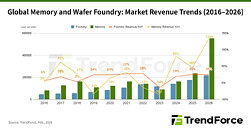 This time, the AI-driven cycle is even more supply-constrained and structurally tighter. There's a greater focus on real-time responsiveness and efficient data access as the AI industry shifts from model training to large-scale inference, which sustains growth in server-side demand for high-capacity, high-bandwidth DRAM, with per-server memory configurations also increasing.
Furthermore, NVIDIA's promotion of its Vera Rubin platform has boosted the demand for high-performance storage, emphasizing the need for enterprise SSDs. To optimize token-generation performance while maintaining cost efficiency, operators will increasingly use high-capacity QLC SSDs to meet large data access demands.
Another key difference from past cycles lies in the buyer profile. Rather than being led primarily by end-device manufacturers, the current wave is driven by CSPs. CSP procurement volumes are growing exponentially, and their relatively lower sensitivity to pricing has enabled record-high price increases exceeding those seen in the previous supercycle.
Foundry growth is more moderate due to capacity structure and pricing mechanisms
Although wafer foundries are gaining from the high demand for AI chips, their revenue growth is generally steadier compared to the memory industry. This difference mainly stems from industry structure and pricing factors.
Advanced-node processes command very high unit prices and have supported industry growth in recent years. However, significant technical barriers and capital intensity have led to a highly concentrated supplier landscape, thereby limiting the pace of capacity expansion. Furthermore, mature nodes still account for roughly 70-80% of total foundry capacity, while advanced nodes represent only about 20-30%. This means, even with premium pricing, advanced processes contribute less to overall revenue.
Additionally, the foundry industry's reliance on contract-based business and long-term agreements reduces price volatility, resulting in less frequent sharp price swings—whether upward or downward—compared to the memory market.
Memory capacity expansion is more flexible than foundry
The growing revenue disparity between the memory and foundry sectors also stems from differences in how they expand their capacity. A key factor is the level of product standardization: memory makers mainly produce standardized, basic product mixes, while foundries that produce mature-node chips, must accommodate a diverse array of process technologies, from 28 nm to beyond 90 nm.
Another factor is that memory products typically require fewer mask layers than logic chips. Consequently, memory makers can convert capital expenditures into effective output more efficiently than pure-play foundries.
TrendForce observes that, since the AI boom is still gaining momentum and supply shortages are unlikely to be resolved soon, memory suppliers maintain very strong pricing power. With ASPs rising due to ongoing supply-demand gaps, the memory industry's revenue growth is projected to outstrip that of wafer foundries.
Source:
TrendForce
A new memory supercycle: Demand resilience and pricing power far stronger than in 2017
The previous memory supercycle from 2017 to 2019 was primarily driven by cloud data center expansions and resulted in a significant gap between memory and foundry revenues.

Furthermore, NVIDIA's promotion of its Vera Rubin platform has boosted the demand for high-performance storage, emphasizing the need for enterprise SSDs. To optimize token-generation performance while maintaining cost efficiency, operators will increasingly use high-capacity QLC SSDs to meet large data access demands.
Another key difference from past cycles lies in the buyer profile. Rather than being led primarily by end-device manufacturers, the current wave is driven by CSPs. CSP procurement volumes are growing exponentially, and their relatively lower sensitivity to pricing has enabled record-high price increases exceeding those seen in the previous supercycle.
Foundry growth is more moderate due to capacity structure and pricing mechanisms
Although wafer foundries are gaining from the high demand for AI chips, their revenue growth is generally steadier compared to the memory industry. This difference mainly stems from industry structure and pricing factors.
Advanced-node processes command very high unit prices and have supported industry growth in recent years. However, significant technical barriers and capital intensity have led to a highly concentrated supplier landscape, thereby limiting the pace of capacity expansion. Furthermore, mature nodes still account for roughly 70-80% of total foundry capacity, while advanced nodes represent only about 20-30%. This means, even with premium pricing, advanced processes contribute less to overall revenue.
Additionally, the foundry industry's reliance on contract-based business and long-term agreements reduces price volatility, resulting in less frequent sharp price swings—whether upward or downward—compared to the memory market.
Memory capacity expansion is more flexible than foundry
The growing revenue disparity between the memory and foundry sectors also stems from differences in how they expand their capacity. A key factor is the level of product standardization: memory makers mainly produce standardized, basic product mixes, while foundries that produce mature-node chips, must accommodate a diverse array of process technologies, from 28 nm to beyond 90 nm.
Another factor is that memory products typically require fewer mask layers than logic chips. Consequently, memory makers can convert capital expenditures into effective output more efficiently than pure-play foundries.
TrendForce observes that, since the AI boom is still gaining momentum and supply shortages are unlikely to be resolved soon, memory suppliers maintain very strong pricing power. With ASPs rising due to ongoing supply-demand gaps, the memory industry's revenue growth is projected to outstrip that of wafer foundries.
15 Comments on AI-Fueled Supercycle Propels Memory Market Revenue to More Than Twice That of Foundry Industry
Then again, it's Pandemic-year+6.
The regulatory bodies won't investigate when policy makers are in on the whole AI scheme.
What will be left after a year or two? A technology nuclear winter with swathes of the tech industry and global economy destroyed, probably with civil unrest as well but who knows exactly.
The reality check is happening, that's what this is. Things get worse before they get better.
If we found a way to utilize drinking water in some way more profitable than drinking, we'd have billions dead before we would even start to investigate why people aren't investing more than businesses if their lives depend on it...
I think there is also a drive to slowly shift everyone to "hardware by subscription", that's why noone is trying to save personal computer - but that isn't even properly set up, I think usefulness of AI as means of reducing company costs, reducing dependency on human work took off way sooner than anyone predicted.
I'd say "follow the money" but they've unfortunately become very good at obfuscating transactions through 3rd parties...
exactly why I hope for and AI crash/bubble pop as early as possible so we can avoid reaching the peak and fall from a lesser height of risk but that entire shitstorm was started and is propelled by corpos that actually have real money to throw around and keep it alive and floating for a long as they can possibly afford it and unfortunately that's gonna be a long time
I'm curious to see at which point will NshittAI/M$lop will stop sending billions-scale life support packages to OpenAI and if that moment would be the trigger for the crash
yeah, we're already engaged unto the slop(e) and at an alarming speed, remains to see if we're gonna end up into a bush or wrapped around a tree trunk.
there's nothing wrong with AI use -we use plenty of it at work to make some powershell script to do things on active directory and whatnot- but they need to stop building apps and core code with AI, they'll run out of clean code to train their models on at some point if they didn't already reach that point by now.
These companies are also making money hand over fist, they have never been more profitable. Why would anyone of them want to rock the boat by rushing out and invest heavily to increase their manufacturing capacity? Over investments will just result in creating oversupply, this is the last thing they need. All of them have all seen this movie before, the cyclical and volatile nature of the memory market always start with a boom that will eventually turn into a bust.
If we can see there's a bubble in AI, then I am sure they can see it as well. This means they are probably even more risk adverse when it comes to investing in building new manufacturing plants. The last thing they want is to lose their pants when the inflated bubble bust.
Micron recicved funding at the expense of taxpayers to expand, but instead they exited the consumer market, and delayed new fab expansion, to go hop on the AI hype train. IMO there needs to be regulations against companies ignoring the market they're essentially being funded by.
There would be no oversupply, datacenters aren't going away, nor is the demand for tech being manufactured that needs memory.
The rate at which corpos are pushing for with AI isn't sustainable, and ironically we won't be able to buy new devices to consume the AI companies want us to use.Corporations making water more profitable to sell than for drinking is what is happening with datacenters, using millions of gallons of water, while those unfortunately living near a water cooled server farm are facing issues with water pressure or unsafe drinking water.
But the shift towards hardware subscriptions in the cloud is something companies have wanted for a while, Microsoft for example with 365 apps, windows 365, forcing Microsoft accounts and copilot onto users, and the increasing amount of parts of the OS getting webview thrown on top of old code. And now the change can happen more quickly when companies can rent out extra server capacity because the average person will be priced out of owning a PC. At most we'll only be able to buy low powered thin clients which will still need some subscription service to play games or do any performance intensive tasks.
The only question is how much money with CXMT make, and how much capacity will they build out, before this crashes?
Never mind the fact that simply allowing memory to be controlled in such a manner will harm many industries and could even be a security threat. Memory is increasingly important and thus the impact of not having it / having to pay 4-5x is significant.
End of the say this isn't a matter of justification for government action, such a thing would be entirely justified. It's a matter of whether we will actually see that.What you are describing is the propensity for competitors in a low regulatory capitalist market to behave like cartels. In a healthy market companies that jack up prices 4-5x get their lunch eaten by competitors.
To me it sounds like you are arguing for nationalization but we already paid these companies money to ensure secure supply. There's no excuse here.