Monday, July 8th 2013

Intel Roadmap Outlines LGA to BGA Transition
Intel's first processors in the BGA (ball-grid array) package, arrive by the end of 2013, according to a leaked roadmap slide. Some of the first of these processors will span across entry-level market segments, covering the Celeron and Pentium brands. The term system-on-chip (SoC) better defines these chips than processors, as they completely integrate the processor as we know it, with the motherboard chipset. Motherboards with BGA processors come with the processors non-replaceable, and hard-wired to the board, with a stock fan-heatsink.
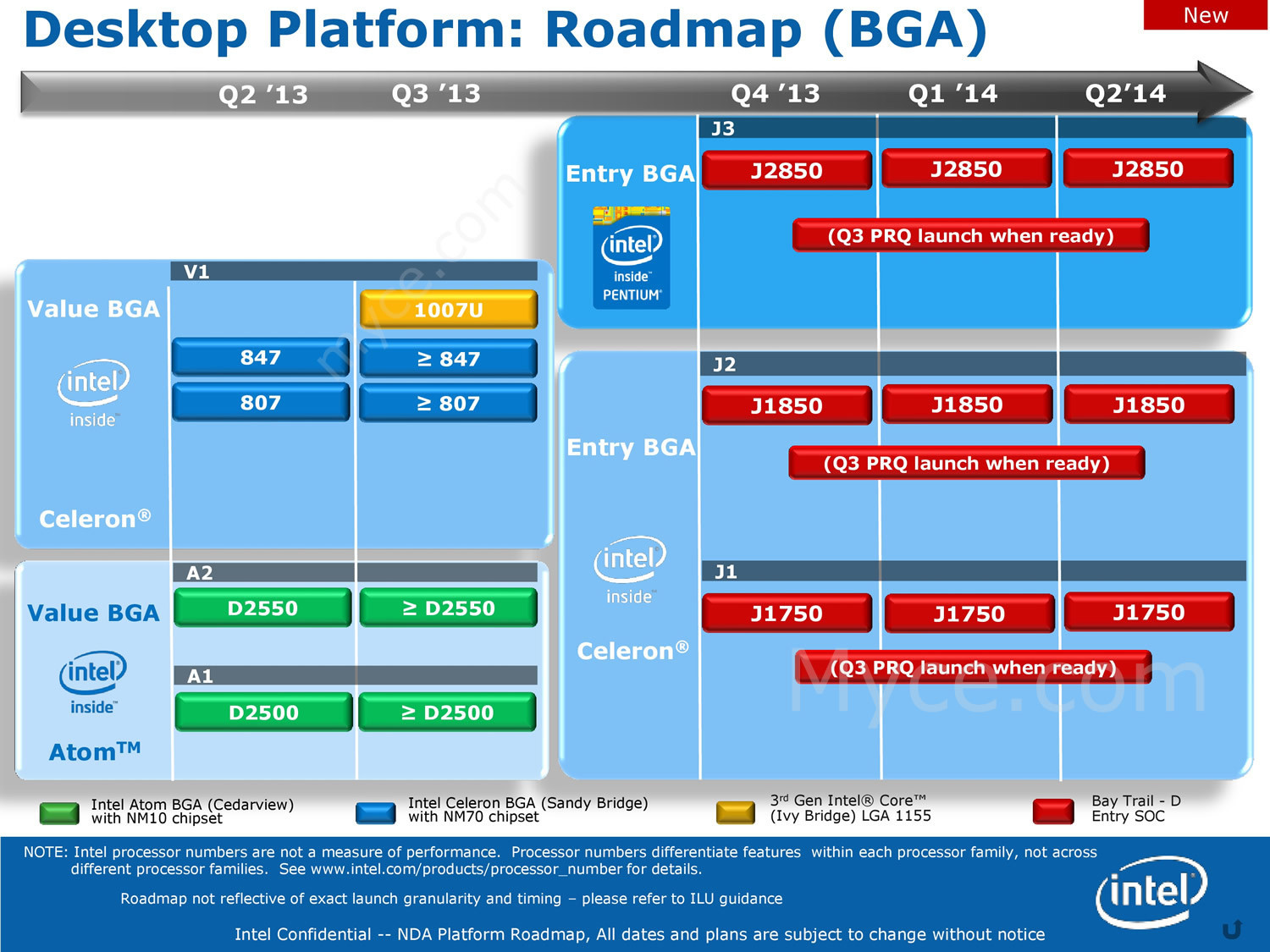
Intel's first SoCs for the desktop are based on the "BayTrail-D" silicon. These include the Celeron J1750, Celeron J1850, and Pentium J2850. Celeron J1750 is a dual-core part, with the CPU cores clocked at 2.41 GHz, GPU at 792 MHz, and a TDP rated at just 10W. Celeron J1850, on the other hand, is a quad-core part, with its CPU cores clocked at 2.00 GHz, and the same 792 MHz GPU. Pentium J2850 tops the series, being a quad-core part with CPU cores running at 2.41 GHz, and GPU at 792 MHz. Both these quad-core parts stick to 10W TDP. Being SoCs, these chips integrate connectivity otherwise handled by a PCH, into the processor package. According to an Intel roadmap slide, the three parts will spearhead Intel's BGA CPU lineup deep into 2014, at least as far as late-June.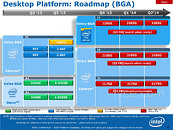
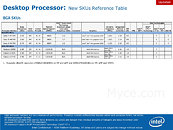 Then there are the mainstream-thru-performance segments. These are chips based on the Haswell-GT3 package. Haswell GT3 is a quad-core Haswell silicon with a larger iGPU. This iGPU features double the number of execution units to conventional Haswell GT1/GT2 (40 EUs vs. 20 EUs); and a large L4 eDRAM cache. Among the first BGA performance-segment parts from Intel, are the Core i5-4570R, i5-4670R, and Core i7-4770R.
The i5-4570R features 2.70 GHz CPU clocks, 3.20 GHz Turbo Boost, 4 MB of L3 cache, Iris Pro 5200 graphics clocked at 1150 MHz, and 65W TDP. The i5-4670R ups that with 3.00 GHz CPU clocks, 3.70 GHz Turbo Boost, the same 4 MB of L3 cache, but faster Iris Pro graphics clocked at 1.30 GHz. Leading the pack is the Core i7-4770R, with 6 MB L3 cache, HyperThreading, 3.20 GHz CPU clocks, 3.90 GHz Turbo Boost, and the same 1.30 GHz graphics core.
Source:
MyCE
Intel's first SoCs for the desktop are based on the "BayTrail-D" silicon. These include the Celeron J1750, Celeron J1850, and Pentium J2850. Celeron J1750 is a dual-core part, with the CPU cores clocked at 2.41 GHz, GPU at 792 MHz, and a TDP rated at just 10W. Celeron J1850, on the other hand, is a quad-core part, with its CPU cores clocked at 2.00 GHz, and the same 792 MHz GPU. Pentium J2850 tops the series, being a quad-core part with CPU cores running at 2.41 GHz, and GPU at 792 MHz. Both these quad-core parts stick to 10W TDP. Being SoCs, these chips integrate connectivity otherwise handled by a PCH, into the processor package. According to an Intel roadmap slide, the three parts will spearhead Intel's BGA CPU lineup deep into 2014, at least as far as late-June.
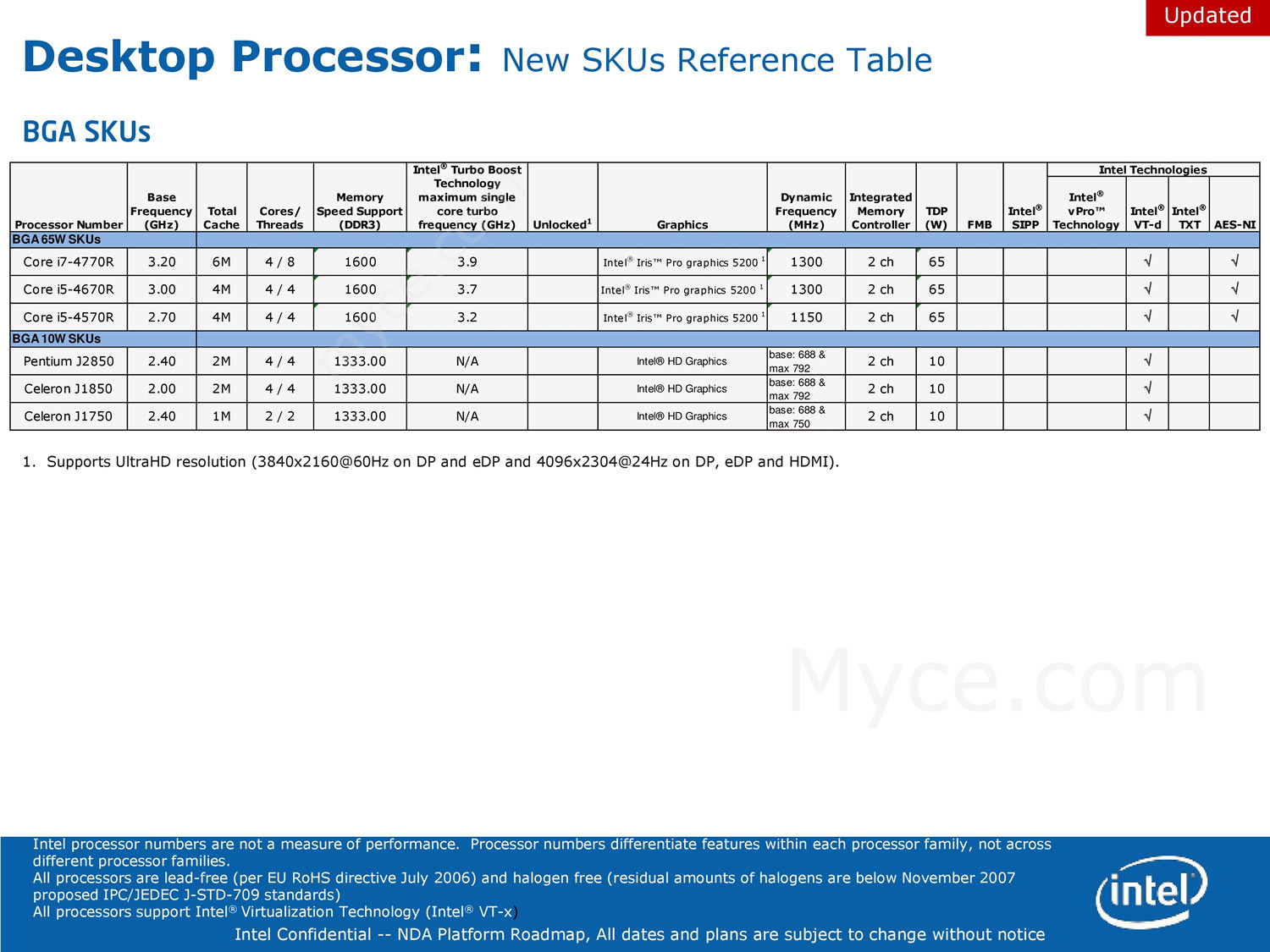
The i5-4570R features 2.70 GHz CPU clocks, 3.20 GHz Turbo Boost, 4 MB of L3 cache, Iris Pro 5200 graphics clocked at 1150 MHz, and 65W TDP. The i5-4670R ups that with 3.00 GHz CPU clocks, 3.70 GHz Turbo Boost, the same 4 MB of L3 cache, but faster Iris Pro graphics clocked at 1.30 GHz. Leading the pack is the Core i7-4770R, with 6 MB L3 cache, HyperThreading, 3.20 GHz CPU clocks, 3.90 GHz Turbo Boost, and the same 1.30 GHz graphics core.
55 Comments on Intel Roadmap Outlines LGA to BGA Transition
Could be just for INTEL mobo's tooYeah those toasty IBM chips who could forget those.
I don't think intel will bga all there chips , certainly doing so on server and enthusiast lines is just passing trade to amd but to me bga is a big step back for everyone but intel, no sooner have intel got most of a pc on a 1 inch ( yeah ish it dont matter) chip and they're making the chip itx size minimum ,, feckin odd world.
All in all I don't mind this one bit. I'm quite sure the enthusiasts will have to move to workstations sooner or later anyway. :laugh:
We will have to see how far INTEL takes this.
im planning on an intel build maybe this winter, but i certainly wouldnt buy BGA.
would be a shame if it were all BGA. but intel arent that stupid, and having LGA and BGA would open doors for revunue and possibly create a whole new era of small 'apple-like' systems!
What if your board dies, and the bga chip on it is a real nice overclocker? you might get a crappy one in exchange.
Keep hold of them nice boards and chips guys, if Intel has it's way we will all be using the same board and cpu.
Asus or other manufacturers wont install an IHS as it will likely void their warranty with Intel. :laugh: Can't exactly read the serial number off of the processor when a chunk of metal is glued to it.
I have faith in the motherboard manufacturers putting their expertise in graphics card cooling to good use.
^CPU with an IHS
^CPU with a bare die
It is a valid argument. Non upgrade PCs tend to get thrown out when their usefulness is done. That is a lot of excess hardware. Not everything gets e-wasted. Sure China has a massive stockpile of materials to just keep making more but that isn't going to last forever. Specially not with how anemic current space programs are. Demand just increases and supplies are not auto replenishing.
I see three scenarios for the mainstream market:
1) Intel Motherboard/CPU market shrinks a little (do not kid yourself, we enthusiasts barely make a dent into Intel's revenue)
2) Motheboard manufacturers offer BGA CPUs adapted to LGA, i.e. the slotket all over again (will Intel allow this???)
3) AMD marketshare raises significantly (+30%) and forces Intel's hand to release new socketed processors (very unlikely, see 1)
- less common format
- enthusiast excuse
Other than that, I don't mind BGA for my secondary computers, which never get upgrades or have a need for bleeding edge speed. Unfortunately, it amounts to getting less for the same price or more because there will be a manufacturing savings but we wont see any trickle down savings, it's been proven that that concept doesn't work.
The second part is speculation. I personally do not think it'll change anything.