Monday, April 25th 2016
AMD Polaris 10 "Ellesmere" as Fast as GTX 980 Ti: Rumor
At a presser in Taiwan for its Radeon Pro Duo launch, AMD talked extensively about its upcoming "Polaris" and "Vega" family of GPUs. The company appears to be betting heavily on two SKUs it plans to launch this June, Polaris 10 and Polaris 11. Polaris 10 is an internal designation to Radeon R9 490(X), based on the 14 nm "Ellesmere" silicon. It may be the biggest chip AMD builds on the "Polaris" architecture, but it won't exactly be a "big chip," in that it doesn't succeed "Fiji." That honor is reserved for "Vega," which debuts in early-2017.
The "Ellesmere" silicon is more of AMD's competitor to NVIDIA's GP104. It is rumored that the R9 490(X), based on this silicon, will offer consumers performance rivaling the GeForce GTX 980 Ti (ergo faster than the Radeon R9 Fury X), at a USD $300-ish price point. "Ellesmere" will be a lean-machine, physically featuring up to 2,560 4th generation GCN stream processors (2,304 enabled on Polaris 10), a possible 256-bit GDDR5X memory interface, and a deep sub-200W typical board power rating.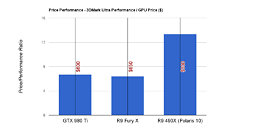
Source:
GameDebate
The "Ellesmere" silicon is more of AMD's competitor to NVIDIA's GP104. It is rumored that the R9 490(X), based on this silicon, will offer consumers performance rivaling the GeForce GTX 980 Ti (ergo faster than the Radeon R9 Fury X), at a USD $300-ish price point. "Ellesmere" will be a lean-machine, physically featuring up to 2,560 4th generation GCN stream processors (2,304 enabled on Polaris 10), a possible 256-bit GDDR5X memory interface, and a deep sub-200W typical board power rating.

91 Comments on AMD Polaris 10 "Ellesmere" as Fast as GTX 980 Ti: Rumor
Sorry i didnt how to hide the image on a spoiler thing (:3)rz
And one thing.... people kinda not remember the relation performance between 780ti and 970
Still my bet is on .... something between 980 and fury/980ti
And for the price 300-400USD
GPUs just add in more processing blocks, maybe chance cache hierarchy, layout, display controller, memory control. Very different is the purposes they are used for.
Long answer: The task a CPU and a GPU are fundamentally different, but the core of it related to your question is parallelism. The GPU tasks are almost perfectly parallelizable while the CPU tasks normal users are doing are not. That is why Fiji has over 4000 cores while S 1151 tops out at 4 cores. Adding extra cores for the CPU does not help, so Intel takes the space saved in each node shrink and ads GPU and other stuff.
Then nvidia will have its own mainstream card around 300USD which ultimately if history is our friend, will beats AMD in 75% of the benchmarks, which will have AMD drop 30 bucks off their original price to remain "competitive" but nvidia will still sell shit loads of cards because in the end, gamers want the best frame rate.
That's my 2 cents ...
Roy Taylor talks about Polaris.What he doesn't tell is that, nvidia will have a replacement at some point for 970, at for sure will have 980+ performance at lower prices.
The top end Polaris 10 might make it to 390/970 level, but just barely. That means competing 28nm cards will be even cheaper for the people wanting the cheapest minimum VR spec. And it's not like Nvidia is going *only* build high end cards with the new node. It's pretty certain they will cover the full range with it before AMD does.
Edit: Having a mainstream card that's as fast as 980Ti would be an achievement, though.
Polaris has 90% the FP resources of the Hawaii chip. I think Polaris has improved "shader-efficiency" over current GCN chips. Polaris should also have memory compression for frame buffer color data, which helped quite a bit with Tonga. Hawaii chips lack this feature.
In the worst case, Polaris XT will match Hawaii XT, which should place it in a very competitive position against Hawaii based cards.
- Nvidia is first to the market with a flagship, milks customers for months
- AMD releases a flagship that's a tad faster than Nvidia's
- Nvidia cuts prices, so AMD gets no chance to make a profit
It's true that money's in the mid-range segment (and OEM), but let's not ignore the elephant in the room: this is the first time Nvidia will release a new flagship and AMD won't have an answer for about a year. And their argument about "VR TAM" is pure rubbish, that's what scares me the most - it means there's no other reason they did this except they couldn't build a proper flagship yet.
As for Polaris 10 positioning, I don't think it's over-optimistic to expect Polaris10 XT to outperform Hawaii XT despite having 90% the SP count of Hawaii. Given the higher shader efficiency, new "geometry engine", pixel color compression, and potentially higher clock speeds of Polaris 10, I think it's highly unlikely for Polaris10 cards to not outperform their Hawaii counterparts.
The other point to be made is that it seems that AMD's cards perform quite a bit better than Nvidia's in DX12.
This trend will continue with the new cards, I think. This will help AMD in the benchmarks.
I think RTG is distancing the traditional idea of some price/performance benchmark leader dictating you get the utmost experience. Honestly, I don't know how RTG can thwart the ingrained perception of if you don't lead in benchmarks you lose. RTG will have to find a way that says for 1440p (or whatever) just looking at max/average frame rate is no longer the "end-all-be-all". The technology and hardware that improved pixels, more color, offer a more immersive experience is what you should look for. As long as the frame-rate and frame-pacing is smooth and consistent, you rely more on the hardware to improve quality; and less on the settings in the game or other middle-ware to improve what your eyes perceive. The problem is that becomes more subjective than a B-M just run with all the setting Ultra-out. Instead of games holding on to the dark, brood'ish, Cinematic or Comic book appearance, many games will make use of the such new technologies and hardware to offer more real-life immersive appearance, as what V-R is going to offer and feel like.
A 200mm² chip is not going to be hig-end, and even AMD says they're targeting mainstream. You'll have to wait at least until Vega before AMD is even trying, if ever again.How would memory compression help with bad performance? AMD has plenty of memory bandwidth, that is really not the issue.
Crossfire R9-390X cards should be fine for gaming.
Also, I have a pair of 980Ti cards in SLI in another box, and those are wicked-fast.
They should both (AMD & NVIDIA) release whatever they're going to, and I'll wait for reviews and prices to stabilize before I consider buying anything else.