Monday, April 25th 2016
AMD Polaris 10 "Ellesmere" as Fast as GTX 980 Ti: Rumor
At a presser in Taiwan for its Radeon Pro Duo launch, AMD talked extensively about its upcoming "Polaris" and "Vega" family of GPUs. The company appears to be betting heavily on two SKUs it plans to launch this June, Polaris 10 and Polaris 11. Polaris 10 is an internal designation to Radeon R9 490(X), based on the 14 nm "Ellesmere" silicon. It may be the biggest chip AMD builds on the "Polaris" architecture, but it won't exactly be a "big chip," in that it doesn't succeed "Fiji." That honor is reserved for "Vega," which debuts in early-2017.
The "Ellesmere" silicon is more of AMD's competitor to NVIDIA's GP104. It is rumored that the R9 490(X), based on this silicon, will offer consumers performance rivaling the GeForce GTX 980 Ti (ergo faster than the Radeon R9 Fury X), at a USD $300-ish price point. "Ellesmere" will be a lean-machine, physically featuring up to 2,560 4th generation GCN stream processors (2,304 enabled on Polaris 10), a possible 256-bit GDDR5X memory interface, and a deep sub-200W typical board power rating.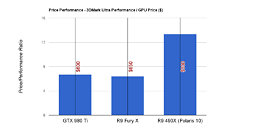
Source:
GameDebate
The "Ellesmere" silicon is more of AMD's competitor to NVIDIA's GP104. It is rumored that the R9 490(X), based on this silicon, will offer consumers performance rivaling the GeForce GTX 980 Ti (ergo faster than the Radeon R9 Fury X), at a USD $300-ish price point. "Ellesmere" will be a lean-machine, physically featuring up to 2,560 4th generation GCN stream processors (2,304 enabled on Polaris 10), a possible 256-bit GDDR5X memory interface, and a deep sub-200W typical board power rating.

91 Comments on AMD Polaris 10 "Ellesmere" as Fast as GTX 980 Ti: Rumor
So lets assume that Samsung/GF/AMD face the same challenge . Cost will be about the same as the previous generation , but performance will be greater . Probably they will open with a price hike to make current stock seem worth while. My guess is $340 US for the R9 490 . Add another $50 to that for the 480X . Still undercutting the 980ti by about $150
Perhaps AMD managed to find major bottleneck/bottlenecks in their earlier "GCN" designs and fixed them with Polaris. We don't know. What we know is that they claim to have improved "shader efficiency", which means more performance with the same amount of processing power or SP count. They also claim to have improved Tessellation performance, which is a major weakness of AMD cards.
The same goes for Nvidia, we don't how well their new chips will perform. We need to wait to see.
Back when the 4000 and 200 series cards were released, the 4870 was position by AMD against the GTX980. Well... it turned out that the 4870 could wrestle with the GTX280 and beat it in some games.
techreport.com/review/14990/amd-radeon-hd-4870-graphics-processor
Slower, more power hungry and more expensive NV chips still kept more than 50% of the market share.
=[They demoed a game though. So "980 Ti" levels comes from there.
I'm not talking about PS4k chip, though.It's "kinda confirmed" that GPU speed will more than double. So it comes down to how do you rate 7870 in the "optimized for this card" context.
Buy an R9 390 or a GTX 970 . The AMD is marginally cheaper . The two swap the lead in games at 1080p , but the R9 is better at higher resolutions [ usually ] . And the Radeon architecture looks to be the better option for DX 12 [ in the very few examples available ]
How does the AMD need to be twice as good?
What we do know is that polaris is using way less power than current generation nvidia graphics cards at similar performance levels . That is as you would expect . 14nm vs 28 nm .
As for which of the new architectures will perform better per watt and per dollar is anyone's guess
Way too early to call.
Its almost like you have abandoned logic and reason to tell us how much better you think one brand is compared to the other.
So I will repeat a few points
1/ In the very few DX12 benchmarks available the existing radeon architecture is well out performing the current nvidia chips . This might be a trend , or it might be just a few results that do not indicate a trend .
2/ AMD say much lower power consumption , and much higher performance per watt . We can judge who has the most power efficient architecture AFTER next gen cards are reviewed and not before .
3/ It looks like nvidia is opening their 16 nm manufacture with high end cards that will be sold in very small number . AMD have aimed squarely at the performance enthusiast market where they hope to get the highest turn over and market penetration .
4/My "dreams" dont affect hardware performance . But then neither do yours so its best we wait for some actual benchmarks
Secondly if the margins seen in DX 12 apply to next generation cards as well then you could turn down AMD clock speed 20% cutting power consumption by more than 50% and still be competitive with nvidias architecture . This is also a spurious argument .
Arguably the 14nm finfet process is superior to TSMC's 16 nm . But that also might not matter .
Lets wait and find out after the cards are released
So when we want to look at apple to apples power consumption, lets look at why its more on many chips, and the issues faced by Nvidia with multiple displays and corruption, poor video playback, and TDR issues with power switching.
As I was alluding to, Fury X had 4,000+ cores vs. 980Ti with 3,000+ cores. They performed similarly. To think that the new Pascal architecture wouldn't also improve shader efficiency is foolish.
Which is Imo more accurate estimation.
This is just around AMD 390x and Nano or 980GTX perf... Same with GP104 Pascal between 980 and 980Ti..