Thursday, March 2nd 2017

AMD's Ryzen Debut: Onwards to the HEDT Market or The Stumbling Hype Train
I should break down the bad news first: we here at TechPowerUp won't be able to provide you with a timely, straight-from-the-oven Ryzen review. Like some other publications, our Ryzen review sample failed to arrive on time. And trust us - we did will it to do so as much as we could, risking a Stranger-Things-esque nosebleed. Alas, to no avail.
The good news is that while we won't be able to offer you our own review of AMD and Jim Kellers' latest high-performance x86 brainchild, we will still strive to bring you meaningful coverage on it. This article aims to make an overall aggregation on review consensus, benchmarks and capabilities of the newest AMD CPU. Trying to add something, we'll also try and evaluate whether AMD learned - or didn't learn - something from its Bulldozer launch fiasco, in a pure marketing perspective. This will justify the editorialized nature of this article, but only after we dive straight to the numbers. Without further ado, follow on to the numbers.
 Multimedia, Encoding, Scientific
Reviews show consensus in that Ryzen is a powerhouse of a processor when it comes to multimedia and encoding workloads, mostly crushing Intel's competition - even in comparisons between chips with an identical number of cores. We've taken results from AnandTech, Tom's Hardware, Techspot, and Ars Technica, so as to be able to show you what different publications achieved with their Ryzen samples.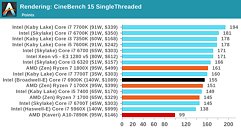
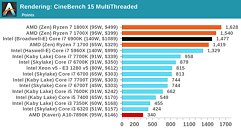
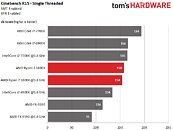
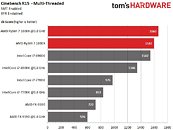
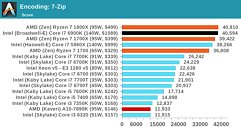
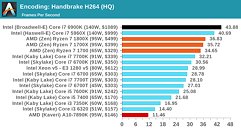
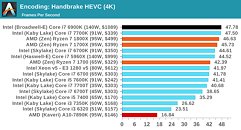
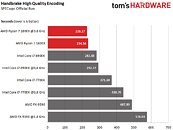
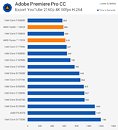
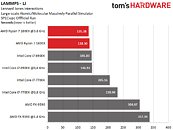 The results really do speak from themselves: AMD's Ryzen are beastly workstation CPUs, pulverizing any competition that Intel has to offer purely in price/performance ratio - and yes, what you see up there is a $499, 95W Ryzen 7 1800X offering more than double the price/performance ratio of Intel's $1089, 140 W i7 6900K. What this represents is AMD's best-case scenario of optimization and performance, and here you can see where all the hype landed: AMD's ZEN architecture posting amazing single-threaded scores in Cinebench against all Intel processors that are even remotely clocked at the same levels. AMD seemingly has the best architecture for these kinds of workloads. Office, scientific, multimedia and encoding workloads seem to be the best fit for AMD's Ryzen, with reviewers far and wide praising the performance and power consumption in these scenarios. AMD truly delivered on the hype train, at least on this side of the equation.
While their chip may not be the fastest in every single benchmark, once you take into account some measure of pricing/performance considerations, Intel's solutions fall flat. The Ryzen 7 1800X absolutely trounces - and I mean, trounces - Intel's i7-6900K and i7-6950X in any performance/watt scenarios, which has typically been a hard playground for AMD. AMD's Ryzen is nothing short of a miracle for AMD in performance/watt terms, and is a culmination of the hype train AMD so thoroughly rode. AMD's Ryzen debut challenges even Kaby Lake in the per-core/power equation, something most of us never dreamed of seeing before. This, backed by AMD's almost revolutionary jump in IPC and single-thread performance, really is a chip to end all others, such as it stands.
Another point to consider is that AMD's Ryzen platform does all of this with measly dual-channel memory, and still goes on to beat Intel's HEDT designs which feature quad-channel memory. This really does go on to show how Intel's approach to the market and its processor and platform design has been clouded in smoke and mirrors, with no real performance advantages to be derived from them.
Gaming
Gaming, however, is another story. If you're looking for the best performer, bar none, for gaming, and have no other use for your PC's beating heart, the Core i7-7700K still remains your best performance bet, due to its inherently strong architecture and freak core-clocks. While AMD doesn't in any way steal the gaming crown from Intel, they did a damn good job at getting back on the gamer's radar. Ryzen is, above all, a competent performer, and a far cry from AMD's defunct Bulldozer and derivatives.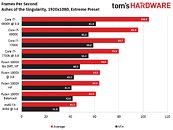
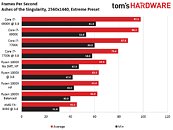
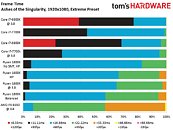
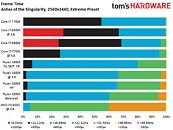
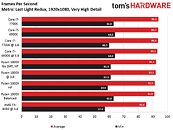
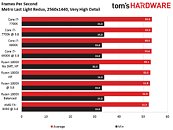

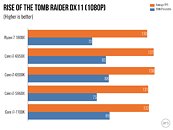
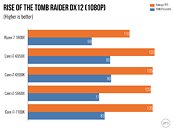
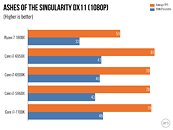
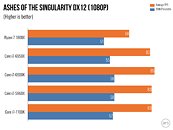
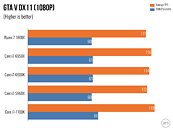 Overall, AMD's solutions are slower than their Intel counterparts in pure FPS terms. Sometimes, the actual difference, while favoring Intel's CPUs, is negligible in pure fluidity terms; in others, the difference is markedly in Intel's favor. However, we can be looking at some bugs and needed optimizations on Ryzen's microcode and software updates for gaming and applications. AMD is fast to claim that it's working with software developers to patch and improve Ryzen support, claiming that its architecture is different enough to warrant some performance outliers. If one looks towards gaming at higher resolutions and with all eye-candy turned up to 11, however, like most of us like to play, suddenly the differences between chips seem to be minimal. Furthermore, AMD has recognized that its gaming performance needs improving, and says it expects "higher performance to occur throughout Q1 and Q2" as it works with developers and engine-makers to get Ryzen up to snuff. Oxide Games' Brad Wardell, for one, mentioned that Ashes of the Singularity currently isn't optimized for Ryzen, and promised future updates would increase performance.
Other things seem to point to some underlying issues: some games show better performance with AMD's SMT disabled. AMD also says that Window's power profiles may adversely affect performance, recommending the SO's High Performance Profile. Also, some games show higher performance on Ryzen with their DX12 code-paths (Hitman), while others show lower performance with it (Rise of the Tomb Raider.) AMD also suggest disabling the HPET (High Precision Event Timer), either in the BIOS or operating system, to gain a 5-8% advantage. AMD has also reportedly informed technology partners about the need to improve microcode on Ryzen in regards to memory performance, which could be negatively affecting performance. AMD has apparently ut all of its available microcode optimizations in time for launch on the CPU cores side of the equation, somewhat leaving memory throughput, performance and latency a little on the green side. This could very well be part of the reason why the Ryzen processors don't fare so well under gaming environments.
Review consensus: AMD's Ryzen chips are promising, but are mostly - and at least for now - superseded by Intel's quad-core i7-7700K (as are most processors in Intel's line-up, for that matter), in pure gaming terms. If gaming is your primary concern, the best performing one is still the i7-7700K. This is surely disappointing from a hype-train perspective. And even if one can call AMD's Ryzen processors disappointing in gaming terms, one can also surely call Intel's chips disappointing in multimedia and encoding tasks after seeing Ryzen's debut. It's a shame, considering all the fuss about low-level APIs, DirectX 12, and all the uttered advantages of the PS4 and XBOX One multi-core CPU approaches that some more improvements still haven't been done in regards to multi-threading capability and core scalability in gaming. A last note goes to AMD's improvement over its defunct Bulldozer architecture: the improvements are such that it starts looking ridiculous.
One other thing some reviewers touched upon was gaming fluidity. Whereas Intel's i7-7700K may often post the best results in pure FPS terms, some reviewers pointed towards a prevalence of dropped frames on Intel's processor - slight hiccups in gaming that mar the otherwise stellar experience. Apparently, AMD's Ryzen 7 processors feature no such hiccups, beating Intel's i7-7700K in that regard. It is a case, it seems, of subjective experience carrying something unseen by FPS counters - to a certain degree.
Overclocking
Overclocking on Ryzen 7's chips seems to top out at 4.1 GHz (from its stock 3.6 GHz), with Techspot's Steven Walton achieving that clockspeed with a 1800X, with voltage on auto, which saw the motherboard boosting it to around 1.35v when under load. The 1700X chip, however, only managed to make 3.95GHz (from its stock 3.4 GHz). Other reviewers seemed to hit the same walls, at least on air-cooling. This seems to point to a degree of binning in the chip's allocation to either 1800X or 1700X, as would be expected, and seems to point towards a 500 MHz overclocking ceiling .
Paul Alcorn over at Tom's Hardware managed to achieve a Prime95-stable 4 GHz clock rate at 1.425V using Asus' Crosshair V Hero (with load-line calibration set to Auto), with the highest temperature being at 82°C during the stress test.
A slight note to AMD's Ryzen Master software, which the company debuted alongside its Ryzen processors, which allows you to tune a number of variables, such as the CPU's ratio multiplier, voltage, and memory speeds, from inside the operating system.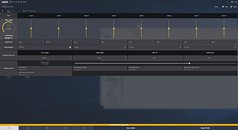 The bottom line
AMD arguably did everything right in the build-up to its Ryzen launch, the company's premier new CPU architecture that's touted to finally make it a serious contender to Intel's domination of the high-performance x86 architecture. With an under-performing and seriously outgunned architecture design on its Bulldozer line of processors - which married brains and brawn in all the wrong places - AMD found itself on a downhill battle for market share. Coupled with an over-promising, over-reaching marketing campaign, the consensus from the enthusiast community was a deserved one for AMD: the company had blatantly lied with regards to its CPUs prowess and capabilities. Lofty performance claims were the bullet-ridden corpses of AMD's dreams, made to cover a single fact: Bulldozer wasn't good enough for its surrounding environment.
A multitude of variables contributed to this particular equation: the cost in time and resources to develop with a multi-threaded workload in mind; the fact that the vast majority of consumers still carried either dual-core or quad-core systems; and Intel's own stance on the processor market, leveraging its indubitably better CPU architecture towards a steady stream of quantifiable yet unremarkable improvements over the years... Whilst keeping core-count increases away from the mainstream market through wallet-murdering pricing. Coupled with a slower than expected transition to GPU-leveraged computing tasks meant AMD's Bulldozer was ill-suited for the workloads that actually existed, much to the chagrin of many customers: that the 4-module, 8-thread 3.6GHz FX-8150 (Zambezi) generally (yet not always) led the 3.3GHz 6-core, 6-thread Phenom II X6 1100T (Thuban) K10 - but generally fell flat, performance-wise, of the 3.3GHz 4-core, 4-thread Core i5-2500 (Sandy Bridge). Lofty performance goals were cried from terraces, but when plied with scrutiny... Failed to keep in balance.
AMD's vision for Bulldozer hinged on the belief for fastly-developing multi-threaded workloads and the precipitous offload of floating point workloads to GPUs. This belief stemmed from AMD's much vaunted, then downplayed, Fusion strategy: the integration of CPU cores and GPU cores into accelerated processing units (APUs) so that mathematical tasks can use the GPU cores. Bulldozer was supposed to usher in a multi-threaded, GPU compute accelerated world. Thus, the problem with Bulldozer stemmed partly from an excessive confidence in the computing and software ecosystems. But it also has to be said that AMD maybe sacrificed too much, too soon, in regards to its generally strong K10 architecture in the pursuit of higher parallelization. The software of those days benefited from strong single-threaded performance. And until now, not much has changed (as Bulldozer's iterations can attest), and most likely won't change. Intel's decade-long approach - to have fewer, wider cores, and extract higher parallelism through the usage of Hyper-Threading - is now AMD's own as well.
Cue the Ryzen launch, and it would almost seem to be mirroring AMD's Bulldozer claims: lofty 40% improvement over the previous architecture claims were met with lukewarm enthusiasm and mild distrust from general consumers, enthusiasts and tech industry experts alike. That a company worth many times less than Intel, with a fraction of it's R&D budget, and which bled money for years, tearing itself apart with spin-offs, sales and lease-back of their own infrastructures could manage to achieve that kind of a performance uptick was a hard pill to swallow. And even so -that would hardly make it competitive with Intel's products. Follow the trickle of leaks and performance hints grew to instill confidence and enthusiasm in the x86 landscape as few times before it.
Ryzen is a return to form by AMD: a simultaneous return to the fold of the slowly-advancing ecosystem, with strong single-thread performance (right up within Intel's range), amazing multi-thread performance, and a level playing field with Intel through the use of SMT; and a look ahead at the future, with the company firmly planting its roots on a higher core-count approach without sacrificing single-threaded performance. It's one of those rare cases of having your cake and eating it too: AMD's Ryzen debut is a serious shakedown of the high-performance x86 market, having prompted various responses from Intel even before the chips were in consumers' hands. With Ryzen being what it is, and costing what it does, AMD will be stoking the furnaces at Intel for some much-delayed innovation and advancements - even if simply in core-count terms. AMD is by no means a saint, but in this case, this is most likely a turning point in the entire x86 hardware and software ecosystem - prompting a race for the pursuit of no holds-barred, increasingly-higher performance and core counts. That AMD's Ryzen is a tad disappointing in gaming terms has a measure of truth - though those differences seem to fade in high-settings, full-blown graphical presentations. But that AMD's Ryzen is a market-bending force in the multimedia, encoding and scientific workloads is a fact unto itself. And if you throw price-performance considerations into the mix, AMD's Ryzen is close to the second coming of the high-performance x86 market. It's not perfect. But it's definitely great.
AMD's toils resulted in Ryzen. A new horizon in the high-performance computing segment. And now, the ball is firmly in Intel's court, and I for one am eagerly expecting the blue giant's move.
Late edit: A last note goes to the fact that AMD's stock fell by 5.3% during the first two hours of Ryzen's launch. However, the trend has already reversed. As always, when a given product fails to hit all of the impossible marks set upon it by a hype train, Wall Street knee-jerks. However, I would say that the overturning that has already happened is here to stay, and will continue climbing to somewhere closer to AMD's pre-Ryzen-launch levels. Ryzen is a great chip, and has the potential to completely turn things around in the workstation and server market if its execution goes as planned, and even its gaming performance is subject to some measure of improvement in the coming months. AMD managed to deliver an incredible architecture from a very tight spot. Everyone will be able to see that, in time. But now, we're all still reeling from some measure of broken dreams and impossible expectations.
Sources:
Techspot, Tom's Hardware, AnandTech, ArsTechnica
The good news is that while we won't be able to offer you our own review of AMD and Jim Kellers' latest high-performance x86 brainchild, we will still strive to bring you meaningful coverage on it. This article aims to make an overall aggregation on review consensus, benchmarks and capabilities of the newest AMD CPU. Trying to add something, we'll also try and evaluate whether AMD learned - or didn't learn - something from its Bulldozer launch fiasco, in a pure marketing perspective. This will justify the editorialized nature of this article, but only after we dive straight to the numbers. Without further ado, follow on to the numbers.


Reviews show consensus in that Ryzen is a powerhouse of a processor when it comes to multimedia and encoding workloads, mostly crushing Intel's competition - even in comparisons between chips with an identical number of cores. We've taken results from AnandTech, Tom's Hardware, Techspot, and Ars Technica, so as to be able to show you what different publications achieved with their Ryzen samples.


While their chip may not be the fastest in every single benchmark, once you take into account some measure of pricing/performance considerations, Intel's solutions fall flat. The Ryzen 7 1800X absolutely trounces - and I mean, trounces - Intel's i7-6900K and i7-6950X in any performance/watt scenarios, which has typically been a hard playground for AMD. AMD's Ryzen is nothing short of a miracle for AMD in performance/watt terms, and is a culmination of the hype train AMD so thoroughly rode. AMD's Ryzen debut challenges even Kaby Lake in the per-core/power equation, something most of us never dreamed of seeing before. This, backed by AMD's almost revolutionary jump in IPC and single-thread performance, really is a chip to end all others, such as it stands.
Another point to consider is that AMD's Ryzen platform does all of this with measly dual-channel memory, and still goes on to beat Intel's HEDT designs which feature quad-channel memory. This really does go on to show how Intel's approach to the market and its processor and platform design has been clouded in smoke and mirrors, with no real performance advantages to be derived from them.
Gaming
Gaming, however, is another story. If you're looking for the best performer, bar none, for gaming, and have no other use for your PC's beating heart, the Core i7-7700K still remains your best performance bet, due to its inherently strong architecture and freak core-clocks. While AMD doesn't in any way steal the gaming crown from Intel, they did a damn good job at getting back on the gamer's radar. Ryzen is, above all, a competent performer, and a far cry from AMD's defunct Bulldozer and derivatives.


Other things seem to point to some underlying issues: some games show better performance with AMD's SMT disabled. AMD also says that Window's power profiles may adversely affect performance, recommending the SO's High Performance Profile. Also, some games show higher performance on Ryzen with their DX12 code-paths (Hitman), while others show lower performance with it (Rise of the Tomb Raider.) AMD also suggest disabling the HPET (High Precision Event Timer), either in the BIOS or operating system, to gain a 5-8% advantage. AMD has also reportedly informed technology partners about the need to improve microcode on Ryzen in regards to memory performance, which could be negatively affecting performance. AMD has apparently ut all of its available microcode optimizations in time for launch on the CPU cores side of the equation, somewhat leaving memory throughput, performance and latency a little on the green side. This could very well be part of the reason why the Ryzen processors don't fare so well under gaming environments.
Review consensus: AMD's Ryzen chips are promising, but are mostly - and at least for now - superseded by Intel's quad-core i7-7700K (as are most processors in Intel's line-up, for that matter), in pure gaming terms. If gaming is your primary concern, the best performing one is still the i7-7700K. This is surely disappointing from a hype-train perspective. And even if one can call AMD's Ryzen processors disappointing in gaming terms, one can also surely call Intel's chips disappointing in multimedia and encoding tasks after seeing Ryzen's debut. It's a shame, considering all the fuss about low-level APIs, DirectX 12, and all the uttered advantages of the PS4 and XBOX One multi-core CPU approaches that some more improvements still haven't been done in regards to multi-threading capability and core scalability in gaming. A last note goes to AMD's improvement over its defunct Bulldozer architecture: the improvements are such that it starts looking ridiculous.
One other thing some reviewers touched upon was gaming fluidity. Whereas Intel's i7-7700K may often post the best results in pure FPS terms, some reviewers pointed towards a prevalence of dropped frames on Intel's processor - slight hiccups in gaming that mar the otherwise stellar experience. Apparently, AMD's Ryzen 7 processors feature no such hiccups, beating Intel's i7-7700K in that regard. It is a case, it seems, of subjective experience carrying something unseen by FPS counters - to a certain degree.
Overclocking
Overclocking on Ryzen 7's chips seems to top out at 4.1 GHz (from its stock 3.6 GHz), with Techspot's Steven Walton achieving that clockspeed with a 1800X, with voltage on auto, which saw the motherboard boosting it to around 1.35v when under load. The 1700X chip, however, only managed to make 3.95GHz (from its stock 3.4 GHz). Other reviewers seemed to hit the same walls, at least on air-cooling. This seems to point to a degree of binning in the chip's allocation to either 1800X or 1700X, as would be expected, and seems to point towards a 500 MHz overclocking ceiling .
Paul Alcorn over at Tom's Hardware managed to achieve a Prime95-stable 4 GHz clock rate at 1.425V using Asus' Crosshair V Hero (with load-line calibration set to Auto), with the highest temperature being at 82°C during the stress test.
A slight note to AMD's Ryzen Master software, which the company debuted alongside its Ryzen processors, which allows you to tune a number of variables, such as the CPU's ratio multiplier, voltage, and memory speeds, from inside the operating system.

AMD arguably did everything right in the build-up to its Ryzen launch, the company's premier new CPU architecture that's touted to finally make it a serious contender to Intel's domination of the high-performance x86 architecture. With an under-performing and seriously outgunned architecture design on its Bulldozer line of processors - which married brains and brawn in all the wrong places - AMD found itself on a downhill battle for market share. Coupled with an over-promising, over-reaching marketing campaign, the consensus from the enthusiast community was a deserved one for AMD: the company had blatantly lied with regards to its CPUs prowess and capabilities. Lofty performance claims were the bullet-ridden corpses of AMD's dreams, made to cover a single fact: Bulldozer wasn't good enough for its surrounding environment.
A multitude of variables contributed to this particular equation: the cost in time and resources to develop with a multi-threaded workload in mind; the fact that the vast majority of consumers still carried either dual-core or quad-core systems; and Intel's own stance on the processor market, leveraging its indubitably better CPU architecture towards a steady stream of quantifiable yet unremarkable improvements over the years... Whilst keeping core-count increases away from the mainstream market through wallet-murdering pricing. Coupled with a slower than expected transition to GPU-leveraged computing tasks meant AMD's Bulldozer was ill-suited for the workloads that actually existed, much to the chagrin of many customers: that the 4-module, 8-thread 3.6GHz FX-8150 (Zambezi) generally (yet not always) led the 3.3GHz 6-core, 6-thread Phenom II X6 1100T (Thuban) K10 - but generally fell flat, performance-wise, of the 3.3GHz 4-core, 4-thread Core i5-2500 (Sandy Bridge). Lofty performance goals were cried from terraces, but when plied with scrutiny... Failed to keep in balance.
AMD's vision for Bulldozer hinged on the belief for fastly-developing multi-threaded workloads and the precipitous offload of floating point workloads to GPUs. This belief stemmed from AMD's much vaunted, then downplayed, Fusion strategy: the integration of CPU cores and GPU cores into accelerated processing units (APUs) so that mathematical tasks can use the GPU cores. Bulldozer was supposed to usher in a multi-threaded, GPU compute accelerated world. Thus, the problem with Bulldozer stemmed partly from an excessive confidence in the computing and software ecosystems. But it also has to be said that AMD maybe sacrificed too much, too soon, in regards to its generally strong K10 architecture in the pursuit of higher parallelization. The software of those days benefited from strong single-threaded performance. And until now, not much has changed (as Bulldozer's iterations can attest), and most likely won't change. Intel's decade-long approach - to have fewer, wider cores, and extract higher parallelism through the usage of Hyper-Threading - is now AMD's own as well.
Cue the Ryzen launch, and it would almost seem to be mirroring AMD's Bulldozer claims: lofty 40% improvement over the previous architecture claims were met with lukewarm enthusiasm and mild distrust from general consumers, enthusiasts and tech industry experts alike. That a company worth many times less than Intel, with a fraction of it's R&D budget, and which bled money for years, tearing itself apart with spin-offs, sales and lease-back of their own infrastructures could manage to achieve that kind of a performance uptick was a hard pill to swallow. And even so -that would hardly make it competitive with Intel's products. Follow the trickle of leaks and performance hints grew to instill confidence and enthusiasm in the x86 landscape as few times before it.
Ryzen is a return to form by AMD: a simultaneous return to the fold of the slowly-advancing ecosystem, with strong single-thread performance (right up within Intel's range), amazing multi-thread performance, and a level playing field with Intel through the use of SMT; and a look ahead at the future, with the company firmly planting its roots on a higher core-count approach without sacrificing single-threaded performance. It's one of those rare cases of having your cake and eating it too: AMD's Ryzen debut is a serious shakedown of the high-performance x86 market, having prompted various responses from Intel even before the chips were in consumers' hands. With Ryzen being what it is, and costing what it does, AMD will be stoking the furnaces at Intel for some much-delayed innovation and advancements - even if simply in core-count terms. AMD is by no means a saint, but in this case, this is most likely a turning point in the entire x86 hardware and software ecosystem - prompting a race for the pursuit of no holds-barred, increasingly-higher performance and core counts. That AMD's Ryzen is a tad disappointing in gaming terms has a measure of truth - though those differences seem to fade in high-settings, full-blown graphical presentations. But that AMD's Ryzen is a market-bending force in the multimedia, encoding and scientific workloads is a fact unto itself. And if you throw price-performance considerations into the mix, AMD's Ryzen is close to the second coming of the high-performance x86 market. It's not perfect. But it's definitely great.
AMD's toils resulted in Ryzen. A new horizon in the high-performance computing segment. And now, the ball is firmly in Intel's court, and I for one am eagerly expecting the blue giant's move.
Late edit: A last note goes to the fact that AMD's stock fell by 5.3% during the first two hours of Ryzen's launch. However, the trend has already reversed. As always, when a given product fails to hit all of the impossible marks set upon it by a hype train, Wall Street knee-jerks. However, I would say that the overturning that has already happened is here to stay, and will continue climbing to somewhere closer to AMD's pre-Ryzen-launch levels. Ryzen is a great chip, and has the potential to completely turn things around in the workstation and server market if its execution goes as planned, and even its gaming performance is subject to some measure of improvement in the coming months. AMD managed to deliver an incredible architecture from a very tight spot. Everyone will be able to see that, in time. But now, we're all still reeling from some measure of broken dreams and impossible expectations.
160 Comments on AMD's Ryzen Debut: Onwards to the HEDT Market or The Stumbling Hype Train
Just as I predicted the memory controller needs work, AMD should have gotten some great overclockers and some people who are good with BIOS's and put them together in a room with red bull or coke instead of some of their other events.
Its also VERY important to remember how fragile the IMC was for Intel on a few chips, and how shitty the original Hyperthreading really performed in all but the most cherry picked scenarios.
Dave, can we get some side by side X87 (SuperPI, Prime95) single and multiple cores, math run? How about some USB and SSD tests? Any deviation when a benchmark is run multiple times (does the AI learn anything, or does it need a kick from the highest prioity thread?) Does changing thread priority do anything?
ASUS ROG board hit 3600 MHz memory, and there are screenshots here in another thread. It's not the board.
BTW, thew board that I posted a screenshot of is only rated for 2400 MHz with 2 DIMMs, and 2666 with only one DIMM. Yet I got 3200 MHz with tight timings with two sticks. No tricks needed... I simply enabled the XMP profile.
Being able to read a manual and properly select supporting review hardware should be very basic for someone trying to review hardware accurately for their readers/viewers.Well, I got higher memory clocks, so I can tell you that it doesn't much. The CPU's cache is a bit of a bottleneck under SMT. Single-threaded workloads have enough bandwidth, only latency improvements are to be had.My 1700X pulls 100W. If a 1700 pulls 35W less, as rated, then it makes sense, and isn't really interesting at all. Unfortunately, the included cooler won't be enough to push good clocks since at the top end we I am seeing 200W+ when overclocked. Again, this is pretty basic stuff as an oc'er.Meh, I have seen enough already. :p Really though.
The challenge of pushing memory clocks will keep me interested for a little bit, but that's all.ROFL.
Oh well, will wait for another 5 years to buy a worthy CPU.
VIdeos were set to 1 minute.
- For best performance you suddenly need BIOS updates, games rewrites, etc. etc. etc. Just like with RX 480 which needed tons of work to show its true performance while so far the truth has been that NVIDIA destroys AMD in D3D 11 and earlier titles and AMD wins in some D3D 12 titles by the virtue of certain games being optimized and written for the GCN arch from the get go (read Doom). But even this advantage will soon be partially negated by D3D 12 ready NVIDIA drivers which will substantially improve NVIDIA's performance.
- TDP is enormous and even more so when being overlocked. It's nowhere near the advertised 95W. It's still miles better than with previous AMD architectures but the hype train certainly derailed here.
- AVX2 performance is halfed thus Ryzen 1800X is practically the same as 7700K in AVX2 workloads (x.265 encoding) even though it has two times more cores and substantially higher TDP.
- I wonder why I've never seen reviews prior to the launch of Ryzen which mentioned micro-stuttering in certain games with the Intel 7700K CPU. Suddenly Ryzen gives better fluidity while it's never been the case before. I call this BS.
- AMD has suddenly decided that most gamers play at 4K. Nope, it's less than 5%.
I was about to dive in but all things considered I will not be upgrading from my Intel Core 2500. Ryzen is an excellent workhorse for certain enterprise workloads but I have a simple desktop under the table. I will wait for Ryzen 2.0 with- Better overall performance
- Reworked AVX 2.0 support (not sure it's possible)
- Better clocking out of the box
- Decreased TDP
- Largely improved IMC
or Coffee Lake which will offer six cores on the desktop.Ryzen launch was certainly rushed but I do understand why AMD did that.
www.anandtech.com/show/3839/intel-settles-with-the-ftc
www.agner.org/optimize/blog/read.php?i=49#794
when it comes to intel, I never trust them... ever again.
*gagrles in ecstasy*
www.hardwarecanucks.com/forum/hardware-canucks-reviews/74814-amd-ryzen-7-1800x-performance-review-7.html
Power consumption is pretty decent, in line with enthusiast intel parts while for R7 1700 is just amazing for a 8 core 16 thread part..
Very good idle and amazing full load, even lower than the i7-6700K, which it trashes in everything but the games, and I have the feeling that will also be resolved by R5, with lower core count and higher frequency:
hothardware.com/reviews/amd-ryzen-7-1800x-1700x-1700-benchmarks-and-review?page=10
Pathetic.
Remind me, how often did we have issues with Intel's chips.
i am baffled by the "missing chip" business.
1. Was it sent in regular mail or what?
2. Has it/they arrived yet
3. Is there any point now in doing your own review?
What does AVX 2.0 have to do with SHA hashing? Who runs SHA hashing workloads on their PCs/Workstations/whatever? You want to mine? Any GPU will be from 5 to 20 times faster while mining than your super duper Ryzen CPU.
Here's one of the examples of AVX 2.0 performance in Ryzen (barely faster than 7700K):
AVX 2.0 is maimed in Ryzen due to the 128bit FMACs vs 256 FMACs in Intel CPUs and there will be no BIOS update for that.
Ryzen is doing really well in 1440p and 4K gaming when the applications are more graphics bound. And we do exceptionally well in rendering and workstation applications where more cores are really useful. In 1080p, we have tested over 100+ titles in the labs…. And depending on the test conditions, we do better in some games and worse in others. We hear people on wanting to see improved 1080p performance and we fully expect that Ryzen performance in 1080p will only get better as developers get more time with “Zen”. We have over 300+ developers now working with "Zen" and several of the developers for Ashes of Singularity and Total Warhammer are actively optimizing now
But isn't it unfair to compare CPUs if there is GPU bottleneck? Then all CPUs will perform similarly.
AMD_RobertTechnical Marketing
21 points 17 minutes ago
First, I think it's important that readers get a complete picture of a processor. People who have 1440p and 4K displays deserve to read how their potential processor will perform on the monitor they have. Don't you agree? We're also not shying away from the 1080p results. We clearly have some work to do with game developers on some of these titles to invest in the vital optimizations that can so dramatically improve an application's performance on a new microarchitecture. This takes time, but we'll get it done. But what's also clear is that there's a distribution of games that run well, and a distribution of games that run poorly. Call it a "bell curve" if you will. It's unfortunate that the outliers are some notable titles, but many of these game devs (e.g. Oxide, Sega, Bethesda) have already said there's significant improvement that can be gleaned. We have proven the Zen performance and IPC. Many reviewers today proved that, at 1080p in games. There is no architectural reason why the remaining titles should be performing as they are.True.
That allowed AMD to save quite a bit of space on Zen's silicon.
To quote you:
www.thesycon.de/eng/latency_check.shtml
I won't have my kit until next week and may not be able to put it together for a bit after that (recovering from surgery).
Thanks!
Barring highly redundant SHA hashing performance (99.99% of people run SHA hashing 0.0001% of their CPU time), Ryzen (in single threaded tasks) is a tad slower than a 6 years old Core i5 2500:
browser.geekbench.com/v4/cpu/compare/38140?baseline=1988008
But I'm positively sure AMD fans will weasel out of this comparison as well.
Overall performance vs price (including running cost potentially) for the work-load(s) you use is all that really matters, the age of the hardware is irrelevant (unless it's dying!).
According to AIDA website it even uses the latest intel vectorization:
"In this benchmark every thread is working on independent 8 KB data blocks, and the MMX, SSE2, SSSE3, AVX or XOP optimized calculation routines implement the latest vectorization idea of Intel"
aida64.helpmax.net/en/benchmark-guide/cpu-hash/
Single core performance is just fine, on par with 6900K, @155 points in cinebench 15.
A Behemoth can only be compared to another Behemoth.
I assume the parts with lower core number will do better from this perspective.