Tuesday, January 2nd 2018

VIA Making a Comeback to x86 CPU Market with Zhaoxin R&D Monies

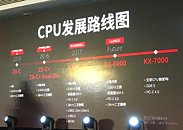
The only other active x86 architecture licensee than AMD, VIA Technologies, is planning a comeback to the x86 processor market, bolstered by R&D investment by Shanghai Zhaoxin Semiconductor. VIA and Zhaoxin have been co-developing the ZX family of x86 processors for rollout in 2018, and at least on paper, the chips appear to have the chops to take on Intel's "Gemini Lake" SoCs. The new VIA-Zhaoxin combine CPU family begins with the KX-5000 "Wudaoku" SoCs launched late-2017. These are full-fledged SoCs, which completely integrate the chipset (including the southrbidge).

The KX-5000 chips feature 4 or 8 CPU cores without SMT, 2.00-2.20 GHz nominal CPU clock, 2.40 GHz boost clock, a dual-channel DDR4 IMC, a PCI-Express gen 3.0 root complex, an integrated graphics core, and platform I/O that includes SATA 6 Gbps, and USB 3.1 gen 2. This chip debuted on only one product from a major OEM, the Lenovo M6200 desktop model launched in China. 2018 could see a broader launch of VIA-Zhaoxin chips, with the KX-6000. While the older chips were built on the 28 nm process, the KX-6000 series will be built on the newer 16 nm process, feature 4 or 8 CPU cores clocked at speeds of up to 3.00 GHz, while retaining the feature-set of the KX-5000 series. These chips could realistically be touted as low-cost alternatives to Intel "Gemini Lake" SoCs, although Zhaoxin is making bold claims about its performance nearing that of AMD Ryzen processors.
Source: Golem.de
Add your own comment

33 Comments on VIA Making a Comeback to x86 CPU Market with Zhaoxin R&D Monies

#26
lexluthermiester
RejZoRI just knew someone will say VIA is Cyrix...
It's true, both from a practical perspective and a legal one.
Posted on Reply
#27
kanecvr
john_They had performance problems with their memory controller that where fixed with the A versions in both cases. SiS was beating those first versions, with chipsets like the excellent 735 in memory performance. But VIA was also a very strong brand back then, with major influence on manufacturers, making life for SiS difficult, the way Intel was doing it for AMD.

VIA had a bad name because it was underperforming compared with chipsets from Intel. I had a BX motherboard with my first Celeron CPU that I managed to burn out of stupidity(no experience with PC hardware). The replacement was a board with VIA chipset. Even with faster 133MHz SDRAM(BX could run the memory only at 100MHz) and AGP overclocking of the graphics card from 66MHz to 75MHz the VIA board was making my system slower than with the BX.
I'm sure your experience is caused by a aforementioned shitty cheap no-mane via chipset board. Check out my threads on Vogons (marvin section) - I benchmarked most slot 1 and socket 370 chipsets last summer. The VIA Apollo PRO and Apollo 133 smoke both the i440 and i815 in AGP performance, while memory read / write speeds are very similar on both chipsets. It is the reason my Win98 P3 Tualatin rig and dual-slot 370 machine both run VIA chipset boards (Abit VH6T Rev 2.0 - VT82C694T chipset and MSI 694D Master-S for the dual P3-1100 rig, with the VT82C694XDP chipset). I was running a Abit ST6, but the VH6R scores 8% faster in 3dmark and 2-10% more in games. It was a pain in the ass to find tough, since most VH6 boards sport the older 82C693A chipset witch does not support tualatin CPUs.

Another nice feature of the VIA 82C694T is that it sports independent FSB/MEM and AGP/PCI multipliers. FSB is only tied to memory speed, and AGP is only tied to PCI speed, so running a 1000MHz P3 @ 1250MHz with SDRAM chugging along at 133MHz (100MHz setting in BIOS) is possible. I managed to clock one of my 1.4GHz tualatin chips at a whopping 1747MHz @ 1.75v using this board. Not sure if it is 100% stable, but I haven't hat time to do proper testing so far.
Posted on Reply
#28
lexluthermiester
kanecvrI'm sure your experience is caused by a aforementioned shitty cheap no-mane via chipset board. Check out my threads on Vogons (marvin section) - I benchmarked most slot 1 and socket 370 chipsets last summer. The VIA Apollo PRO and Apollo 133 smoke both the i440 and i815 in AGP performance, while memory read / write speeds are very similar on both chipsets. It is the reason my Win98 P3 Tualatin rig and dual-slot 370 machine both run VIA chipset boards (Abit VH6T Rev 2.0 - VT82C694T chipset and MSI 694D Master-S for the dual P3-1100 rig, with the VT82C694XDP chipset). I was running a Abit ST6, but the VH6R scores 8% faster in 3dmark and 2-10% more in games. It was a pain in the ass to find tough, since most VH6 boards sport the older 82C693A chipset witch does not support tualatin CPUs.

Another nice feature of the VIA 82C694T is that it sports independent FSB/MEM and AGP/PCI multipliers. FSB is only tied to memory speed, and AGP is only tied to PCI speed, so running a 1000MHz P3 @ 1250MHz with SDRAM chugging along at 133MHz (100MHz setting in BIOS) is possible. I managed to clock one of my 1.4GHz tualatin chips at a whopping 1747MHz @ 1.75v using this board. Not sure if it is 100% stable, but I haven't hat time to do proper testing so far.
Holy blast from the past time Batman!
Posted on Reply
#29
john_
kanecvrI'm sure your experience is caused by a aforementioned shitty cheap no-mane via chipset board. Check out my threads on Vogons (marvin section) - I benchmarked most slot 1 and socket 370 chipsets last summer. The VIA Apollo PRO and Apollo 133 smoke both the i440 and i815 in AGP performance, while memory read / write speeds are very similar on both chipsets. It is the reason my Win98 P3 Tualatin rig and dual-slot 370 machine both run VIA chipset boards (Abit VH6T Rev 2.0 - VT82C694T chipset and MSI 694D Master-S for the dual P3-1100 rig, with the VT82C694XDP chipset). I was running a Abit ST6, but the VH6R scores 8% faster in 3dmark and 2-10% more in games. It was a pain in the ass to find tough, since most VH6 boards sport the older 82C693A chipset witch does not support tualatin CPUs.

Another nice feature of the VIA 82C694T is that it sports independent FSB/MEM and AGP/PCI multipliers. FSB is only tied to memory speed, and AGP is only tied to PCI speed, so running a 1000MHz P3 @ 1250MHz with SDRAM chugging along at 133MHz (100MHz setting in BIOS) is possible. I managed to clock one of my 1.4GHz tualatin chips at a whopping 1747MHz @ 1.75v using this board. Not sure if it is 100% stable, but I haven't hat time to do proper testing so far.
My experience with VIA is not just one board, considering that after that first Celeron, all other processors I had where AMD. So, don't be so sure. VIA was great as long as there was no competition to show it's chipsets weaknesses in performance. The only really good thing they had to show, was their Vinyl Audio. As for your benchmarks, I doubt they are not biased/done wrong. On the other hand there where more than one 440 chipsets, but I don't remember how much better BX was compared to the other versions. Also if I remember correctly, 815 was slower than 440BX in some benchmarks. In any case Apollo 133 was much worst than 440BX. I had to overclock both the graphics card and the CPU to get the numbers I was getting with BX at defaults. And this is something I remember very well, even after 18 years. You can't forget that kind of disappointment.
Posted on Reply
#30
kanecvr
john_As for your benchmarks, I doubt they are not biased/done wrong.
20 years of experience in IT and my university degree should prove they are not. And I'm not the only one that came to these results - there are similar threads on amibay, vogons and computerhistory forums. The 440BX was only one thing, and that is stable. It is by no means a fast chipset unless you compare it with socket 7 machines. It is in fact the slowest of all socket 370 chipsets. As for the 815 being slower the the 440, that is another myth spread by people with limited patience and understanding of PC architecture - yes the 440BX is faster, but only when using PC100 SDRAM (tighter timings) and a AGP 2x video card. With a fast AGP 4x card, the 440 performs horribly. There was also the CPU cache latency issue with the 815, but since it was designed to run socket 370 chips with on die cache, it's not really an issue. Anyway, prove your claims before calling my benchmarks wrong.
john_In any case Apollo 133 was much worst than 440BX. I had to overclock both the graphics card and the CPU to get the numbers I was getting with BX at defaults. And this is something I remember very well, even after 18 years. You can't forget that kind of disappointment.
Have you seen my IMGUR album? Collecting, repairing and messing around with old x86 hardware is what I've been doing for the past 6 years. All you have to back up your claims are words. Post benchmarks to prove you claims.
Posted on Reply
#31
lexluthermiester
john_VIA was great as long as there was no competition to show it's chipsets weaknesses in performance.
john_In any case Apollo 133 was much worst than 440BX.
Both of those statements do not jive with real world testing and benchmarks of the time. VIA's chipsets operated within 3% to 5% of Intel's chipsets in most applications. I remember this debate because I lost a $250 bet about it. I was under the opinion, like yours, and a friend benchmarked VIA vs Intel based mobo's right in front of me. Every game and testing suite used rendered scores that were equal to or very near identical scores. Then the over-clocking debate started and was quickly silenced when it was shown that the CPU's actually OC'd better on VIA. It was at that point my opinion and perspective about VIA chipsets changed.
Posted on Reply
#32
john_
kanecvr20 years of experience in IT and my university degree should prove they are not. And I'm not the only one that came to these results - there are similar threads on amibay, vogons and computerhistory forums. The 440BX was only one thing, and that is stable. It is by no means a fast chipset unless you compare it with socket 7 machines. It is in fact the slowest of all socket 370 chipsets. As for the 815 being slower the the 440, that is another myth spread by people with limited patience and understanding of PC architecture - yes the 440BX is faster, but only when using PC100 SDRAM (tighter timings) and a AGP 2x video card. With a fast AGP 4x card, the 440 performs horribly. There was also the CPU cache latency issue with the 815, but since it was designed to run socket 370 chips with on die cache, it's not really an issue. Anyway, prove your claims before calling my benchmarks wrong.

Have you seen my IMGUR album? Collecting, repairing and messing around with old x86 hardware is what I've been doing for the past 6 years. All you have to back up your claims are words. Post benchmarks to prove you claims.
Look, don't get me wrong. I have my experience that tells me something completely different. Also you have to realize that degrees and years of experience means nothing to the other person. I mean, I have seen in the past people posting BS (not in this forum) and after they where getting ridiculed from many members, they where throwing degrees all over the place in a final effort to defend themselves. It's the internet. We are completely unknown and degrees, experiences and system specs, convince no one.

I repeat. Don't get me wrong. And I have to prove nothing to you, as you have to prove nothing to me. OK, it's easy to say to someone "Prove me wrong" for hardware that was sold/thrown away 20 years ago. I don't have a time machine. Do you? Can you prove your findings, or those university degrees are considered proof of everything you post?

Sorry, but I know what I have seen back then. You really don't have to convince everyone.
lexluthermiesterBoth of those statements do not jive with real world testing and benchmarks of the time. VIA's chipsets operated within 3% to 5% of Intel's chipsets in most applications. I remember this debate because I lost a $250 bet about it. I was under the opinion, like yours, and a friend benchmarked VIA vs Intel based mobo's right in front of me. Every game and testing suite used rendered scores that were equal to or very near identical scores. Then the over-clocking debate started and was quickly silenced when it was shown that the CPU's actually OC'd better on VIA. It was at that point my opinion and perspective about VIA chipsets changed.
Again. I know what I have seen back then. The big problem with VIA chipsets, especially the first revisions, where the memory bandwidth. That's why you always waited for the A versions.
Posted on Reply
#33
SaltyFish
I suppose with the Meltdown flaw affecting Intel CPUs, now's not a bad time to announce getting back into the x86 CPU market. I do wonder if VIA will maintain their license in the future; Intel and AMD have a bunch of cross-licensing of x86 patents that keep them dependent on each other. VIA has no such thing to hedge in on the duopoly. Granted, VIA isn't exactly a significant competitor. But if that's the reason VIA has been allowed to continue, that puts VIA in a crappy position with regards to potentially putting out truly competitive products.
Posted on Reply
Add your own comment
Nov 23rd, 2026 05:13 CST change timezone

New Forum Posts

Popular Reviews

TPU on YouTube

Controversial News Posts