Friday, February 6th 2026

Major PC OEMs Reportedly Exploring Chinese CXMT Memory Amid Shortages
According to Nikkei Asia, some of the biggest PC makers like ASUS, Acer, Dell, and HP are exploring alternative memory suppliers amid industry-wide memory shortages, which are forcing PC OEMs to seek supply even from Chinese memory maker CXMT. Late last year, CXMT unveiled its homegrown DDR5-8000 and LPDDR5X-10667 memory modules at the 2025 China International Semiconductor Expo. This has likely prompted many OEMs to start finding alternatives to the traditional triad of SK Hynix, Samsung, and Micron, whose supply has been very limited outside AI accelerator workloads.
CXMT offers 12 Gb and 16 Gb LPDDR5X capacities, while DDR5 scales to 16 Gb and 24 Gb module formats. The 16 Gb DDR5 chips from CXMT measure 67 square millimeters, with a density of 0.239 Gb per square millimeter. The G4 DRAM cells are 20% smaller than CXMT's previous G3 generation. Reportedly, CXMT manufactures these chips using a 16 nm node, which is three years behind Samsung, SK Hynix, and Micron in manufacturing capabilities. However, CXMT is progressing quickly, and its DRAM modules adhere to the official JEDEC specifications and even exceeding the specification, making them ideal for OEM PCs depending on the use case.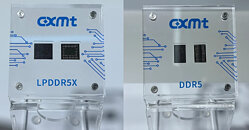 CXMT's LPDDR5X and DDR5 memories are now shipping, but we don't have the exact wafer output of CXMT's fabs. Presumably, the output could be enough to satisfy both domestic demand in China and fill the massive hole in the supply chain in the Western part of the hemisphere, which was impacted by AI. Some could cite national security concerns, but for everyday consumers, the source of their memory is the least of their concerns, as availability and pricing are the ultimate deciding factors.
CXMT offers 12 Gb and 16 Gb LPDDR5X capacities, while DDR5 scales to 16 Gb and 24 Gb module formats. The 16 Gb DDR5 chips from CXMT measure 67 square millimeters, with a density of 0.239 Gb per square millimeter. The G4 DRAM cells are 20% smaller than CXMT's previous G3 generation. Reportedly, CXMT manufactures these chips using a 16 nm node, which is three years behind Samsung, SK Hynix, and Micron in manufacturing capabilities. However, CXMT is progressing quickly, and its DRAM modules adhere to the official JEDEC specifications and even exceeding the specification, making them ideal for OEM PCs depending on the use case.

32 Comments on Major PC OEMs Reportedly Exploring Chinese CXMT Memory Amid Shortages
Go go China :D
And some articles have exactly opposite conclusions, that the output + future expansion isn't even enough for domestic AI needs, let alone other uses.
And what about announced 100% tariffs on all memory producers that don't expand US production? Chinese factories can hardly meet that.
Or that's all bs and the additional supply ends up within the AI bubble anyway.
No RAM for anyone at any sane price before 2028. Goodbye technology industry pretty much.
I agree their production is insufficient right now. They can do about 4% of global RMA production and forecast an increase to12%, but we also know how fast the Chinese can ramp things up.....so who knows. I hope they take the market by storm.
Great fucking job, I guess?
The long term geopolitical implications of this will be mind boggling. We may live to see China invading Taiwan and South Korea and the US will be not allowed to intervene because it would risk their access to semiconductors. Gonna be hilarious. Well, not for Taiwan obviously.
Yeah that is a significant variable, sure, but do anyone think that new AI-Servers are build with DDR4 Memory? The Price of a 32GB Kit of DDR4 changed from 50USD to 300USD. DDR4 uses older nodes and it is outdated tech, not used in Servers for years. They all use DDR5 and variant thereof or even HBM, certainly not DDR4.
But more competition is always a good thing for the consumers, right?
Now the supply of DDR4 has been purged due to high demand and what little production remains cannot keep up. Its not just servers either, its industrial PCs, its waves of older hardware still being used around the world, it snew builds using socket AM4 because AM5 has become unaffordable, the list goes on.
Although it would be interesting if the US gov would allow AI to quickly crash and burn because they simply wouldn't let critical allies making semiconductors and about everything else to be lost by a hostile take over.
then you have the tons of warehouses that are sitting on a crazy amount of DDR5, since they can't be put to use right not, and that's caused by all the data centers that CAN'T be built because of the shortages of the GRID hookups and the lack of capable power plants, so these companies are running around looking for places that have excess power and buying up land in anticipation that eventually, they will be able to build those data centers
Then, most of the DRAM makers have all the capable factories set to produce DDR5 which has the most profit
those that have older factories have those producing DDR4/3, but are limited by the silicon wafer shortage
so it's all a mess thanks to the billions that each of the companies are scheming to keep this going as long as possible, that's why Nvidia is giving billions to the AI guys, and the AI guys place billions of orders back to Nvidia
CXMT will likely put up a price for their RAM that will be the same for every purchaser regardless of region or nationality, with the exception of maybe throwing in a discount for anyone buying a large enough amount of RAM or signing a contract to buy X amount over a span of time. And it so happens that most if not nearly all the OEMs that'd buy the largest quantities are in the US, so I'd think US-based OEMs will have a chance to see a reduction on their total tariff costs if they buy enough amounts.
Additionally, the US has a higher purchasing power than most other markets so I don't see why CXMT would particularly care about making a massively discounted regional price for US-based OEMs, specially when the US is actively hostile to Chinese products and companies.
I can't comment more on that due to no politics.I mean memory stateside is like 4x what these cost so even with tariffs they are a good deal.