Monday, March 25th 2019

ASUS and ASRock AMD X570 Chipset Motherboards Listed
AMD X570 is the companion premium chipset option for the company's 3rd generation Ryzen "Matisse" processor family, and is expected to debut alongside the first of these processors some time in June, 2019. Unlike the X470 and X370, the new X570 will be based on an in-house chipset design by AMD, and probably manufactured at GlobalFoundries on its 14 nm node. The mid-range "B550" and lower chipset models could continue to be sourced from ASMedia. Motherboard majors ASUS and ASRock put out their first partial lists of motherboard models based on the AMD X570.
ASUS will launch as many as seven motherboard models in its Republic of Gamers (ROG) family, led by the Crosshair VIII Formula. This indicates that ASUS is placing high enough sales expectations from the "Valhalla" platform across the competitive landscape to come out with an ROG Formula product. You can expect goodies such as 8-layer PCBs, liquid-cooling preparation for the VRM heatsinks, Thunderbolt, or 10 GbE, and the most number of overclocker-friendly features. Next up, are the ROG Crosshair VIII Hero and Crosshair VIII Hero WiFi, which could be the company's second-best product offerings. For the first time on the AMD platform, ASUS will launch an ROG Impact mini-ITX product, with the ROG Crosshair VIII Impact. There will be three ROG Strix family products based on the X570, the Strix-E (premium ATX), Strix-F (mid-range ATX), and Strix-I (premium mini-ITX).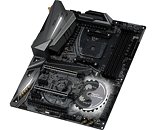 Positioned roughly in-between the Crosshair VIII Formula and Crosshair VIII Hero WiFi, will be the WS X570-ACE, a quasi workstation-grade motherboard based on this platform, which is another first by ASUS for its AMD motherboard product-stack. The mainline Prime series includes the Prime X570-Pro (mid-range) and Prime X570-P (value). There are only two TUF Gaming products, the TUF Gaming X570-Plus, and the TUF Gaming X570-Plus WiFi.
Over to the ASRock camp, and we see its lineup capped by the no-nonsense X570 Taichi. The Taichi brand by ASRock has earned reputation among enthusiasts for its minimalist, yet highly functional design, and a powerful feature-set. This will be closely followed by the X570 Phantom Gaming X. It won't surprise us if these two boards share the same PCB with cosmetic changes to their feature-sets. At the upper-mid segment ASRock is positioning the X570 Phantom Gaming 6. ASRock could heavily implement 2.5 GbE LAN across the upper half of its X570 lineup as a killer-feature. Bang in the middle of the pile is the X570 Phantom Gaming 4, which could command a sub-$150 sweetspot price. This is where the Phantom Gaming segment ends, and the Extreme series begins. The X570 Extreme4 will be the mid-range ATX offering, followed by the X570 Pro4, and X570M Pro4.
Source:
VideoCardz
ASUS will launch as many as seven motherboard models in its Republic of Gamers (ROG) family, led by the Crosshair VIII Formula. This indicates that ASUS is placing high enough sales expectations from the "Valhalla" platform across the competitive landscape to come out with an ROG Formula product. You can expect goodies such as 8-layer PCBs, liquid-cooling preparation for the VRM heatsinks, Thunderbolt, or 10 GbE, and the most number of overclocker-friendly features. Next up, are the ROG Crosshair VIII Hero and Crosshair VIII Hero WiFi, which could be the company's second-best product offerings. For the first time on the AMD platform, ASUS will launch an ROG Impact mini-ITX product, with the ROG Crosshair VIII Impact. There will be three ROG Strix family products based on the X570, the Strix-E (premium ATX), Strix-F (mid-range ATX), and Strix-I (premium mini-ITX).

Over to the ASRock camp, and we see its lineup capped by the no-nonsense X570 Taichi. The Taichi brand by ASRock has earned reputation among enthusiasts for its minimalist, yet highly functional design, and a powerful feature-set. This will be closely followed by the X570 Phantom Gaming X. It won't surprise us if these two boards share the same PCB with cosmetic changes to their feature-sets. At the upper-mid segment ASRock is positioning the X570 Phantom Gaming 6. ASRock could heavily implement 2.5 GbE LAN across the upper half of its X570 lineup as a killer-feature. Bang in the middle of the pile is the X570 Phantom Gaming 4, which could command a sub-$150 sweetspot price. This is where the Phantom Gaming segment ends, and the Extreme series begins. The X570 Extreme4 will be the mid-range ATX offering, followed by the X570 Pro4, and X570M Pro4.
49 Comments on ASUS and ASRock AMD X570 Chipset Motherboards Listed
You are mixing things up seriously, it is not a server chipset residing an array of Teslas or Instincts.
Sure, we can go on about "muh bandwidth" however, in a consumer setting, bandwidth is not really an issue anymore. There is no difference between PCIe 3.0 x8 and x16 on a single video card, the only thing GPU wise that ever pushed slots to their limit was dual GPU, which is not long dead. And thats on the highest end hardware, which only a small # of people use. The vast majority of PC gamers are still below the 1060 in performance, and play at 1080p or lower. This puts the number of gamers pushing for new PCIe as a niche of a niche market.
What about NVMe you ask? Well, I ask, why do you need more? NVMe drives today are easily 6-7X faster then the best SATA III SSDs, and yet the real world results show that does diddly squat. Load times for windows are, what, a whole second faster? Maybe 2 in a pinch? IME, CIV V takes just as long to load from my 950 pro as it did off of my old mushkin reactor SSD. Waiting for windows to load takes almost the same amount of time, and waiting for programs like STEAM and Afterburner to load after launch shows no difference either. Multiple benchmarks show no difference in consumer software between SATA and NVMe. Bulk file movements, like for 4K video editing benefit, but only on a local machine, and transferring between devices is limited by network speeds, and file sizes big enough to benefit make USB 3 drives irrelevant, even then the best only hit around SATA III speed, and super fast high density USB C 10 Gbps drives are unicorns.
I feel that we are hitting the sharp, hard wall of diminishing returns. Modern computer hardware was already way too fast for tasks outside of 3d gaming or productivity work, and this push for stupid fast internal bus speeds seems to be ignoring the potential applications for consumers when network, flash, and external storage already cant fully utilize what we have, and professional markets are already using x16 card SSDs, again asking what the consumer market well get out of this new, expensive tech. I see people here saying that having faster lanes will allow more connectivity, but surely having MORE PCI3 lanes so I dont need to split them between interfaces would accomplish this goal just as well at a far lower cost?
To me, PCI4 is just like USB 6.9 2x2 ultra mcnugget drives. Most people I know still have and use 2.0 USB drives, a few use 3.0, and those are already more then fast enough for the files they are moving. Much like how SATA III SSDs and USB 3 flash drives are more then enough for consumers, I feel PCI3 is already faster then most users will likely utilize in the next decade.
There are tons of homelab builders and even laboratories using gaming grade computer components to run experiments with GPU. Oh, did I mention there are the miners? Did they use Tesla? Or Instinct?
Professional miners, whom make up the majority of GPU mining buyers, use specialized "mining" boards with 15+ PCIe connections on them, then connect the GPU via ribbon cable, as a x1 connections sufficient for mining. Only amateurs are using gaming boards, and again, mining would not benefit from faster PCIe connectors, but rather additional lanes.
Maybe not the main frame of the school, but in a lab, in students’ office, and by professors.
Source: I am a final year PhD student in experimental quantum information. I don’t have the numbers, but I never see, unless for mission critical main frame, one will deploy anything more serious than a gaming computer, obviously due to cost.
I agree mining isn’t the best example, by pointing it out I meant there are “tons” of application that one can use the PCI-E slot for. Comments claiming PCI-E 4 on gaming board are pointless simply are beyond under-informed.
For the fun of it, we are operating two fragile, 400k+ each equipment using a “cheap” Intel 4770 computer with some random ASUS boards, this is also used for taking data. Been like this for a few years without any problems. It’s really not that crazy to see gaming hardware being used in a serious manner.
Gaming name should be scrapped for everything, ROG covers that, so Crosshair Formula/Extreme and then TUF.
Debating on a ASRock Fatal1ty x570 Gaming X or a ASUS Crosshair VIII x570. Will have to do a side by side comparison when they are released. :D
Any way, I am wondering what is it with complaining about having "TOO FAST" or "TOO MUCH" in mainstream hardware when we are finally getting more power for similar price on a each new gen.
You know something that used to be the norm is now a taboo. Am I still on an enthusiast forum these days? o_O
What I totally missed before was that it's only 2 months left to Computex.
ROG CROSSHAIR VIII FORMULA
ROG CROSSHAIR VIII HERO
ROG CROSSHAIR VIII HERO (WI-FI)
ROG CROSSHAIR VIII IMPACT
ROG STRIX X570-E GAMING
ROG STRIX X570-F GAMING
ROG STRIX X570-I GAMING
PRIME X570-P
PRIME X570-PRO
Pro WS X570-ACE
TUF GAMING X570-PLUS (WI-FI)
TUF GAMING X570-PLUS
I’m still signing myself up for the Formula if it isn’t at an extortionate price. If it is, I’ll happily settle for the Hero again. I’m still very happy with my CHVI. It’s a fantastic board.