Friday, July 17th 2020

Windows 10 Scheduler Aware of "Lakefield" Hybrid Topologies, Benchmarked
A performance review of the Intel Core i5-L16G7 "Lakefield" Hybrid processor (powering a Samsung Galaxy S notebook) was recently published by Golem.de, which provides an in-depth look at Intel's ambitious new processor design that sets in motion the two new philosophies Intel will build its future processors on - packaging modularity provided by innovative new chip packaging technologies such as Foveros; and Hybrid processing, where there are two sets of CPU cores with vastly different microarchitectures and significantly different performance/Watt curves that let the processor respond to different kinds of workloads while keeping power-draw low. This concept was commercially proliferated first by Arm, with its big.LITTLE topology that took to the market around 2013. The "Lakefield" i5-L16G7 combines a high-performance "Sunny Cove" CPU core with four smaller "Tremont" cores, and Gen11 iGPU.
The Golem.de report reveals that Windows 10 thread scheduler is aware of the hybrid multi-core topology of "Lakefield," and that it is able to classify workloads at a very advanced level so the right kind of core is in use at any given time. The "Sunny Cove" core is called upon when interactive vast serial processing loads are in demand. This could even be something like launching applications, new tabs in a multi-process web-browser, or less-parallelized media encoding. The four "Tremont" cores keep the machine "cruising," handling much of the operational workload of an application, and is also better tuned to cope with highly parallelized workloads. This is similar to a hybrid automobile, where the combustion engine provides tractive effort from 0 kph, while the electric motor sustains a cruising speed.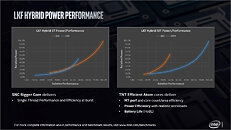
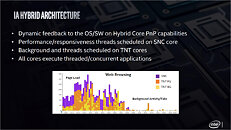
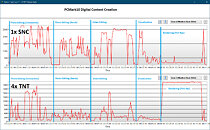
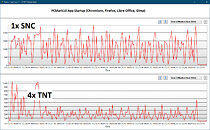 The Core i5-L16G7 has a rated SDP (scenario driven power) rating of 7 W. The package PL1 value is 7 W, too. Intel also gave the chip a PL2 value of 9.5 W, and a Tau value of 28 seconds. Some notebook vendors, however, are expected to set PL1 at 5 W. Raising it to 7 W will only be possible through a UEFI firmware update. Throughout Golem's testing, they observed that the "Sunny Cove" core kicks in during interactive workloads that require burst performance from the CPU, with the core typically clocked at 2.50 GHz, occasionally hitting 2.90 GHz. The smaller "Tremont" cores are typically clocked at 1.90 GHz during workloads, and can boost up to 2.70 GHz.
Perhaps the biggest dividend of topology-awareness by Windows OS scheduler is with the core rotation policy. By default, the Windows scheduler spreads a single-threaded workload across multiple cores (in sequence). AMD had to work with Microsoft to make Windows aware of the topology of its multi-CCX Ryzen processors, so workloads aren't spread between two CCX's if they don't have to. Similarly with "Lakefield," core rotation is localized to the "Tremont" cores.
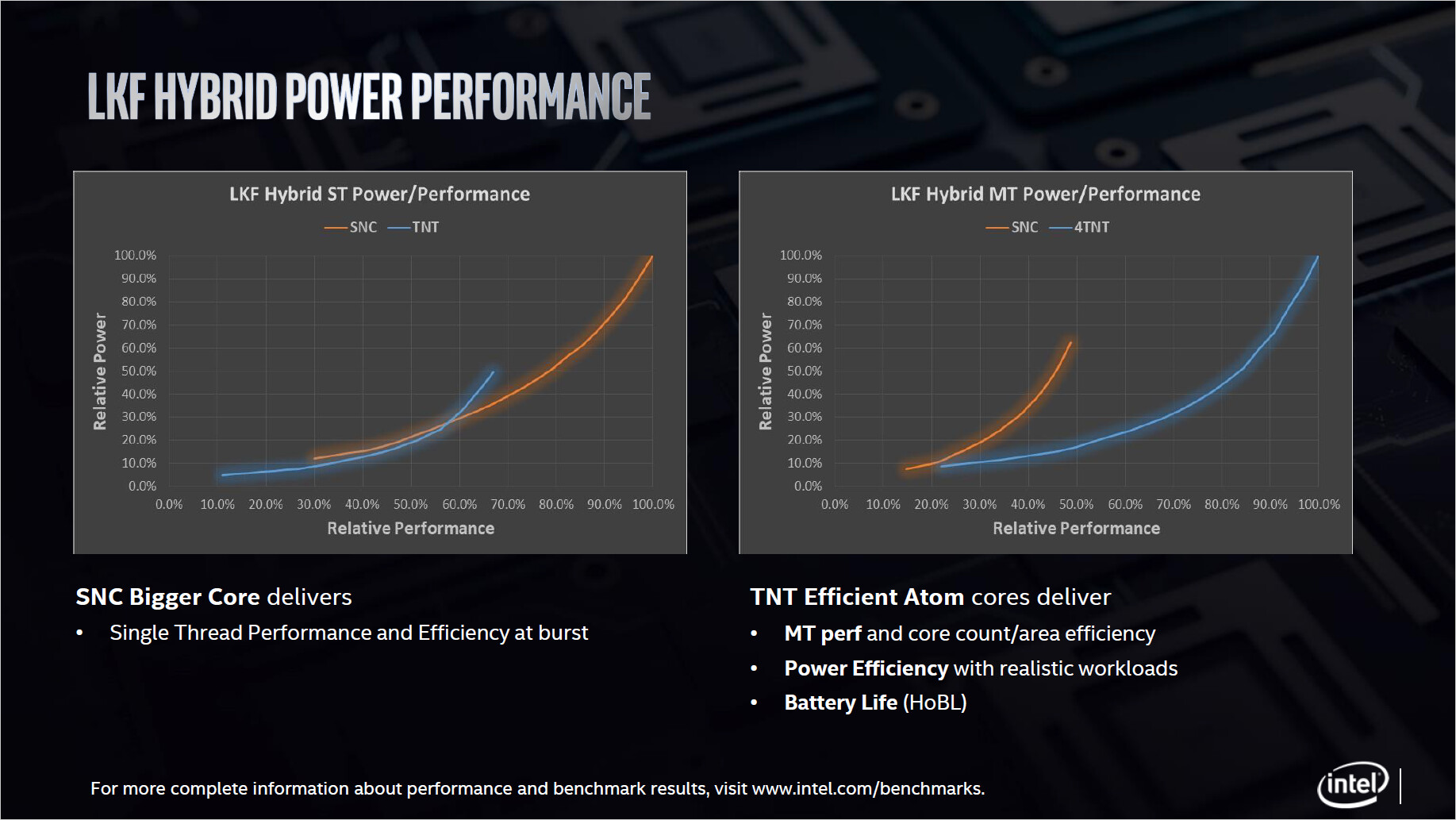
Golem outlined the performance equation between the single "Sunny Cove" core and the four "Tremont" cores. A single "Sunny Cove" core has anywhere between 25-65% higher performance than a single "Tremont" core. On the other hand, the entire block of 4 "Tremont" cores offer 2x the performance of a single "Sunny Cove" core. This lends the two core blocks very different performance and power characteristics.

 The Core i5-L16G7 tests consistently ahead of the Qualcomm Snapdragon 8xC 8-core (4 big+4LITTLE) processor that has the same 7 W TDP. Golem tested the processor across 25 tests, comparing it with i7-1065G7 ICL-U 15 W, an i5-10210U "Comet Lake-U" 15 W processor, and a Pentium Silver N5000 SoC that has just "Tremont" cores. Raising the power limits appears to increase performance of the i5-L16G7 by anywhere between 40-60%.

 Much of what Intel learns from "Lakefield" will be implemented in future client-segment architectures such as "Meteor Lake," which will combine larger hybrid CPU core arrays to achieve high core counts. The i5-L16G7 allows notebook designers to make ultra portable devices with the power envelope of Snapdragon, but with the benefits of x86.
Find more benchmark results and commentary in the source link below.
Source:
Golem.de
The Golem.de report reveals that Windows 10 thread scheduler is aware of the hybrid multi-core topology of "Lakefield," and that it is able to classify workloads at a very advanced level so the right kind of core is in use at any given time. The "Sunny Cove" core is called upon when interactive vast serial processing loads are in demand. This could even be something like launching applications, new tabs in a multi-process web-browser, or less-parallelized media encoding. The four "Tremont" cores keep the machine "cruising," handling much of the operational workload of an application, and is also better tuned to cope with highly parallelized workloads. This is similar to a hybrid automobile, where the combustion engine provides tractive effort from 0 kph, while the electric motor sustains a cruising speed.

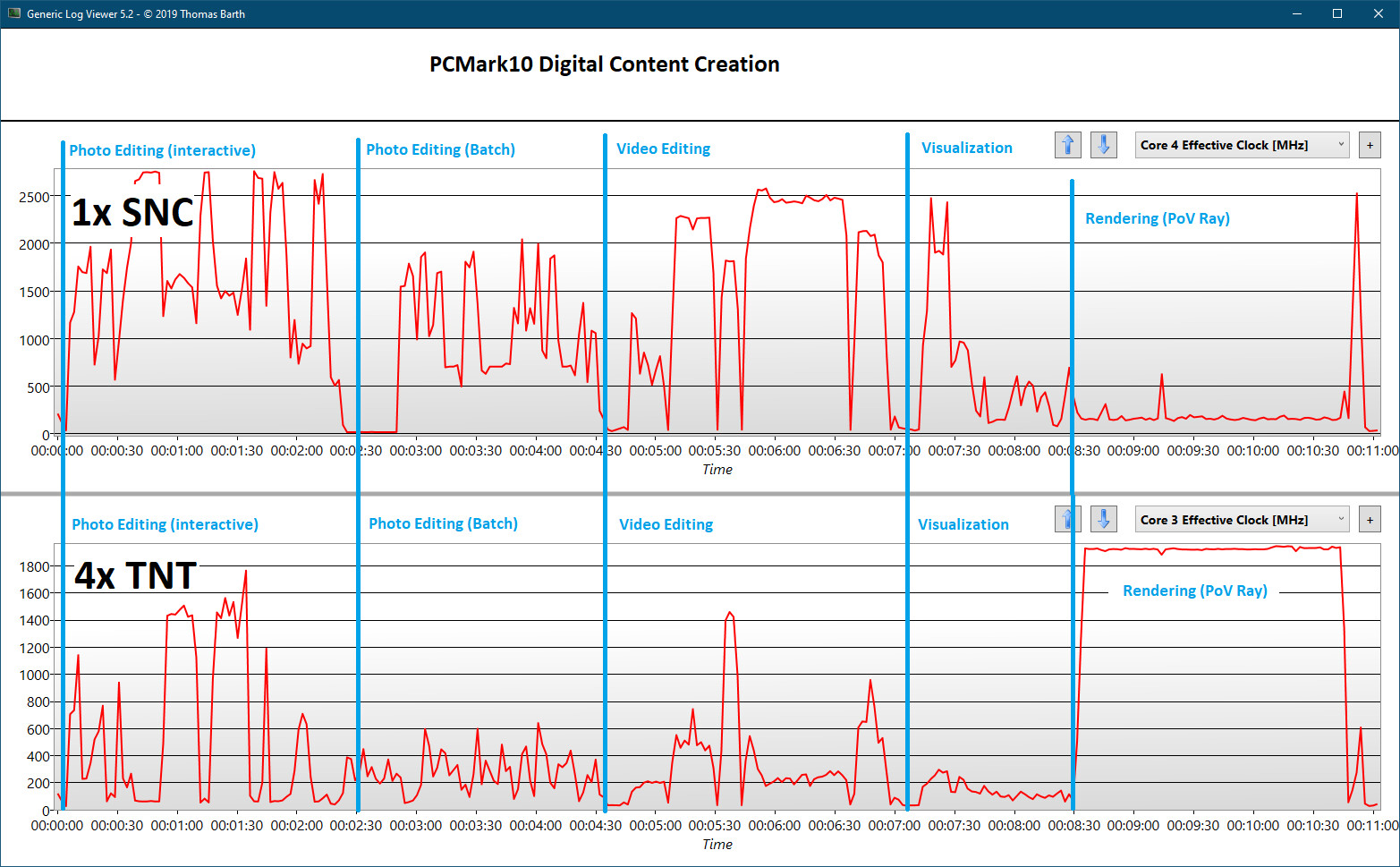

Perhaps the biggest dividend of topology-awareness by Windows OS scheduler is with the core rotation policy. By default, the Windows scheduler spreads a single-threaded workload across multiple cores (in sequence). AMD had to work with Microsoft to make Windows aware of the topology of its multi-CCX Ryzen processors, so workloads aren't spread between two CCX's if they don't have to. Similarly with "Lakefield," core rotation is localized to the "Tremont" cores.
Golem outlined the performance equation between the single "Sunny Cove" core and the four "Tremont" cores. A single "Sunny Cove" core has anywhere between 25-65% higher performance than a single "Tremont" core. On the other hand, the entire block of 4 "Tremont" cores offer 2x the performance of a single "Sunny Cove" core. This lends the two core blocks very different performance and power characteristics.


Find more benchmark results and commentary in the source link below.
35 Comments on Windows 10 Scheduler Aware of "Lakefield" Hybrid Topologies, Benchmarked
I feel people buying a laptop with an ARM or Lakefield processor is unlikely to consider performance as a priority. Between the 2, the performance delta is not ground breaking for most users to experience during light usage, which is likely going to be the use case for this class of laptop. Rather, battery life is the main consideration which ARM based SOCs still hold an advantage.
In my opinion, another Windows phone (even if viable from a hardware standpoint) may be too late at this stage since the market is already very saturated.
As more anecdotal evidence, my ancient 1st-gen 2700U boosts above its base clock by around 150MHz even when configured down to its minimum 12W cTDP.
Still does not change my point about spec.
If 1.8GHz is minimum P-state, the only time you'll see lower clocks than that is when you aren't running an all-core load and the CPU is shifting the threads around the cores to distribute heat better. The lower clocks you see will be an average between the active minimum P-state clock, and zero for a parked core. For example, in AMD uProf I can see clocks 300MHz lower on all 8 logical cores than the minimum when running just three threads, but if I change to an all-core load the clock rises to at least the base clock.
To the best of my knowledge, Renoir will follow the same rules as 1st Gen Ryzen, and if you read the cTDP whitepapers you'll see that the reason 1st-Gen's cTDP only goes down to 12W is because at this point it cannot maintain 8 active threads. I have the ability to set it lower using RyzenAdj but that just means it's going to throttle so hard it will be forced to park cores. In the context of this article discussing Lakefield's hybrid topologies, it almost doesn't matter what clockspeed the lowest active P-state is, so long as all cores are active at the stated cTDP. The whole argument is nearly a moot point anyway, because Intel's definition of TDP is very different to AMD's definition of TDP and there's no shortage of mainstream Youtubers independently demonstrating that Intel's TDP figures are even further away from real-world power consumption values than AMD's (which are quite clearly restricted and controllable via most BIOS options and/or Ryzen Master).
But i think Intel deserves at least some of the current backlash cause of the way they treated security in their latest iterations of CPUs (Meltdown, ... the ME flaws ...).
Some people risk everything (want to be a journalist in China/Turkey/North Korea/Poland/Hungary ... at the moment?) for publishing truth and should be able to rely on their tech.
They are both expensive.
ark.intel.com/content/www/us/en/ark/products/202777/intel-core-i5-l16g7-processor-4m-cache-up-to-3-0ghz.html
Cheapest current i7 is 10610U at $409:
ark.intel.com/content/www/us/en/ark/products/201896/intel-core-i7-10610u-processor-8m-cache-up-to-4-90-ghz.html
The price depends on the model not the CPU.
Niche product have niche prices.