Sunday, August 30th 2020

Samsung 980 PRO NVMe SSD Uses TLC NAND Flash with Half the Endurance of 970 PRO: Product Page
Samsung's hotly anticipated 980 PRO M.2 NVMe flagship client-segment SSD is the company's first "PRO" branded SSD to feature TLC NAND flash memory, breaking from a unique tradition of using MLC (2 bits per cell) NAND flash. Product pages of the drive went live, and its specifications clearly state the use of "Samsung V-NAND 3-bit MLC," which is another way of saying TLC. "MLC" generally referred to as NAND flash memory that stores 2 bits per cell, even through the term "Multi-level" is amorphous.
The product page lists other juicy specs of Samsung's first M.2 NVMe client SSD that takes advantage of PCI-Express gen 4. The drive uses Samsung's in-house design "Elpis" controller, which uses NVMe 1.3 protocol over PCI-Express 4.0 x4, and an LPDDR4 DRAM cache. The 980 PRO comes in capacities of up to 1 TB, with up to 1 GB of DRAM cache. Samsung rates the 1 TB version as capable of up to 7000 MB/s sequential reads, up to 5000 MB/s sequential writes, and up to 1 million IOPS 4K random reads/writes at QD32. The use of TLC impacts endurance adversely in comparison to that of the drive's immediate predecessor, the 970 PRO, with the 1 TB 980 PRO warranty covering only up to 600 TBW, in comparison to 1200 TBW of the 970 PRO 1 TB, and the 500 GB 980 PRO offering just 300 TBW warranty coverage in comparison to 600 TBW of the 970 PRO 512 GB.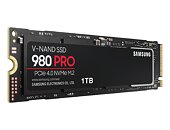
Source:
th3typh00n (Reddit)
The product page lists other juicy specs of Samsung's first M.2 NVMe client SSD that takes advantage of PCI-Express gen 4. The drive uses Samsung's in-house design "Elpis" controller, which uses NVMe 1.3 protocol over PCI-Express 4.0 x4, and an LPDDR4 DRAM cache. The 980 PRO comes in capacities of up to 1 TB, with up to 1 GB of DRAM cache. Samsung rates the 1 TB version as capable of up to 7000 MB/s sequential reads, up to 5000 MB/s sequential writes, and up to 1 million IOPS 4K random reads/writes at QD32. The use of TLC impacts endurance adversely in comparison to that of the drive's immediate predecessor, the 970 PRO, with the 1 TB 980 PRO warranty covering only up to 600 TBW, in comparison to 1200 TBW of the 970 PRO 1 TB, and the 500 GB 980 PRO offering just 300 TBW warranty coverage in comparison to 600 TBW of the 970 PRO 512 GB.


81 Comments on Samsung 980 PRO NVMe SSD Uses TLC NAND Flash with Half the Endurance of 970 PRO: Product Page
Maybe the Samsung PM1733 is the better option at this point...
These are available in 2/4/8/16 TB sizes and have rated endurances of 3.5/7/14/28 PB.
The 2TB version is available for ~530€, 4TB is ~890€ (in Germany, including taxes). For a fast and long-lasting PCIe4 SSD this sounds reasonable.
sabrent has matching competition now. nice, i will probably just get the sabrent and save the $100 samsung name fee.
But seriously, has no one seen this coming? The only way NAND has scaled since its inception was added levels. And adding levels suffers big time from diminishing returns. Improved fab process is not really an answer, everybody seems to be strapped for capacity these days.
Personally, would prefer sth with a bit more longevity, got 8 years out of Crucial M4 64GB for my usage patterns.
Got one of the last Transcend SSD370s 512GB samples, and given above, expect over a decade from it.
Doubt I'd pull out as much from TLC based one, let alone QLC.
Not to mention these are supposed to be PRO drives, with supposedly superior performance and longevity.
And yet we get half the TBW of 970 PRO at respective capacities.
For less demanding use there is still EVO series...
Still, always disheartening to see a downgrade like this.
TLC on professional focused products is dubious. MLC and SLC are the only types that have the durability to qualify being in professional tier products. This will be a different story if there has been an advance in NAND chemistry or some other advance that make TLC more durable.
Perhaps they will drop the public-facing 3-bit spec as they got trashed on every tech site for using TLC in a Pro product. From the beginnings of SSD tech there was SLC, MLC, then came TLC and QLC. MLC meant 2-bit to the market and of course multi- is indeed applicable to TLC (triple) and QLC (quad). With the stank surrounding the more specific TLC it is no wonder they didn't want to describe it that precisely and try using MLC with an asterisk.
But I will say good wear leveling in the controller helps alot.
How is it the Phison E16 controller with TLC on the current PCIe 4.0 drives are rated for 1,800 TBW written
Yet this new Samsung drive also on TLC is at 600 TBW the difference to me has to be the controller and wear leveling, and I'm not sure what Samsung was thinking but they seemed to drop the ball here.
It is useless to me if i buy one ?
My chipset : Z390
If you're still on HDD for OS, it won't be useless obviously.
If you already have at least reasonably good SSD, use case for this one will be much more limited.
Find me real life data where you exhaust the drive lifespan without filling it with billions of bits of garbage 24x7 & 365 days a year! FYI some of the best performing drives on the market right now are TLC & most if not all TBW rating are highly conservative ~ The Best NVMe SSD for Laptops and Notebooks: SK hynix Gold P31 1TB SSD Reviewed
Also (rated) endurance ≠ reliability or indeed drive lifespan :rolleyes:
Others are compiling large projects, some are doing photo/video work.
I don't think we're being scammed into buying inferior products, but I do think it's good to know the limitations of what we buy.Considering NAND exhausting p/e cycles is the only thing that can fail on a SSD, endurance is at least 90% of reliability.
If the Manufacturers Endurance rating is not good enough then what is?
And i'm aware things can happen during the warranty period so there is no guarantee.
To answer your question, it's hard to say as of now because of a variety of factors involved. For instance we have no idea how operating drives (3D NAND) at high temps for an extended period of time affects the NAND "lifespan" or indeed what happens when you're using drives for read/write heavy tasks with say good airflow. To map out scenarios where a standard TBW rating applies to all possible use cases for the drive, since the SSD maker cannot control what the drive is being used for, is nigh impossible. It's like saying AMD, Intel or Nvidia guarantee their chips work under a trillion other possible (computational) use cases & never fail within that 3 year lifetime. This is why you have the lowest common denominator at work.
PS5018-E18 controller in it.
The same read speed as the same but faster writes.
7000/5000 Nvme 1.3 vs 7000/6850 Nvme 1.4
I'll ask again, can you link me to studies which map out let's say a 1000 possible use cases for these drives & covering the NAND "endurance" part? You know why that's not happening ~ the answer's in my last reply!