Sunday, August 30th 2020

Samsung 980 PRO NVMe SSD Uses TLC NAND Flash with Half the Endurance of 970 PRO: Product Page

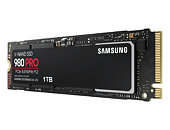
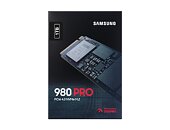
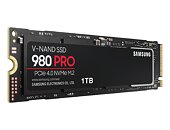
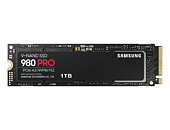
Samsung's hotly anticipated 980 PRO M.2 NVMe flagship client-segment SSD is the company's first "PRO" branded SSD to feature TLC NAND flash memory, breaking from a unique tradition of using MLC (2 bits per cell) NAND flash. Product pages of the drive went live, and its specifications clearly state the use of "Samsung V-NAND 3-bit MLC," which is another way of saying TLC. "MLC" generally referred to as NAND flash memory that stores 2 bits per cell, even through the term "Multi-level" is amorphous.

The product page lists other juicy specs of Samsung's first M.2 NVMe client SSD that takes advantage of PCI-Express gen 4. The drive uses Samsung's in-house design "Elpis" controller, which uses NVMe 1.3 protocol over PCI-Express 4.0 x4, and an LPDDR4 DRAM cache. The 980 PRO comes in capacities of up to 1 TB, with up to 1 GB of DRAM cache. Samsung rates the 1 TB version as capable of up to 7000 MB/s sequential reads, up to 5000 MB/s sequential writes, and up to 1 million IOPS 4K random reads/writes at QD32. The use of TLC impacts endurance adversely in comparison to that of the drive's immediate predecessor, the 970 PRO, with the 1 TB 980 PRO warranty covering only up to 600 TBW, in comparison to 1200 TBW of the 970 PRO 1 TB, and the 500 GB 980 PRO offering just 300 TBW warranty coverage in comparison to 600 TBW of the 970 PRO 512 GB.
Source: th3typh00n (Reddit)
Add your own comment

81 Comments on Samsung 980 PRO NVMe SSD Uses TLC NAND Flash with Half the Endurance of 970 PRO: Product Page

#76
R0H1T
lexluthermiesterThat's a load of nonsense. 1000P/E cycles is absolutely terrible for a OS/Boot drive.
It really depends on what you're using the drive for. I wouldn't recommend QLC for anyone who's using the drive for say applications/tasks with large number of writes but then when you're using the QLC argument for sweeping statements like these ~
lexluthermiesterSSD Makers are failing to state those stats because they want to hide QLC's pathetic lack of durability.
You're also failing to understand the basic premise which I've been trying to debunk over the last few pages!
Much more important than the performance changes is the write endurance boost the 665p brings compared to the 660p. Both capacities of the 665p have 50% higher rated write endurance than the 660p, bringing them up to about 0.16 drive writes per day (DWPD) from the 660p's 0.11 DWPD. This is still a lot lower than the 0.3 DWPD that is typical for low-end consumer SSDs that use TLC NAND, but the increase does show that Intel's feeling more confident in their second generation of QLC.


Intel wouldn't back their QLC drives for 5 years if they are as brittle as some of the theories here suggest, in having said that given you actually know your workloads well ~ you should get the appropriate drive whether QLC, TLC or MLC. At the risk of repeating myself I'd say modern NVMe drives labelled PRO, in case of Samsung, are geared more towards (higher) performance than durability or better endurance. For that you have enterprise drives, now you can debate all you want whether these (PRO) drives should be rated as highly as their predecessors wrt TBW but there's no evidence to suggest as of now they're any less reliable or lasting than their predecessors!
Posted on Reply
#77
lexluthermiester
R0H1Tthere's no evidence to suggest as of now they're any less reliable or lasting than their predecessors!
Other than common sense you mean?
Posted on Reply
#78
R0H1T
If only it was as simple as that, looking at this thread though it's pretty apt that "common sense isn't as common" as you'd think. I'm sure you've heard of the term write amplification, haven't you?

Let some of the experts weigh in ~
1 DW/D Does Not Equal 1 DW/D
A common misconception when examining SSD specifications is that “1 DW/D” on one drive means the same endurance as “1 DW/D” on another drive. That’s not true, even for drives of the same model but different capacities.

This effect becomes even more pronounced as drives increase in capacity. When comparing the highest capacity model of the Ultrastar DC SS200 at 1 DW/D with the highest capacity Ultrastar DC SS200 available in a 3-DW/D specification, we see that even though the DW/D value of one is three times the value of the other, the actual amount of lifetime data that can be written to the 3.2TB model is only about 25% more
Following up ~
Micron's 64-layer 3D TLC NAND has consistently proven to offer higher performance than their first-generation 32L TLC, but Memblaze isn't advertising any big performance increases over the earlier PBlaze5 SSDs. Instead, they have brought the overprovisioning ratios back down to fairly normal levels after the 32L PBlaze5 drives. Those drives were rated for 3 DWPD, and as a result kept almost 40% of their raw flash capacity as spare area. The PBlaze C916 with 64L TLC, on the other hand, reserves only about 27% of the flash as spare and suffers only a slight penalty to steady-state write speeds, and no penalty to rated endurance. (For comparison, consumer SSDs generally reserve 7-12% of their raw capacity for metadata and spare area, and are usually rated for no more than about 1 DWPD.)
www.anandtech.com/show/15939/microchip-announces-flashtec-nvme-3108-enterprise-ssd-controller

You know the single biggest difference between enterprise drives & the lesser rated PRO drives, from someone like Samsung is? Apart from the custom firmware & sometimes different controller ~
If you haven't guessed it already it's overprovisioning!
The first drives that can take advantage of the new features are already shipping to interested parties. The PM1733 and PM1735 are based on a common hardware platform. The PM1733 is rated for 1 DWPD and offers capacities up to 30.72 TB, while the PM1735 has more overprovisioning and lower usable capacities to reach 3 DWPD. Both models are available in either U.2 or PCIe add-in card form factors. The U.2 form factor gives a few more capacity options, while the add-in card versions have a PCIe 4.0 x8 interface to enable 25% higher sequential read performance (for other workloads, PCIe 4.0 x4 is fast enough to not be the bottleneck).
www.anandtech.com/show/14884/samsungs-pcie-gen-4-enterprise-ssds-get-reliability-performance-boost

So to summarize ~
A TLC drive, say 1.5TB, can easily last as long if not longer than an MLC, at 1TB, if you keep enough spare room on it. Write amplification is a drive killer & there's something on the horizon ready to address that ~
Used properly, ZNS allows the host software to avoid almost all of the circumstances that would lead to write amplification inside the SSD. Enterprise SSDs commonly use overprovisioning ratios up to 28% (800GB usable per 1024GB of flash on typical 3 DWPD models) and ZNS SSDs can expose almost all of that capacity to the host system without compromising the ability to deliver high sustained write performance.
www.anandtech.com/show/15959/nvme-zoned-namespaces-explained

And before you pivot back to the "TBW" ratings I'll add a couple of points ~

No two drives are the same, with the exact same NAND or even controller+firmware. There are minute differences at the atomic & subatomic levels, then there's entropy. That's an undeniable fact. Which also means that to get to the NAND "endurance" rating that some of you want, Samsung will have to sacrifice on the usable space whether doing more OP or going MLC. So pick your poison.

Lastly the useless back & forth here is like someone having a 3950x & complaining it doesn't do 1000 fps in Doom Eternal. People who can afford the 980 Pro can surely afford an enterprise grade drive, & if you don't know the kind of writes (or WA) your applications/work demands then you're not a PRO! Like I said previously, you can't have it all ~
a drive having chart leading performance, which "lasts" 10 years, is cool to boot & covers itself in glory for everything you throw at it.
Posted on Reply
#79
lexluthermiester
R0H1TI'm sure you've heard of the term write amplification, haven't you?
Yes, I have and it is a very serious factor in wear leveling.
R0H1TA TLC drive, say 1.5TB, can easily last as long if not longer than an MLC, at 1TB, if you keep enough spare room on it.
True! But then that might eat into the profit gains of using TLC over MLC. This depends on the cost of the making the TLC VS the cost of making MLC.
R0H1TAnd before you pivot back to the "TBW" ratings I'll add a couple of points ~
Wasn't going too. You make valid points.
R0H1TNo two drives are the same, with the exact same NAND or even controller+firmware. There are minute differences at the atomic & subatomic levels, then there's entropy. That's an undeniable fact. Which also means that to get to the NAND "endurance" rating that some of you want, Samsung will have to sacrifice on the usable space whether doing more OP or going MLC. So pick your poison.
I complete agree with your factual perspectives. The main problem with the cell durability question is a matter of usage model. Heavy usage would indicate the need for a more durable type of storage, lighter usage would make durability a lesser concern.
Posted on Reply
#80
Octopuss
olstyleOnce the Cache has a size which is bigger then 10 times your normal file size it's kind of academic.
That's a bit like saying my VRAM is not fast because once it's exceeded the system RAM is used.
Possibly, but I hate the concept anyway.
What's the cache on 970 Pro models, anyone knows?
Posted on Reply
#81
mechtech
Dave65Has Samsung went to sheet or am I missing something?
profits.............
Posted on Reply
Add your own comment
Nov 26th, 2026 21:35 CST change timezone

New Forum Posts

Popular Reviews

TPU on YouTube

Controversial News Posts