Monday, September 19th 2022

AMD Ryzen 9 7900X CPU-Z Benched, Falls Short of Core i7-12700K in ST, Probably Due to Temperature Throttling
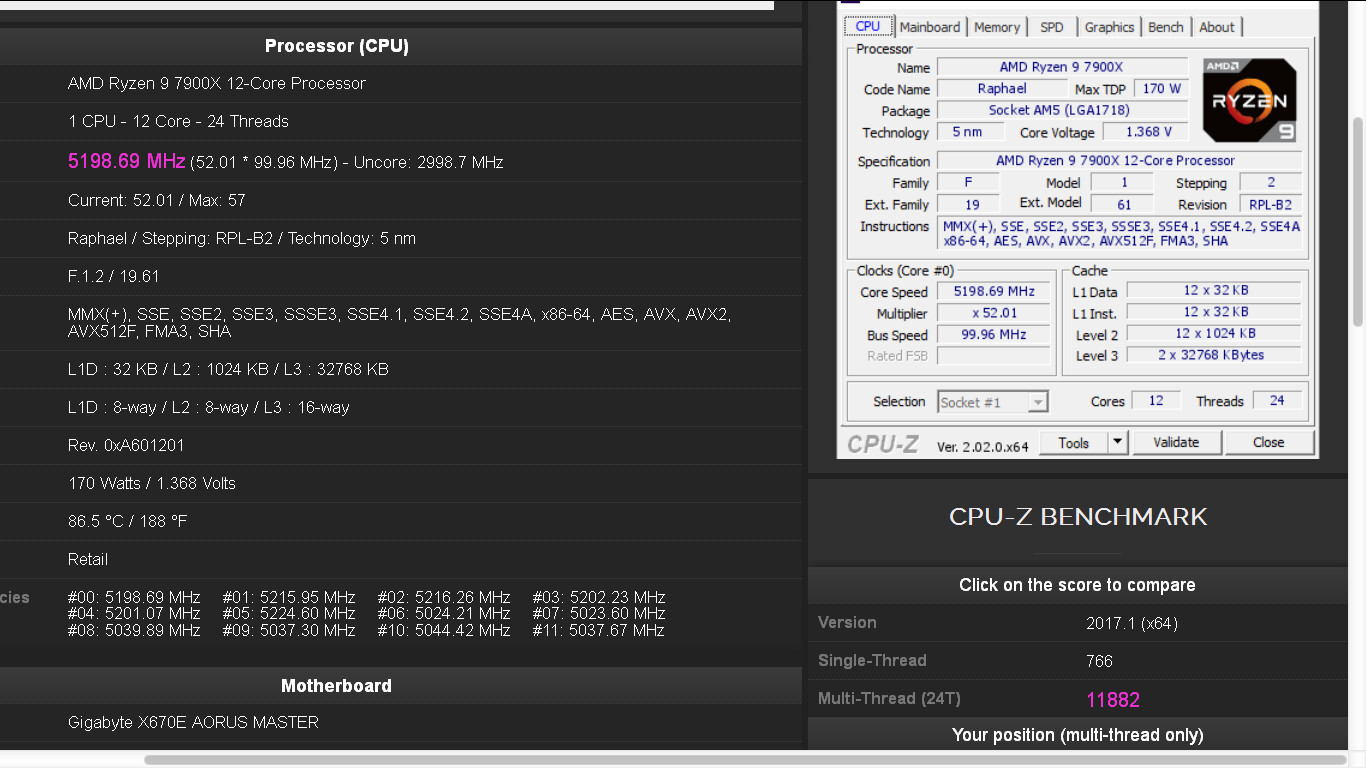
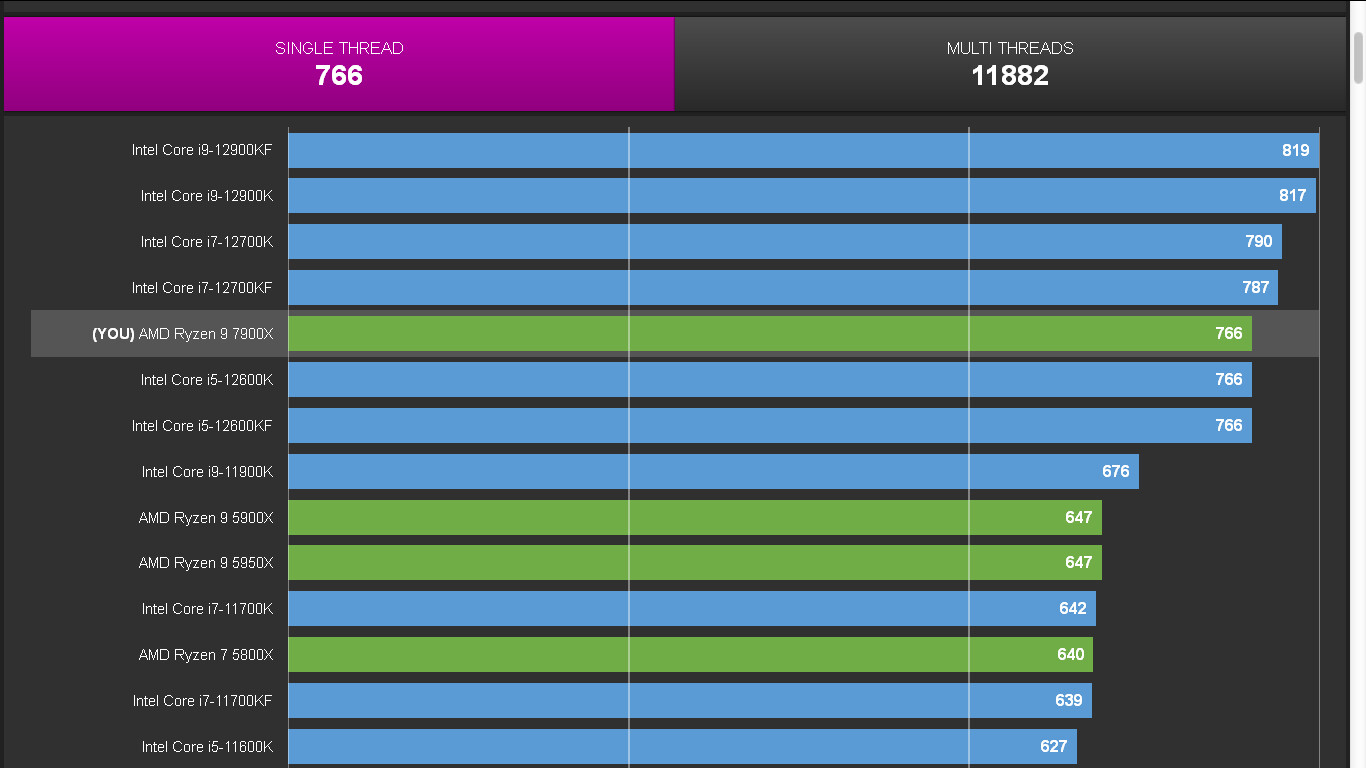
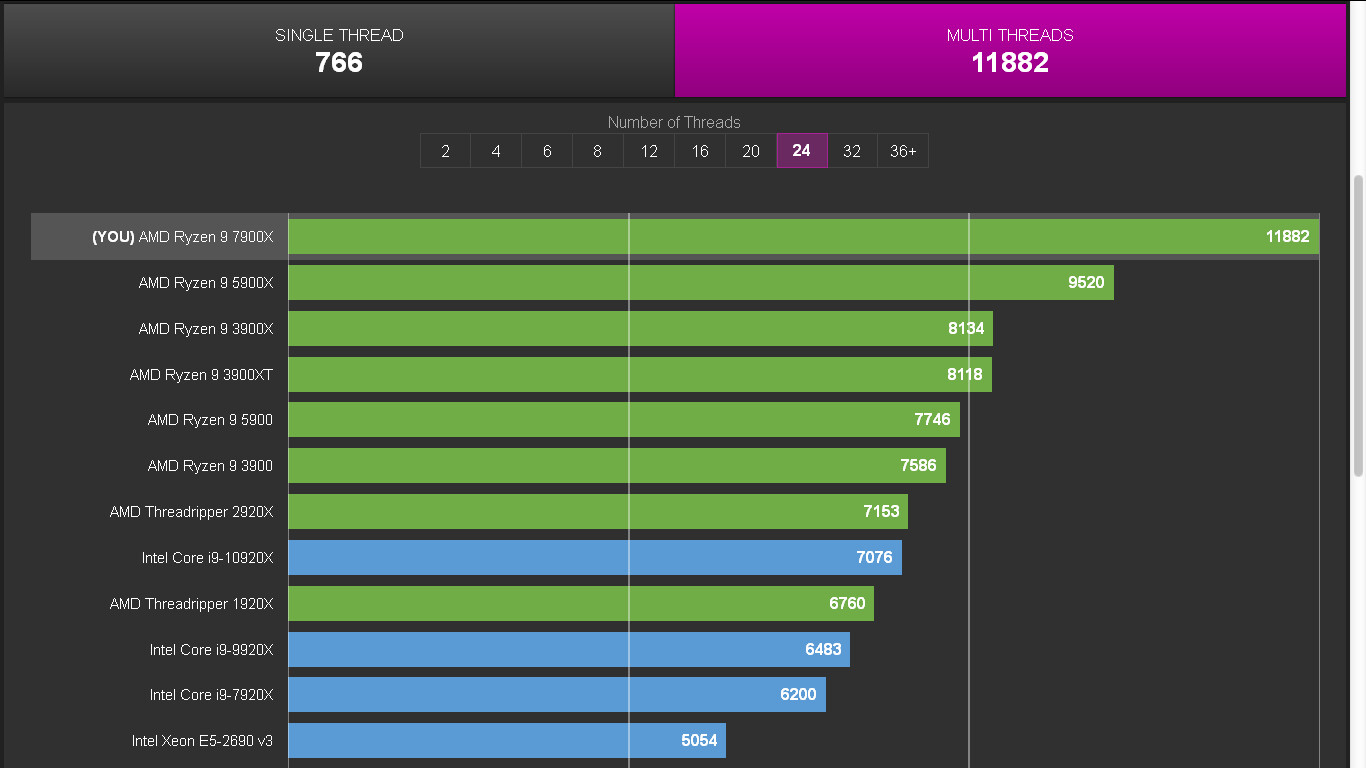
An AMD Ryzen 9 7900X 12-core/24-thread processor sample was put through CPU-Z Bench, the internal benchmark of the app. The chip boosted up to 5.20 GHz in the test, and ran at temperatures as high as 86°C, as reported by CPU-Z. It scored 766 points in the single-threaded test, and 11882 points in the multi-threaded one. The single-threaded numbers in particular are interesting. 766 points would put the 7900X behind the Core i7-12700K and its "Golden Cove" P-core by around 3%. In the multi-threaded test, however, the 7900X, with its 11822 points, is in the league of the next-generation Core i7-13700K (8P+8E) processor, which was recently spotted scoring 11877 points with a 6.20 GHz overclock. The 7900X will hence be pushed as a superior alternative to the i7-13700K for productivity and creator tasks, whereas its single-threaded score ensures that it falls behind the i7-13700K in gaming by a fair bit.


Sources:
Elchapuzas Informatico, TUM_APISAK (Twitter)

123 Comments on AMD Ryzen 9 7900X CPU-Z Benched, Falls Short of Core i7-12700K in ST, Probably Due to Temperature Throttling
But people will of course compare it to newest Intel generation, which promises 20% higher gaming and 40% higher productivity scores for their flagship.
And AMD also has a problem of 5800X3D, which they will barely match in gaming with this brand new platform, with much more expensive CPUs, motherboards, RAM...
Does it perform as you'd expect? Is its power consumption and heat dissipation acceptable for your needs? Do you find the price of upgrade worth it? - these are the questions one should be asking.
Edit: 13% is really not a lot, but if you're coming from a 2700X, or let alone 1700X, the improvement will be significant.
As concerns the AMD slide: all the games presented here strongly depend on ST performance, hence the projected gains. I'm surprised GTA shows only marginal improvement, since it's a heavily ST bound title.
So that leak has the P-Cores to 6.2Ghz. A stock 12900K gets 11700pts, so a 13700K at stock should beat that easily, and other leaks have also shown a score closer to 13000.
Intel Core i7-13700K has been overclocked to 6 GHz, in the CPU-Z ST test | dtechted
This last sentence just doesn't seem likely:
The 7900X will hence be pushed as a superior alternative to the i7-13700K for productivity and creator tasks, whereas its single-threaded score ensures that it falls behind the i7-13700K in gaming by a fair bit."
1. As @Valantar pointed out, CPU-Z is absolutely not indicative of gaming performance, so there's not a way to gauge that from this bench. The 5800x3d gets 639 ST score in CPU-Z and absolutely dominates in gaming, for example.
2. The 13700K has already posted higher MT scores in other leaks -it's EXTREMELY unlikely it will only be 3% faster in MT than a 12900k at stock.
If anything it will likely be the opposite - the 7900x and 13700k will trade blows depending on game, with a solid chance that 7900x is faster than the 13700k, and the 13700k will beat it in MT on non-avx 512 loads.
I don't like e-core shit, and I don't like the massive and consistent security flaws that Intel had year over year over year.... so I really want to stay with AMD.
As for it being a unique SKU - it is so far, but all signs point towards there being more X3D SKUs in the 7000 series.
You got 8 cores crammed in a tiny little CCD with a bunch of cache that needs to be always powered on.
Once you start crossing the 5Ghz mark temps just fly upwards and it wont be better the higher or faster you go.
Both camps are pretty much at their limit to what they can do here really. Going smaller would only yield a more difficult source of heat to cool.
But really if i look at those graphs... 50 points behind on ST but a massive improvement on MT. I know my pick.
This table comparing the out of order engines of Zen 3 and Alder Lake is reproduced from Chips and Cheese's excellent overview of Alder Lake/Golden Cove. I've changed the order of various entries, and eliminated some columns for brevity. The most important column is the last one; most structures in the out of order engine of Golden Cove are much larger than their counterparts in Zen 3, and even Sunny Cove (Ice Lake), has larger structures than Zen 3. Despite all that, Zen 3 beats all Intel architectures before Golden Cove.
117 Not Taken
1.33x
(~248+32)
With Raptor Lake having higher clocks, and apparently able to maintain them better, the pure performance win is pretty obvious to predict.
How this plays out in real life applications is going to have a lot to do with the cache and memory performance though. Every indication is that Raptor Lake will have a DDR5 memory speed advantage, but will be disadvantaged vs Zen 4's cache.
Reminder :