Monday, September 19th 2022

AMD Ryzen 9 7900X CPU-Z Benched, Falls Short of Core i7-12700K in ST, Probably Due to Temperature Throttling
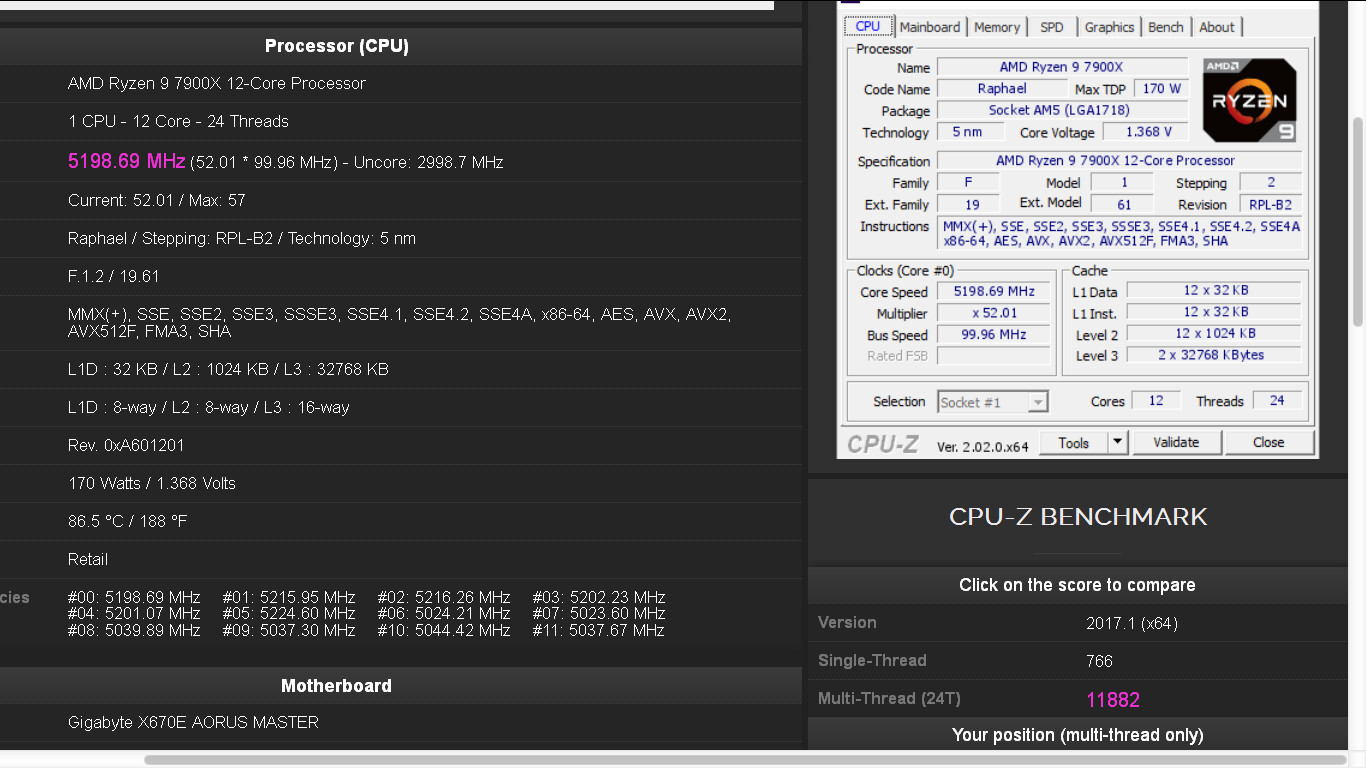
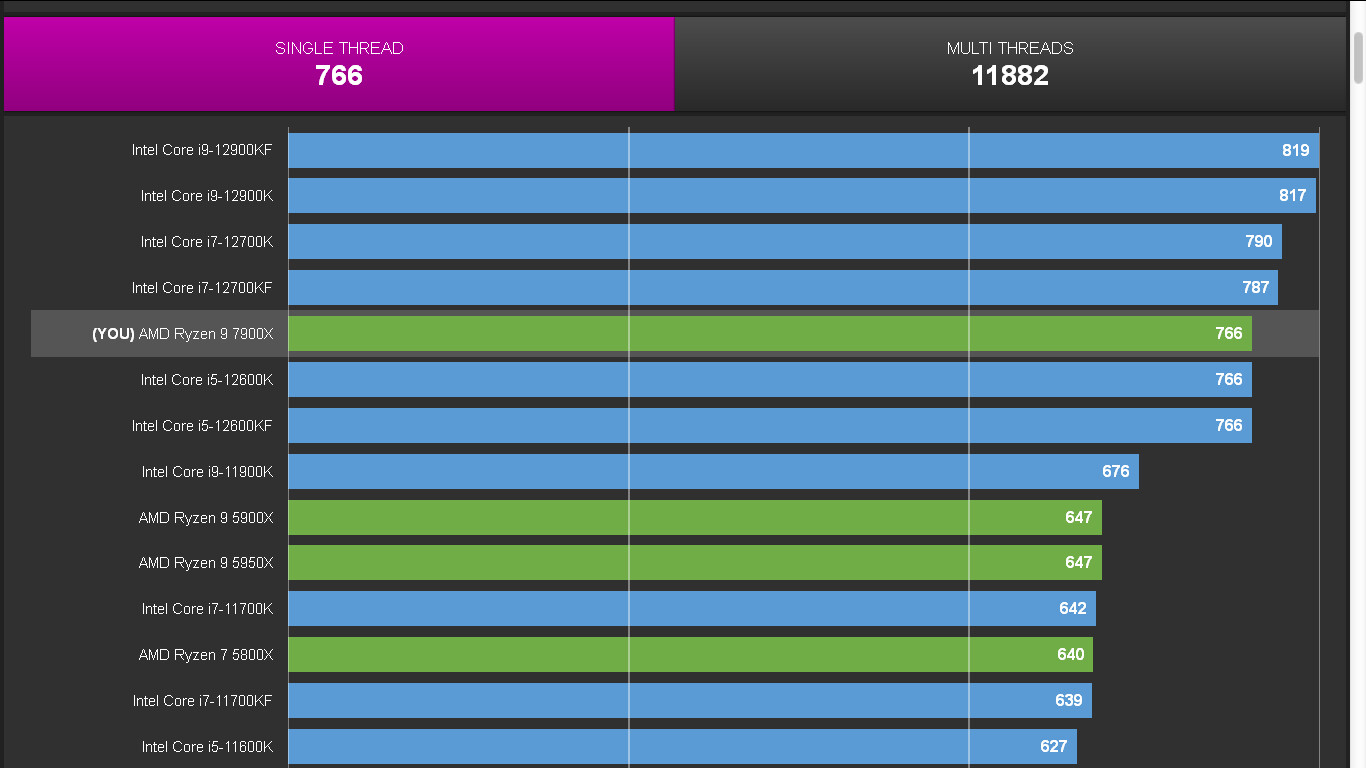
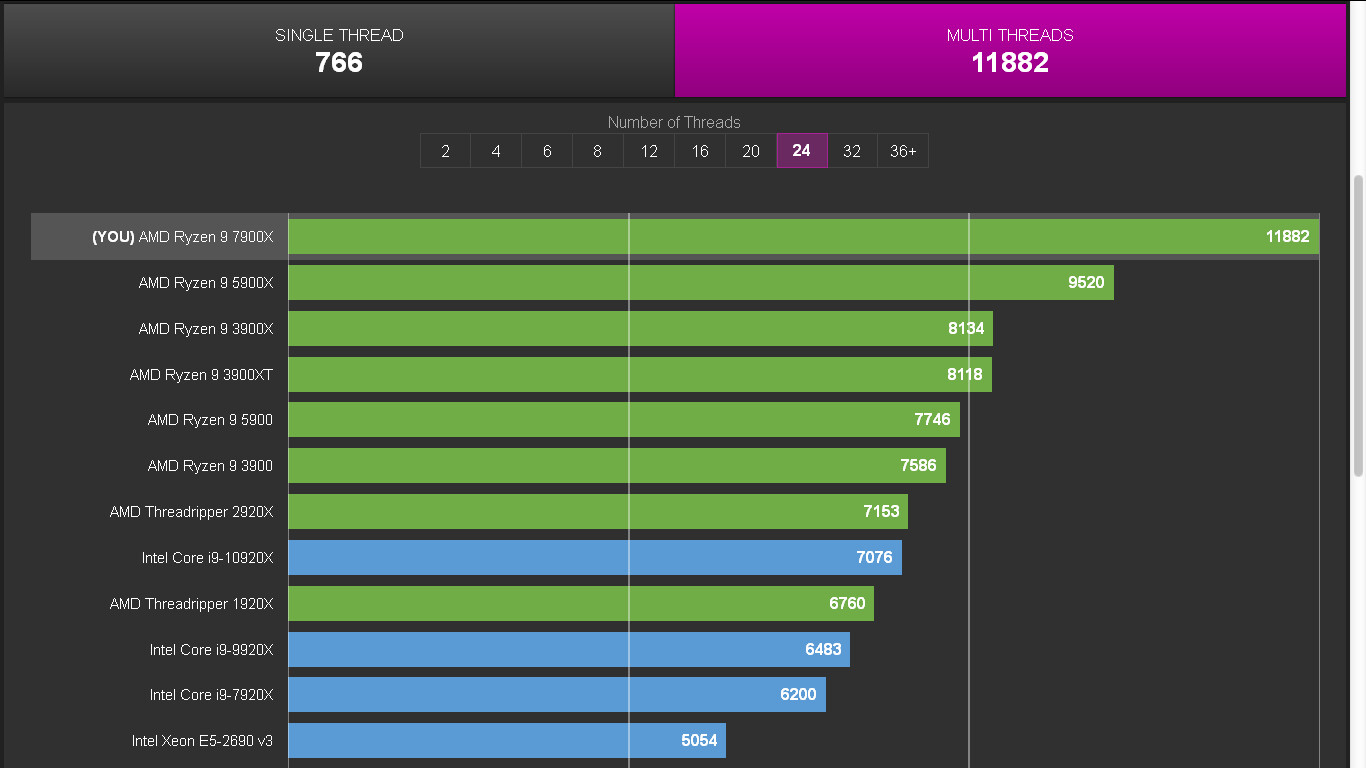
An AMD Ryzen 9 7900X 12-core/24-thread processor sample was put through CPU-Z Bench, the internal benchmark of the app. The chip boosted up to 5.20 GHz in the test, and ran at temperatures as high as 86°C, as reported by CPU-Z. It scored 766 points in the single-threaded test, and 11882 points in the multi-threaded one. The single-threaded numbers in particular are interesting. 766 points would put the 7900X behind the Core i7-12700K and its "Golden Cove" P-core by around 3%. In the multi-threaded test, however, the 7900X, with its 11822 points, is in the league of the next-generation Core i7-13700K (8P+8E) processor, which was recently spotted scoring 11877 points with a 6.20 GHz overclock. The 7900X will hence be pushed as a superior alternative to the i7-13700K for productivity and creator tasks, whereas its single-threaded score ensures that it falls behind the i7-13700K in gaming by a fair bit.


Sources:
Elchapuzas Informatico, TUM_APISAK (Twitter)

123 Comments on AMD Ryzen 9 7900X CPU-Z Benched, Falls Short of Core i7-12700K in ST, Probably Due to Temperature Throttling
CPU-Z is not running at a specific clock speed though, it's not a measure of IPC.
So if you take the combination of IPC measured by SPEC at a fixed clock, then throw in CPU-Z results, you start to get a picture.
Raptor Lake has higher IPC, Raptor Lake clocks higher, Raptor Lake wins on CPU-Z.
Is more needed? Of course, that's why I said earlier that what remains is how fast and efficient the cache and main memory are.
But for round one of IPC and raw Mhz to make use of that IPC, Raptor Lake appears to be winning.
Maybe try to pretend AMD is Intel and Intel is AMD for a minute and you can uncloud your bias enough to comprehend the obvious that is right in front of you.
Which also proved the E cores are total garbage for battery life also... ADL wasn't improved versus Ryzen there either.
That this is due to IOD power requirements is also a misunderstanding - the IOD in terms of its I/O functionality is perfectly fine for efficiency - its memory, PCIe and other controllers are neither more nor less efficient than those found in APUs - it's the same or very similar silicon, after all, just on a slightly older node (which doesn't matter much for I/O purposes, as I/O power doesn't scale like logic power with node changes). It's just connected to the CCDs through a relatively high power interconnect (which, to be clear, is still the most efficient interconnect of its kind - it's just inherently less efficient than anything die-to-die). I have no doubt that AMD have worked on improving the per-bit efficiency of through-package IF, especially as they have to run it faster to match DDR5 - but there's nothing they can do to bring its power requirements down to a level where it matches a monolithic chip, save for direct die-to-die interconnects - which we know Zen4 doesn't have (at least in its AM5 iterations).
I mean, just look at EPYC and TR Pro - they run ~100W uncore power, even with essentially all PCIe and other I/O idle. Why? Becuase of those 8 IF links through the substrate. This is also why we still haven't seen MCM APUs from AMD for the mobile space - those won't be coming until they can mass produce them with a die-to-die interconnect at acceptable prices. I was hoping AM5 Ryzen CPUs would be using LSI, but sadly that didn't pan out - but I still hope we'll see it implemented for upcoming APUs, as that would be a massive benefit to these chips.
Better yet, what the hell has happened to this website?... -_-
I absolutely deplore posts and posters like the one above. This is the type of fanboy pressure exerted on sites to come to the conclusions their viewers want to see, basically to become a source of confirmation bias, that ultimately leads to tech tubers and tech sites that just cater to telling their audience what they want to hear and ultimately makes them worthless.
Nobody said anything about Zen 4 being slower than Raptor Lake in actual applications, there's a lot more to a system than a one core synthetic test. And no there is nothing wrong with CPU-Z as a quick test, provided you know what it is testing. Same thing goes for Geekbench, or even full blown applications if taken in a vacuum.
I really, really hope that AMD starts moving to more advanced packaging sooner rather than later, especially as Intel is already well on their way with Meteor Lake. LSI and similar interconnects allow for combining the best properties of monolithic and MCM designs, with the only disadvantage being packaging complexity (which typically, at least early on, means higher costs and lower yields). But the tech exists, and AMD needs to start taking advantage of it sooner rather than later.Using a cutting-edge node for a die that's nearly exclusively I/O would be immensely wasteful and bring very few real-world benefits with it - I/O needs a lot of die area (which, like power, doesn't tend to shrink with node shrinks like logic area does) meaning you'll be spending a lot of wafers on a very expensive node making something that'll at best be marginally better than a slightly larger, much cheaper version of the same die. A more dense silicon lithography node does not in any way reduce the voltage or power necessary to transmit a high bandwidth signal through fiberglass-embedded copper wires. Better designs in silicon can (and do!) both increase bandwidth and reduce power, but those don't tend to scale much with node changes either, but with further design effort spent on refining the architectures involved. And, crucially, AMD already needs to increase IF clock speeds to match DDR5 clock speeds, which will most likely eat up whatever efficiency gains they have manged since the previous version of IF.
Apple M2 Pro and A17 Bionic chips to enter mass production in September 2022. Multiple reports from Taiwanese news outlets suggest that the M2's successor, the Apple M2 Pro, will be mass produced later this year. It will use TSMC's cutting-edge N3 node and power MacBooks/Mac Minis sometime in 2023/2024. Apple M2 Pro and A17 Bionic chips to enter mass production in September 2022 - NotebookCheck.net News
Still, N5/N4 are still essentially cutting edge nodes - they're more advanced than what is widely adopted in most industries, and in most high volume chip production. And they're massively expensive still (though hopefully prices are dropping now that TSMC's order numbers are dropping).
A big part of why the cost of a CPU for example flatlined for 20+ years, despite having more and more transistors and associated fab costs along with normal compounding inflation effects, was the increase in density meant more chips per wafer. If we have hit that inflection point where cost to produce ramps faster than density improvements and per wafer chip yields can offset, then the next 20 years will look quite different than the last 20 years.