Monday, September 11th 2023

Die-shot Suggests "Phoenix 2" is AMD's First Hybrid Processor

The 4 nm "Phoenix 2" monolithic APU silicon powering the lower end of AMD's Ryzen 7040-series mobile processors, could very well be the company's first hybrid core processor, even though the company doesn't advertise it as such. We first caught whiff of "Phoenix 2" back in July, when it was described as being a physically smaller chip than the regular "Phoenix." It was known to have just 6 CPU cores, and a smaller iGPU with 4 RDNA3 compute units; in comparison to the 8 CPU cores and 12 compute units of the "Phoenix" silicon. At the time a lack of 2 CPU cores and 8 CUs were known to be behind the significant reduction in die size from 178 mm² to 137 mm², but it turns out that there's a lot more to "Phoenix 2."

A die shot of "Phoenix 2" emerged on Chinese social media platform QQ, which reveals two distinct kinds of CPU cores. There are six cores in all, but two of them appear larger than the other four. The obvious inference here, is that the larger cores are "Zen 4," and the smaller ones are the compacted "Zen 4c." The "Zen 4c" core has the same core machinery as "Zen 4," albeit it is re-arranged to favor lower area on the die. The trade-off here is that the "Zen 4c" core operates at lower voltages and lower clock-speeds than the regular "Zen 4" cores. At the same clock speeds, both kinds of cores have an identical IPC. The two also have an identical ISA, so any software threads migrating between the cores will not encounter runtime errors. Unlike Intel Thread Director, AMD can use a less sophisticated software-based solution to ensure that the right kind of workload is allocated to the right kind of cores, and prevent undesirable migration between the two kinds of cores. Unlike the hardware-based Thread Director, AMD's solution can be continually updated.
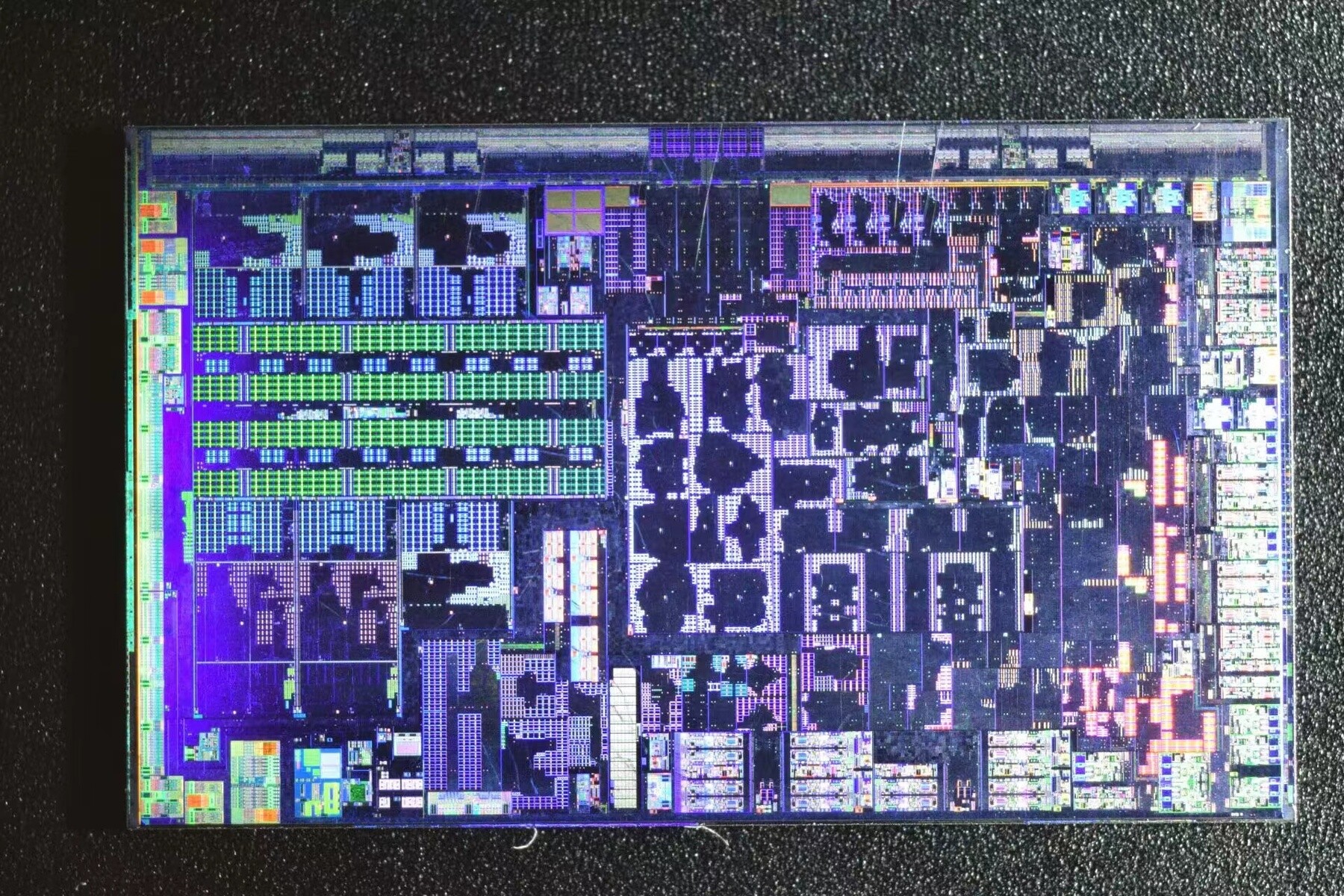
Sources: HXL (Twitter), VideoCardz
Add your own comment

62 Comments on Die-shot Suggests "Phoenix 2" is AMD's First Hybrid Processor

#26
atomsymbol
fevgatosAnd how is this different in practice? If a workload decides to load the C core instead of the full fat core, the end result is the same
A factor that makes practical difference is that [when the number of tasks running on the CPU is higher than the number of P-cores (irrespective of whether it is an AMD or an Intel P-core)] whether another task scheduled on an already half-used P-core (which has HT/SMT) will run faster or slower compared to scheduling the task on an unused E-core, while taking into account the fact that running a 2nd thread on a P-core will slow down the 1st thread on the P-core by about 40%. Instead of time, the question can also be reformulated in terms of power usage. Given the numbers and performance ratios, the usual core allocation order (when optimizing for time and not optimizing for power usage) is the following: 1 thread per P-core, then 1 thread per E-core, then the 2nd threads on P-cores, then the 2nd threads on E-cores (if the E-cores have HT/SMT). If optimizing for power usage instead of time, the allocation order is different. The allocation order can also be different if the application (or the OS) knows that certain threads running on the CPU are heavily sharing data via L1D / L1I / L2 caches.
Posted on Reply
#27
AnotherReader
atomsymbolA factor that makes practical difference is that [when the number of tasks running on the CPU is higher than the number of P-cores (irrespective of whether it is an AMD or an Intel P-core)] whether another task scheduled on an already half-used P-core (which has HT/SMT) will run faster or slower compared to scheduling the task on an unused E-core, while taking into account the fact that running a 2nd thread on a P-core will slow down the 1st thread on the P-core by about 40%. Instead of time, the question can also be reformulated in terms of power usage. Given the numbers and performance ratios, the usual core allocation order (when optimizing for time and not optimizing for power usage) is the following: 1 thread per P-core, then 1 thread per E-core, then the 2nd threads on P-cores, then the 2nd threads on E-cores (if the E-cores have HT/SMT). If optimizing for power usage instead of time, the allocation order is different. The allocation order can also be different if the application (or the OS) knows that certain threads running on the CPU are heavily sharing data via L1D / L1I / L2 caches.
Optimizing for power is more complex especially with Intel's E cores which are less power efficient than P cores for many tasks.

Posted on Reply
#28
Assimilator
fevgatosIf the Zen 4c core would perform as well as the full fat core then there wouldn't be any full fat cores. Obviously that is not the case, zen 4c will be slower so it will have the same "issues" ecores do.
It will almost certainly be slower in some scenarios. What those scenarios are we don't know yet, and they may be irrelevant to most users.
Posted on Reply
#29
atomsymbol
AnotherReaderOptimizing for power is more complex especially with Intel's E cores which are less power efficient than P cores for many tasks.
It is considered to be complex today (year 2023). A major issue is that most operating systems aren't designed to measure total task power. If they were able to measure it, optimizing for total task consumption would be very simple from end-user perspective (i.e: just a few key presses or mouse button clicks to turn such an optimization target on/off). Sometime in the future, it will be simple.
Posted on Reply
#30
persondb
atomsymbolA factor that makes practical difference is that [when the number of tasks running on the CPU is higher than the number of P-cores (irrespective of whether it is an AMD or an Intel P-core)] whether another task scheduled on an already half-used P-core (which has HT/SMT) will run faster or slower compared to scheduling the task on an unused E-core, while taking into account the fact that running a 2nd thread on a P-core will slow down the 1st thread on the P-core by about 40%. Instead of time, the question can also be reformulated in terms of power usage. Given the numbers and performance ratios, the usual core allocation order (when optimizing for time and not optimizing for power usage) is the following: 1 thread per P-core, then 1 thread per E-core, then the 2nd threads on P-cores, then the 2nd threads on E-cores (if the E-cores have HT/SMT). If optimizing for power usage instead of time, the allocation order is different. The allocation order can also be different if the application (or the OS) knows that certain threads running on the CPU are heavily sharing data via L1D / L1I / L2 caches.
Most of what you say is already applicable to systems with only one core type. Note that a lot of thing that you take as assumption isn't necessarily true too.

You talked about a P-core that is 'half-used', in which you seem to be talking about one thread running in one of the two hardware threads. Will scheduling a new task on the other hardware thread end up harming the performance of the first? Maybe.

There is actually no way of knowing without analyzing exactly what each of those threads are doing. For all we know, the first thread might be stalled because it's accessing some peripheral(say a SSD) that has a latency in the orders of microseconds(note clocks are in nanoseconds or less range for GHz), if it's already not using the core resources then it likely won't matter. Same thing for say, the first thread doesn't use FP/Vector code and the second one does use it very heavily. Or etc etc, threads can end up stalling for whatever reason(and OoO execution tries to hide that but it's not perfect) and so one thread basically has all core resources for some time.

Also, it's not as simple as your solution seems to suggest, you are just locking threads on core types as they are spawned. A good reason to start with is that any modern OS will have more than a hundred threads running at the same time...

Well, there is a lot of reasons, but this is already too long.
Posted on Reply
#31
atomsymbol
persondbMost of what you say is already applicable to systems with only one core type. Note that a lot of thing that you take as assumption isn't necessarily true too.

You talked about a P-core that is 'half-used', in which you seem to be talking about one thread running in one of the two hardware threads. Will scheduling a new task on the other hardware thread end up harming the performance of the first? Maybe.

There is actually no way of knowing without analyzing exactly what each of those threads are doing. For all we know, the first thread might be stalled because it's accessing some peripheral(say a SSD) that has a latency in the orders of microseconds(note clocks are in nanoseconds or less range for GHz), if it's already not using the core resources then it likely won't matter. Same thing for say, the first thread doesn't use FP/Vector code and the second one does use it very heavily. Or etc etc, threads can end up stalling for whatever reason(and OoO execution tries to hide that but it's not perfect) and so one thread basically has all core resources for some time.

Also, it's not as simple as your solution seems to suggest, you are just locking threads on core types as they are spawned. A good reason to start with is that any modern OS will have more than a hundred threads running at the same time...

Well, there is a lot of reasons, but this is already too long.
The above arguments seem obvious from my perspective. So, I agree.
Posted on Reply
#32
Geofrancis
persondbNotice the same clock speed. This isn't going to have the same clock speed at all, if AMD could do a core that was half the size and had roughly the same clock speed, they would just do that...

If the 2 Zen 4 cores are loaded and the program needs more cores then the Zen4C will be the bottleneck just like how Gracemont is for Golden Cove. Or there might be cases like the OS schedules tasks to Zen4C(which will boost to the highest clock) instead of Zen4 cores

The physical implementation is different anyhow too, so how knows the effect of stuff like the different Memory Cell that they are using for Zen4C.

www.semianalysis.com/p/zen-4c-amds-response-to-hyperscale
My understanding is that windows normally wants to send the most resource hungry process to the core with the highest clock speed, with the 7950x3d it was a problem because the non v-Cache cores ran faster than the ones with the cache, that's a totally different scenario to this where the zen4 cores will always clock faster than the zen4c cores so will always be preferred.
Posted on Reply
#33
Squared
fevgatosIf the Zen 4c core would perform as well as the full fat core then there wouldn't be any full fat cores. Obviously that is not the case, zen 4c will be slower so it will have the same "issues" ecores do.
Zen 4 is a balanced core; it is designed to get the best of power efficiency, density, and clock speed from 15W notebooks to 170W desktops. Zen 4C has the same logic but re-arranged for power efficiency and density. The result is that at a given lower clock speed, it needs less power than Zen 4 at that same clock speed, but it performs the same. But it consumes more power at higher clock speeds, so it can't clock as high. A single Zen 4 core can consume 15W, so in a 15W laptop processor, two Zen 4 cores cannot reach their maximum clock speed simultaneously. So as the number of cores in use goes up, the clock speed goes down to stay within the power and heat limits of the laptop. At some point, the clock speed will go down to a speed where Zen 4 and Zen 4c are equally efficient. Below that point, Zen 4c will actually be able to clock higher in the same power limit, or use less power so that Zen 4 can keep up.

So in a 15W laptop processor, it's quite possible and I think more likely than not that two Zen 4 plus four Zen 4c will be faster in most tasks than six Zen 4 cores.
Posted on Reply
#34
R0H1T
persondbIf the 2 Zen 4 cores are loaded and the program needs more cores then the Zen4C will be the bottleneck just like how Gracemont is for Golden Cove. Or there might be cases like the OS schedules tasks to Zen4C(which will boost to the highest clock) instead of Zen4 cores
That's only because of the alleged low clock speeds of zen4c on servers, we don't know how they'll clock on desktops if they're even released there.
persondbThe physical implementation is different anyhow too, so how knows the effect of stuff like the different Memory Cell that they are using for Zen4C.
Why does it matter how they implement the cores? They could throw in a fake 4D effect for all I care ~ AMD Ryzen Z1 APU Features Zen 4c Cores

The only thing that matters is the performance & with a shared L3 it looks like there could be minimal difference there!
Posted on Reply
#35
persondb
R0H1TWhy does it matter how they implement the cores? They could throw in a fake 4D effect for all I care ~ AMD Ryzen Z1 APU Features Zen 4c Cores

The only thing that matters is the performance & with a shared L3 it looks like there could be minimal difference there!
Because physical implementation is part of the performance. There is a lot of details in physical implementation, like say register duplication, which is in many cases much faster than without as you would be reducing the critical paths, routing and etc.

There is very likely a reason why they have chosen to only use the 6T pseudo-dual port memory cell for Zen 4c and not the normal cores. Those details are likely going to bring clocks considerably down.

About shared L3, it can also depend if they are doing a single CCX or not. I remember that there were stuff about a 4 cores Zen 5 and 8 cores Zen 5c APU(or was it Zen 4 variants for both?) that had each of the core types in one CCX. The new memory cells might also be of higher latency too, it doesn't contradict with anything AMD said about Zen 4c afaik since that isn't viewed as part of the architecture and they only said the architecture remains the same.

Either way, the result is likely that it isn't going to clock anywhere as high as normal Zen 4 and it's also going to have different V/F curves.
Posted on Reply
#36
R0H1T
And AMD can simply artificially limit the zen4 clocks if they really need to, though that would defeat the purpose of going this route in essence. Also for the current performance targets, for Z1 APU, the clocks are perfectly reasonable.

What you're saying is also not unheard of, in fact *dozer probably had some of these higher density variants on 28nm(?) IIRC which were supposedly designed to save space. It was around that timeline, though I'm not 100% sure if it were the same products.
Posted on Reply
#37
qcmadness
R0H1TAnd AMD can simply artificially limit the zen4 clocks if they really need to, though that would defeat the purpose of going this route in essence. Also for the current performance targets, for Z1 APU, the clocks are perfectly reasonable.

What you're saying is also not unheard of, in fact *dozer probably had some of these higher density variants on 28nm(?) IIRC which were supposedly designed to save space. It was around that timeline, though I'm not 100% sure if it were the same products.
Saving die space and thus current leakage.
Posted on Reply
#38
zlobby
Space Lynx@lexluthermiester for context, I hate ecores with a passion. I saw total war warhammer utilize 81% in ecore and like 10% in pcore randomly at times, causing the game to have low fps dips once in awhile. 99% of games work fine, but I want ALL games to work fine.

down with ecores!!! DOWN WITH THEM!!!!


:cry::cry::cry::cry:
Amen!
Posted on Reply
#39
lexluthermiester
fevgatosthe end result is the same
No, it isn't.
persondbThere is no difference between P-cores and E-cores in Intel client implementation, ISA-wise.
Moose muffins. There absolutely is a difference. Just because you don't understand the difference doesn't mean there isn't one. However, it is VERY complicated and I'm not going to take the time to explain it.
Posted on Reply
#40
dyonoctis
lexluthermiesterNo, it isn't.

Moose muffins. There absolutely is a difference. Just because you don't understand the difference doesn't mean there isn't one. However, it is VERY complicated and I'm not going to take the time to explain it.
I just feel likes this whole debate will ultimately depends on whether or not AMD decides to limit the clock of zen 4C vs classic zen 4.
Posted on Reply
#41
lexluthermiester
dyonoctisI just feel likes this whole debate will ultimately depends on whether or not AMD decides to limit the clock of zen 4C vs classic zen 4.
It seems they have already done that. The thing is, the cores are seemingly electrically and functionally the same, just clock limited. With Intel's Big/Little, the P-Cores are functionally different from the E-Cores. The E-Cores are an enhanced Atom generation CPU core, were as the P-Cores are the new hotness. Windows has to have a different set of runtimes for one core VS the other on Intel, where-as Windows does not need to do anything different for this new Ryzen CPU as the cores are functionally the same, just at different speeds, something far easier to manage.
Posted on Reply
#42
Squared
lexluthermiesterMoose muffins. There absolutely is a difference. Just because you don't understand the difference doesn't mean there isn't one. However, it is VERY complicated and I'm not going to take the time to explain it.
The instruction set architecture or ISA is the language right processor and software talk to one another in. Software either uses a subset of the ISA that's common to all current x86 processors or it checks what instructions are available and uses what it can. Windows will move software around between P cores and E cores while the software is running, so if the software starts in a P core and starts using AVX-512, then gets moved to an E core that doesn't have it, it'll probably crash. Intel disabled all instructions in Alder Lake that weren't available to both Golden Cove (P core) and Gracemont (E core) to avoid this issue. So they have an identical ISA.

What's different is their microarchitecture, which is the inner workings of the CPU core. Zen 4 and Zen 4c on the other hand have nearly identical microarchitectures. They're differentiated by tracing, layout, and cache, with AMD claiming that the end result is identical performance when at the same clock speed. But a Golden Cove core is a lot faster than a Gracemont core when running at the same clock speed.
Posted on Reply
#43
persondb
lexluthermiesterMoose muffins. There absolutely is a difference. Just because you don't understand the difference doesn't mean there isn't one. However, it is VERY complicated and I'm not going to take the time to explain it.
No, there isn't. The ISA/feature level is exactly the same, it runs the same code.

If you are talking about performance, then yes, for sure, there is a huge difference.

Are you talking about specific MSRs? That does seem to have a difference, specially for the performance counters but that isn't meaningful in the discussion. The difference we are talking about is what it can execute or not at different performance levels, sure a Golden Cove is going to be much faster than a Gracemont, but so is going to be Zen 4 vs Zen 4c, which is where the complication of scheduling arrives.

perfmon-events.intel.com/ahybrid.html

Noting that people have been implementing the same core but in different ways for quite some time. There are plenty of A53 SoCs that have two clusters running at different clocks.
Posted on Reply
#44
Wirko
dyonoctisI just feel likes this whole debate will ultimately depends on whether or not AMD decides to limit the clock of zen 4C vs classic zen 4.
lexluthermiesterIt seems they have already done that. The thing is, the cores are seemingly electrically and functionally the same
Sure, AMD did limit the clock of the 4C core, but they did it at the design stage, not only after the processor was powered on. Larger transistors = faster transistors, at least on average, because the necessary size of each transistor depends on its role in the circuit. If its role is to drive some signal to many other transistors and/or over longer wires and/or at a higher speed, it needs to be larger in order to overcome the capacitances in the circuit. I'm posting a link to an article by David Kanter here again, it's not an easy read but it is very informative.
High-speed designs like the server processor tend to use more custom circuit design and larger transistors that have greater drive strength and reduced variability. In modern FinFET-based designs, this translates into more transistors with 2 fins, 3 fins, or even more. In contrast, lower-speed logic like an explicitly parallel GPU or ASICs often employ the densest transistors that use just a single fin, sacrificing clock speed to improve density. Similar to high-speed logic, ultra-low leakage transistors are often larger as well.
persondbThere is very likely a reason why they have chosen to only use the 6T pseudo-dual port memory cell for Zen 4c and not the normal cores.
They did that for the L2 cache IIRC, right?
Posted on Reply
#45
JustBenching
lexluthermiesterIt seems they have already done that. The thing is, the cores are seemingly electrically and functionally the same, just clock limited. With Intel's Big/Little, the P-Cores are functionally different from the E-Cores. The E-Cores are an enhanced Atom generation CPU core, were as the P-Cores are the new hotness. Windows has to have a different set of runtimes for one core VS the other on Intel, where-as Windows does not need to do anything different for this new Ryzen CPU as the cores are functionally the same, just at different speeds, something far easier to manage.
So if a thread is sent to the 4c core, performance will suffer, just like with ecores. Yes?
Posted on Reply
#46
Wirko
fevgatosSo if a thread is sent to the 4c core, performance will suffer, just like with ecores. Yes?
Yes, and in a way, it's worse: performance will suffer even more if two threads are sent to a 4c core when it's not absolutely necessary. That is, when you have another free 4c core but you choose to keep it idle to save power.
Posted on Reply
#47
qcmadness
fevgatosSo if a thread is sent to the 4c core, performance will suffer, just like with ecores. Yes?
Theoretically, yes.
Practically, no.
Posted on Reply
#48
AnotherReader
I think there's much ado about nothing here. Regular processors, even ones with the same cores such as the 12600k or AMD's entire Ryzen portfolio before this SKU, already have different maximum clock speeds. In this case, it looks like the Zen 4 and Zen 4c cores share the same L3. If that's the case, then there will be no difference in IPC. However, the Zen 4c cores will clock lower than the Zen 4 cores which is a consequence of their physical design. In a power constrained scenario, that's unlikely to matter as these cores will only have threads scheduled onto them if the Zen 4 cores are occupied. In that case, the entire SOC will be running below peak clocks. Remember that Windows allocates threads in this manner:
  1. Cores get threads allocated in order of their speed with thread 1 going to core 0, thread 2 going to core 1, and so on
  2. Once the number of threads in the active task reaches the number of cores, then simultaneous mulithreading kicks in and again threads are allocated in order of core speed
As can be seen from the above, for a hypothetical process that can utilize 12 threads, it'll get scheduled onto the Zen 4 cores first (2 threads) and then 4 threads will be scheduled onto the Zen 4c cores. The remaining 6 threads will also be scheduled in a similar fashion. If it spawned only 2 threads, then they will be scheduled onto the Zen 4 cores.
Posted on Reply
#49
Squared
fevgatosSo if a thread is sent to the 4c core, performance will suffer, just like with ecores. Yes?
Theoretically, if Zen 4c is more power-efficient at low power and if in a low-power device, it could be faster than Zen 4. Especially if the two Zen 4 cores are already busy.
Posted on Reply
#50
unwind-protect
Well, this will still require the OS scheduler to be aware of which core is potentially fast and which one has a lower maximum speed limit. Imagine that a heavily multicore load suddenly morphs into a single thread that was slacking off. You want that thread on one of the potentially high clocked cores, but it might sit on a low core right now. So you have to make a decision whether to move it, which is a very difficult decision to make for a scheduler since it doesn't know how much longer this particular situation will last.

In other words, some losses from sub-optimal scheduling are unavoidable if you have faster and slower cores.

BTW, this concept is much older than E-cores on 12th gen Intel. They had Xeon chips with cores with different clock limits way before.
Posted on Reply
Add your own comment
Nov 15th, 2026 04:22 CST change timezone

New Forum Posts

Popular Reviews

TPU on YouTube

Controversial News Posts