Wednesday, May 21st 2025

ASRock Displays Its New Taichi OCF and Creator, and Phantom Gaming X870E/X870 Motherboards
In addition to new graphics cards, ASRock also showcased a couple of new motherboards at the Computex 2025 show in Taipei, including the new X870E Taichi OCF, X870 Taichi Creator, as well as the new Phantom Gaming X870 Nova Wi-Fi motherboard.
The star of the show is the new X870E Taichi OCF, which is also the first OC Formula motherboard based on AMD platform. This feature packed motherboard will support AMD Ryzen 9000, 8000, and 7000 series processors on AM5 socket. It features a 25-power phase VRM with 110A SPS, has two DDR5 DIMM slots, two PCIe 5.0 x16 and single PCIe 4.0 x4 slot, a total of six M.2 ports (two of which are PCIe Gen 5 x4), plenty of USB ports, 5 Gbps Ethernet, integrated Wi-Fi 7 and Bluetooth, and most importantly, "Professional Overclocking Toolkit", which means that this one is aimed at some high overclocking. ASRock also showcased the new X870 Taichi Creator, a more standard motherboard that has 21-phase VRM design, but comes with Marvell's 5 Gbps and 10 Gbps Ethernet ports.

 ASRock also had the X870 LiveMixer motherboard on display, a series which was recently only offered based on the B860 and Z890 chipsets, as well as the new Phantom Gaming series X870 NOVA WiFi, and the PRO Series X870 PRO-A WiFi motherboards.
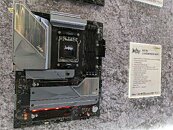
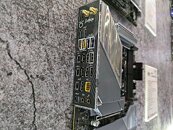
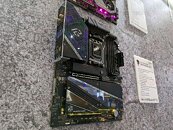
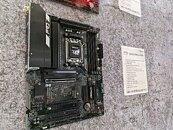
The star of the show is the new X870E Taichi OCF, which is also the first OC Formula motherboard based on AMD platform. This feature packed motherboard will support AMD Ryzen 9000, 8000, and 7000 series processors on AM5 socket. It features a 25-power phase VRM with 110A SPS, has two DDR5 DIMM slots, two PCIe 5.0 x16 and single PCIe 4.0 x4 slot, a total of six M.2 ports (two of which are PCIe Gen 5 x4), plenty of USB ports, 5 Gbps Ethernet, integrated Wi-Fi 7 and Bluetooth, and most importantly, "Professional Overclocking Toolkit", which means that this one is aimed at some high overclocking. ASRock also showcased the new X870 Taichi Creator, a more standard motherboard that has 21-phase VRM design, but comes with Marvell's 5 Gbps and 10 Gbps Ethernet ports.


9 Comments on ASRock Displays Its New Taichi OCF and Creator, and Phantom Gaming X870E/X870 Motherboards
I’d like a memory oc focused board, but at or above $600 is too much.
The failure rate is still way below one-tenth of 1%. That's just the cost of doing business.
At least ASRock is working with AMD to address the issue and has taken steps to reduce the number of cases. Let's remember, ASRock isn't the only brand to have this issue with AM5 CPUs. Furthermore, both companies are working with customers to get replacements sent out when this issue exists.
Nobody's done anything sneaky. Neither ASRock nor AMD have tried to hide this issue, sweep it under the rug, or try to deny anyone an RMA for it.
At least ASRock isn't ramping up voltages intentionally to try and get extra performance out of CPUs when used with their brand of motherboard like ASUS was with Raptor Lake CPUs; at least they haven't completely botched basic security measures like ASUS and Gigabyte have recently.
I really don't understand the gripe. The chances of everything being perfect and working perfectly when you take it out of the box is actually pretty damn high, especially considering how advanced the manufacturing pipelines are on a lot of these modern PC parts.
The fact that a couple hundred units out of the millions of units produced of the most advanced x86_64 desktop consumer CPUs to date, that boost to almost 6.0 Ghz on eight or more cores and 16 or more threads with 3D stacked L3 cache, have fried isn't something I find surprising or unacceptable. In fact, common sense would have me be grateful that these components we have today don't blow themselves up more often considering how much power is pushed through nanometer-wide traces with billions and even trillions of transistors.
Like, what are we complaining about here? That there's a 1 in 100,000 chance you might need to get a replacement CPU and motherboard for your video game machine?
That's what is known as a nice problem to have.
Unless ASRock/AMD are having an "Intel 13th and 14th Gen Degradation Issue"-sized problem then who gives a flying f. You're bound to have an issue with SOMETHING regardless of who you go with. Welcome to technology.