Wednesday, August 27th 2025

AMD's Next-Gen UDNA: Four Die Sizes, One Potential 96-CU Flagship
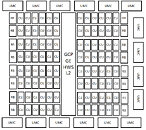
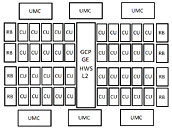
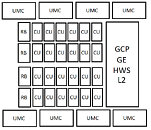
New block diagrams from a well-known hardware leaker @Kepler_L2 sketch out a very modular AMD UDNA family that could include four die sizes, with the largest rumored to reach 96 compute units. The images show repeating shader arrays and shader engines, each engine holding a handful of compute units and its own render backend. Those engines feed into a central SoC block that contains the graphics command processor, the graphics engine, hardware schedulers, and a shared L2 cache. On the memory side, the flagship diagram shows sixteen unified memory controllers, each with 32 bits, which would add up to a 512-bit external interface. The leak also mentions the possibility of a much larger on-die Infinity Cache for the top part.
If you map the parts together, the flagship's numbers line up with the diagram. Eight shader arrays with two shader engines each give 16 shader engines, and with six compute units per engine, that reaches the 96 CU figure. The mid-tier design pares things back: four shader arrays and eight shader engines, with five compute units per engine, which is about 40 compute units and an estimated six memory controllers for a 192-bit bus. Below that are 24 CU and 12 CU designs built from smaller arrays and fewer controllers. The 24 CU design is shown with as many as eight memory controllers, which could mean different controller widths depending on whether the part uses a traditional GDDR style interface or an LPDDR5X-like arrangement.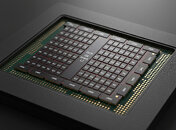
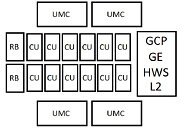 There are other hints in the diagrams that go beyond just compute counts and bus widths. One interesting detail is the suggestion that some data-center-focused parts could get much larger per-CU local caches. The documents also imply some convergence between Radeon and Instinct features under the UDNA label, which could let AMD reuse the same building blocks for both gaming and AI or accelerator roles. That kind of modular SoC layout would make it easier to mix and match engine counts, cache sizes, and memory controller counts across a single family of parts. All of this remains unofficial and speculative. The diagrams offer a plausible way for AMD to scale a single architecture up and down, but they do not prove that silicon has been taped out or that final specifications are fixed. AMD could still change CU counts, memory widths, cache sizes, or SKU names before production begins.
Sources:
Kepler_L2, via VideoCardz
If you map the parts together, the flagship's numbers line up with the diagram. Eight shader arrays with two shader engines each give 16 shader engines, and with six compute units per engine, that reaches the 96 CU figure. The mid-tier design pares things back: four shader arrays and eight shader engines, with five compute units per engine, which is about 40 compute units and an estimated six memory controllers for a 192-bit bus. Below that are 24 CU and 12 CU designs built from smaller arrays and fewer controllers. The 24 CU design is shown with as many as eight memory controllers, which could mean different controller widths depending on whether the part uses a traditional GDDR style interface or an LPDDR5X-like arrangement.


87 Comments on AMD's Next-Gen UDNA: Four Die Sizes, One Potential 96-CU Flagship
Did you think through your argument?
The other possibility for the seeming double count in other leaks would be that CUs have gotten wider. If each were twice as wide, as wide as a full WGP is now, that could get double-counted by somebody looking at shader counts.
And what's the problem with 192bit busses?
Obviously this is something Mark C. (and I believe the chaps at AMD) have spoken of increasing as to help with the use of FSR, etc.
I do not have the conversation at my fingertips, but it's out there as a goal for the next gen but not in any definitive terms afaik.
Hypothetically speaking, that would put the combined bandwidth for something like the 192-bit part at something not unlike 64MB of L2 (if my math isn't terribly off).
This makes sense to me, as does a theoretical world where nVIDIA uses a very dense version of the process aiming for clocks not dissimilar to what Apple did with N3B.
Those chips were clocked at 3780-4050mhz, where-as the higher-end M4 was 4.4-4.51 on N3P. The GPU holds the real clock potential though; take those 3x and they equal 4510-4734mhz.
Hence, the real clock potential of N3P is probably closer to 4.7ghz+ than even the higher-binned M4 at 4510mhz.
Hence, you can imagine a world where nVIDIA adds one more shader cluster to something like the 80 series for 12288sp, which according to my math would be balanced at 3780/36000.
You could imagine, for instance, a stock clock of 3700mhz with overclocking up to ~4050; not dissimilar to how one could expect 36gbps GDDR7 to overclock.
OTOH, AMD with '10240sp' would essentially be shooting for higher clocks, and since cache bw scales with clockspeed, you could imagine them equalizing it to ~3800-4000 initially, later perhaps slightly higher.
The difference being I think AMD will use the full clock capability of the process, as they often do and is rumored to occur if we ever see a faster N48 (perhaps w/ GDDR7), which I think was always originally planned to be paired with the (not really available) 24gbps GDDR6 from Samsung. Because yet again, we see the M2 at 3.5-3.7ghz...not unlike we expect from said part.
There is a world those could clock anywhere from 4.4-4.7ghz+ at best, as that's how N3P appears to be trending. Obviously not a stock clock, but perhaps w/ OCing and/or a future sku w 40gbps ram.
Perhaps not dissimilar to how we see current N48 power/clock limited below 3400mhz because of bw limitations (and even lower w/ RT etc), we could see a tiered launch with 36/40gbps and different clock/power limits and overall clock potential. Perhaps one at 3.8+/36000 and another 4.3+/40000.
TLDR; AMD would likely plant themselves to be both faster than a hypothetical '6070ti', with the upper bounds being very close/similar to a stock '6080', while likely pricing themselves similar/under 6070ti.
So...kinda what the 9070xt is to the 5070ti/5080. Makes sense. Also, 5070ti pricing being $750, 9070xt pricing $700...2GB extra ram...it all kind of fits together well-enough to guesstimate.
That's my best current estimate without bloviating on cache/bw scaling details and all the like...to essentially trap nVIDIA in that gap where they won't let a 6070ti cross; which is to say probably ~4090 or slightly faster.
It's impossible to make concrete declarations because the bw usage/perf of something like DLSS/RT is a fluid thing; where it once was 60/120, you now see a 4090 at ~55 or so...just outside OC limits of 60.
My guess is that nVIDIA will once again create this divide with 6070ti/6080, and AMD will stomp right on it with the 192-bit UDNA chip...tailoring their AI models/rt/ram usage etc to hit those thresholds.
My major fear is 18GB being enough without some 'tweener chip between it and the halo; if cache and distilling AI models can make everything fit.
Personally, I'd feel much more content with 24/32GB moving forward for 1440/4k, especially with the rise of potential 30/36GB consoles...themselves even perhaps up-scaling from 1080p or not much greater.
As such, if 6080 is indeed just 4080/5080 with an extra shader chunk, but retaining the 256-bit bus, it will be interesting to see those differences/trade-offs of 18 vs 24GB, if nothing else.
For us nerds that care about the business aspect, how low would AMD dare price such a part versus 6070ti (perhaps also 10240sp if not forced to 10752 at least with a Super)...That could be fairly interesting.
I'm interested in this gen...but certainly waiting for news of a potential refresh to see the maximum potential of the process (perhaps with 40gbps/more ram...will 4GB GDDR7 chips be a thing by 2028ish?).
Perhaps a 192-bit part on release, and then whatever the refresh of the large chip is as a long-term investment (if substantially better $/perf vs Rubin/Super), if not the OG biggin' used?
We'll see how it shakes out.
I don't think we'll ever see a 1080ti (or even 2080Ti)-like lifecycle again, simply due to how they can now manipulate the goal posts beyond raster in so many different ways (beyond just VRAM, but also VRAM). While one can make an argument for 4090 holding up pretty well by maintaining the VRR (48hz+) window, it should given it created a new price bracket, and yet the 5000 series purpose was relegate it to <60.
There is a VERY known level of performance people want; one can palpably see it on the charts; AMD/nVIDIA have also actively avoided it for a good long while...because they might kill the market TBH.
It *was* a 4090, but performance of that card has slipped slightly over time. People that bought one made a good investment if not anal about 60/120mins, but again, it was far from mainstream pricing.
I won't try to form a conspiracy; simply look at the charts from older and newer games. A 4090, even with an overclock, won't hold 60fps in many scenarios it once did...
...yet neither 5080 (even 24GB) nor 5090 is a replacement. 6080 has to be, with it's main limitation over time likely RAM...just like 5080. Same may also be true, but to a greater extent for the '10240sp/18GB' Radeon.
There is a pretty clear gulf, and it's very intentional...as once that level of perf/ram drops to a more mainstream pricing the consumer market may truly be mostly cooked due to slower advancements/pricing.
The answer to your 3000 series question is because the 3000 series was...not great? It wasn't just the node jump, it was the crappy Samsung node + crypto boom + a few other factors.
My point is that 6080 will probably be that card (for a while), while 6070ti will likely be kept from being that card. It's all relative bc again, things could shift outside raster (relative TOPs/rt/new DLSS/etc).
A major question is how much the new consoles will play a role in helping things stabalize, and also if their ratios of certain units weighted differently.
My personal belief is the real long-term highest-end will eat >24GB at 4k. AMD/nVIDIA might try to squeeze out 18GB being sufficient, but we already see Snowdrop using >18GB at 1440p.
So, in reality, it's currently 24GB imho (in which 5080 will have not enough grunt to saturate, the biggin' consumer RDNA5 if 24GB a potential future bottleneck).
Because I'll be damned if I can't make Div3 look the best it can. :P
What we want is a card like this original post is proposing...32GB and perhaps ~100TF. Perhaps ~60TF+/24GB for 1440p and ~70TF+ (intentionally faster than 5080 Super) for upscaling 1440p to 4k imho.
18GB may work for one or both 1440p options for a bit, but my guess is upscaling/FG/etc will require >18GB on nVIDIA pretty quick on higher-end titles. That just makes sense from a business perspective.
There are a lot of ways to 'trick' people by not satisfying one of those metrics. Just like 8GB cards, another is 16GB being a limitation on 5080, but yet another is 5080 not having the horsepower to be a 4090.
That will likely continue...because it has to...or again, people would likely just buy 'that' card and be done for a really long time.
As I've said before, a '6070' will likely beat a 5080 super, which is kind of what you're saying, and I'll explain why: 5080 needs >16GB but <24GB. If 6070 is 192-bit/18gb/9216sp and >proportional clocks...
Again, I remain curious if 4GB GDDR7 chips will exist in the 3nm generation (even if a 'refresh' gen), because a not-biggest-chip card with 24GB *could* potentially upscale 1440p->4k for quite a while, and potentially a '6080 super' with 32GB *could* be enough (if you overclock the crap out of it) to be okay for 4k.
Will nVIDIA let that happen? Probably not. Because they play this segment like a fiddle, stringing people along with such shennanigans and forcing upsells. AMD *has* tried it as well, but more likely to compromise.
It's one of those things where I can imagine 6080 Super debuting with 99.99TF OC limits/59fps in demanding games at 4k maxed out...but 32GB! (You get my point; perf-wise likely accurate, maybe not flops).
Will AMD release a 256-bit (AT1/refresh?) or 384/512-bit version of AT0 with 32/36GB that might actually fit the niche without requiring a second mortage? Those are more plausible imho.