Wednesday, August 27th 2025

AMD's Next-Gen UDNA: Four Die Sizes, One Potential 96-CU Flagship

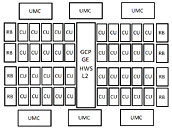
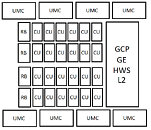
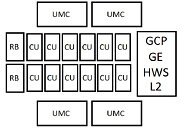
New block diagrams from a well-known hardware leaker @Kepler_L2 sketch out a very modular AMD UDNA family that could include four die sizes, with the largest rumored to reach 96 compute units. The images show repeating shader arrays and shader engines, each engine holding a handful of compute units and its own render backend. Those engines feed into a central SoC block that contains the graphics command processor, the graphics engine, hardware schedulers, and a shared L2 cache. On the memory side, the flagship diagram shows sixteen unified memory controllers, each with 32 bits, which would add up to a 512-bit external interface. The leak also mentions the possibility of a much larger on-die Infinity Cache for the top part.

If you map the parts together, the flagship's numbers line up with the diagram. Eight shader arrays with two shader engines each give 16 shader engines, and with six compute units per engine, that reaches the 96 CU figure. The mid-tier design pares things back: four shader arrays and eight shader engines, with five compute units per engine, which is about 40 compute units and an estimated six memory controllers for a 192-bit bus. Below that are 24 CU and 12 CU designs built from smaller arrays and fewer controllers. The 24 CU design is shown with as many as eight memory controllers, which could mean different controller widths depending on whether the part uses a traditional GDDR style interface or an LPDDR5X-like arrangement.
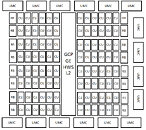
There are other hints in the diagrams that go beyond just compute counts and bus widths. One interesting detail is the suggestion that some data-center-focused parts could get much larger per-CU local caches. The documents also imply some convergence between Radeon and Instinct features under the UDNA label, which could let AMD reuse the same building blocks for both gaming and AI or accelerator roles. That kind of modular SoC layout would make it easier to mix and match engine counts, cache sizes, and memory controller counts across a single family of parts. All of this remains unofficial and speculative. The diagrams offer a plausible way for AMD to scale a single architecture up and down, but they do not prove that silicon has been taped out or that final specifications are fixed. AMD could still change CU counts, memory widths, cache sizes, or SKU names before production begins.
Sources: Kepler_L2, via VideoCardz
Add your own comment

87 Comments on AMD's Next-Gen UDNA: Four Die Sizes, One Potential 96-CU Flagship

#51
Nhonho
FrickNvidia is better at making videos
This is the only reason that forces me to buy Nvidia.
AMD should work with various app developers to enable 2-pass video encoding at the maximum quality profile to enable maximum image quality with a low bitrate.
Posted on Reply
#52
TheGeekn°72
TomorrowIf the rumors of LPDDR6X on lower end RDNA 5 parts is true then that may be the case again.
Wait, LPD6X ? DDR memory on GPUs ?
I know it's been done before but only on very low end GT cards, I thought I read you mean GD6X (which is an Nvidia exclusive, right?) then did a double take and this is the triple take, I was confused about non-G DDR memory on a new GPU generation
Tomorrow7000 series was just not very compelling. Sure it was more compact that Nvidia. Had regular power connectors and DP 2.1, but the performance uplift from 6000 series was disappointing
Was it ? I thought it was significant since the 7600XT beat the 4060 and the XTX was trading blows with the 4080, as far as I could tell, besides the RT, AI and encode performance (even if it did enable AV1, encode metrics really weren't that great), 7000 was pretty much equal to the 40 series beside a missing competitor in the Halo segment
NhonhoThis is the only reason that forces me not to buy Radeons.
AMD should work with various app developers to enable 2-pass video encoding at the maximum quality profile to enable maximum image quality at the lowest bitrate.
...isn't it already the case ? I thought OBS was set by default to 2-pass ? I didn't observe performance dips with my 70XT and it's not like Twitch allows for insane bitrates...
But I'm not an expert in that field so you've probably more experience with those kinds of settings than I do
Posted on Reply
#53
Nhonho
TheGeekn°72I thought OBS was set by default to 2-pass ? I didn't observe performance dips with my 70XT and it's not like Twitch allows for insane bitrates...
I wasn't referring to "screen recording" videos, but rather to converting video files.
Posted on Reply
#54
john_
TomorrowNvidia dropping prices? I believe it when i see it. With their market share they have zero incentive to get into a price war with AMD.

If Radeon did not go bankrupt during the Fury/Vega dark times then it's certainly wont now. Not with AMD backing it with those sweet server dollars.
If ATI was it's own separate company with much less staff and resources i could foresee them closing shop, but as part of AMD they're safe.

On this i agree. People who ask lower AMD prices rarely buy AMD as a result. Also AMD had a period of very low prices and people still bought Nvidia.

AMD will keep up with VRAM advancements just like they always have. In several cases in the past AMD was actually the pioneer in VRAM technologies.
If the rumors of LPDDR6X on lower end RDNA 5 parts is true then that may be the case again.
I honestly dont get where this notion has originated that somehow AMD will not use G7. Of course they will.
The exact speed is TBA, but for a 2027 product 40Gbps makes perfect sense and by that time G7 is not very expensive as everyone will be using it, including Intel (assuming they dont shutter their GPU department before).

Infinity Cache exists to avoid unnecessary jumps from L1 etc to RAM. It's about data locality. Not about avoiding the use of certain memory.

Marketing sure, but very few people cared about it. So selling=no. Even today when a tech site or a Youtuber conducts a poll on what people value most in a GPU the RT performance is never in the top. And these are people who presumably are enthusiasts willing to try new things first.
TPU poll results: www.techpowerup.com/forums/threads/next-gen-gpus-what-matters-most-to-you.326792/

On the upscaling front i agree. Tho 6000 series sold very well. 7000 series was a disappointment in the performance segment and AMD did not help their case by misrepresenting it in their pre launch slides. I very much doubt many people cared about RT in 2020. Probably more in 2022, but i doubt that was the deciding factor. I mean when we look at games that have transformative RT the number is very low: www.techspot.com/article/2910-ray-tracing-performance-test/

I doubt it. It is not any one feature. It's about the whole package. 7000 series was just not very compelling. Sure it was more compact that Nvidia. Had regular power connectors and DP 2.1, but the performance uplift from 6000 series was disappointing and the market was flooded with much cheaper used mining cards. Even if 7000 series had the RT uplift that would have still left worse FSR, occasionally buggy drives and higher prices.
All of which have been fixed or mitigated this generation.

Part of what makes the 9000 series is features for sure, but it's also the price. Sure people complain that it's not 599 like promised, but it's also not 999 despite the fact that it nearly catches the previous 999 model in raster and easily beats it in RT and upscaling. People see that and they like it, which is why it sells well by all accounts.
Nvidia is dropping prices in the mid-low end market because of competition. They call it "euro strengthening over dollar". And they do have the Super line waiting.

In the Fury/Vega era, AMD wasn't selling as much CPUs as now and didn't had Instinct cards to care about so much. So more resources and wafers for the Radeon group.

Nvidia is a very strong brand. People go where all the fuss is about, that's why RTX 3050 sold so much better than RX 6600.

I doubt AMD will choose the best VRAM available. They try to keep costs low because they have to compete with Nvidia with lower profit margins and much less market share. So they try to cut costs, to be able to price their cards cheaper than Nvidia's. AMD will go with GDDR7 if this is cheap and all the hype is about... GDDR8?

Infinity cache exists to help you build high end graphics cards without paying the fastest VRAM type or having to use a 384bit or even a 512bit data bus. It's as simple as that.

Marketing and hype sells cards. People read the RTX 3090 review, open up their wallets and go and buy an RTX 3050, because they don't have much money and because that card is also Nvidia is also from the same series, probably uses the same magic. They don't even know that RX 6600 is cheaper and runs circles around the 3050. Forget tech site and youtuber polls. They are useless. At wccftech for example, that is in fact the play area of all the Nvidia and Intel trolls of the internet, ALL polls end up with anything AMD on top. Useless polls. What is important is that tech press will promote raytracing as the tech of tomorrow, or else they will be banned from Nvidia's reviewers lists. So all that hype and marketing will fill your brain with one thought. "I need raytracing to see all those wanderful raytraced graphics of the current games and be ready for all those wanterfull raytraced graphics of the future games". So you go and buy an RTX 3050 for raytracing, because it is Nvidia and all tech press says that for raytracing Nvidia is the best. Add to that all the tech press insisting that DLSS is better than reality, while FSR is an appointment with your eye doctor and you get the point. in fact the point is more or less the reality we are living reading reviews those last years. Marketing and hype sells cards. The higher number of cards.

As for the 9000, it started as a VFM product with features that RX 7000 should have from the beginning. But the price didn't remained as an advantage for long, because prices of RX 9000 series gone up. But they are still excellent options for anyone who doesn't want to keep promoting Nvidia's monopoly. But the next hype will be around AI and performance in AI. Tech press will start focusing on it and games using AI to make NPCs look more real will start being in the center of discussions. AMD better be ready to offer and promote top notch AI capabilities by then, or we will be talking in 5 years from now how "AI performance wasn't importand in 2027 and there was no reason for gamers to be choosing Nvidia".
Posted on Reply
#55
Tomorrow
TheGeekn°72Wait, LPD6X ? DDR memory on GPUs ?
I know it's been done before but only on very low end GT cards, I thought I read you mean GD6X (which is an Nvidia exclusive, right?) then did a double take and this is the triple take, I was confused about non-G DDR memory on a new GPU generation
I may be mistaken but something like that was mentioned somewhere. Not sure how credible it is or maybe i got the mobile parts confused with the desktop parts.
TheGeekn°72Was it ? I thought it was significant since the 7600XT beat the 4060 and the XTX was trading blows with the 4080, as far as I could tell, besides the RT, AI and encode performance (even if it did enable AV1, encode metrics really weren't that great), 7000 was pretty much equal to the 40 series beside a missing competitor in the Halo segment
I meant compared to 6000 series, not 40 series.
Posted on Reply
#56
john_
TheGeekn°72Wait, LPD6X ? DDR memory on GPUs ?
I know it's been done before but only on very low end GT cards, I thought I read you mean GD6X (which is an Nvidia exclusive, right?) then did a double take and this is the triple take, I was confused about non-G DDR memory on a new GPU generation
TomorrowI may be mistaken but something like that was mentioned somewhere. Not sure how credible it is or maybe i got the mobile parts confused with the desktop parts.
It's a rumor from Moore's law Is Dead. It does makes sense. LPDDR5X is considered much cheaper and with Infinity Cache helping the lack of bandwidth might not be a significant problem for cards that cost $300 or less. With 192bit data bus someone gets 240GB/sec bandwidth, a number not much lower that the bandwidth on an RX 7600XT. Then there is the possibility of using LPDDR6, that will be available in 2026 and will be offering higher bandwidth.
Posted on Reply
#57
TheGeekn°72
TomorrowI may be mistaken but something like that was mentioned somewhere. Not sure how credible it is or maybe i got the mobile parts confused with the desktop parts.
well the specs have to be fixed anyway so there's still a high chance a bunch of things could get modified by production time
TomorrowI meant compared to 6000 series, not 40 series.
that confuses me even more because if 6000 series was considered less good than RTX 30 (which it wasn't by a borderline negligible amount, the 6600XT was glued to the ass of the 3060 and the 6950XT was equaling the 3090) and 7000 series equals the RTX 40 besides RT, how was the uplift considered *not* compelling, especially when you remember the prices Nvidia applied on their cards, making the 4080 @ 1200$ when the XTX was 999$
people really confuse me between what they ask for and what they do, like the usual bullshit of "AMD should lower their prices" before buying Nvidia's halo SKU
john_It's a rumor from Moore's law Is Dead. It does makes sense. LPDDR5X is considered much cheaper and with Infinity Cache helping the lack of bandwidth might not be a significant problem for cards that cost $300 or less.
so that would be "reserved" for the the low end then since Infinity Cache is "that good" ?
john_With 192bit data bus someone gets 240GB/sec bandwidth, a number not much lower that the bandwidth on an RX 7600XT.
figures, since the 90-series is still on GD6, just slightly faster bins instead
john_Then there is the possibility of using LPDDR6, that will be available in 2026 and will be offering higher bandwidth.
they should have their hands on some samples from memory manufacturers to test with by now, no ? but since LPD6 is fresh out of the oven, wouldn't that be expensive anyways ?
Posted on Reply
#58
demu
Vayra86Yeah and it sucked harder than most AMD gaming cards in the last two decades. Your point?
...you can't have more than a 256-bit bus wired around the chip, it's just impossible...
It was possible 10 years ago, it is possible with previous and current nVidia datacenter GPU:s (Pascal, Volta, Turing, Ampere, Hopper, Ada Lovelace, Blackwell) and all AMD datacenter GPU:s since MI 8 (MI8, MI25, MI50, MI60, MI100, MI210, MI250, MI250X, MI300A, MI300X, MI325X, MI350X, 355X).
There are no physical limitations why it cannot be used for desktop graphics solutions.
Posted on Reply
#59
Tomorrow
john_Nvidia is dropping prices in the mid-low end market because of competition. They call it "euro strengthening over dollar". And they do have the Super line waiting.
That is a mere price correction due to exchange rate. Not a price drop. If the exchange rate went the other way the prices would rise again. Nvidia never intentionally lowers prices. Super lineup will, at best come at same prices as current one. Zero chance for a price drop.
john_In the Fury/Vega era, AMD wasn't selling as much CPUs as now and didn't had Instinct cards to care about so much. So more resources and wafers for the Radeon group.
Less resources. AMD was on the verge of bankruptcy at one point. The whole AMD, not just Radeon group.
Saying that Radeon group somehow had more resources and wafers because the CPU side was doing bad is a ridiculous thing to say.
john_Nvidia is a very strong brand. People go where all the fuss is about, that's why RTX 3050 sold so much better than RX 6600.
Nvidia has strong marketing. That's for sure. There's a reason they're sometimes called a "green Apple".
They sell more features and "vibe" than raw performance and low price.
john_I doubt AMD will choose the best VRAM available. They try to keep costs low because they have to compete with Nvidia with lower profit margins and much less market share. So they try to cut costs, to be able to price their cards cheaper than Nvidia's. AMD will go with GDDR7 if this is cheap and all the hype is about... GDDR8?
Well see i guess. AMD may very well use the fastest G7 and Nvidia goes to Micron to co-develop G7X instead. Right now AMD uses the most expensive G6 at 20Gbps. We are talking about products that are still ~18 months out. Plenty of time for G7 price to fall. Current leaks say they'll use 36Gbps. We'll see.
john_Infinity cache exists to help you build high end graphics cards without paying the fastest VRAM type or having to use a 384bit or even a 512bit data bus. It's as simple as that.
Fastest RAM is not a substitute to large local cache and vice versa.
john_But the price didn't remained as an advantage for long, because prices of RX 9000 series gone up.
After the launch yes. Now it has fallen below MSRP in some regions and still maintains price advantage over Nvidia with significantly improved feature parity.
The main issue for 9000 series now seems to be performance deficit in professional apps and the lower number of games supporting FSR 4, compared to DLSS 4.
TheGeekn°72that confuses me even more because if 6000 series was considered less good than RTX 30 (which it wasn't by a borderline negligible amount, the 6600XT was glued to the ass of the 3060 and the 6950XT was equaling the 3090) and 7000 series equals the RTX 40 besides RT, how was the uplift considered *not* compelling, especially when you remember the prices Nvidia applied on their cards, making the 4080 @ 1200$ when the XTX was 999$
6000 series was very good. AMD's pre-launch numbers were on point and after 5700 XT they were right back in the high end with 6900 XT that lost only 11% to 3090. The reason 7000 series was disappointing was that AMD fudged the pre-launch numbers by setting unrealistic expectations that fell way short in reality and Nvidia widened the gap at the high end significantly because 7000 series under-performed. Then there was the 7900 XT absurd price that killed that card and so on.

Im not saying 7000 series were bad cards. They were just not as good as 6000 series against their competitors.
demu...you can't have more than a 256-bit bus wired around the chip, it's just impossible...
So AMD did the impossible by releasing a 384bit 7900 XTX ?

Don't be ridiculous. The bus width depends on the PCB and the number of memory controllers on the edges of the die.
If AMD wanted to they could make a 512bit card, but i doubt they will do it as the PCB gets expensive and complex and the die has to be big.
Posted on Reply
#60
TheGeekn°72
demuIt was possible 10 years ago, it is possible with previous and current nVidia datacenter GPU:s (Pascal, Volta, Turing, Ampere, Hopper, Ada Lovelace, Blackwell) and all AMD datacenter GPU:s since MI 8 (MI8, MI25, MI50, MI60, MI100, MI210, MI250, MI250X, MI300A, MI300X, MI325X, MI350X, 355X).
There are no physical limitations why it cannot be used for desktop graphics solutions.
that's what I keep telling people ! I dream of the day we get consumer HBM again but the problem is cost, that shit costs more than the die it is paired to... (I assume)
though I'd love to see a cost analysis of a single stack of HBM on a consumer card (I have no idea how much VRAM a single stack contains but if it does contain something in the 8-12GB range, surely there's way to benefit from that through some clever cost cutting and maybe economy of scale ?)
EDIT : according to wikipedia, we'd absolutely be getting some decent memory amount & bandwidth is HBM2/2E was still in production

Imagine this : you have one section with all the compute and just next to it, a big "coob" of VRAM, the dream... just one stack of HBM3 would make nicely for an XTX SKU and one 3E for a pro/AI SKU instead
demu...you can't have more than a 256-bit bus wired around the chip, it's just impossible...
TomorrowSo AMD did the impossible by releasing a 384bit 7900 XTX ?

Don't be ridiculous. The bus with depends on the PCB and the number of memory controllers on the edges of the die.
If AMD wanted to they could make a 512bit card, but i doubt they will do it as the PCB gets expensive and complex and the die has to be big.
the 5090 has a 512-bit bus, right ? the damn thing is gigantic anyways
Posted on Reply
#61
eyenix
512-bit bus would be possible, they will use chiplet if they need to unify architectures for UDNA
Posted on Reply
#62
Elessar1
Tek-CheckThis might be AMD changing names 1 CU = 1 WGP on RDNA5 = 2 CU on RDNA4
Perhaps, the issue with "news" like these is the endless speculation involved, which I dislike. Tuvok was right...
Posted on Reply
#63
Tek-Check
Elessar1Perhaps, the issue with "news" like these is the endless speculation involved, which I dislike. Tuvok was right...
It's a dead season for silicon launches from AMD and Intel, so leaks take some space. Nothing new.
Posted on Reply
#64
TheGeekn°72
LastDudeALiveYep, AMD has always been at least two generations behind, so finally beating a 5 year old flagship card sounds about right.
if it was true, would you mind explaining to me how the 6950XT benched the same as the 3090, XTX benched the same as the 4080, 9070XT benches the same as the 5070Ti
at the low end, 6600XT equals the 3060, 7600XT equals the 4060, 9060 equals the 5060, so really there's no room for arguments claiming AMD to be two gens behind, it's just factually not true
just because they stopped going for flagships and reduced their product portfolio doesn't mean they're behind if the performance of the tier they're competing with is the same
you can't even attack them on features anymore because they caught up with Nvidia big time over the years (though I'll be the first to admit they really used to suck in that department)
the one last relevant thing is CUDA vs ROCm but that one's much harder to solve because even if ROCm was 1:1 to CUDA, getting people to adopt it is a massive feat to achieve
now they're scaling their product line back up thanks to UDNA and I'm curious to see how ROCm's update to v7 is gonna fare and how AMD plans to prop it up for further user adoption
Posted on Reply
#65
JustBenching
TheGeekn°72if it was true, would you mind explaining to me how the 6950XT benched the same as the 3090, XTX benched the same as the 4080, 9070XT benches the same as the 5070Ti
They don't bench the same. Only in a very specific myopic scenario, raster. Anything else including upscaling, ray tracing, Ai cuda etc etc they are nowhere near. Sad but true

That's like saying that the 9600x benches the same as the 9970wx threadripper while only looking at single threaded performance.
Posted on Reply
#66
TheGeekn°72
JustBenchingThey don't bench the same. Only in a very specific myopic scenario, raster. Anything else including upscaling, ray tracing, Ai cuda etc etc they are nowhere near. Sad but true
The one thing that truly matters is raster, despite all the marketing, RT is not necessary to play games, and upscaling is there as a crutch for bad optimization.
AI is only relevant to professionals who have the budget for pro cards anyway since the market for consumer AI apps that run locally, make use of GPUs and actually do something useful is essentially non existent (I myself use a couple of niche LLMs that actually do useful stuff, they run on CPU)
JustBenchingThat's like saying that the 9600x benches the same as the 9970wx threadripper while only looking at single threaded performance.
That is, literally not the same thing.
Apple to oranges comparison here.
Posted on Reply
#67
JustBenching
TheGeekn°72The one thing that truly matters is raster,
The one thing that truly matters to YOU. It doesn't matter to me, I think raster is pure marketing.
Posted on Reply
#68
Tek-Check
JustBenchingThe one thing that truly matters to YOU. It doesn't matter to me, I think raster is pure marketing.
Hahaha! Ask Jensen to remove raster silicon and then enjoy the rest of action.
Posted on Reply
#69
JustBenching
Tek-CheckHahaha! Ask Jensen to remove raster silicon and then enjoy the rest of action.
Haha ask Lisa to remove RT silicon and then enjoy the rest of the action.

What kind of argument is that? Grow up man
Posted on Reply
#70
TheGeekn°72
JustBenchingThe one thing that truly matters to YOU. It doesn't matter to me, I think raster is pure marketing.
...you- you know that GPUs *need* raster to do what they're designed for, right ? without raster, what are your RT and AI cores doing for you ?
JustBenchingHaha ask Lisa to remove RT silicon and then enjoy the rest of the action.
well shit, I would if I could, the AI cores too, that'd make space for more raster cores, sure would help to get extra horse power with all the unoptimized games going around
Posted on Reply
#71
JustBenching
TheGeekn°72...you- you know that GPUs *need* raster to do what they're designed for
Yes, they do. Im arguing I already have enough of that, it's the RT games that my card struggles with. Offer me a GPU with 50% more raster vs a GPU with 50% more RT performance, I have absolutely no need for the first.
Posted on Reply
#72
Tek-Check
JustBenchingHaha ask Lisa to remove RT silicon and then enjoy the rest of the action.
I have been enjoying the action without RT on a brilliant OLED display since 2019. My quality of life has not suffered at all.
JustBenchingWhat kind of argument is that? Grow up man
Take it easy. It's a banter. Have a cup of tea.
Posted on Reply
#73
Tomorrow
Still arguing with that justbenching guy?

Give it a rest. It's not worth it. Just put him in the ignore list and you save countless hours arguing with a person who does not argue in good faith.
Posted on Reply
#74
JustBenching
The guy that said he bought a 9070xt cause nvidia might block dlss 5 from the 50series while that was exactly what AMD just did with FSR 4 is calling me out for not arguing in good faith :D
Posted on Reply
#75
Denver
Based on the LLVM clues, these are 96 dual-CUs (equivalent to WGPs), totaling 192 CUs for the full chip. AMD is clearly going all out.
But the full chip is only expected to appear in the professional/AI market.
Posted on Reply
Add your own comment
Nov 26th, 2026 18:20 CST change timezone

New Forum Posts

Popular Reviews

TPU on YouTube

Controversial News Posts