Wednesday, August 27th 2025

AMD's Next-Gen UDNA: Four Die Sizes, One Potential 96-CU Flagship
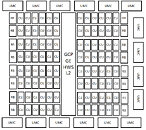
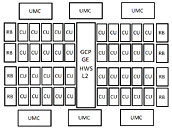
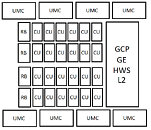
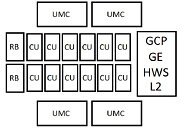
New block diagrams from a well-known hardware leaker @Kepler_L2 sketch out a very modular AMD UDNA family that could include four die sizes, with the largest rumored to reach 96 compute units. The images show repeating shader arrays and shader engines, each engine holding a handful of compute units and its own render backend. Those engines feed into a central SoC block that contains the graphics command processor, the graphics engine, hardware schedulers, and a shared L2 cache. On the memory side, the flagship diagram shows sixteen unified memory controllers, each with 32 bits, which would add up to a 512-bit external interface. The leak also mentions the possibility of a much larger on-die Infinity Cache for the top part.
If you map the parts together, the flagship's numbers line up with the diagram. Eight shader arrays with two shader engines each give 16 shader engines, and with six compute units per engine, that reaches the 96 CU figure. The mid-tier design pares things back: four shader arrays and eight shader engines, with five compute units per engine, which is about 40 compute units and an estimated six memory controllers for a 192-bit bus. Below that are 24 CU and 12 CU designs built from smaller arrays and fewer controllers. The 24 CU design is shown with as many as eight memory controllers, which could mean different controller widths depending on whether the part uses a traditional GDDR style interface or an LPDDR5X-like arrangement.
 There are other hints in the diagrams that go beyond just compute counts and bus widths. One interesting detail is the suggestion that some data-center-focused parts could get much larger per-CU local caches. The documents also imply some convergence between Radeon and Instinct features under the UDNA label, which could let AMD reuse the same building blocks for both gaming and AI or accelerator roles. That kind of modular SoC layout would make it easier to mix and match engine counts, cache sizes, and memory controller counts across a single family of parts. All of this remains unofficial and speculative. The diagrams offer a plausible way for AMD to scale a single architecture up and down, but they do not prove that silicon has been taped out or that final specifications are fixed. AMD could still change CU counts, memory widths, cache sizes, or SKU names before production begins.
Sources:
Kepler_L2, via VideoCardz
If you map the parts together, the flagship's numbers line up with the diagram. Eight shader arrays with two shader engines each give 16 shader engines, and with six compute units per engine, that reaches the 96 CU figure. The mid-tier design pares things back: four shader arrays and eight shader engines, with five compute units per engine, which is about 40 compute units and an estimated six memory controllers for a 192-bit bus. Below that are 24 CU and 12 CU designs built from smaller arrays and fewer controllers. The 24 CU design is shown with as many as eight memory controllers, which could mean different controller widths depending on whether the part uses a traditional GDDR style interface or an LPDDR5X-like arrangement.


87 Comments on AMD's Next-Gen UDNA: Four Die Sizes, One Potential 96-CU Flagship
Even when 6900 XT was much closer to 3090 in performance (11%) the price gap was still 999 vs 1499.
AMD did not price theirs at 1200 because they were close. Nor should they if they want to gain market share.
Nvidia -50 = AMD price does not work.RDNA 5 will also have G7. Even if pure CU uplift is 50% then G7 may well make up for that last 10%.
And AMD will be jumping on second gen G7 with faster speeds than today's G7 that tops out at 32Gbps.
Likely AMD will use something like 40Gbps which will be 2x bandwidth increase over today's 20Gbps G6 (at same bus width obviously).
Improvement in RT will likely exceed 60% easily.It wasn't. By the time they got their RT to an acceptable level (2025) it's when RT started to somewhat matter. Having the fastest RT in 2022 would have been pointless. Not enough games using it. Lack of RT performance did not kill 7900 series. It was incorrect performance and efficiency figures touted by AMD coupled with absurd price for the XT model.
The reason for not building 96 CU model for RDNA 4 has less to do with RDNA 3's under-performance and more with the fact that they supposedly could not get chiplets to work well enough to do a dual chiplet 64+64 CU card.At half the price...
I guess we'll have to wait and see.
Lisa Su called the demand "unprecedented" in an interview.
People quoted saying "you can get 5070 Ti level performance for only $599 USD" (versus $749).
It's difficult to assert the 'more performance for a lower price' slogan specifically for RDNA 4 products because they came incredibly close to parity across the line this time, but in RDNA3's prime and for RDNA2 following the crypto mining implosion, that axiom has largely been true. The better statement is unfortunately the vaguer one, which is 'consistently better value for gamers'.
Nvidia sells 8 to 2 (if not 9 to 1) and with higher profit margins. If AMD price their cards -100 or -200, Nvidia can lower prices and make Radeon cards look -50 again. People seeing Nvidia responding and dropping prices will drive them to buy a new Nvidia card even if they don't want a new one at the time. Result? AMD ending up with a huge almost unsellable inventory that even if they manage to sell it they will make ridiculously low profits. Nvidia will still make a sizable profit because it sells with higher profit margin and a much higher number of cards. Radeon group will go bankrupt, Nvidia will announce 5 billion sales with probably 0.5% lower profit margin in general, from 73.5% to 73%.
People keep asking from AMD to just suicide, so they can buy cheaper Nvidia cards. That's what that "change that -50 AMD or I am not buying" is. Because it was never "change that -50 AMD or I am not buying" in the last 10-20 years. It was always "change that -50 AMD because I want to buy cheaper Nvidia". Well, they aren't going to do it. In the gaming GPU market people buy Nvidia with every excuse imaginable. A good one or a ridiculous one. Until this changes, they can't price their cards like they want to go bankrupt. People should realize that and if they want to see lower prices, just stop supporting the current market reality that is a monopoly.I don't expect them to go for a very expensive VRAM type. They build Infinity Cache to avoid expensive VRAMs and a wide data bus. They will go fast VRAM only if they start targeting AI with their gaming GPUs. And they should. They should start selling those gaming cards as AI powerhouses to increase the base of people using ROCm.It was. From the introduction of RTX 3000 series, raytracing performance was a huge marketing and selling parameter. People where avoiding RX 6000 cards because of lack of a DLSS equivalent and low reaytracing performance. AMD should have seen that. They didn't, they released RX 7000 without a real improvement in raytracing and we seen the results. On the contrary, RX 9000 series sees a much higher raytracing performance and FSR 4, meaning people have less reasons to not buy an AMD card. If RX 7000 had the raytracing performance of RX 9000 series cards, we might have seen a high end RX 9000 card today and AMD could be close to 20% market share.
Part of this is on AMD; the combination of lacking any sort of feature that makes them uniquely desirable and lacking an in-house reference model to dictate price means that there is no way for them to compete on their own terms. Part of this is on the fact that, like you said, the current paradigm is the only stable arrangement; Nvidia is in a far better position to fight a price war if it erupts. AMD is subservient to this disadvantaged position because it is better to be at a disadvantage than it is to be dead.
As it pertains to UDNA, I think we can expect more of the same. "Nvidia -$50" has gotten extremely close to a good buy for me (9060 XT 16GB) regardless, and if the performance increases are sufficient and the price is right, it will be an acceptable buy for me. I have no need of Nvidia's features, so the better deal is the better deal. I might bemoan my loss of speed in casual AI hobbyism, but, well... I'm really only a power supply and maybe a 16 gig kit of DDR4 away from just making a CUDA box I can use instead.
If ATI was it's own separate company with much less staff and resources i could foresee them closing shop, but as part of AMD they're safe.On this i agree. People who ask lower AMD prices rarely buy AMD as a result. Also AMD had a period of very low prices and people still bought Nvidia.AMD will keep up with VRAM advancements just like they always have. In several cases in the past AMD was actually the pioneer in VRAM technologies.
If the rumors of LPDDR6X on lower end RDNA 5 parts is true then that may be the case again.
I honestly dont get where this notion has originated that somehow AMD will not use G7. Of course they will.
The exact speed is TBA, but for a 2027 product 40Gbps makes perfect sense and by that time G7 is not very expensive as everyone will be using it, including Intel (assuming they dont shutter their GPU department before).
Infinity Cache exists to avoid unnecessary jumps from L1 etc to RAM. It's about data locality. Not about avoiding the use of certain memory.Marketing sure, but very few people cared about it. So selling=no. Even today when a tech site or a Youtuber conducts a poll on what people value most in a GPU the RT performance is never in the top. And these are people who presumably are enthusiasts willing to try new things first.
TPU poll results: www.techpowerup.com/forums/threads/next-gen-gpus-what-matters-most-to-you.326792/On the upscaling front i agree. Tho 6000 series sold very well. 7000 series was a disappointment in the performance segment and AMD did not help their case by misrepresenting it in their pre launch slides. I very much doubt many people cared about RT in 2020. Probably more in 2022, but i doubt that was the deciding factor. I mean when we look at games that have transformative RT the number is very low: www.techspot.com/article/2910-ray-tracing-performance-test/I doubt it. It is not any one feature. It's about the whole package. 7000 series was just not very compelling. Sure it was more compact that Nvidia. Had regular power connectors and DP 2.1, but the performance uplift from 6000 series was disappointing and the market was flooded with much cheaper used mining cards. Even if 7000 series had the RT uplift that would have still left worse FSR, occasionally buggy drives and higher prices.
All of which have been fixed or mitigated this generation.
Part of what makes the 9000 series is features for sure, but it's also the price. Sure people complain that it's not 599 like promised, but it's also not 999 despite the fact that it nearly catches the previous 999 model in raster and easily beats it in RT and upscaling. People see that and they like it, which is why it sells well by all accounts.