Tuesday, September 9th 2025

NVIDIA RTX Remix Update Introduces Advanced Path-Traced Particle System
Many classic PC games remain beloved for their unforgettable stories, characters, and gameplay. But as technology advances, their visuals struggle to keep up, making it harder for the original gamers who played them, or new generations, to appreciate their magic. NVIDIA RTX Remix, a modding platform for RTX AI PCs, was built to change that. By reimagining the graphics of these timeless classics with cutting-edge path tracing, we're allowing longtime fans to relive their favorite adventures in stunning detail, while introducing a new wave of players to the games that defined an era.
Today, we've released a new RTX Remix update through NVIDIA app, adding an advanced particle system that enables modders to enhance traditional fire and smoke effects, as well as more fantastical effects, like those in Portal. Check out our official documentation to see the full release notes.
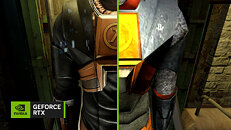
 In RTX Remix, legacy particles from a classic game could be interpreted as path-traced, enabling them to cast realistic light, enhancing the appearance of many scenes. But ultimately, these particles were still over 20 years old, lacking detail, flair, and fluid animations.
Now, modders can create brand new particles in Remix that match the look of those found in modern titles. This opens the door for over 165 RTX Remix compatible games to have advanced particle effects for the first time, and we can't wait to see all the ways modders dazzle gamers with realistic and spectacular effects.
RTX Remix particles are GPU-driven, meaning you can add tens of thousands of them without significantly reducing performance. They are path-traced, meaning they cast accurate shadows, and are reflected in the world-a rarity in games. Additionally, they feature a realistic physics simulation, complete with proper collisions with the environment. All of these elements together give modders a chance to make breathtaking VFX. As an example, we've designated the Antlion Guard from Half-Life 2 RTX as a particle emitter. Over 100,000 shadowed particles are performantly rendered, and as the Antlion Guard moves, the physics of each particle is accurately reflected and affected.
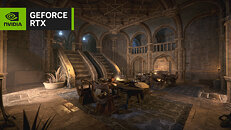
In the clip below, you can see how the fire in Half-Life 2 RTX can be elevated to look more natural and realistic through the use of advanced particles, with smoke billowing from the tips, and embers sparking and floating through the air:
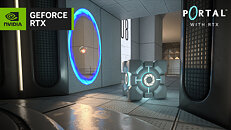
These effects can be tuned dramatically, giving modders many ways to channel their creativity. For example, here are three vastly different interpretations of the high energy pellet from Portal with RTX:
And best of all, RTX Remix lets you add particles into your scene instantly while you play - it's instantaneous and a whole lot of fun.
Adding RTX Remix particles is fast and easy. Simply open the Alt+X RTX Remix Developer Menu while in-game, navigate to the Games Setup > Categorize Textures tab, and select any game element, be that a fire effect, character, or malfunctioning light-from there, simply select "particle emitters" to see particles spawn. On the "Rendering tab", adjust the size of the effect, the number of particles spawned, the color, and other fields to achieve the perfect look - it's as easy as that!
For more serious modders, we recommend building your particles in the RTX Remix Toolkit, which offers a lot more control. For a complete breakdown of all the new particle options, check out the release notes, and head over to the RTX Remix developer manual.
Since its initial release, the RTX Remix modding community has grown to 237 active projects, with over 100 RTX Remix mods released. They span a catalog of beloved games like Half-Life 2, Need for Speed Underground,Portal 2 and Deus Ex, boasting over 2 million downloads.
Recently, we asked the community to make new mods and enhance their existing work in our RTX Remix Mod Contest. The mods created were phenomenal, and ultimately we awarded $60,000 in cash prizes to the developers of Painkiller RTX Remix, Vampire The Masquerade: Bloodlines - RTX Remaster, I-Ninja Remixed, and Call of Duty 2 RTX Remix of Carentan. Head to our contest article to learn more, and to download the mods.
As a modder plays through a classic game with RTX Remix, textures, models, lighting, effects, and more can all be captured, and reassembled into an editable scene. Through an intuitive interface, the RTX Remix application lets modders drag and drop lights, recreate every object and material to modern standards, copy-paste existing objects into a scene to increase clutter and grass coverage, convert lights to be fully ray-traced, AI enhance textures, and add DLSS 4 to improve image quality and accelerate performance.
Make Your Own Mods With NVIDIA RTX Remix Or Download From ModDB
To make your own RTX mods, download NVIDIA RTX Remix from the Home screen of NVIDIA app. And grab the Half-Life 2 RTX demo or Portal with RTX from Steam for an example of what's possible with the latest RTX Remix upgrades.
NVIDIA RTX Remix requires a GeForce RTX GPU to create RTX Remix Mods, while mods and games built using Remix are compatible with any hardware that can run Vulkan ray-traced games.
To find RTX Remix mods to download and play, we recommend ModDB and the RTX Remix Showcase Discord server.
Source:
NVIDIA
Today, we've released a new RTX Remix update through NVIDIA app, adding an advanced particle system that enables modders to enhance traditional fire and smoke effects, as well as more fantastical effects, like those in Portal. Check out our official documentation to see the full release notes.


Now, modders can create brand new particles in Remix that match the look of those found in modern titles. This opens the door for over 165 RTX Remix compatible games to have advanced particle effects for the first time, and we can't wait to see all the ways modders dazzle gamers with realistic and spectacular effects.
RTX Remix particles are GPU-driven, meaning you can add tens of thousands of them without significantly reducing performance. They are path-traced, meaning they cast accurate shadows, and are reflected in the world-a rarity in games. Additionally, they feature a realistic physics simulation, complete with proper collisions with the environment. All of these elements together give modders a chance to make breathtaking VFX. As an example, we've designated the Antlion Guard from Half-Life 2 RTX as a particle emitter. Over 100,000 shadowed particles are performantly rendered, and as the Antlion Guard moves, the physics of each particle is accurately reflected and affected.
In the clip below, you can see how the fire in Half-Life 2 RTX can be elevated to look more natural and realistic through the use of advanced particles, with smoke billowing from the tips, and embers sparking and floating through the air:
These effects can be tuned dramatically, giving modders many ways to channel their creativity. For example, here are three vastly different interpretations of the high energy pellet from Portal with RTX:
And best of all, RTX Remix lets you add particles into your scene instantly while you play - it's instantaneous and a whole lot of fun.
Adding RTX Remix particles is fast and easy. Simply open the Alt+X RTX Remix Developer Menu while in-game, navigate to the Games Setup > Categorize Textures tab, and select any game element, be that a fire effect, character, or malfunctioning light-from there, simply select "particle emitters" to see particles spawn. On the "Rendering tab", adjust the size of the effect, the number of particles spawned, the color, and other fields to achieve the perfect look - it's as easy as that!
For more serious modders, we recommend building your particles in the RTX Remix Toolkit, which offers a lot more control. For a complete breakdown of all the new particle options, check out the release notes, and head over to the RTX Remix developer manual.
Since its initial release, the RTX Remix modding community has grown to 237 active projects, with over 100 RTX Remix mods released. They span a catalog of beloved games like Half-Life 2, Need for Speed Underground,Portal 2 and Deus Ex, boasting over 2 million downloads.
Recently, we asked the community to make new mods and enhance their existing work in our RTX Remix Mod Contest. The mods created were phenomenal, and ultimately we awarded $60,000 in cash prizes to the developers of Painkiller RTX Remix, Vampire The Masquerade: Bloodlines - RTX Remaster, I-Ninja Remixed, and Call of Duty 2 RTX Remix of Carentan. Head to our contest article to learn more, and to download the mods.
As a modder plays through a classic game with RTX Remix, textures, models, lighting, effects, and more can all be captured, and reassembled into an editable scene. Through an intuitive interface, the RTX Remix application lets modders drag and drop lights, recreate every object and material to modern standards, copy-paste existing objects into a scene to increase clutter and grass coverage, convert lights to be fully ray-traced, AI enhance textures, and add DLSS 4 to improve image quality and accelerate performance.
Make Your Own Mods With NVIDIA RTX Remix Or Download From ModDB
To make your own RTX mods, download NVIDIA RTX Remix from the Home screen of NVIDIA app. And grab the Half-Life 2 RTX demo or Portal with RTX from Steam for an example of what's possible with the latest RTX Remix upgrades.
NVIDIA RTX Remix requires a GeForce RTX GPU to create RTX Remix Mods, while mods and games built using Remix are compatible with any hardware that can run Vulkan ray-traced games.
To find RTX Remix mods to download and play, we recommend ModDB and the RTX Remix Showcase Discord server.
8 Comments on NVIDIA RTX Remix Update Introduces Advanced Path-Traced Particle System
Dead Space remake review - a horror original re-engineered as a franchise prequel
www.eurogamer.net/dead-space-remake-review-a-horror-original-re-engineered-as-a-franchise-prequelIt defeats the purposed of RT shadows in the first place because everything looks blurry instead of accurate shadows that should be sharper near the source. Might as well use rasterized shadows at this point, it'd look a lot better without the performance hit.
I imagine they avoid moving RT light emitters because as other RT titles have shown, resolving to full lighting quality with current hardware takes multiple frames. It's why HWUB was able to demonstrate in games lik CP2077 that lighting quality with PT / RT enabled massively dips in motion and there's a persistence issue when RT effects will lag behind several frames.
So yeah, this is basically just enabling RT shadows for PhysX particles. I will also add, not very high quality particles either, almost seems like circa 2015 quality. Modern compute based particle systems can produce much finer more detailed effects.
In *some* cases, the ratio of penumbra to umbra should get smaller the closer you get to the shadow-casting object, yes, but it only nears zero at contact point. A floating object evidently wouldn't have a contact point, and particles and debris are typically very small in size compared to the light source, resulting in shadows that are penumbra/antumbra or "soft" (notwithstanding other weird effects you get with overlaps and adjacency).
Interestingly, how rasterized renderers simulate this does actually involve blurring.
Some lighting/geometry combinations do call for hard, sharp shadows, but I don't think those would ever cover things like (discrete) particles.