Friday, September 19th 2025

PCI-SIG Confirms PCIe 8.0 Will Deliver 1 TB/s Bidirectional Bandwidth, First Spec Draft Now Available

PCI-SIG has announced a clear step forward for peripheral connectivity: PCIe 8.0 is being developed to run at 256 GT/s, which translates to about 512 GB/s in each direction and roughly 1 TB/s of simultaneous bidirectional bandwidth in a full x16 slot. Version 0.3 of the PCIe 8.0 specification has been released to member companies for review, marking the first formal draft from the working group. This draft is an early milestone on a multi-year path toward a final 1.0 release, and member feedback will shape further drafts as the consortium works to complete the standard by the targeted timeframe in 2028.

The draft reiterates several engineering priorities beyond raw speed. PCIe 8.0 will continue to use PAM4 signaling while doubling the bit rate over PCIe 7.0 and quadrupling it over PCIe 6.0, with a strong emphasis on keeping compatibility with past generations. Power efficiency and protocol optimizations for even higher rates are under active consideration, and the working group is testing new connector approaches. Optical links remain a topic of interest because they could extend reach and reduce energy use, but cost and interoperability questions will need to be resolved before they become mainstream in the PCIe ecosystem. Vendors and designers are already reviewing the draft as they plan silicon, switch, and system roadmaps that will leverage the next generation of bandwidth, particularly in high-performance computing and AI.
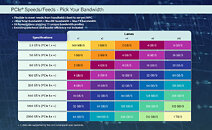
Source: PCI SIG
Add your own comment

17 Comments on PCI-SIG Confirms PCIe 8.0 Will Deliver 1 TB/s Bidirectional Bandwidth, First Spec Draft Now Available

#1
r00tcz
I expect this to be last PCIe standard over regular copper traces. v7 is already hitting the limit of it and requires re-drivers to even reach all slots on regular motherboard. v8 will only be worse, since coding is still the same (and even going to more states than PAM4 would only make it worse again). And that's with all of the expensive tricks of using inner PCB layers for traces with ground all around etc. You can push through with enough juice, but that doubles with each generation too. PCIe driver logic used go be miscellaneous part of the die but now it's taking 30+W, only to get worse.
So future is optical interconnects and I'm excited to see how will the new connectors and entire ecosystem look like! PCI-SIG will surely design something with backwards compatibility in mind, I expect something like connector where there's short "x1" management bus accompanied with 16 fibers, MPO/MTP connector style. WDM (wavelength multiplexing) could also be used, but that would limit bifucation like we know it, so maybe just for RX/TX pairs over the same fiber. Optical re-drivers will likely be used for a few generations since incorporating optonics directly on the CPU/GPU/FPGA dies is still a big leap into the future, however it's going to happen eventually.
All this will of course hit server market first, don't expect to see any of this in consumer, even workstation grade hardware for maybe ~10 years. But it will eventually happen and it will be very interesting.
Posted on Reply
#2
trparky
Other than for data center operations, this is beyond overkill.
Posted on Reply
#3
Wirko
Sorry, PCI-SIG. 512 MB/s multiplied by two does not equal 1 TB/s.
Posted on Reply
#4
Easo
WirkoSorry, PCI-SIG. 512 MB/s multiplied by two does not equal 1 TB/s.
Word "roughly" was used, though.
Posted on Reply
#5
Six_Times
r00tczI expect this to be last PCIe standard over regular copper traces. v7 is already hitting the limit of it and requires re-drivers to even reach all slots on regular motherboard. v8 will only be worse, since coding is still the same (and even going to more states than PAM4 would only make it worse again). And that's with all of the expensive tricks of using inner PCB layers for traces with ground all around etc. You can push through with enough juice, but that doubles with each generation too. PCIe driver logic used go be miscellaneous part of the die but now it's taking 30+W, only to get worse.
So future is optical interconnects and I'm excited to see how will the new connectors and entire ecosystem look like! PCI-SIG will surely design something with backwards compatibility in mind, I expect something like connector where there's short "x1" management bus accompanied with 16 fibers, MPO/MTP connector style. WDM (wavelength multiplexing) could also be used, but that would limit bifucation like we know it, so maybe just for RX/TX pairs over the same fiber. Optical re-drivers will likely be used for a few generations since incorporating optonics directly on the CPU/GPU/FPGA dies is still a big leap into the future, however it's going to happen eventually.
All this will of course hit server market first, don't expect to see any of this in consumer, even workstation grade hardware for maybe ~10 years. But it will eventually happen and it will be very interesting.
Yes. Light bus pathways are next.
Posted on Reply
#6
LiKenun
WirkoSorry, PCI-SIG. 512 MB/s multiplied by two does not equal 1 TB/s.
If you want to be even more pedantic, the real speed (goodput) isn’t even 512 MB/s. The actual payload transmission rate hasn’t been a nice round number since PCIe 3.0. These round numbers are just counting the encoding overhead, which is equivalent to counting your time commuting to the office towards the number of useful hours you contributed to the company’s bottom line.
Posted on Reply
#7
ARF
:kookoo:

Meanwhile, how much is the transfer rate between the CPU and RAM ? :banghead:
And do we have fast enough CPUs to make use of so high CPU - GPU throughput ?
Posted on Reply
#8
dtoxic
In standard gaming with all the settings to the max one can not saturate PCIe 4 not to speak of 5 and beyond, perhaps in the future but for now 3 and 4 are more than enough
Posted on Reply
#9
ARF
dtoxicIn standard gaming with all the settings to the max one can not saturate PCIe 4 not to speak of 5 and beyond, perhaps in the future but for now 3 and 4 are more than enough
Nvidia likes higher PCIe versions, because it likes to put less VRAM, and whenever there is less VRAM, the slot thoughput becomes more important.
They will be able to make a 4GB PCIe 8.0 card and call it a day.
Posted on Reply
#10
dtoxic
That does make sense but then how will they justify high prices? Low Vram and high pcie,the question is will pcie 8 be more expensive vs ram chips? Nvidia and low prices perhaps in some other universe not this one that is guarantied.
Posted on Reply
#11
LabRat 891
ARFNvidia likes higher PCIe versions, because it likes to put less VRAM, and whenever there is less VRAM, the slot thoughput becomes more important.
They will be able to make a 4GB PCIe 8.0 card and call it a day.
NGL, (jokes aside) I'd salivate over a modern hyper-effcient SFF GPU w/ 4GiB of insanely fast HBM4(e?) on PCIe6.0 AM6.


Basically, an R9 Nano for the late 2020s :love:
Posted on Reply
#12
Panther_Seraphin
ARFMeanwhile, how much is the transfer rate between the CPU and RAM ? :banghead:
Are we talking Desktop or Server here? Server can easily keep up and saturate this sort of bandwidth with current servers pushing 500Gb/s on current part per Socket
LocalLLaMA/comments/1g22wd2/epyc_turin_9575f_allows_to_use_99_of_the
ARFAnd do we have fast enough CPUs to make use of so high CPU - GPU throughput ?
Thats another question. In Server land? Maybe not for a while yet but with offloading into accelerators or other devices directly without having to interact with the CPU all the time you could take advantage of it.

In Desktop land? Nooooooooooooooooooooooooooooooooooooooooooooooooooooooooooo and not for a very long time as well.
Posted on Reply
#13
windwhirl
LabRat 891NGL, (jokes aside) I'd salivate over a modern hyper-effcient SFF GPU w/ 4GiB of insanely fast HBM4(e?) on PCIe6.0 AM6.
Tbh you could probably put 16 GB of HBM memory on it easily, if not way more... as long as you're willing to pay the price. AMD ships Instinct accelerators on OAM modules with monster amounts of memory (288 GB) and those are barely different in size compared to the R9 Nano.

OAM module: 102mm x 165mm

Radeon R9 Nano: 155 mm x 110 mm.

Of course there's the matter of how power delivery and data transfers are done differently compared to consumer PCIE boards, but it's not impossible at all for AMD or Nvidia to do their own current-gen version of the R9 Nano, if they wanted to, with massive amounts of VRAM even.
Posted on Reply
#15
ymdhis
LabRat 891NGL, (jokes aside) I'd salivate over a modern hyper-effcient SFF GPU w/ 4GiB of insanely fast HBM4(e?) on PCIe6.0 AM6.


Basically, an R9 Nano for the late 2020s :love:
Or even better, a Strix Halo style APU using 1/2/4 stacks of HBM for 32/64/128GB configs. All the rest of the PCIe lanes are used for m.2 drives (at least 3x). Cherry on top is dual 10GbE.
If we are talking dream SFF machines, anyway.

For PCIe 6.0, only thing I want is a x4 card that can use PCIe 6.0 x4 bandwidth to run four PCIe 4.0 m.2 drives at close to full speed (yes, it would require one insane bridge chip and would probably cost more than a motherboard). That way we no longer have to deal with motherboards never having enough drive connections.
Posted on Reply
#16
shuffy_losys
LabRat 891NGL, (jokes aside) I'd salivate over a modern hyper-effcient SFF GPU w/ 4GiB of insanely fast HBM4(e?) on PCIe6.0 AM6.


Basically, an R9 Nano for the late 2020s :love:
I really wish one of the companies would push the boundaries of a single slot within the 75W envelope again. But those cards don't sell enough for the companies to care about.
Posted on Reply
#17
ToTTenTranz
I guess if we reach the point where we get 512GB/s duplex from 16x PCIe 8.0 lanes, then come DDR6/LPDDR6 the dGPU makers might want to look at saving a bit on GDDR7/7X capacity and depend a bit more on streaming from the cheaper system RAM.

Especially if games start firing up large AI models for neural texture generation, natural audio language, large language models etc.


In the meantime, I wonder why the PCI SIG hasn't looked at implementing asymmetric TX/RX bandwidths yet like Thunderbolt 5 and USB4v2.
At least I haven't seen any use case where the CPU really needs to receive data from the GPU (highest consumer of bandwidth at the moment?) at the same bandwidth as it sends there.
WirkoSorry, PCI-SIG. 512 MB/s multiplied by two does not equal 1 TB/s.
Of course not. 512MB/s multiplied by two is 1GB/s.
Posted on Reply
Add your own comment
Nov 22nd, 2026 15:49 CST change timezone

New Forum Posts

Popular Reviews

TPU on YouTube

Controversial News Posts