Thursday, October 16th 2025
MIPI Alliance Launches Next-Gen Audio Interface Specification for Consumer Electronics
The MIPI Alliance, an international organization that develops specifications that standardize wired interfaces for mobile and other connected ecosystems, today announced the release of SoundWire I3S (MIPI SWI3S v1.0). The new specification provides a transformative approach to audio transport by unifying control and data over a single scalable and power-efficient interface.
Consumer electronics, automotive and industrial applications increasingly require more sophisticated audio capabilities in smaller, denser, feature-rich devices where EMI, power and space are critical constraints. Legacy audio interfaces like I2S or TDM struggle to meet these requirements across long traces or flexible cables. SWI3S builds upon the two-pin, multi-drop architecture of MIPI SoundWire, offering higher bandwidth, low power consumption and built-in support for scalable multi-device topologies to meet the increasing demands of modern audio systems.
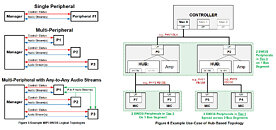
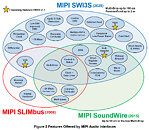 MIPI SWI3S v1.0 supports data rates up to 76 Mbps over a two-pin interface, operating in "forwarded clock" or "differential low voltage signaling" modes for exceptional noise immunity, allowing for reduced EMI shielding and improved EMC. A SWI3S system may include one or more links, each with a manager and up to 12 peripherals, including microphones, amplifiers and others, to support multiple topologies. Additionally, the interface supports bus management, in-band command transport and a precise "audio quality" clock.
To support implementers, MIPI recently made available a SWI3S visualizer tool to model SWI3S DataPort behavior. This tool enables engineers to configure the DataPort parameters and visualize the resulting traffic patterns on the SWI3S bus, enabling experimentation with bandwidth allocation.
Upcoming Audio Webinar Series and New Technical Brief
MIPI is offering a three-part webinar series 21-23 October, where leaders of the MIPI Audio and Software working groups will provide an introduction to the portfolio of current MIPI audio specifications and share insights into future specifications in development. The series will start with a primer session, offering a system-level overview and high-level introduction to MIPI audio interfaces and supporting software specifications. The following two webinars will take a more in-depth look at the latest audio advancements—MIPI SWI3S and the growing suite of audio software specifications and tools.
In addition, a SWI3S technical brief is now available to download.
To keep up with MIPI Alliance, subscribe to the MIPI blog and stay connected by following MIPI on LinkedIn, X and YouTube.
Source:
MIPI Alliance
Consumer electronics, automotive and industrial applications increasingly require more sophisticated audio capabilities in smaller, denser, feature-rich devices where EMI, power and space are critical constraints. Legacy audio interfaces like I2S or TDM struggle to meet these requirements across long traces or flexible cables. SWI3S builds upon the two-pin, multi-drop architecture of MIPI SoundWire, offering higher bandwidth, low power consumption and built-in support for scalable multi-device topologies to meet the increasing demands of modern audio systems.


"MIPI SWI3S is a game changer for embedded audio systems. Its flexible architecture, with support for multiple PHYs and environments, enables companies to optimize for performance, cost and protection against EMI across a wide range of physical layouts and topologies," said Hezi Saar, chair of MIPI Alliance. "The new audio interface is well-positioned to serve all computing market segments, from ultra-low-power edge devices to high-bandwidth, multichannel systems, while simplifying integration and future-proofing designs."The specification was developed by the MIPI Audio Working Group, whose collective knowledge and broad industry perspectives ensure that the specification was designed to address the diverse needs of today's audio ecosystem, while also establishing a clear evolution for next-generation audio systems.
To support implementers, MIPI recently made available a SWI3S visualizer tool to model SWI3S DataPort behavior. This tool enables engineers to configure the DataPort parameters and visualize the resulting traffic patterns on the SWI3S bus, enabling experimentation with bandwidth allocation.
Upcoming Audio Webinar Series and New Technical Brief
MIPI is offering a three-part webinar series 21-23 October, where leaders of the MIPI Audio and Software working groups will provide an introduction to the portfolio of current MIPI audio specifications and share insights into future specifications in development. The series will start with a primer session, offering a system-level overview and high-level introduction to MIPI audio interfaces and supporting software specifications. The following two webinars will take a more in-depth look at the latest audio advancements—MIPI SWI3S and the growing suite of audio software specifications and tools.
In addition, a SWI3S technical brief is now available to download.
To keep up with MIPI Alliance, subscribe to the MIPI blog and stay connected by following MIPI on LinkedIn, X and YouTube.

3 Comments on MIPI Alliance Launches Next-Gen Audio Interface Specification for Consumer Electronics
You'll have to excuse my ignorance; I've never used something like that for production work; although I find it very interesting.
That said, I feel like at some point over the last 20 years, I was the one saying that and you were the one saying "NEVER!"
Perhaps I am mistaken. Point is, I agree with you on the type of gear used, and have really since Aptx. More-so because of LDAC, and even more-so because there's so much other stuff that's also just 'good-enough' if not more-than-enough...As long as companies build in a decent amp/dsp/battery. That's the problem is that so many don't. So perhaps this will come into play with new (mini) dac/amps?
I really want an upgraded qudelix-5k; like a T71with LDAC (or-the-like) TX/RX (like the 5k RX), perhaps with their own eq/visualizer stack, rather than going routes like this. Maybe some day they'll make one. :)
SoundWire only appears to be used in some laptops and possibly in tablets and phones.
I wasn't even thinking Bluetooth audio, as all gaming headsets and many other PC headsets have a dedicated dongle.
It would be interesting to know how many people use their onboard audio daily in 2025.
I have some desktop speakers, but they get used maybe once or twice a week.
I guess we'll see if anything comes of this, but at last in desktops, it seems like USB has become the "new" standard for audio if you look at the kind of chips that are being used on a lot of recent motherboards.