Saturday, November 21st 2026
Moore Threads Claims Its Next GPU Will Break the Consumer VRAM Record
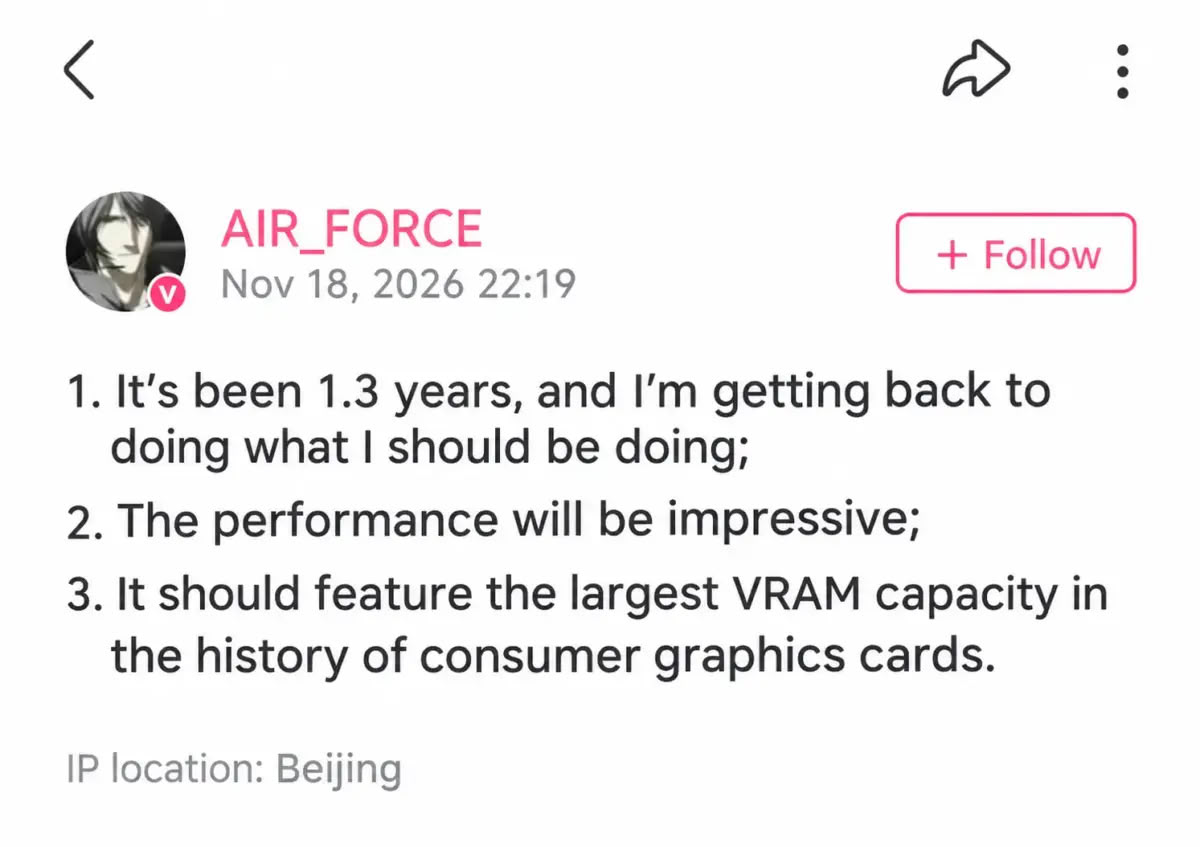
Another player is coming to stake their claim against NVIDIA, AMD, and Intel in the GPU market. A product manager behind Moore Threads' MTT S80 claims that the company's next desktop graphics card, codenamed Lushan, could set the record for the largest VRAM capacity ever put on a consumer graphics card. He posted this on November 18 on Weibo, but didn't disclose how much VRAM it would actually have. After that, Moore Threads published its first poster for MDC 2026, and the artwork hints at the graphics card. It is mostly hidden behind a pair of peaks, with one rendered as a 3D mesh and the other as a neural network. MDC is the MUSA Developer Conference, set for December 29 in Beijing.
We saw the concept behind Lushan at the first MUSA Developer Conference last December, alongside the Huagang architecture. The company then claimed 15x higher AAA gaming performance than its previous generation, as well as 50x faster ray tracing and 64x more compute, some truly gigantic leaps. If we look at what Moore Threads is claiming, the target to beat is the GeForce RTX 5090 at 32 GB of VRAM (if you consider the 5090 a consumer card at all). The MTT S80 has 16 GB of VRAM, and Moore Threads has previously promised four times the memory capacity over its predecessor. That works out to 64 GB, which would definitely be a record, but this is speculation, and Moore Threads has not confirmed any number at the time of writing. There's also debate over whether gamers really need that much VRAM, and whether such a large memory pool would attract workstation and local LLM users instead.

Sources:
Moore Threads, Videocardz
We saw the concept behind Lushan at the first MUSA Developer Conference last December, alongside the Huagang architecture. The company then claimed 15x higher AAA gaming performance than its previous generation, as well as 50x faster ray tracing and 64x more compute, some truly gigantic leaps. If we look at what Moore Threads is claiming, the target to beat is the GeForce RTX 5090 at 32 GB of VRAM (if you consider the 5090 a consumer card at all). The MTT S80 has 16 GB of VRAM, and Moore Threads has previously promised four times the memory capacity over its predecessor. That works out to 64 GB, which would definitely be a record, but this is speculation, and Moore Threads has not confirmed any number at the time of writing. There's also debate over whether gamers really need that much VRAM, and whether such a large memory pool would attract workstation and local LLM users instead.

3 Comments on Moore Threads Claims Its Next GPU Will Break the Consumer VRAM Record
This amount of memory will clearly price it out of any gaming audience that would be willing to pay for the rendering performance.
get everyone to include more of it.
So demand remains high enough to keep fabs running and prices don't drop to critical levels
I wonder if More threads has improved their drivers