Thursday, October 23rd 2025

Intel Beats Q3 Profit Targets as Cost Cuts and Strategic Investments Take Effect

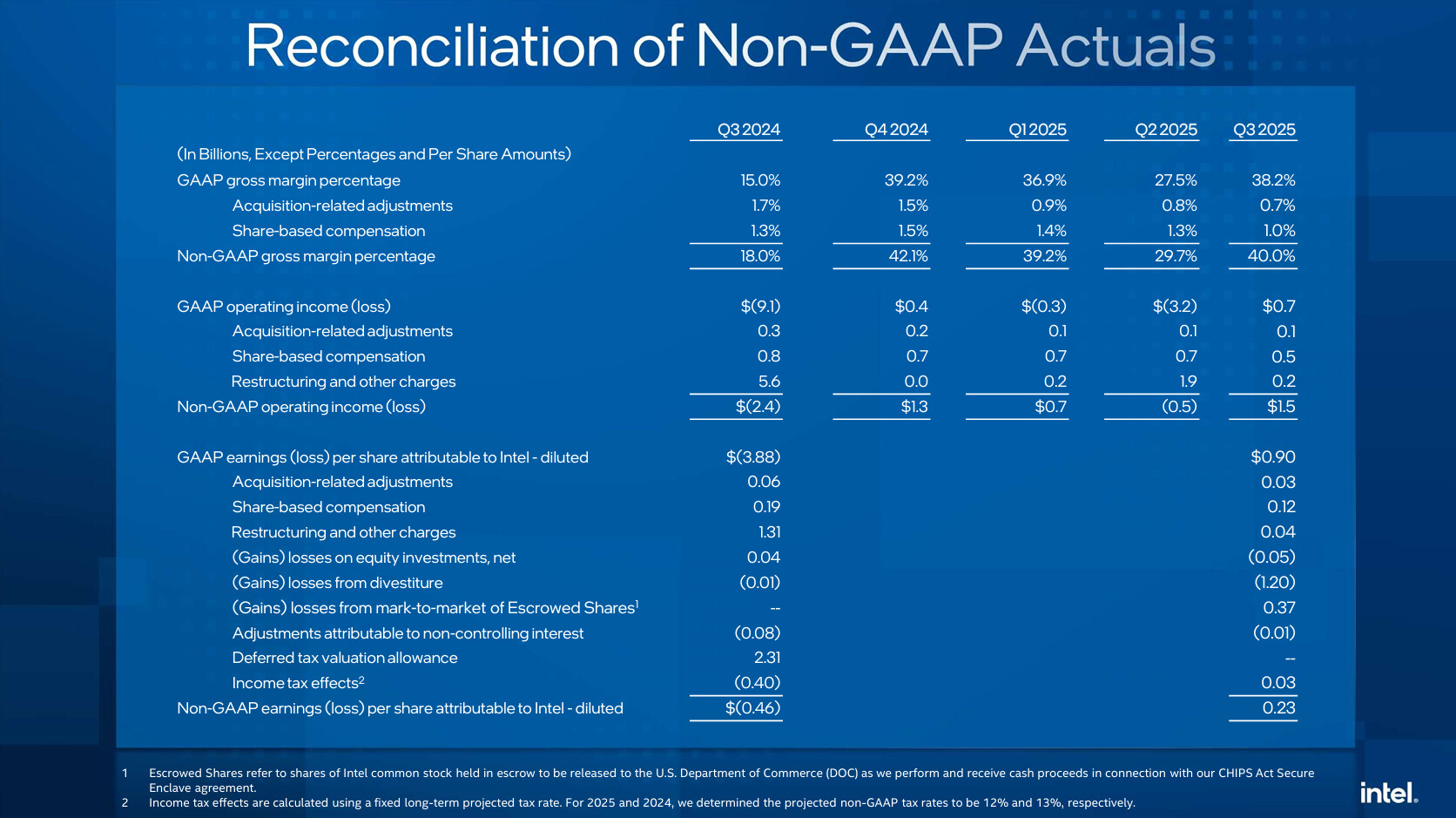
Intel has posted stronger than expected third-quarter 2025 results, boosted by aggressive cost-cutting measures under CEO Lip-Bu Tan and fresh capital injections from NVIDIA, SoftBank, and the U.S. government. Shares rose about 5% after its share price drop of about 60% last year. Team Blue reported $2.5 billion in operating cash flow, its fourth straight quarter of improved execution, and noted that demand is now outpacing supply heading into 2026. CFO David Zinsner said the new funding increases Intel's operational flexibility and highlights its importance to the broader semiconductor ecosystem.

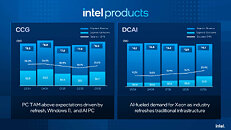
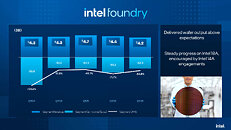
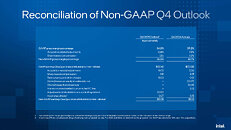
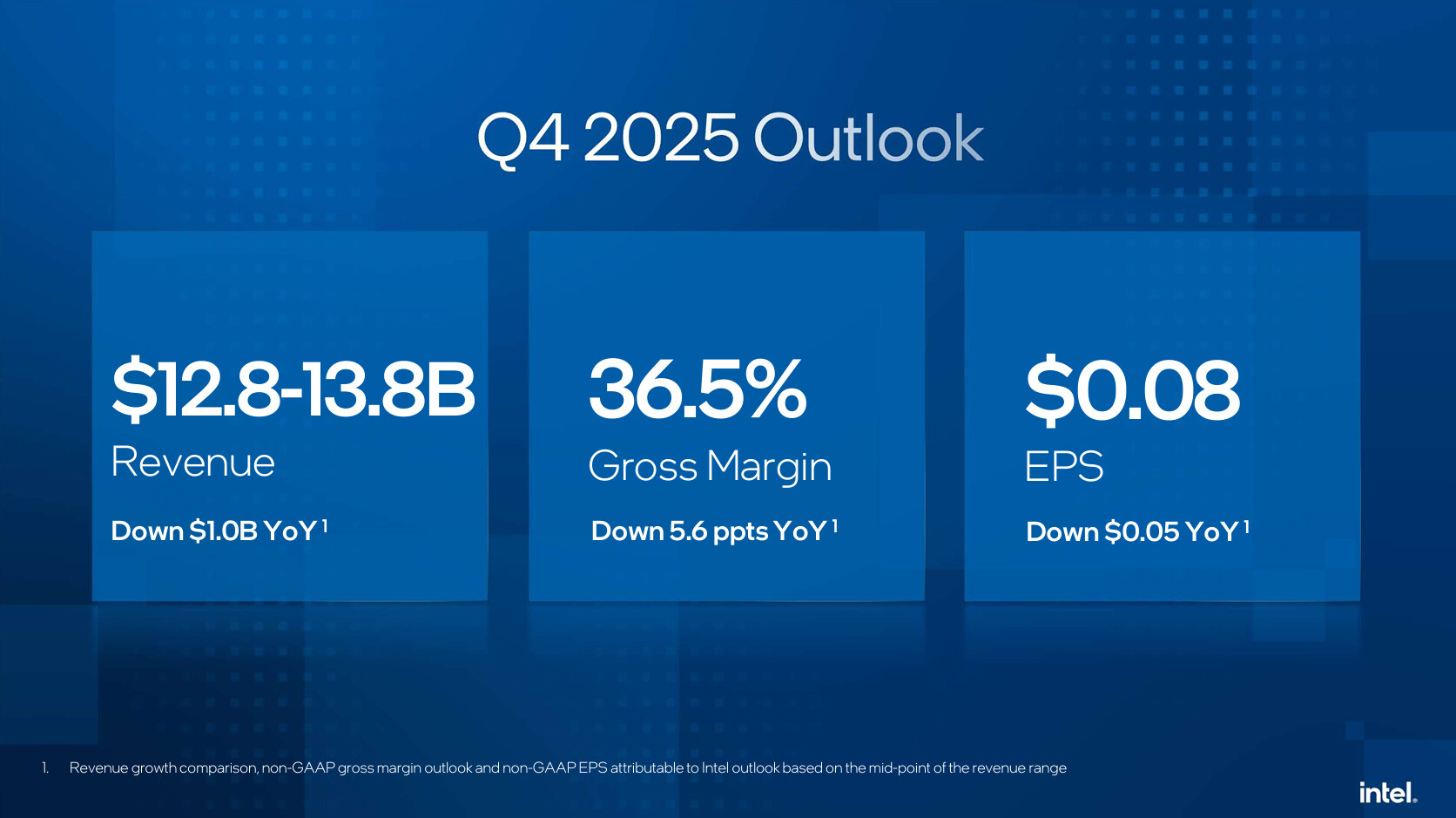
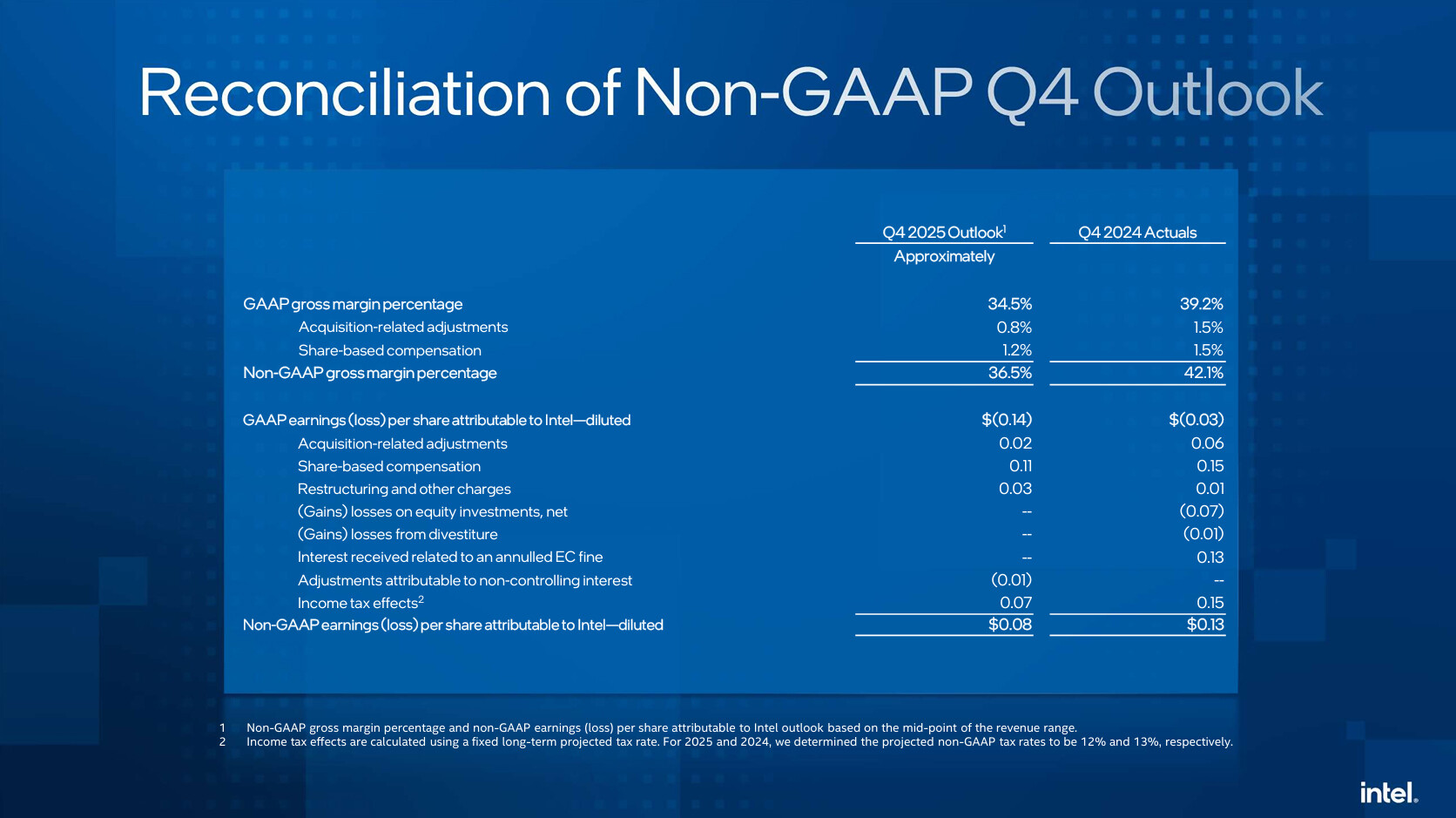
Recently Intel unveiled its Core Ultra Series 3 "Panther Lake" processors and Xeon 6+ "Clearwater Forest", both built on Intel 18A process technology, alongside a new inference GPU, "Crescent Island." Meanwhile, Fab 52 in Chandler, Arizona is now fully operational, producing 18A wafers, part of Intel's $100 billion domestic expansion plan. Intel strengthened its balance sheet in Q3 with several major deals. The company received $5.7 billion from a planned $8.9 billion U.S. government, while NVIDIA invested $5 billion and agreed to co-develop future PC and datacenter platforms using NVLink. SoftBank added $2 billion to support Intel's U.S. fab expansion, and the Altera stake sale generated an additional $5.2 billion in cash. Compared to Q3 2024 Intel Foundry's revenue is still down 2% while Data Center and AI dropped 1% indicating that both divisions are still under pressure. For the fourth quarter of 2025, Intel expects revenue between $12.8 billion and $13.8 billion.
Business Highlights

  • Intel and the Trump Administration announced an agreement to support the continued expansion of American technology and manufacturing leadership through $8.9 billion in funding from the U.S. Government. During the quarter, Intel received $5.7 billion from the U.S. Government.
  • Intel and NVIDIA announced a collaboration to jointly develop multiple generations of custom data center and PC products across hyperscale, enterprise and consumer markets. The collaboration will integrate the strengths of Intel's leading CPU technologies and x86 ecosystem with NVIDIA's AI and accelerated computing platforms using NVIDIA NVLink.
  • NVIDIA also agreed to invest $5 billion in Intel common stock.
  • SoftBank Group made a $2 billion investment in Intel common stock, reflecting its belief that Intel will play a critical role in expanding advanced semiconductor manufacturing and supply in the United States.
  • Intel unveiled the architecture of its Intel Core Ultra series 3 processors (code-named Panther Lake), the first client SoCs built on Intel 18A technology. Additionally, Intel advanced its relationship with Microsoft through a collaboration with Windows ML and the integration of Intel vPro manageability with Microsoft Intune.
  • The company provided a first look at Intel Xeon 6+ (code-named Clearwater Forest), Intel's next-gen server product on Intel 18A, showing significant power and performance gains. It also announced details of a new inference-optimized GPU code-named Crescent Island for token clouds and enterprise-level inference.
  • Fab 52, Intel's fifth high-volume fab at its Ocotillo campus in Chandler, Arizona, became fully operational. This facility manufactures Intel 18A wafers, the most advanced logic wafers developed and produced in the United States, and is part of the more than $100 billion Intel is investing to expand its domestic operations.
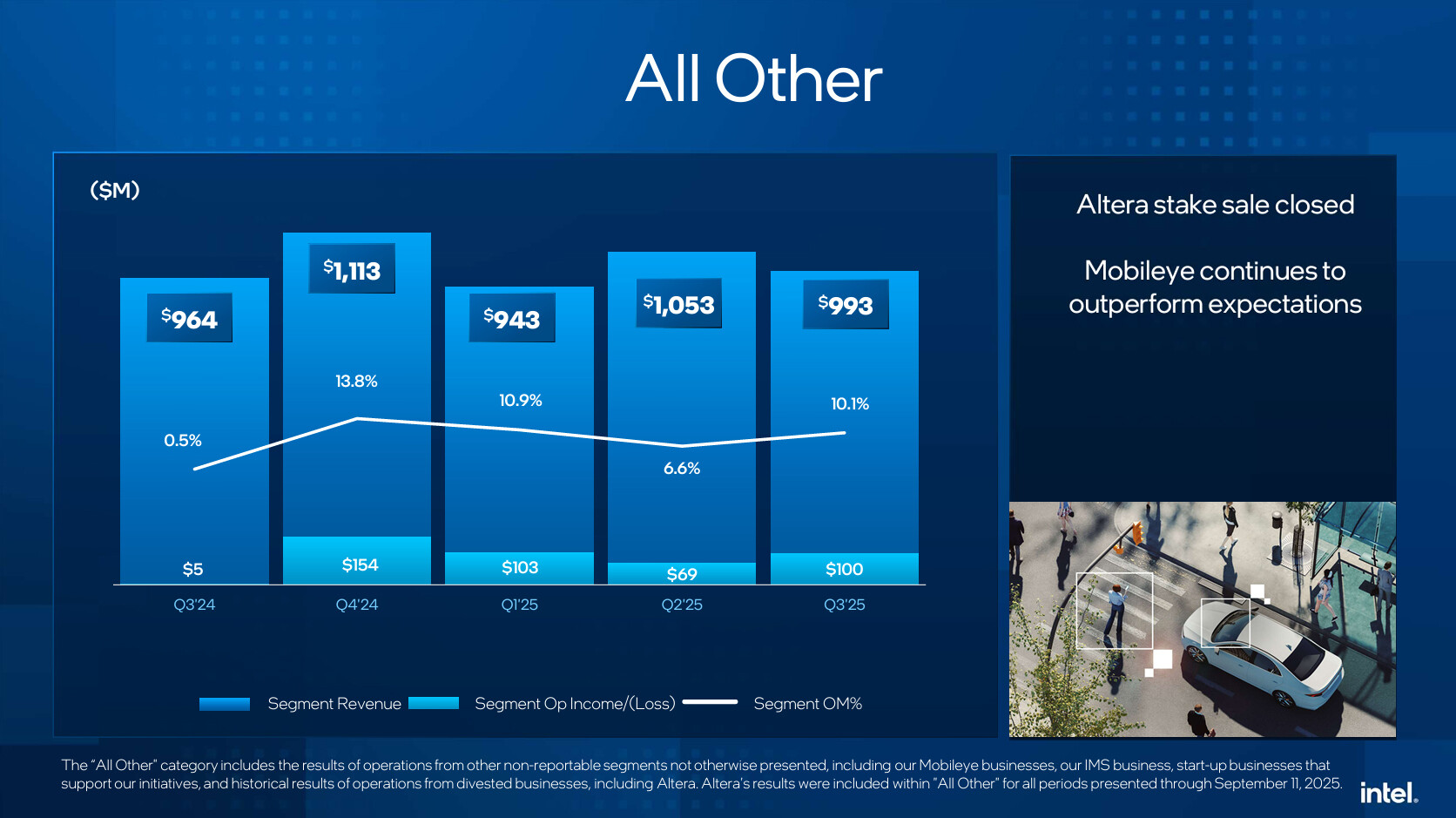
  • Intel received $5.2 billion with the completion of the Altera transaction and a stake sale of Mobileye.
Source: Intel
Add your own comment

24 Comments on Intel Beats Q3 Profit Targets as Cost Cuts and Strategic Investments Take Effect

#1
TheinsanegamerN
The beginnings of Intel's comeback?

My stocks are doin REAL good right now. If they can stop losing money for more than a quarter maybe we'll break intel's ~$50 all time stock high.
Posted on Reply
#2
kondamin
I hope they get some apple money too.
And get things running smooth by Q3 2026
Posted on Reply
#3
Dr. Dro
kondaminI hope they get some apple money too.
And get things running smooth by Q3 2026
Apple Silicon on an advanced Intel node would be a sight to see.
Posted on Reply
#4
qcmadness
Dr. DroApple Silicon on an advanced Intel node would be a sight to see.
Due to the past experience with Samsung, I doubt Apple will ever want to use Intel fab for M and A chip.
Posted on Reply
#5
john_
TheinsanegamerNThe beginnings of Intel's comeback?

My stocks are doin REAL good right now. If they can stop losing money for more than a quarter maybe we'll break intel's ~$50 all time stock high.
Intel and AMD will be 1 trillion dollars companies in the next 5-10 years(Nvidia will be over $6B by then). AMD will probably get there faster, thanks to the deal with OpenAI that will lead to more deals, but Intel will eventually go there when they fix manufacturing, improve their GPUs, produce valid solutions for AI and use their OEM ties to promote those, start producing their own CPUs in their own fabs, meaning a closer collaboration between the team behind the CPU/GPU/NPU architecture and the team in manufacturing. What Intel was doing in it's good days.

PS Intel was over $70 in the past. They will be over $100 in 5 years max(JMO).
Posted on Reply
#6
Dr. Dro
qcmadnessDue to the past experience with Samsung, I doubt Apple will ever want to use Intel fab for M and A chip.
I don't see why not. Intel's 18A, if it can achieve a substantial volume, is a bona fide next-gen lithography node. Some of their improvements are genuinely groundbreaking, like RibbonFET and PowerVia.
Posted on Reply
#7
trsttte
john_Intel and AMD will be 1 trillion dollars companies in the next 5-10 years(Nvidia will be over $6B by then). AMD will probably get there faster, thanks to the deal with OpenAI that will lead to more deals, but Intel will eventually go there when they fix manufacturing, improve their GPUs, produce valid solutions for AI and use their OEM ties to promote those, start producing their own CPUs in their own fabs, meaning a closer collaboration between the team behind the CPU/GPU/NPU architecture and the team in manufacturing. What Intel was doing in it's good days.

PS Intel was over $70 in the past. They will be over $100 in 5 years max(JMO).
The market looks at profits and easily overlooks how Intel is a manufacturing power house. AMD and Nvidia can say goodbye to all their profits without a partner like TSMC, Samsung or even Intel to actually make their product, Intel can do it all on their own.

It can and recently has been a huge liability (due to very stupid decisions of sitting on their laurels by dumb bean counters) but it's also a major value opportunity only Intel (and Samsung) have - being able to both design and produce their product.
Posted on Reply
#8
Denver
The narrative in the article is incorrect. Intel is merely reaping one-off capital gains from the sale of assets, and already has losses forecast for the next quarter. In other words, caution is advised, as there is still much to be proven.
Posted on Reply
#9
Squared
Dr. DroI don't see why not. Intel's 18A, if it can achieve a substantial volume, is a bona fide next-gen lithography node. Some of their improvements are genuinely groundbreaking, like RibbonFET and PowerVia.
RibbonFET is Intel's name for gate all-around transistirs, which Samsung's SF3 node already uses. It's on store shelves now in the Galaxy Watch 7.
Posted on Reply
#10
RandallFlagg
trsttteThe market looks at profits and easily overlooks how Intel is a manufacturing power house. AMD and Nvidia can say goodbye to all their profits without a partner like TSMC, Samsung or even Intel to actually make their product, Intel can do it all on their own.

It can and recently has been a huge liability (due to very stupid decisions of sitting on their laurels by dumb bean counters) but it's also a major value opportunity only Intel (and Samsung) have - being able to both design and produce their product.
It is something often misattributed to Nvidia and AMD. They are both design houses, they make nothing physical. A big part of their success is attributable to TSMCs success with their advanced nodes.

But if TSMC falters, then they falter. And TSMC may be sowing the seeds of such a failure by not investing in High-NA EUV right now. It's pretty hard to see future consequences in these things.

I also suspect 18A is much cheaper than N2.

And I don't think people are going to be happy when they see what chips made on N2 cost. I expect much screaming and gnashing of teeth when Zen 6 and Nova Lake arrive.
Posted on Reply
#11
Dr. Dro
SquaredRibbonFET is Intel's name for gate all-around transistirs, which Samsung's SF3 node already uses. It's on store shelves now in the Galaxy Watch 7.
I'm aware, but Intel's node is particularly interesting because like TSMC's, it is adequate to make larger, high performance processors like the Max and Ultra variants of the M series chips. Unsure if Samsung builds anything as large nowadays.
RandallFlaggIt is something often misattributed to Nvidia and AMD. They are both design houses, they make nothing physical. A big part of their success is attributable to TSMCs success with their advanced nodes.

But if TSMC falters, then they falter. And TSMC may be sowing the seeds of such a failure by not investing in High-NA EUV right now. It's pretty hard to see future consequences in these things.

I also suspect 18A is much cheaper than N2.

And I don't think people are going to be happy when they see what chips made on N2 cost. I expect much screaming and gnashing of teeth when Zen 6 and Nova Lake arrive.
Very likely to be the case, yeah. Intel being able to continue supplying high-performance semiconductors, even if at a smaller scale, could be very beneficial in the longer term. Especially if the climate in Taiwan deteriorates and/or TSMC's US venture runs into any unforeseen issues. The cost is also a consideration.
Posted on Reply
#12
qcmadness
Dr. DroI don't see why not. Intel's 18A, if it can achieve a substantial volume, is a bona fide next-gen lithography node. Some of their improvements are genuinely groundbreaking, like RibbonFET and PowerVia.
The real problem is "stealing" or "learning" designs, not transistor performance.
Posted on Reply
#13
LittleBro
So, basically, they were finally able to show some better results. Thanks to huge layoffs, not thanks to good sales or foundry.
It was good decision to make those layoffs, to be honest. So many levels of management are contraproductive.
Posted on Reply
#14
Arrakis9
Intel is back to kick ass and chew bubble gum. The only regret I have is not buying more stocks when they were at $20:oops:
Posted on Reply
#16
Dr. Dro
qcmadnessThe real problem is "stealing" or "learning" designs, not transistor performance.
I genuinely don't think Intel Foundry Services would commit corporate espionage, but this is a concern for any fabless design house, and it could happen with any fab, including TSMC.
Posted on Reply
#17
Tek-Check
trsttteThe market looks at profits and easily overlooks how Intel is a manufacturing power house. AMD and Nvidia can say goodbye to all their profits without a partner like TSMC, Samsung or even Intel to actually make their product, Intel can do it all on their own.
Intel can also say goodbye to their profits and many of their products in client market without a partner like TSMC. Let's not be gullible and silly.
trsttteIt can and recently has been a huge liability (due to very stupid decisions of sitting on their laurels by dumb bean counters) but it's also a major value opportunity only Intel (and Samsung) have - being able to both design and produce their product.
Being able to design and produce own products is not an inherent value, neither for Intel nor for Samsung. In the same way, designing and building a bridge or anything else by the same company would not necessarily be the best thing to do. It's a fallacy. They both struggle in some regards. The success of majority of global and advanced semiconductor products from Apple, Nvidia, AMD, Intel(!), Qualcomm, Mediatek, Broadcom, Google and many other companies lie with TSMC - a dedicated and most advanced planetary foundry with over 70% of revenue share. You would need to live under the rock to be able to miss such basic fact.
www.trendforce.com/presscenter/news/20250901-12691.html
www.tomshardware.com/tech-industry/semiconductors/tsmc-posts-record-quarter-results-as-skyrocketing-ai-and-hpc-demand-drives-two-thirds-of-revenue-company-pulls-in-usd33-1-billion
Intel has a long way to go in order to learn how to offer its foundry service to global players to a high standard. Offering the foundry to itself only backfired spectacularly and only now do they realize that the most advanced nodes need to be offered to everybody, not just to Intel chip designers. Their last chance to get this homework finally done properly is perhaps 14A. Let's see what happens.
Posted on Reply
#18
ThomasK
Great, Intel ain't crashing and burning anymore. No pun intended.
Posted on Reply
#19
qcmadness
Dr. DroI genuinely don't think Intel Foundry Services would commit corporate espionage, but this is a concern for any fabless design house, and it could happen with any fab, including TSMC.
TSMC does not have a conflict of interest.
Posted on Reply
#20
Dr. Dro
qcmadnessTSMC does not have a conflict of interest.
Technically, neither does Intel Foundry Services, just like Samsung Foundry. The fabs are affiliated with the companies, but intentionally kept a legally separate entity - besides, it's not like their technology is behind anyways. This is just that age old anti-Intel sentiment kicking in. Samsung makes chips of their own and directly competes with Apple in their primary markets, for example. And Globalfoundries isn't up to the task to be a backup or secondary supplier. They've never went past 12 nm, and only their Dresden fab can manufacture their 12 nm - with 14 nm wafers being also manufactured in US soil. The rest are ancient nodes 28 nm and above, unsuitable for modern semiconductors.
Posted on Reply
#21
qcmadness
Dr. DroTechnically, neither does Intel Foundry Services, just like Samsung Foundry. The fabs are affiliated with the companies, but intentionally kept a legally separate entity - besides, it's not like their technology is behind anyways. This is just that age old anti-Intel sentiment kicking in. Samsung makes chips of their own and directly competes with Apple in their primary markets, for example. And Globalfoundries isn't up to the task to be a backup or secondary supplier. They've never went past 12 nm, and only their Dresden fab can manufacture their 12 nm - with 14 nm wafers being also manufactured in US soil. The rest are ancient nodes 28 nm and above, unsuitable for modern semiconductors.
So Apple never use Samsung fab for Apple A or M chips since that.

Time will prove.
Posted on Reply
#22
Hecate91
Good if Intel can finally compete and get their fabs in order, but their higher than expected profits is from layoffs and handouts, it would be more interesting to see if they can keep their profits from being negative.

As for Intel foundry, it's only technically a separate division, they're still very much still Intel. Apple or AMD shouldn't be trusting a competitor with IP and trade secrets, also there's a rumor that Intel wants to have their own X3D cpu's I wouldn't doubt Intel would want to borrow that tech.
Posted on Reply
#23
Dr. Dro
Hecate91Good if Intel can finally compete and get their fabs in order, but their higher than expected profits is from layoffs and handouts, it would be more interesting to see if they can keep their profits from being negative.

As for Intel foundry, it's only technically a separate division, they're still very much still Intel. Apple or AMD shouldn't be trusting a competitor with IP and trade secrets, also there's a rumor that Intel wants to have their own X3D cpu's I wouldn't doubt Intel would want to borrow that tech.
It's not like there are super secret things in AMD chips and a massive gap in their technologies, Intel already understands well what makes Ryzen tick, from both AMD and TSMC's sides. They also have their own in-house equivalents to these, with EMIB, Foveros, etc. which are widely known to be on par with TSMC's.

IFS is really the only truly viable option for a secondary supply chain IMO.
qcmadnessSo Apple never use Samsung fab for Apple A or M chips since that.

Time will prove.
Apple has used the Samsung foundry to build the A9 SoC used in the iPhone 6s family, but all chips since then are TSMC built. They've a priority contract where Apple basically purchases TSMC's entire manufacturing capacity for the first batches of their latest node a year in advance, after all.
Posted on Reply
#24
EsaT
Dr. DroTechnically, neither does Intel Foundry Services, just like Samsung Foundry. The fabs are affiliated with the companies, but intentionally kept a legally separate entity
Still doesn't change the fact that as 100% pure fab not doing any design work TSMC has the least reason to go peeping on insides of the chips they're making.

Samsung's fabs are again "part of mothership" with quite lots of chip design included in their huge spectrum of business areas.

Again Intel is basically pure semiconductor company with no other businesses than designing and manufacturing ICs giving the highest risk of conflict of interest.
Though they have more legal ways to keep tab on competition. (but we know MBAs and their corporate lawyers have no shame)
Posted on Reply
Add your own comment
Nov 20th, 2026 16:11 PST change timezone

New Forum Posts

Popular Reviews

TPU on YouTube

Controversial News Posts