Friday, October 24th 2025
AMD Radeon AI PRO R9700 GPU Arrives October 27 at $1,299 for Retail
AMD has finally set the retailer date and the price tag for its professional Radeon AI PRO 9000 series graphics cards, suitable for tasks like professional visualization or workstations that can accommodate up to four cards. Set to launch on October 27 for retailers, the flagship Radeon AI PRO R9700 will arrive at $1,299. Previously, AMD focused solely on the OEM and system integrator segment, leaving retailers and individuals building their own workstations for AI and professional visualization workloads without options. The company aimed to launch this GPU for retailers by the end of July, but supply constraints prevented this, as OEMs and system integrators consumed the entire supply.
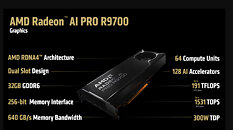
These Radeon AI PRO R9700 GPU features a 4 nm "Navi 48" GPU, equipped with 64 RDNA 4 compute units, providing 4,096 stream processors and 128 AI accelerators for enhanced matrix operations across various data formats. A key improvement over the RX 9070 XT gaming GPU is the increased memory capacity, now doubled to 32 GB. The memory subsystem includes 20 Gbps GDDR6 across a 256-bit wide interface, delivering 640 GB/s of memory bandwidth, supported by a 64 MB 3rd Gen Infinity Cache. The AMD Radeon AI PRO R9700 achieves up to 191 TeraFLOPS FP16 dense performance and up to 1531 TOPS INT4 sparse performance, all within a power footprint of up to 300 W. The card is packed in dual-slot design with blower-style cooler, so dense multi-GPU configurations can be easily achieved.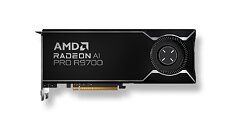
Source:
via VideoCardz
These Radeon AI PRO R9700 GPU features a 4 nm "Navi 48" GPU, equipped with 64 RDNA 4 compute units, providing 4,096 stream processors and 128 AI accelerators for enhanced matrix operations across various data formats. A key improvement over the RX 9070 XT gaming GPU is the increased memory capacity, now doubled to 32 GB. The memory subsystem includes 20 Gbps GDDR6 across a 256-bit wide interface, delivering 640 GB/s of memory bandwidth, supported by a 64 MB 3rd Gen Infinity Cache. The AMD Radeon AI PRO R9700 achieves up to 191 TeraFLOPS FP16 dense performance and up to 1531 TOPS INT4 sparse performance, all within a power footprint of up to 300 W. The card is packed in dual-slot design with blower-style cooler, so dense multi-GPU configurations can be easily achieved.


56 Comments on AMD Radeon AI PRO R9700 GPU Arrives October 27 at $1,299 for Retail
at least that is my understanding. AMD is really far behind... more than I realized.
as an AMD fanboy i am disappoint.
This Radeon PRO card is the only current workstation card they have at this time.
The only products that have an actual difference are their x100 lineup, such as the B100 found in the GB200/GB300, H100/H200, etc etc, for which AMD's counterpart are the Instinct lineup (MI300, MI350, MI450, etc).
Nitpicking as usual but 48GB of VRAM + FP4 and FP6 support would've been very nice but I guess that's reserved for CDNA cards (for now).
Currently you'd need at least 3 of these to run GPT OSS 120B completely in memory and 4 to run a Qwen3 235B quant. Not bad but there's scope for improvement.
1. doesnt gimp or cripple gaming vs computing GPUs
2. you can install regular drivers on PRO card and pro drivers on regular ones
3. memory tax is hilariously low compared to only existing competition (its ECC VRAM not regular, supposedly)
And yet, people complain.
If I should complain, I would like to know...
1. whats fp64 performance? (Im assuming around 9070 XT.. obviously, but still?)
2. is ECC 9700 AI PRO exclusive or not?
Apart that, AMD is finally working to make AI usable on their GPUs, so it will be decent solution, altho it will need probably some elbow grease to make a lot of AI related SW work. Thankfully a lot of it is in Python.
I guess Meta uses a decent amount of AMD chips.
newsletter.semianalysis.com/p/mi300x-vs-h100-vs-h200-benchmark-part-1-training
Stock:stock, Spec:spec, the R9700 is a SMIDGE slower than the 9070XT.
However, both of the R9700s I've had hands-on time with, reliably boosted beyond spec (w/o manual adjustment), and sustained it better than either of the 2x Pulse 9070XTs I've played with. -Under UE5 and other game loads, not LLMs, tho.Apparently, ECC VRAM support is only supported under a Linux+ROCm operating environment. But, is otherwise a common feature to R9700.
To put things in-perspective, AMD favorably compared the R9700 32GB to the RTX 5080 16GB in their pre-release presentations. :laugh:
That sounds absurd at first but 'by the $', if your workload isn't massively advantaged by CUDA or you flat-out JUST need big VRAM, the R9700 is arguably economical for-purpose.
Still, it's not CUDA, and that's sufficient information for many to (understandably) completely dismiss the R9700.
If what 'AI things' one is doing are supported under ROCm or generic Vulkan, it's likely a very competitive option for 32GB of VRAM and competent computational performance.
www.techpowerup.com/gpu-specs/radeon-9700-pro.c50
If AMD'd felt it profitable, we could've had an 'RX 9070 XTX 32GB'. -Basically, the R9700's VRAM and binnings but, with the 360w+ TDP (As-seen w/ the XT Taichi) and with 5080/5090-like PCIe slot-breaking coolers.
TBQH, I don't fault AMD for not making that. (despite, RX480->RX580->RX590 pulling off similar, pretty well)
A. All 9070XTs are already pretty far into 'diminishing returns', regarding power:clocks.
B. It seems like a waste of high-profit margin bin'd Navi48s. High$ products like Radeon AI Pro R9700 or a prospective W9700, are (probably) much better uses for those binnings.
C. The performance improvement from 9070 to 9070 XT is already small. The difference between AIB OC XT models, even smaller.
"Aligning the stars" for The Perfect Navi48 Card, would still net very little over the XT. [In 'retro' terms, think: 6800GT v. 6800Ultra 512MB]AMD had to choose between Nostalgia Marketing and copying nVidia for this gen.
:laugh:
Just a few titles running in 4k as well: Most don't go over 12GB but I wouldn't use 12 for 4k just in case.
I do know this is not for gaming so I know it's slightly off topic but I'm always curious about VRAM usage.
OtOH, Beam.NG/Beam.MP can use more than 16GB VRAM and, the R9700 performs notably 'better' than a 9070XT. Not sure why but, it is repeatable.Most games I've tried out, seemingly try to stay inside 12-16GB, even beyond 4K (VSR).
Seems by 'where the numbers hang out' that these are intentional "optimizations" by game devs and/or the driver.AFAIK, the R9700s are the only 2-slot blower Navi 48 cards on the market/soon-to-market. These occupy a position similar to those nVidia RTX not-quadro low-profile cards. They're "professional" cards but, due to some specific overlaps in needs, ends up desirable to select Gamer-Enthusiast persuasions (SFF builds, LLMs, etc.).
In workstation/AI going from 16 to 32 is presumably much bigger impact. By the time 16GB+ becomes useful there are cheaper consumer cards available with 18-24GB.I constantly see sustained 3Ghz on up to 3.4Ghz boost on my XT. Could be your Pulse samples just not being very good.
Not that my Gigabyte Gaming OC is anything special...In the RDNA4 family, yes. In previous families they're always had Pro cards too.People are expecting that from Nvidia. Thus no one bats an eye when they do it, but if AMD does it then they're greedy.Go look at Nvidia workstation card prices and you'll see that +600 and 1300 total is pennies compared to what Nvidia charges for their workstation cards with extra VRAM.I did see about 14GB used in modded Skyrim at 1440p. Not sure how much the extra VRAM effected the performance as i had a 11GB 2080 Ti before and with 9070 XT performance improved by 60% in the 0.1% lows. 12% in averages and 20% in maximums. Im sure that at 4K i would be able to saturate 16GB.
But that's just one modded game.
By any chance do you know of 9700 has DP 2.1 UHBR 80 ports?
Previous Radeon Pro cards have had higher bandwidth display outs. Mostly miniDP.
I wonder if the same is true this time or have they cheaped out as XT has UHBR 13.5
I use a Club3D UHBR13.5(DP54)->HDMI2.1 48gbps hub to drive my 4K OLED.
I had assumed the R9700 has DP80 but, monitors w/ that capability are few and far-between. So, I'm really not sure, either.
Seems like without very clear specification from AMD, the only way to find out would be to try a UHBR20/DP80 display.
Gigabyte Aorus FO32U2 ProMSI MPG 322URX QD-OLED
MPG 272URX QD-OLED
ASUS PG27UCDMis the only US/CAN market displayare
sI'm finding w/ DP80/UHBR20.Prior to release it'd been rumored to support UHBR20/DP80 but, I feel like it would be safer to assume "No."
A. The only AMD cards w/ advertised full UHBR20/DP80, were/are the W7800 and W7900.
B. The R9700 is not even supported by the same driver branch as the W-series. I suspect the DP80 feature would be 'left out' of the R9700.