Tuesday, October 28th 2025

Almost 90% of Windows Games Run on Linux, Notes Report
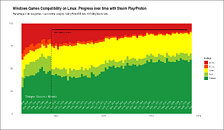
Linux gaming has quietly reached a new inflection point. A recent Boiling Steam summary of crowd-sourced ProtonDB compatibility reports shows that about 89.7% of Windows titles now at least launch on Linux systems. The numbers are spread into a few categories. Games rated "Platinum," meaning they install, run, and save on Linux without requiring user intervention, made up 42% of new releases tracked in October, up from 29% the previous year. At the same time the share of titles that refuse to launch, the so-called "Borked" cohort, has fallen to roughly 3.8%, a group that still includes deliberate blocks such as March of Giants, which explicitly detects Wine and Proton and exits to the desktop.
The most persistent obstacles are not obscure indies but anti-cheat middleware and contractual choices. Easy Anti-Cheat, BattlEye, and similar systems remain the primary gatekeepers for online multiplayer, and enabling them on Linux is often more a negotiation than a mere technical flip of a switch. When a studio approves Steam Deck support, desktop Linux compatibility frequently follows within a single build cycle, suggesting the code paths are already unified and only sign-off is pending.
 We recently saw a YouTuber test the ASUS ROG Xbox Ally X with Bazzite, a Linux distribution similar to Valve's SteamOS. At 17 W TDP, the Xbox Ally X achieves about 47 FPS in Kingdom Come: Deliverance 2 on Windows, compared to 62 FPS on Bazzite. At 13 W, Windows gets 35 FPS, while Bazzite reaches around 37 FPS. In Hogwarts Legacy, performance jumps from 50 FPS on Windows to 62 FPS on Bazzite at 17 W. At 35 W, the gap narrows to 5 FPS, with Bazzite still leading. Additionally, Bazzite delivers a more consistent frame rate, avoiding the frequent dips seen on Windows. When Valve decides to roll out SteamOS to the public, we might see an uptick of Linux gamers to a point where making a Windows-exclusive title is no longer a common case.
Sources:
Boiling Steam, Proton DB
The most persistent obstacles are not obscure indies but anti-cheat middleware and contractual choices. Easy Anti-Cheat, BattlEye, and similar systems remain the primary gatekeepers for online multiplayer, and enabling them on Linux is often more a negotiation than a mere technical flip of a switch. When a studio approves Steam Deck support, desktop Linux compatibility frequently follows within a single build cycle, suggesting the code paths are already unified and only sign-off is pending.


58 Comments on Almost 90% of Windows Games Run on Linux, Notes Report
Once you factor in the popularity of games 2025 will look a lot more like 2020. Probably even worse actually.
I'm a Linux user for around 2 years now (CachyOS). Linux is far from perfect, it has its quirks and issues but then so does Windows, if there's one thing that Linux has taught me it's that Windows falls well short of perfect too!
In any case, with the path Windows has been following for a number of years now, I no longer like doing computer stuff in Windows and so don't.
I do game though from time to time and know that while Linux has made huge strides with gaming compatibility, it is still not there yet.
Because of it I still dual boot, at the end of the day the cost of a spare drive is peanuts and I get the best of both worlds.
I do all my computer stuff in Linux and only switch to Windows for gaming.
2 years ago there were no workaround for kernel level anticheat. Now there are several.
Tbh tho, I don't see why geeking out with hardware has anything to do with gaming. It's nice to have, sure, but it's by no means critical, as evident in the plethora of people playing on consoles, handhelds, and even PCs (because seriously, do you think the average user even knows what a clock is?).
Signed: Someone with an ancient, Nvidia GPU.
I'm more interested in the games that do not work—and why.
Note: I doubt - I think I saw dr dro in another topic with a nvidia 5090 in a screenshot.
High level Hardware support is just bad. Regardless if it is a nvidia gpu or amd gpu. I tested nvidia 960 early 2023 again. The lact package came far too late and only works for a few months for a radeon 7800xt. That package should be developed by amd and shouldd have been perfect 4 years ago. I have only tested so far if GPU fans can be turned off or not, which seems to work.You named a reason where I would keep a separate windows installation. I would not bet on it that timing wise and device wise everything is passed on just in time correctly low hardware level wise.
To the average user Linux is a better choice. It's easier to understand and lacks bloated settings useful only in corporate environment. Most posts on computer forums are out of touch with reality. We, people whose computer hardware is a passion, are in a minority. The majority care none, and don't want to learn of what was written here. Otherwise Apple wouldn't be so successful.
Anticheat is a dev issue, not linux. Enough people move over and they WILL support linux.
"A red herring is a logical fallacy where an irrelevant topic is introduced to divert attention from the original, and often more important, issue. It's a tactic used to mislead an audience by shifting focus to a different subject, often a more emotionally charged or easily defensible one, to avoid addressing the real point at hand"
Any driver that is not included in your chosen distribution has to be compiled into your kernel. This is not a new thing, nor is it a major deal. This is true for any hardware, not just graphics cards. Every time the linux kernel is updates, all drivers in tree are recompile as well. In Linux Mint it is a 1 click, 1 password, 1 restart install. No harder than it is on Windows 11.
The proprietary nvidia drivers work fine on linux. The function of installing new drivers in linux does not change this fact. As "someone with an Nvidia GPU" you should be able to come up with a better argument than this.
www.if-not-true-then-false.com/2015/fedora-nvidia-guide/
This is where my boomer inclinations kick in, I don't really have much or any mastery over Linux at all, I've used Windows my whole life and I'm not exactly close minded
There is no try.I used to play Baldurs Gate and Baldurs Gate II on Red Hat 7.1
Worked better on Linux than on WIndows NT 4.Compile kernel?
You do not have to.
But you can.
Note: I used Garuda with it (and still do on my AMD desktop), and it has a driver manager for choosing between open and proprietary drivers. I'm unaware how vanilla Fedora deals with this.