Tuesday, October 28th 2025

Almost 90% of Windows Games Run on Linux, Notes Report
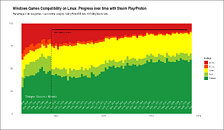
Linux gaming has quietly reached a new inflection point. A recent Boiling Steam summary of crowd-sourced ProtonDB compatibility reports shows that about 89.7% of Windows titles now at least launch on Linux systems. The numbers are spread into a few categories. Games rated "Platinum," meaning they install, run, and save on Linux without requiring user intervention, made up 42% of new releases tracked in October, up from 29% the previous year. At the same time the share of titles that refuse to launch, the so-called "Borked" cohort, has fallen to roughly 3.8%, a group that still includes deliberate blocks such as March of Giants, which explicitly detects Wine and Proton and exits to the desktop.
The most persistent obstacles are not obscure indies but anti-cheat middleware and contractual choices. Easy Anti-Cheat, BattlEye, and similar systems remain the primary gatekeepers for online multiplayer, and enabling them on Linux is often more a negotiation than a mere technical flip of a switch. When a studio approves Steam Deck support, desktop Linux compatibility frequently follows within a single build cycle, suggesting the code paths are already unified and only sign-off is pending.
 We recently saw a YouTuber test the ASUS ROG Xbox Ally X with Bazzite, a Linux distribution similar to Valve's SteamOS. At 17 W TDP, the Xbox Ally X achieves about 47 FPS in Kingdom Come: Deliverance 2 on Windows, compared to 62 FPS on Bazzite. At 13 W, Windows gets 35 FPS, while Bazzite reaches around 37 FPS. In Hogwarts Legacy, performance jumps from 50 FPS on Windows to 62 FPS on Bazzite at 17 W. At 35 W, the gap narrows to 5 FPS, with Bazzite still leading. Additionally, Bazzite delivers a more consistent frame rate, avoiding the frequent dips seen on Windows. When Valve decides to roll out SteamOS to the public, we might see an uptick of Linux gamers to a point where making a Windows-exclusive title is no longer a common case.
Sources:
Boiling Steam, Proton DB
The most persistent obstacles are not obscure indies but anti-cheat middleware and contractual choices. Easy Anti-Cheat, BattlEye, and similar systems remain the primary gatekeepers for online multiplayer, and enabling them on Linux is often more a negotiation than a mere technical flip of a switch. When a studio approves Steam Deck support, desktop Linux compatibility frequently follows within a single build cycle, suggesting the code paths are already unified and only sign-off is pending.


58 Comments on Almost 90% of Windows Games Run on Linux, Notes Report
shit works fine
¯\_(ツ)_/¯
It's WAY better than bumblebee was (I'd know, I used it with a Haswell/Kepler laptop on Mint and openSUSE), that thing was a nightmare to get working right.
CachyOS is mutable, the opposite, a rolling distro that always has the latest and greatest updates, at a cost sometimes. CachyOS has many many desktop environments available, but Plasma is probably the most popular, the best preforming for gaming, and something that a Windows user wouldn't have huge difficulties switching to.
Omarchy is a mutable distro specifically built around the hyprland tiling desktop manager, a very different experience to a Windows desktop and someone not looking specifically to play with that may not have an enjoyable experience. Hyprland isn't as gaming optimized as Plasma yet, and I believe it has some weird issues with some games and the way it handles things as a tiling desktop manager. In tiling desktop manager almost everything is done with the keyboard. The tiling bros pride themselves on never touching the mouse.
I'd actually argue that getting older games to function is easier on Linux these days!
A couple of things I'd note from my experience:
- KDE always tries to be cutting edge, and that means something in it gets broken in some releases. I got tired of that and switched to GNOME - hasn't failed me once and I saw no difference in features or performance.
- Atomic distros and Flatpaks are a match made in heaven. Bazzite and other Universal Blue distros use Bazaar to manage apps. Use it and forget downloading/building packages yourself. Beautious.
- Bazzite comes with Lutris and Heroic Launcher pre-installed for managing your games and launching them. But I've found PortProton to be less bloated, much easier to use and to work more reliably (has a ton of emulators for old games built in, as well).
Nope.
Nvidia still had the problem to force recompiles and kernel downgrades in early 2023. Same problems as years ago, ~10 years ago, ~15 years ago.
Amd does not need changes to the kernel when changing from the powercolor radeon 7800xt to the integrated graphics of the ryzen 7600x or the previous MSI Radeon 6800 Z Trio with my long term gnu gentoo linux installation from 2006.
I get the felling the poster does not have a glue how it works. I had for years nvidia based gaming notebooks and in 2023 i testedd for at least 3 months the nivida latest driver release with a second hand supported graphic card chip 960.
I tested various hardware configurations to see how much cpu power do i really need: 5800x -> 3700x -> 5800x -> ryzen 3 3100 -> ryzen 7600x
I tested various graphic cards to see how much gpu i need: nvidia 9800m gts (but i also had antoher notebook iwht integrated graphicsd at that time) -> nvidia 660m mobile -> radeon 6600XT -> nvidia 960 -> ryzen 7600x graphics -> radeon 6800 non xt -> Ryzen 7600x graphics -> radeon 7800xt.
I did not yet bother with signing. That sounds like lot of headache and extra work just for microsoft to have secure boot. Which does not bring any benefits, see e.g. the CVE which affected a year ago the uefi.
-- We should focus on the linux gaming topic. That includes no existing hardware support. That also includes that Battle Field 6 Whatever Secure Boot and whatever feature to run only in windows 11 pro.
On the other hand, it's still undeniably a huge problem that Gabe Newell can't count up to three when it comes to games ...
Windows is evil. Windows is buggy messy privacy violating service. Period. Those times when tweaking in Linux was absolutely must are long gone.
Sometimes I get reactions from people when they hear I say something about Linux - "But surely you're using Linux with GUI, right?"
Man, these people are so behind. Yep, non-GUI Linux is still a thing today, it's just only hardcore Tuxers do it - browsing web without GUI. :D
Yes you do, because any driver that must be added to the kernel requires a recompile. In most distros this is automated when you install the driver, becuase the distro maintainer will complie and update them for you. In Mint/Ubuntu/Other debian distros, this is included under the proprietary drivers setting, you just click the driver and reboot. Manjaro is the same way.
It sounds like Fedora sees no reason to include nvidia's drivers in their releases, and that is a slight against Fedora.I have no idea where this comment is going.
nvidia drivers work fine. If you run a distro that doesnt include those drivers, then yes you will need to add them yourself. That is on the distro maintainer for not supporting the most widely used GPUs on the market.
AMD drivers are kernel dependant, and this caused major issues in ubuntu and debian distributions because they used outdated kernels resulting in terrible performance from AMD cards and various compatibility issues. This also occured in 2023. The easy solution, just like with nvidia, was to use a distro that updated MESA regularly.
Thankfully this issue appears to have been resolved, for now. We'll see if ubuntu can keep up with kernel releases or if arch will continue to be the more up to date gaming OS.
Maybe you have tried the wrong DE?
I have an OLED screen (Alienware) and KDE Plasma.
Both 2D (desktop/HDR images) and 3D (games) are running perfectly fine in HDR.
I think the HDR configuration options are superior on the latest Plasma compared to Win11.
And yet, linux is even better than that now.I had forgotten how awful those days were. Yup, if I were going to get a gaming laptop today I'd prefer the ryzen max pro chips so that I didn't have to do dual-gpu stuff.
You know therein lies the problem, distros pretty much do things their own way. Something could work for you, but not for me. Linux maintainers need to invest in standardization.
I won't start with "Fuck off, users that want the same limited closed experience of others OS", because is not in the spirit of the FOSS community.But unifyng the ecosystem Is exactly what not to do.
The existance of hundreds distros and a dozen of DE Is the power of GNU/Linux, where everyone can find some ring tailored to his needs instead of accepting the limitations of other OS.
And this apparente fragmantations is not a problem.
For gaming Is not necessary to wander trough dozens of distros, there are about four distros aimed at gaming, and only two are been mentioned several time in this comment section.
As for the DE go with GNOME just if you can't stand PLASMA.
Doesn't seem much fragmentation.