Monday, November 3rd 2025

Kingston FURY Renegade G5 Now Available in 8 TB
Kingston FURY, the high-performance division of Kingston Digital, Inc., the flash memory affiliate of Kingston Technology Company, Inc., a world leader in memory products and technology solutions announces it has rounded out the recently named PCWorld "Editor's Choice" Kingston FURY Renegade G5 line with an 8192 GB full capacity option for high-power uses from video editing, 3D rendering, to gaming and more.
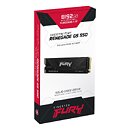
Optimized for those who need a system that can keep up with their workflow or gaming needs, Kingston FURY Renegade G5 PCIe 5.0 NVMe M.2 2280 SSD utilizes the latest PCIe Gen 5 x4 controller and 3D TLC NAND to reach speeds up to 14,800/14,000 MB/s read/write and over 2M IOPS to provide extreme performance and endurance, and now with over 8 TB to store more of your favorite games and media without losing system responsiveness.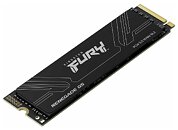
Source:
Kingston
Optimized for those who need a system that can keep up with their workflow or gaming needs, Kingston FURY Renegade G5 PCIe 5.0 NVMe M.2 2280 SSD utilizes the latest PCIe Gen 5 x4 controller and 3D TLC NAND to reach speeds up to 14,800/14,000 MB/s read/write and over 2M IOPS to provide extreme performance and endurance, and now with over 8 TB to store more of your favorite games and media without losing system responsiveness.


"Whether for work or play, users need more power and space," said Keith Schimmenti, SSD business manager, Kingston. "We're happy this 8 TB addition to Kingston FURY Renegade G5 SSD can provide high-power users and hardware enthusiasts both."Kingston FURY Renegade G5 is available in full capacities from 1024 GB to 8192 GB and is backed by a limited five-year warranty, free technical support, and legendary Kingston reliability.
30 Comments on Kingston FURY Renegade G5 Now Available in 8 TB
If I happen to find RAM that has good speed, great timings, has decent price and happens to be on QVL as well, it's literally stupid not to pick that one.
Reason I'm bringing this up is for example my Seagate Firecuda 530 4TB SSD. It was great in reviews, it's great on paper, Seagate is established storage drives maker and yet it's a disappointment because of things that weren't really specified in reviews. Drive technically works well, but things around it are stupid especially considering how expensive it was. It's why I prefer not leaving things to chances and I still burn myself sometimes. Imagine if you don't check anything and just buy whatever. You either have zero expectations and you're never disappointed by anything or just insanely lucky every single time.
If your kit doesn't work at the advertised speed, it could be a combination of reasons, but as I said, I have bought QVL memory that never, ever once worked at the rated speed in an X370 motherboard with a Ryzen 7 1700. There was a reason Corsair had a terrible rep for compatibility with the first Ryzen platform, but Asus still had that kid in its QVL at the rated speed. So please explain that to me, if the QVL is always right? I have never in my life, had so much headache from a single memory kit and I upgraded the RAM back when 30-pin SIMMs was a thing.No-one said you're not allow to buy products on the QVL, my point is that you can't trust the QVL to be 100% reliable. On top of that, the board makers and the RAM makers have different QVL's that say different things, please explain how that's possible, for the same memory kit.Again, no-one is forcing you to buy something you don't want to buy. You had one bad experience, it happens. I've had zero issues with the SSDs I've owned over the years, others seem to have had a lot of issues. I don't normally buy budget drives, not saying the Firecuda 530 is a budget model by any means, but I see plenty of people here buying random drives from Aliexpress and you're angry with Seagate for having a reskinned firmware upgrade app when those people are unlike to get any support whatsoever.
You buy what you feel is safe, but it still doesn't make other products bad.
Also, I clearly read the SSD reviews here before I spend any money on an SSD and so far I haven't ended up with a bad drive.
I'll say that the Corsair drive I have is a bit meh, but I didn't pay for that one so 🤷♂️
It's nice to look for best in
peoplecorporations but we can only look so far...I never looked at a QVL, specs exist for a reason, if it doesn't work with the sticks I bought and they're within the supported spec there's an issue with the components, I don't give a damn if it's in some QVL or not.I lie, I sometimes look, not to look for compatible ram, but to check if the board was tested with ECC sticks at all to try to figure if the board is going to support it :D
RAM and SSDs are obviously sold in very different ways, but technically there's no reason why they couldn't do it the way you suggest. However, I do agree that there are companies taking advantage of not having to list specs on SSDs and I did get tricked once, as the drive in question was supposed to be a certain spec with DRAM according to reviews and what I got was a DRAM-less drive with a different controller, so it went back. Sadly, the industry is not self regulating here, as it doesn't benefit anyone in the industry, whereas selling RAM with better specs means you can charge more.
I'm not trying to look for the best in corporations, but I've been involved in making products in Taiwan for close to a decade and sometimes things can change over night. Take the pandemic, it really messed up a lot of things and it didn't take long for there to be a shortage of common components, as orders where cancelled, production stopped and people laid off and then all of a sudden, companies realise they need products and you have a lead time of a year or more for a common MCU.There's nothing wrong with looking at a QVL, but as you say, things like memory and SSDs should just work if it's the right specs, although it doesn't always do that as we know, even if it's on a QVL sometimes.