Thursday, August 20th 2026
Sandisk Introduces Sandisk NAS SSDs for Prosumers and Small Businesses
Sandisk today announced the Sandisk NAS portfolio of high-endurance SSDs purpose-built for modern network-attached storage (NAS) environments. As prosumers and small businesses generate more data and increasingly rely on collaborative, always-on workflows, users are seeking reliable high-speed private cloud deployments utilizing NAS. The new Sandisk NAS 600 SATA SSD and Sandisk NAS 800 NVMe SSD are engineered to deliver the reliable, consistent performance, high-endurance, and scalability required for today's demanding NAS workloads.
Designed for accelerating hybrid and all-flash NAS systems, Sandisk's new NAS SSD portfolio includes two high-endurance and high-performance SSDs engineered for multi-user or demanding creative professional workloads.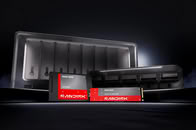
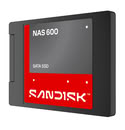
 Sandisk NAS 600 SATA SSD - Optimized for creative professionals and small businesses modernizing NAS by replacing HDDs with SSDs or accelerating by adding a solid-state cache or tier, the Sandisk NAS 600 SATA SSD delivers high endurance with up to 2,500 TBW (4 TB model) and up to 2.25M hours MTTF to support demanding multi-user workloads. Its 2.5"/7 mm SATA form factor integrates into existing 3.5" NAS drive bays supporting 2.5" SSDs, delivering sequential reads up to 560 MB/s with no mechanical noise, making it an accessible upgrade path from HDDs. Designed for reliability in multi-drive and RAID configurations, it helps ensure consistent, responsive performance in collaborative environments and content-rich workflows while helping to lower TCO by improving productivity. Available in high-endurance models from 500 GB up to 4 TB.
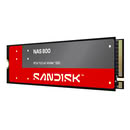
Sandisk NAS 800 NVMe SSD - Designed for deploying all-flash and hybrid NAS running demanding or business critical workloads, the Sandisk NAS 800 NVMe SSD with PCIe 5.0 is engineered with a high-endurance rating of up to 14 PBW (7.68 TB) for caching, storage tiering, or as primary storage. It delivers up to 2.3M/2M IOPS random read/write speeds (3.84 TB) and sequential read/write speeds up to 14,900/13,200 MB/s (1.92 TB) for multiuser collaborative environments, databases, virtualization, content creation, or agentic AI. It reliably performs in demanding NAS environments and is tested with many leading NAS systems for M.2 2280 compatibility. Choose capacities from 960 GB to 7.68 TB with Sandisk TLC 3D NAND.
The increasing emphasis on private cloud integration, local and AI data management and control is helping to drive demand for reliable storage solutions that can help protect valuable content and business-critical data.
Source:
Sandisk
Designed for accelerating hybrid and all-flash NAS systems, Sandisk's new NAS SSD portfolio includes two high-endurance and high-performance SSDs engineered for multi-user or demanding creative professional workloads.


Sandisk NAS 800 NVMe SSD - Designed for deploying all-flash and hybrid NAS running demanding or business critical workloads, the Sandisk NAS 800 NVMe SSD with PCIe 5.0 is engineered with a high-endurance rating of up to 14 PBW (7.68 TB) for caching, storage tiering, or as primary storage. It delivers up to 2.3M/2M IOPS random read/write speeds (3.84 TB) and sequential read/write speeds up to 14,900/13,200 MB/s (1.92 TB) for multiuser collaborative environments, databases, virtualization, content creation, or agentic AI. It reliably performs in demanding NAS environments and is tested with many leading NAS systems for M.2 2280 compatibility. Choose capacities from 960 GB to 7.68 TB with Sandisk TLC 3D NAND.
The increasing emphasis on private cloud integration, local and AI data management and control is helping to drive demand for reliable storage solutions that can help protect valuable content and business-critical data.
"The way users employ NAS has fundamentally changed," said Anil Moolchandani, vice president, product management at Sandisk. "Today's prosumers, creative professionals, and small businesses are managing larger datasets, collaborating across teams, and relying on systems that need to perform around the clock. We built the Sandisk NAS portfolio to meet those evolving demands, giving users SSDs that make it easy to modernize existing NAS environments or unlock the performance of all-flash deployments."Both the Sandisk NAS 600 SATA SSD and Sandisk NAS 800 NVMe SSD will be available for purchase in September at Sandisk.com, select retailers and e-tailers worldwide. The Sandisk NAS 600 SATA SSD will start at $179.99 U.S. MSRP (500 GB) and the Sandisk NAS 800 NVMe SSD will start at $309.99 U.S. MSRP (960 GB).
19 Comments on Sandisk Introduces Sandisk NAS SSDs for Prosumers and Small Businesses
TeamGroup has been noted for fully honoring their warranties when people have had device issues. I had considered them strictly "second tier", but given a choice between second tier where the company has done the right thing for their customers when their devices act up, and these 3 that view their customers as "consumers" and have decided not to do the right thing, while making record profits, to me the choice is clear.
Adata, Biostar, Emtec, Gigabyte, Kioxia (maybe -- they're in a joint venture with Sandisk; but they are their own company with their own policies), Lexar, Patriot, PNY, Transcend. Yes I'm just going down a list of SSD vendors and picking off names I recognize. I'd check the warranty terms and buy from any of them before bying directly from Sandisk, Samsung, or Cruicial, based on their recent behaviors.
[INDENT=3]
[INDENT=3]havecamerawilltravel.com/fastest-sd-cards/[/INDENT]
And to get much lower in price you have to go extreme no-name and risk everything. :(
[INDENT=3]
[INDENT=3][/INDENT]
If you use your camera (or other device) for recording high bit-rate video or use burst mode much, SanDisk has had the crown more often than not over the past 15+ years. And they're RMA support services has a good rep - I have a buttload of them but never needed to warrantee any so all I know is what others say about returns and support. For awhile there back 15+ years ago they were offering a free data recovery service as well as replacement on their SD cards - they might still, I dunno.
I bought an exact one from Lexar 2 years ago, similar specs , for 5000 Yen, 10x times cheaper.
The prices are out of control.
SanDisk SD Cards do often (but not always) carry the highest price within whatever class of cards you're looking at but not by that much - a few bucks, like I said. And again, they're usually at the top of each class. Photographers and videographers are willing to pay a slight premium so they don't have to go hunting around in articles like I linked. It's an ease of mind assurance and convenience tax worth paying for most of us. Head to a "pro" photography site and ask about SD Cards for high bitrate video and/or high density (MP) burst shooting, the majority will recommend SanDisk - myself included, and I'm a total cheapskate! :D A lot of higher end cameras require UHS-II V90 just to be able to function at spec. And even more-so if you're a firmware modder! If your camera is lower spec (or you're just using them as casual storage media) then you can use lower class (less expensive) cards of course - and there are more than a few different classes. :P
EDIT: I do sometimes see "UHS-II V90" or "UHS-II V60" cards for like ¥5,000 but they are fake and typically perform just like other ¥5,000 cards - or worse, they perform like low end cards and are 256Mb, not 256MB. 🤪
This offering will separate more than a few fools from their money, sadly. As someone who once bought a Barracuda Pro before I found out about datacenter HDDs, I learned that the hard way.
Adding to injury, only noticed today the new NAS 600 SATA series have no DRAM (unlike the old WD SA500 it replaces, that one likely related to WD Blue 3D/Sandisk 3D Plus).
See spec sheet, while announced TBW remains the same as previous SA500. OTH, the NAS 800 NVMe still retains it.
Very underwhelming detail for this "class" on SATA, regardless of current DRAM scarcity or crazy prices on SSDs all combined.
Got shitty marketed by "friendly" local parts store salesman that "don't buy the cheapest ssd, get Lexar at least, they are ok!" - "happy" client was having good times with failing Lexar 480 or 512 GB whatever SATA SSD. The PC was randomly freezing, replaced this crap with another SSD and all good. Same shit experience as Kingston A400 - it either works ok for long, or fails and give you such a good brainf*ck.;)