Wednesday, November 5th 2025

AMD Readies Ryzen AI MAX+ 388: 8C/16T and Full 40-CU Radeon 8060S GPU
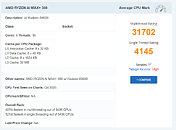
AMD is gearing up to release a new "Strix Halo" Ryzen AI MAX+ SKU specifically designed for gamers who don't need more than 8 cores and 16 threads of CPU power. In a recent PassMark benchmark, a new SKU called Ryzen AI MAX+ 388 was spotted. It features 8 cores, 16 threads, and a fully equipped Radeon 8060S GPU with 40 RDNA 3.5 Compute Units (CUs). Previously, the full Radeon 8060S configuration was only available in the high-end Ryzen AI Max+ 395 model, which combines 16 cores and 32 threads with the 40 CU Radeon 8060S. However, that model is more expensive and better suited for tasks like productivity and AI that benefit from higher core counts.
If and when AMD introduces the 8-core, 16-thread Ryzen AI MAX+ 388, we anticipate that more gaming devices will adopt this chip, as it offers an ideal balance of CPU and GPU power for running modern games. AMD supports up to 128 GB of 256-bit LPDDR5x memory at 8000 MT/s with its Ryzen AI MAX+ SoCs. However, the actual memory configuration will depend on the choices of the OEM or device manufacturer. Some devices, such as SIXUNITED 14-inch tablets, have already been seen using this APU, configured with a 65 W TDP. AMD provides a configurable TDP range of 45-125 W, with a default TDP of 55 W for its top three SKUs. Therefore, we can expect to see various TDP ratings as OEMs tailor this chip to their specific requirements, based on the device's form factor and thermal capacity.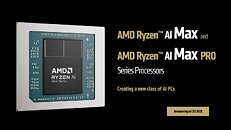
Sources:
@realVictor_M on X, PassMark, via VideoCardz
If and when AMD introduces the 8-core, 16-thread Ryzen AI MAX+ 388, we anticipate that more gaming devices will adopt this chip, as it offers an ideal balance of CPU and GPU power for running modern games. AMD supports up to 128 GB of 256-bit LPDDR5x memory at 8000 MT/s with its Ryzen AI MAX+ SoCs. However, the actual memory configuration will depend on the choices of the OEM or device manufacturer. Some devices, such as SIXUNITED 14-inch tablets, have already been seen using this APU, configured with a 65 W TDP. AMD provides a configurable TDP range of 45-125 W, with a default TDP of 55 W for its top three SKUs. Therefore, we can expect to see various TDP ratings as OEMs tailor this chip to their specific requirements, based on the device's form factor and thermal capacity.


49 Comments on AMD Readies Ryzen AI MAX+ 388: 8C/16T and Full 40-CU Radeon 8060S GPU
The whole gaming shtick on this APU is them trying to repurpose a supposed "AI" chip for gaming needs.
Unsurprisingly, there are very few first party devices utilising similar hardware in a laptop format.It's a waste for gaming especially at the current price point.The answer is probably much simpler and you might already know it.
Prices are going down, the GMKtec with a 395, 64GB RAM and 1TB SSD started at €2400 peaked at 2900, and now it's €1600.
Yes, you will say that it's till too much, you've made your point lolPure bs
Anyways, we still need more devices with such processors at decent price points, regardless of what you intend to use them for.
The only laptop available with Strix Halo is still the HP zbook G1a, that's it, almost a year after launch of the original chip there's only that on the marketI don't understand what's taking them so long! Maybe it's because it doesn't work with SODIMM so they can't do the crap they pulled with the T14 with the Intel version having fast LPDDR and AMD Strix Point using much slower SODIMM.
The only other thing I can think of is maybe the battery life proposition because supposedly having a dGPU still eats away at battery life even if it's not doing anything. But I have a gaming laptop with a decent dGPU and I believe it can last 9-10 hours on battery after using it on a long train ride. Not gaming of course, but I didn't buy it to game on battery anyway.
Hence me speculating that it could be an issue with bad silicon and it not enough chips making the grade to be binned as an higher end sku.
Currently you have to get either the 385, 32GB RAM and the 8050S SKU for $1100 or the 395+, 64GB RAM and the 8060S SKU for $1600.
If this one comes in at the middle at 32/48GB RAM and the 8060S that would be more popular with gamers.
It's a true 8-core with single thread power like top Ryzen and Epyc chips.
It's in the same performance bracket as the 5900X I've been eyeballing lately.
I of course mean that very loosely as I just want double cores+performance.
Look at that cache. Hey guys are we ever gonna need more than 640K?
www.notebookcheck.net/Computer-Games-on-Laptop-Graphics-Cards.13849.0.html?type=&sort=&gpubenchmarks=0&professional=2&dx=0&multiplegpus=1&showClassDescription=0&deskornote=0&series_uid=0&archive=1&condensed=0&id=0&perfrating=0&or=0&itemselect_12965=12965&itemselect_12964=12964&condensed=0&showCount=0&showBars=1&showPercent=1&settings_class_array[]=1&settings_class_array[]=2&settings_class_array[]=3&settings_class_array[]=4&settings_class_array[]=11&settings_class_array[]=6&settings_class_array[]=8&settings_class_array[]=9&settings_class_array[]=7&gameselect%5B%5D=1086&gameselect%5B%5D=1083&gameselect%5B%5D=1081&gameselect%5B%5D=1078&gameselect%5B%5D=990&gameselect%5B%5D=974&gpu_fullname=1
Which means the 395 (and then the 388) actually gets higher performance-per-watt than the 385.
There's a good chance the 395 uses a higher binned IOD that allows for higher clocks at that same TDP.
But an all-around better machine for smarter people/workers, who don't want a childish logo on it, want better battery performance and heat performance while on the go, that may be better than bulky desktops which can't be used by traveling professionals. It is certainly desired.
If you are 'settled' somewhere, the point of having a mini PC which is worse than a larger PC for air/cooling, makes no sense. It's a scam if it's miniature. The interesting thing is the laptop that has no dGPU, can sort of run like one, can be used for work, with less power consumption, and could be plugged in and used as a mini PC to a high-performance monitor; that is what this seems to offer, and it's better than everything.
I'd like the idea that my machine can run something modern, was stronger than my previous cheap/custom desktop (custom built through the years, and was modernized back in 2019, ran everything, never failed, but I stored/sold it as it's far too bulky to bring anywhere while on the go, and nothing held my immediate interest to run anyways).
The idea it can be placed on a laptop, maybe with a better screen quality, higher HZ, lose the typical gimmicks and problems (like battery consumption, heat, and other issues) of even the best priced discrete GPU laptops, is definitely a big factor for this.
Only stupid people (novices, beginners, people who don't understand what it does) want to actually 'run AI models' locally on their machine. That's what I find 90-95% of the time. Experts know it's useful to use AI, but I've never used it yet. I indirectly use it, as I found it only useful in context like major search engine AI saves you a lot of time when doing a reference search, and can even write some code, so that you don't have to go through like 3 webpages to compile it all together; the logic is all done for you. It's a useful helper, but doesn't do everything, which is why experts will be needed; and the obsession with running AI to do a task that can be just done directly is of course based on a misunderstanding by the average user. Almost every 'AI Task' can be done by a way more optimized or direct way, or a direct coding that works literally 1000x times faster and efficiently. Once understanding that, AI in professional areas can be used to slowly resolve tasks in the background and/or used to perform most tech support chat tasks, for example; I've seen many airlines doing this properly, with usage of supplying #'s, cancelations, and other things, it is the perfect environment for such a tool. For the average person or even enthusiasts however, if they are thinking they can just buy an AI machine and type "do my work", then that's pathetic; they are cheaters and will never be expert level, and they clearly do not understand it's never going to do it all for them (Especially not in it's current state!). Knowing when it's useful, when it's not, what can be done, what can't be done, and being able to put it together, is all a crucial tool for them. It's appealing, to those who don't know things or how anything works, and seems magical or cool to them, but that's its limitation factor overall.
That being said I look forward to potentially the 1000$ or sub 1000$ laptop that has all around better screen (possibly even stronger than my desktop had), and can still power down, can use the space or reduce space because of no need for the power-hungry dGPU, and other downsides (aside from childish gimmicky logos, that I find I would never want as an adult professional) that even the best gaming laptops have had. That being said it's all perfect because, again, there's no games or things coming out that are worth upgrading for. But I'd still like to see this technology come out and make everything slimmer/better. I'd like to see a laptop sort of like the Strix Rog that came out, better screen etc. and be able to run still like a 4060 or higher. Hopefully all in a discreet 15" laptop, that doesn't cost like 3000$ for no reason. No need for 16 cores, or 100GB ram, etc.. This would still be faster than my desktop was even with its enhanced screen and stable working parts, so interesting times to live in to see the birth of the future tablet or the mini-PC; keeping in mind you can plug in those to a monitor, and it's basically not just a laptop, but a mini-PC itself. Mini-PCs are too limited for travel and so their entire thing is a gimmick- if you have room for one, then you have room for the larger desktop anyway and may as well have the perks of cooling and open-source; mini-pcs I imagine, become a pain to open and mess around with, aside from the slight decrease in cooling, and offer absolutely nothing for the 'miniature' part (the sales point), unless you plan to bring a giant monitor while you plan to remain mobile with it for some reason.. That makes 0 sense over a full laptop with a output port to a monitor which would serve as a mobile desktop and a laptop in one; which is what Strix seems to offer.
I want this for mainly compatibility, ability to run future/modern games if they do come out, and keep all work/things in one machine, while traveling too, but I recognize I could want 1-2 years for it too.