Monday, November 24th 2025

Chinese CXMT Shows Homegrown DDR5-8000 and LPDDR5X-10667 Memory
Chinese company CXMT has unveiled its first homegrown DDR5-8000 and LPDDR5X-10667 memory modules at the 2025 China International Semiconductor Expo. These are CXMT's most advanced memory modules, matching the offerings from major South Korean manufacturers like Samsung and SK Hynix, as well as U.S.-based Micron. The expansion of Chinese server infrastructure for traditional computing and AI has been constrained by domestic silicon production capabilities. CXMT's DDR5 memory operates at 8,000 MT/s, while its LPDDR5X memory reaches 10,667 MT/s. This performance is comparable to Samsung's latest offerings, including their LPDDR6 memory, which matches the top speed of their LPDDR5X chips at 10,700 MT/s.
These memory modules are available in 12 Gb and 16 Gb LPDDR5X capacities, while DDR5 scales to 16 Gb and 24 Gb module formats. These are later packaged into RDIMM, MRDIMM, and TFF MRDIMM for data centers and enterprise servers. UDIMMs are designed for mainstream desktops and PCs, while SODIMMs are intended for laptops and compact devices. Additionally, clock drive modules like CUDIMM and CSODIMM are meant for the high-end overclocking and workstation markets. In the server market, which is the largest segment, CXMT RDIMMs offer a range of capacities to cover mainstream platform memory configurations.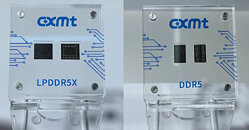 In January, TechInsights identified CXMT's new 16 nm DRAM chips in Gloway DDR-6000 UDIMM modules, marking a significant advancement in the Chinese memory industry. These 16 Gb DDR5 chips from CXMT measure 67 square millimeters, with a density of 0.239 Gb per square millimeter. The G4 DRAM cells are 20% smaller than CXMT's previous G3 generation. This development follows the company's progression from 23 nm (G1) and 18 nm (G2) nodes. However, despite this progress, CXMT remains approximately three years behind Samsung, SK Hynix, and Micron in manufacturing capabilities, so don't expect the global DRAM shortage to be resolved anytime soon.
Source:
ICViews
These memory modules are available in 12 Gb and 16 Gb LPDDR5X capacities, while DDR5 scales to 16 Gb and 24 Gb module formats. These are later packaged into RDIMM, MRDIMM, and TFF MRDIMM for data centers and enterprise servers. UDIMMs are designed for mainstream desktops and PCs, while SODIMMs are intended for laptops and compact devices. Additionally, clock drive modules like CUDIMM and CSODIMM are meant for the high-end overclocking and workstation markets. In the server market, which is the largest segment, CXMT RDIMMs offer a range of capacities to cover mainstream platform memory configurations.

16 Comments on Chinese CXMT Shows Homegrown DDR5-8000 and LPDDR5X-10667 Memory
@AleksandarK It's confusing to use the term "module" here. The industry uses various terms, chip, package, chip package, part, device, nothing*, but a module is a DIMM or CAMM module.
* Samsung calls its chip packages simply "DRAM", without any further description.
I also prefer to avoid "chip" because sometimes it stands for "die" and at other times it's the same as "chip package" which can pack many stacked dies.
In all likelihood, 100% of their output will be directed toward national security projects that align with the CCP's objectives. This will only effect the world market if it otherwise replaces orders to foreign firms for RAM.