Wednesday, December 3rd 2025

Windows 10 Market Share Dips Below 30% as Gamers Migrate to Windows 11
Gamers are aware of the end of life for Windows 10, which occurred on October 14, prompting a mass migration to Windows 11. They hope this new operating system will support their gaming sessions for the foreseeable future. The shift in market share between Windows 10 and Windows 11 has now become significantly pronounced, according to the latest November-based Steam Hardware and Software Survey. As the data shows, Windows 10 has dipped below 30% market share among operating systems, which is -2.08% reduction from October data. At the same time, Windows 11 gained +2.02%, which is seemingly the entire population that was lost from the Windows 10 transition.
An interesting development is the increase in Linux usage, which recorded a 0.15% gain, reaching its highest-ever share of 3.20%. This could be attributed to some Windows 10 users migrating to Linux-based operating systems. Another possibility is that from October to November, a significant number of users purchased handheld devices like the Steam Deck, which runs on SteamOS, a Linux-based system. Additionally, many gamers might have experimented with Linux operating systems in anticipation of Windows 10's end of life.
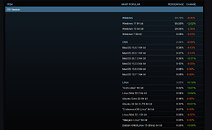 The 30% figure may remain stable, as approximately 500 million PCs were unable to upgrade to Windows 11 when Windows 10 reached its end of life. The slow transition requires hardware upgrades, and the market remains hesitant to upgrade. This is particularly notable given the company's strong push towards an AI-focused operating system, which has driven some users away. Meanwhile, Extended Security Updates (ESU) are designed to ease the transition, not to serve as a permanent solution. The program excludes new features and non-security fixes. According to Dell's COO, about 500 million additional PCs can transition to Windows 11 without needing a hardware update.
Source:
Steam
An interesting development is the increase in Linux usage, which recorded a 0.15% gain, reaching its highest-ever share of 3.20%. This could be attributed to some Windows 10 users migrating to Linux-based operating systems. Another possibility is that from October to November, a significant number of users purchased handheld devices like the Steam Deck, which runs on SteamOS, a Linux-based system. Additionally, many gamers might have experimented with Linux operating systems in anticipation of Windows 10's end of life.


41 Comments on Windows 10 Market Share Dips Below 30% as Gamers Migrate to Windows 11
And Windows 11? Performance wise it's more or less like Windows 10. When you're in the game, you won't tell the difference. Which means - no wins (or losses) here. But it's so f**king annoying at the same time that it's simply better to keep using Windows 10.
Not to mention all the updates drama. Windows 10 gets just security patches. Nothing's broken, everything just works.
And I wouldn't expect AAA studios like EA to support Linux, not unless Windows continues to be crappy enough for Linux to get enough attention to grab more market share away from Windows.
But IMO, Windows 11 is worth complaining about, and the complaints are plenty valid, I'd gladly pay for a version of Windows without all of the bloat, preinstalled junk, copilot spyware, or forced updates.
Yes I know Windows LTSC is a thing, however most users aren't going to use an enterprise version of Windows.
The bloat is there when 11 is slower than 10, it's less noticeable with higher end hardware but I think it's still there. Windows 10 had gotten to the point that it's stable and didn't force people to e-waste adequate hardware.Much of the complaints are AAA games the studio chooses not to allow Linux support for, usually with kernel level anti-cheats on multiplayer titles, I'd just rather choose to vote with my wallet and not pay $70 for games being restricted to Windows only. I would personally want to have a game library that lets me move to Linux if I want to.
I prefer 10, but drivers and application support for 10 probably won't last much longer, game performance isn't a massive deal, but it's the buggy updates that often does ruin performance is a concern, and 10 not getting all of the same bloat 11 is a good thing.
I will move to 11 (as a gaming console only, I'm already dual booting with Ubuntu) first thing when I notice I'm missing something. Currently I'm not.
I'll admit that Gaming on Linux is not without challenges, but a lot of those can be eliminated by going with a gaming-centric distro. Once I went to Bazzite, the compatibility issues on certain games just went away entirely,
You know that you can just pause updates. it is 2 clicks, open updates page, hit pause updates. You can pause for 5 weeks.
I loved win10. I thought it could have just stayed forever, but MS had other ideas, wish complaining about it on the internet made a difference.
Also doesn't help that the update icon is annoying af and get ANGRY after 28 days of uptime or so. Just look at this bullshit:
This is what I see from my developer box. I don't want to restart now. I want to restart NEVER. There is NO reason to update this machine.
It is perfectly capable of downgrading to Win11. I'm not doing that for very obvious reasons. Win11 is not an agreeable OS. It's malware.
If you love Win11 telemetry, more forced updates that break your ENTIRE installation and other dumb bullshit, great. Count me out.
I need to come up with a minimal WinPE-like Win10 distro purely for broadcasting and then a Win10ProWS loadout for this workstation.
If any of you have ever encountered storage issues with Steam dumping logs every second in VR to the tune of 11MB/s, you know why.
a/ Uncharted - Steam
b/ CP2077 - Epic
c/ Guardians of the Galaxy - Epic
d/ Control - Epic
e/ Assassin's Creed: Syndicate - Ubisoft Connect
f/ The Last of Us 1 - Steam
Would you call them AAA titles? Absolutely no issues running Steam or Epic games via Steam and Heroic. AC was a bit more of a hassle, since Lutris isn't the best in managing Proton etc., but once I got it running, it was a breeze.
I do own an AMD card, haven't bought anything NVIDIA in ages, so maybe that's the reason, heard with NVIDIA it's a bit more difficult, but haven't tried myself.What do you mean precisely? I'm not a system admin, just an average user, I'm not noticing any deterioration in the system lately. I do have the WU icon as well (a blue one that suggests I should update to 11 25H2), but it doesn't bother me that much :).That's (at least I assume so) representative sampling, meaning you can extrapolate the results to the whole population.
Granted, it's a very popular niche--online shooters, online racing. If you're into that sort of thing, then there's really no discussion: stay on Windows. Likewise, if you're a cutting edge gamer who has to buy the newest AAA releases on the very first day, then you should stick to Windows.
For people into anything else, Linux gaming will probably work just fine. If it's a single-player game released in let's say the last 20 years, I can almost guarantee you it will work. I don't even look at a game's protondb ratings before I buy it, anymore. Some games take a little tweaking. A small minority take a lot of tweaking. A tiny fraction won't work at all. But that's true on Windows too. What we're discussing here is a difference of degree, not kind. In the vast majority of cases, just toggling on ProtonGE is good enough. There are even rare cases where a game will work better in Linux.
I couldn't get The Technomancer to work in Windows 10 with an i7-12700, for example; that game has an infamous problem with >8 CPU cores. I messed around with it on Windows for awhile, used Process Lasso, tried launch arguments, edited some ini files, though I did stop short of disabling cores in the BIOS. I'm sure I could have gotten it working on Windows eventually, but it certainly wasn't a straightforward fix. After an hour or so, I gave up. But in Linux? 2 minutes of browsing Protondb gave me the fix, which IIRC is just an environment variable; paste it into Steam/Heroic's launch field. Voila.
Certainly there are valid reasons to stay away from Linux. Certainly there are difficulties in using Linux, particularly if you've spent decades using Windows. The culture shock can be immense. But the generic gaming use case really isn't a major bar to entry anymore. The Steam Deck gets rave reviews for a reason.
If you look at Windows vs Linux, this is for example how Guardians of Galaxy looks like (check out VRAM usage and FPS graph - top is Windows, bottom is Ubuntu):
You basically just want to be an edge device in Windows' eyes, that's how the OS is still functional. Any other way? Just no. You set it, you forget it, and every few months you might angle in some security updates. That is how you roll with this OS from 2025 onwards. Everything else is just a slow painful death. Also you get 24H2 preview or something earlier because everything beyond means you are knee deep in the Copilot mud.
The only reason I feel the need to keep that option open is because of Xbox app. My audience is weird and likes that route.
XP is basically 2000 with consumer bloat integrated, like the kiddie themes and such.
Of course as time passed by XP was discovered to have some major issues, I still vaguely remember the BSOD's related to AGP issues, and of course the security band aiding that had to be done as an emergency. The security issues with XP is what got me into making custom ISOs with integrated updates, else if you clean installed XP the machine could be owned before you seen the desktop for the first time (remember this was an era where most consumers were not using routers with integrated firewalls, NAT was still done on Windows for their network).
Also regarding LTSC, IoT for consumer devices, its an extra 5 years, but by the time the standard 5 years ends for LTSC, I expect people will have upgraded or moved to Linux by then as 3rd party support will be bad at that point. I think 10 is probably going to be reasonably usable until somewhere between end of 2026 and end of 2027. Standard LTSC has an EOL of Jan 2027. This is all dependent on 3rd parties if they decide to block 10 on new versions of their software. Nvidia blocking Windows 8.1 on Ampere drivers forced me to finally upgrade from 8.1 to 10.
Putting that aside drivers have also gotten pretty bad and all the garbage app that you need for even basic functionality are making Winshaft a real shit show.