Wednesday, December 3rd 2025

Windows 10 Market Share Dips Below 30% as Gamers Migrate to Windows 11
Gamers are aware of the end of life for Windows 10, which occurred on October 14, prompting a mass migration to Windows 11. They hope this new operating system will support their gaming sessions for the foreseeable future. The shift in market share between Windows 10 and Windows 11 has now become significantly pronounced, according to the latest November-based Steam Hardware and Software Survey. As the data shows, Windows 10 has dipped below 30% market share among operating systems, which is -2.08% reduction from October data. At the same time, Windows 11 gained +2.02%, which is seemingly the entire population that was lost from the Windows 10 transition.
An interesting development is the increase in Linux usage, which recorded a 0.15% gain, reaching its highest-ever share of 3.20%. This could be attributed to some Windows 10 users migrating to Linux-based operating systems. Another possibility is that from October to November, a significant number of users purchased handheld devices like the Steam Deck, which runs on SteamOS, a Linux-based system. Additionally, many gamers might have experimented with Linux operating systems in anticipation of Windows 10's end of life.
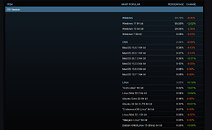 The 30% figure may remain stable, as approximately 500 million PCs were unable to upgrade to Windows 11 when Windows 10 reached its end of life. The slow transition requires hardware upgrades, and the market remains hesitant to upgrade. This is particularly notable given the company's strong push towards an AI-focused operating system, which has driven some users away. Meanwhile, Extended Security Updates (ESU) are designed to ease the transition, not to serve as a permanent solution. The program excludes new features and non-security fixes. According to Dell's COO, about 500 million additional PCs can transition to Windows 11 without needing a hardware update.
Source:
Steam
An interesting development is the increase in Linux usage, which recorded a 0.15% gain, reaching its highest-ever share of 3.20%. This could be attributed to some Windows 10 users migrating to Linux-based operating systems. Another possibility is that from October to November, a significant number of users purchased handheld devices like the Steam Deck, which runs on SteamOS, a Linux-based system. Additionally, many gamers might have experimented with Linux operating systems in anticipation of Windows 10's end of life.


41 Comments on Windows 10 Market Share Dips Below 30% as Gamers Migrate to Windows 11
I wonder what it will be in another 5 years?
By the time I retire we may hit the lofty goal of double digit marketshare!Games run fine in 11. Gamers look at a 1 FPS loss then immediately cry the sky is falling.
the fact that the most dont "debloat" their OS despite the "awful" performance should clue you into that....
Sure, Windows is Windows and bugs are still there, but plenty of us haven't experienced this apparent degradation that some of you speak of.
Windows 11 definitely felt slower to me, especially in the file system before removing bloatware and copilot.
To use a non computer related analogy, Plato's cave allegory. The people in the cave did not realise how much there was to life until they stepped out of the cave. NOW, that's not to say that making the switch from Windows to anything else is as drastic a realisation as stepping out of Plato's cave, but I am saying that if you live with one thing for all your life, you won't know anything else.
People also don't debloat their OS because most of the time that debloating will probably go away with a future windows update, or also don't want to put in the effort to go through with even running a debloating script, much like they're not going to go through the effort of looking elsewhere for their OS needs. People in real life care much, much less than anyone that comes to a tech forum.Depending on where the data is sourced from the % differs, most recently reported figures from a US government (if I recall correctly) website apparently tracked 5%? And I recall seeing 6% somewhere else. Besides, the steam hardware survey is a bit slow to update, and many people are never even prompted to have a survey done. I myself haven't been surveyed for over a year I want to say? And since then I've changed both my OS and my gpu, so while it is useful, it's also not the definitive statistic.
Not having any more micro stuttering.
Still a shit OS though, plenty wrong with it.
There are some things I miss about 10, no doubt, but W11 hasn't really felt like a notable step back to me (especially in HDR).
-People clung onto 2000 for years (you're getting old if you remember this drama), eventually adopting XP and proclaiming it superior to Vista.
-People clung onto XP for years, eventually adopting 7 and proclaiming it superior to 10
-People clung onto 7 for years, eventually adopting 10 and proclaiming it superior to 11
-People clung onto 10 for years, (you are here), eventually adopting 11 and proclaiming it superior to agentic12aimythroatdaddi.
Every single windows OS is the worst ever, its terrible and unusable and surely consumers will switch to Linux or stick with the old Windows rather then use the old garbage. Everyone proclaiming 11 is awful, terrible, ece, if their accounts are old enough, guarantee you go back to the early windows 10 and windows 8 threads and they would be saying the EXACT same things about 10, tweaked for the current at the time outrage. We see this every 5-10 years, its a pattern. in 10 years, all these same accounts, if they are still around, will say the same thing about agentic12aimythroatdaddi edition, how they'd rather stick with 11 and copiot or move to Linux.
History isnt a photocopy, but boy does it rhyme.Wait wait wait, so now he's seeing a boost from the 285k, which consistently benchmarks slower then Raptor lake, on the OS that supposedly has awful performance?
Now how exactly does that work?
"I don't like change"
After several decades and tons of versions, I saw those tantrums way too many times. I pitty the fools that hang to old windows versions.
I'm always an early adopter, and I had access to pre-release Windows at two of the companies I worked on.
Sure, there are new things to learn/adapt to, and there are always options to customize the OS to your liking, in every single version:
- Yes you can change the look and even the position of any buttons
- Yes you can disable Copilot
- Yes you can disable auto updates
- Yes you can bring back the old taskbar/start button if you want
- Yes you can control what applications/services are installed and running
- Yes you can have complete acces to every single system file and folder
- Yes you can run a full blown Linux inside your Windows
... but not for people that stagnate/are unable to learn new things!
For my part, I was against 10 from using it at work and preconceived notions. But when I migrated in August 2019, I quite liked it. OpenShell did much, and it felt more minimalistic than Vista and 7. Apart from a Vista laptop, I actually went from XP to 10.
In short, 9x to NT was an objective improvement, and XP made NT friendly, combining the consumer and business lines into one OS. After that, it has been a mixed bag, tending more towards down, down, down, 7 and 10 being honourable exceptions—on release and retrospectively.
If we take 132 million users as the reference (Steam active users base):
- 1% of 132 million is 1.32 million.
- 0.15% is 0.0015 × 132 million = 198,000.
Like, cool and stuff, but what would I need to do this in the first place when Windows 10 serves my needs perfectly and there are basically no upsides of using Windows 11 at the moment?So you conveniently skipped Me, Vista and 8 because it didn't match your argument? xDLinux aside.
Win10 vs 11 is not even worth crying about, who cares, move on and upgrade to Windows 11, you didn't have to pay for it, it is such an easy upgrade or clean install. Just do it, waste to fight the system when you had to do it for the last "11" OS Microsoft did.
I didn't notice a single FPS difference when I moved to Windows 11. I am not really sure what "bloat" everyone speaks of, what bloat is on Windows 11 that wasn't on 10?
I turn on my computer, play a game and have fun, stop worrying about 2 FPS you left on Windows 10.