Wednesday, December 10th 2025

Upcoming Flagship "Panther Lake" APU Geekbenches Above AMD's Best Ryzen AI Mobile Chip
The upcoming "Panther Lake" mobile processor series seems to consist of (at least) fourteen distinct SKUs, according to a major mid-October and November leaks. Since then, a bunch of these elaborately named models have been fleshed out in greater detail—courtesy of benchmark data appearing across online repositories. The supposed flagship option—"Core Ultra X9 388H"—has appeared again; courtesy of a mysterious "Default string Default string" test system posting results and basic specifications onto the Geekbench Browser database. Almost two months ago, the not-yet-launched Core Ultra X9 388H chip's integrated graphics solution seemed to do quite well in 3DMark Time Spy tests.
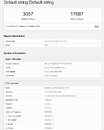
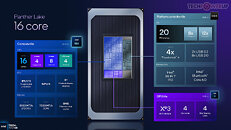
Looking at intriguing Geekbench 6.5 info, a 16-core CPU design—hosted on an "NM14PTL" board—scored (overall) 3057 points in single-core stakes, and 17687 points in multicore scenarios. These tallies seem to place the next-gen "flagship" above the "Arrow Lake-H" Core Ultra 9 285H APU, with an approximate 15 to 19% performance advantage over the "direct predecessor." The leaked Core Ultra X9 388H candidate seems to perform in the region of Team Blue's beefier "Arrow Lake-HX" Core Ultra 9 275HX model. Looking at current-gen competition, AMD's "Strix Halo" range topper—Ryzen AI Max+ 395—about matches the forthcoming "Panther Lake" flagship in terms of multicore, but Team Blue's futuristic design seems to win in the realm of single core performance. Additional "Core Ultra X9 388H" fundamentals include a measured 5.078 MHz maximum frequency, 4.0 GHz base frequency, and 18 MB of L3 cache. Cluster 1 consists of four cores, presumably "Cougar Cove" Power units. Cluster 2 sports twelve cores in total; official slides designate "Darkmont" architecture across eight E-cores and four LP-E cores.
Sources:
Geekbench Browser, CPU Monkey Tweet, Notebookcheck, Tom's Hardware, VideoCardz
Looking at intriguing Geekbench 6.5 info, a 16-core CPU design—hosted on an "NM14PTL" board—scored (overall) 3057 points in single-core stakes, and 17687 points in multicore scenarios. These tallies seem to place the next-gen "flagship" above the "Arrow Lake-H" Core Ultra 9 285H APU, with an approximate 15 to 19% performance advantage over the "direct predecessor." The leaked Core Ultra X9 388H candidate seems to perform in the region of Team Blue's beefier "Arrow Lake-HX" Core Ultra 9 275HX model. Looking at current-gen competition, AMD's "Strix Halo" range topper—Ryzen AI Max+ 395—about matches the forthcoming "Panther Lake" flagship in terms of multicore, but Team Blue's futuristic design seems to win in the realm of single core performance. Additional "Core Ultra X9 388H" fundamentals include a measured 5.078 MHz maximum frequency, 4.0 GHz base frequency, and 18 MB of L3 cache. Cluster 1 consists of four cores, presumably "Cougar Cove" Power units. Cluster 2 sports twelve cores in total; official slides designate "Darkmont" architecture across eight E-cores and four LP-E cores.


16 Comments on Upcoming Flagship "Panther Lake" APU Geekbenches Above AMD's Best Ryzen AI Mobile Chip
Reaching Strix Halo's multithreaded score with a monolithic 4P + 8E + 4 LPE solution is actually a big step up.
Also why does "memory channel" come anywhere near this equation wrt Geekbench?
Strix Halo has 256GB/s from the RAM whereas Panther Lake has 137GB/s.
255H:
285HX:
AMD's HX 370 has x16 PCI-E 4.0 lanes, but you would expect 4 of those dedicated for NVMe SSD usage:
9950HX is as expected, since its basically a power-limited desktop 9950X:
Something like how some AMD laptops still pairs HX 370 with a dGPU despite only having x8 lanes dedicated to it (with x4 for NVMe).
Truth be told, thin and light laptops wouldn't be able to pair with GPUs big/performant enough where 8x is a bottleneck, and desktop replacements use power-limited desktop CPUs anyways.It makes sense that Intel doesn't really want OEMs to pair their big iGPU SKUs with Nvidia dGPUs. Doing so would probably dilute their marketing efforts for propping up ARC iGPUs.
I also think the Steam Deck and Lunar Lake chips were great because they're the only small CPU big iGPU chips which is ideal for handhelds (from a cost-to-performance and size-to-performance perspective).
OEMs just can't help themselves putting a nvidia GPU everywhere. I think some OEMs even took the hilarious decision of pairing a Ryzen 7 8840U with a slower RTX 2050 dGPU.