Thursday, January 15th 2026

Core Ultra 9 290K Plus "ARL-S Refresh" CPU Geekbenched - Test Shows ~9% Uplift Over 285K

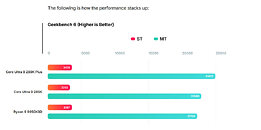
Recent Geekbench Browser database entries have outed test scores and basic specifications for two of Intel's upcoming "Arrow Lake Refresh" flagships. On January 13, a not-yet-launched Core Ultra 9 290HX Plus mobile unit was tracked in a new Acer Predator Helios gaming laptop. A few hours earlier, Team Blue's Core Ultra 9 290K Plus desktop chip entered the fray onboard a test rig built around Gigabyte's top-level and world record-holding Z890 AORUS TACHYON ICE mainboard configured with 48 GB DDR5-8000 of system memory. This leak shows the future 24-core "Arrow Lake Refresh" range topper posting overall scores of 3456 single-core and 24610 multicore points in Geekbench 6.5 test scenarios. Naturally, news reports have quickly compared the Core Ultra 9 290K Plus to a nearby non-refreshed "Arrow Lake" part—Core Ultra 9 285K.

The newcomer managed to build upon the current flagship's officially ranked achievements (based upon multiple entries); doing 7% better in single-core stakes, and 9% in multicore tests. When compared to AMD's fanciest "Granite Ridge" desktop offering—Ryzen 9 9950X3D—the Core Ultra 9 290K Plus is 2% faster in terms of single-core results, and 11% above in multicore. Interestingly, the lesser Core Ultra 9 270K Plus model was Geekbenched in December—producing 3235 (single-core) and 21368 (multicore) tallies. The flagship "Arrow Lake-S Refresh" SKU is about 7% and 15% faster (respectively) than its (also) 24-core sibling. According to Geekbench diagnostic data and other specification leaks, the two (8P + 16E) siblings feature minor differences in core clock speeds, so it is possible that Team Blue engineers have tuned the more expensive option to a greater degree. Golden Pig Upgrade has proposed a March/April launch window for the Core Ultra 200 Plus desktop family, consisting of the two aforementioned models and an 18-core (6P + 12E) Core Ultra 5 250K Plus SKU.

Sources: Geekbench Browser, VideoCardz, Guru3D, Wccftech (perf. comparison graphic)
Add your own comment

31 Comments on Core Ultra 9 290K Plus "ARL-S Refresh" CPU Geekbenched - Test Shows ~9% Uplift Over 285K

#1
HDBitdata
It is faster but damn is it underwhelming.
Posted on Reply
#2
Bobaganoosh
HDBitdataIt is faster but damn is it underwhelming.
Did you think the refresh was going to be a massive improvement?
Posted on Reply
#3
RejZoR
It's so weird they are just now releasing this. When was 285K even released? Feels like years ago at this point and it was trailing behind AMD's poundemonium the entire time. They should have released 290K like half a year ago if not even earlier and even then it would still be somewhat underwhelming. At the moment, you wonder why is this even getting released when we should be seeing 385K release instead...
Posted on Reply
#4
igor_kavinski
Intel doesn't care about the consumer market anymore. That is the only explanation of their behavior since Alder Lake. Going hybrid cores with the slower ones offering Skylake performance? Stupid. Fixed that with Skymonts offering close to Raptor Lake performance but then putting them in a tile based design with high RAM latency? WTF??? It's like some crackpot doing experiments in his basement trying to make the perfect crack and not worried about sales because his buyers are so addicted that they will buy ANYTHING. Except AMD sales went through the roof and Intel, with the launch of Arrow Lake Refresh, still fails to get the memo.
Posted on Reply
#5
XeonsNOpterons
Cool stuff, a relatively minor upgrade for the Core Ultra 9 class, but the Core Ultra 7 should be more interesting. Kind of unfortunate about the launch date, a little late. That was the most frustrating thing about CES this year I think: we knew a ton of stuff was pretty much supposed to launch (Arrow Lake-Refresh, Zen 5 Refresh, B770, Granite Rapids-WS) and yet not even a hint was given about them.
RejZoRIt's so weird they are just now releasing this. When was 285K even released? Feels like years ago at this point and it was trailing behind AMD's poundemonium the entire time. They should have released 290K like half a year ago if not even earlier and even then it would still be somewhat underwhelming. At the moment, you wonder why is this even getting released when we should be seeing 385K release instead...
I am sorry, but this myth that Intel is miles behind AMD needs to stop. Intel loses in games, sure, but most people do not care about getting more FPS beyond 60-100 anyways. Intel wins in productivity and compute for Arrow Lake, really showing how powerful even their E-cores have gotten. But again, most people do not care about rendering a video super fast or simulating super fast either. Intel and AMD are in a heated race, but nearly level standing. Seriously, some people forget what actually being a mile behind the competition means: cough cough... AMD Bulldozer refreshes for like 6 years against Intel before Zen.
igor_kavinskiIntel doesn't care about the consumer market anymore. That is the only explanation of their behavior since Alder Lake. Going hybrid cores with the slower ones offering Skylake performance? Stupid. Fixed that with Skymonts offering close to Raptor Lake performance but then putting them in a tile based design with high RAM latency? WTF??? It's like some crackpot doing experiments in his basement trying to make the perfect crack and not worried about sales because his buyers are so addicted that they will buy ANYTHING. Except AMD sales went through the roof and Intel, with the launch of Arrow Lake Refresh, still fails to get the memo.
Alright, maybe think a bit before commenting. Intel has had scummy practices in the past, but their E-cores are not something they did just to "stiff consumers". Intel CPUs have much lower idle power than AMD because of those E-cores. And by my estimations for FP32 performance in benchmarks, the E-cores in Arrow Lake are around 80% as good as Zen 5 cores in IPC. Raptor Lake's ones were more weak. Nova Lake will bring that gap in IPC between P-cores and E-cores even further, likely in planning for reunification in Hammer Lake or whatever the next architecture is. Here is a secret why Intel is not panicking about AMD: They are just objectively delivering products which are very equal to AMD, this is nothing like the disaster of AMD's Bulldozer era. Could Intel do better, absolutely, but they are not in a terrible position
Posted on Reply
#6
igor_kavinski
XeonsNOpteronsThey are just objectively delivering products which are very equal to AMD, this is nothing like the disaster of AMD's Bulldozer era. Could Intel do better, absolutely, but they are not in a terrible position
Not according to Amazon best seller list: www.amazon.com/Best-Sellers-Computer-CPU-Processors/zgbs/pc/229189

Maybe I'm blind but I see Arrow Lake beyond No. 30? That's not terrible?

I'm just sorely disappointed because Intel lagging in their game is bad for competition and progress. If they up their game, so does AMD and we get faster, better CPUs at a much quicker pace. Intel's decisions seem to be boneheaded executive decisions rather than engineering decisions. No one asked for the dumb E-core. Why can't they offer products with only P-cores? It's the same type of mad, stubborn behavior that got them shipping Pentium 4 for years.
Posted on Reply
#7
XeonsNOpterons
igor_kavinskiNot according to Amazon best seller list: www.amazon.com/Best-Sellers-Computer-CPU-Processors/zgbs/pc/229189

Maybe I'm blind but I see Arrow Lake beyond No. 30? That's not terrible?

I'm just sorely disappointed because Intel lagging in their game is bad for competition and progress. If they up their game, so does AMD and we get faster, better CPUs at a much quicker pace. Intel's decisions seem to be boneheaded executive decisions rather than engineering decisions. No one asked for the dumb E-core. Why can't they offer products with only P-cores? It's the same type of mad, stubborn behavior that got them shipping Pentium 4 for years.
I can understand your disappointment, but it is not entirely founded. The E-cores are not entirely dumb as I already explained. I do agree they should offer mainstream P-core only chips, though you can purchase Sapphire Rapids-WS or upcoming Granite Rapids-WS which are all P-cores. Planning on potentially upgrading from my trusty but old Haswell system to Granite Rapids-WS. Not to say it is cheap, AMD has gone insane with $13000 9995WX, partially due to lack of competition from Intal in HEDT. HEDT should not cost more than $3000 for the top chip.
Posted on Reply
#8
AnotherReader
XeonsNOpteronsCool stuff, a relatively minor upgrade for the Core Ultra 9 class, but the Core Ultra 7 should be more interesting. Kind of unfortunate about the launch date, a little late. That was the most frustrating thing about CES this year I think: we knew a ton of stuff was pretty much supposed to launch (Arrow Lake-Refresh, Zen 5 Refresh, B770, Granite Rapids-WS) and yet not even a hint was given about them.


I am sorry, but this myth that Intel is miles behind AMD needs to stop. Intel loses in games, sure, but most people do not care about getting more FPS beyond 60-100 anyways. Intel wins in productivity and compute for Arrow Lake, really showing how powerful even their E-cores have gotten. But again, most people do not care about rendering a video super fast or simulating super fast either. Intel and AMD are in a heated race, but nearly level standing. Seriously, some people forget what actually being a mile behind the competition means: cough cough... AMD Bulldozer refreshes for like 6 years against Intel before Zen.


Alright, maybe think a bit before commenting. Intel has had scummy practices in the past, but their E-cores are not something they did just to "stiff consumers". Intel CPUs have much lower idle power than AMD because of those E-cores. And by my estimations for FP32 performance in benchmarks, the E-cores in Arrow Lake are around 80% as good as Zen 5 cores in IPC. Raptor Lake's ones were more weak. Nova Lake will bring that gap in IPC between P-cores and E-cores even further, likely in planning for reunification in Hammer Lake or whatever the next architecture is. Here is a secret why Intel is not panicking about AMD: They are just objectively delivering products which are very equal to AMD, this is nothing like the disaster of AMD's Bulldozer era. Could Intel do better, absolutely, but they are not in a terrible position
At least for the respective flagships, TPU found Zen 5 to be slightly better at productivity than Arrow Lake.
Posted on Reply
#9
XeonsNOpterons
AnotherReaderAt least for the respective flagships, TPU found Zen 5 to be slightly better at productivity than Arrow Lake.
Ah, ok, I guess I mean different stuff for productivity lol. I run a ton of CFD and simulations (non-AI), so I do not really consider video render times or how fast Office loads XD. That is my mistake in my terminology, I am sorry. You are right in those tasks, Intel loses overall, though just my opinion, not really anything important to encode an MP3 3 seconds faster when both chips take around 60 seconds anyways.

In raw floating point for compute tasks, 285K has 225000 versus only 165000 for the 9950X through PassMark's suite of tests. Whatever the issue with some productivity tasks are, it is not the cores as they have a ton of power, Intel probably just failed to have these tasks properly optimized. I have Intel's Arrow Lake P-cores have around ~2330 FP/Ghz/core IPC and AMD's Zen 5 cores at ~1820 FP/GHz/core IPC based on PassMark. For reference, Skylake was around 1145 FP/GHz/core.
Posted on Reply
#10
AnotherReader
XeonsNOpteronsAh, ok, I guess I mean different stuff for productivity lol. I run a ton of CFD and simulations (non-AI), so I do not really consider video render times or how fast Office loads XD. That is my mistake in my terminology, I am sorry. You are right in those tasks, Intel loses overall, though just my opinion, not really anything important to encode an MP3 3 seconds faster when both chips take around 60 seconds anyways.

In raw floating point for compute tasks, 285K has 225000 versus only 165000 for the 9950X through PassMark's suite of tests. Whatever the issue with some productivity tasks are, it is not the cores as they have a ton of power, Intel probably just failed to have these tasks properly optimized. I have Intel's Arrow Lake P-cores have around ~2330 FP/Ghz/core IPC and AMD's Zen 5 cores at ~1820 FP/GHz/core IPC based on PassMark. For reference, Skylake was around 1145 FP/GHz/core.
You should at least look at the benchmarks in the review. Even applications that stress wide vectors like Blender see Zen 5 match or surpass Arrow Lake. With that being said, there were tests where Arrow Lake was significantly better, e.g. NAMD. Speaking of CFD, in one test of OpenFOAM, the 285K was faster than the 9950X but slower than the 9950X3D.

Posted on Reply
#11
Sol_Badguy
igor_kavinskiWhy can't they offer products with only P-cores?
You can't fit that many P-Cores on the compute tile (pretty much 12 for slightly smaller tile or 14 for slightly longer tile). Meaning the total number of cores would be relatively small and thus be at a disadvantage compared to some AMD CPUs in MT workloads.

But then someone would say "oh but these CPUs wouldn't be targeted at the MT productivity crowd they would be targeted at something that scales past 8 P-Cores but isn't Blender, NAMD or whatever". Okay then what would that workload be, gaming??? I suppose some games would benefit from extra P-Cores but what % are those from the totality of games?

Also there is the power draw issue, such a CPU would suck on those EPS connectors like crazy in full load.

Comparing such a CPU with 12P or 14P vs 8P+16E for roughly similarly sized compute tiles, both 12P and 14P would draw more power in full load but lose in MT. They would fare better in gaming, sometimes due to the extra P-Cores and sometimes due to not having scheduling issues.

Then there is the cost issue, would such a CPU be cheaper to make? Correlating cost with performance and the result is not great. There has to be a balance, everything is a compromise, even if that sounds negative it's pretty much what a balanced product is, a sum of reasonable compromises, whenever there is a clear handicap then that product isn't balanced.

If we're talking just 8P for gaming, the problem is that it still wouldn't perform great, sure there won't be scheduling issues but the inter-tile latency would still be there and extra L3 cache wouldn't help, maybe a bit but it won't solve the issue like super speed RAM which was expensive before the fake crisis.

So, despite the lackluster performance in gaming, Intel isn't that stupid, sure Arrow Lake should've stayed in the oven for a couple more months, but realistically that wouldn't have changed the outcome, meaning AMD would've still dominated in gaming as such the reception of Arrow Lake might have been warmer but gamers would have still bought AMD.
Posted on Reply
#12
XeonsNOpterons
AnotherReaderYou should at least look at the benchmarks in the review. Even applications that stress wide vectors like Blender see Zen 5 match or surpass Arrow Lake. With that being said, there were tests where Arrow Lake was significantly better, e.g. NAMD. Speaking of CFD, in one test of OpenFOAM, the 285K was faster than the 9950X but slower than the 9950X3D.

Is that OpenBenchmark? If so, I know of the 285K vs 9950X performance there, though to be honest I wish there was a little more system information to get a better comparison of performance. PassMark takes the average performance, which is pretty much the stock performance. Who knows if the 285K was overclocked or the 9950X was overclocked in these OpenFOAM tests. I mostly use the OpenFOAM CFD benchmarks there to compare the heavy weights like Granite Rapids-SP/AP and Turin as those cannot be overclocked. Interestingly enough, OpenFOAM seems to get a decent boost from cache where the essentially X3D quad 96-core Zen 4 EPYC configuration beats everything on the current charts.
Sol_BadguyYou can't fit that many P-Cores on the compute tile (pretty much 12 for slightly smaller tile or 14 for slightly longer tile). Meaning the total number of cores would be relatively small and thus be at a disadvantage compared to some AMD CPUs in MT workloads.

But then someone would say "oh but these CPUs wouldn't be targeted at the MT productivity crowd they would be targeted at something that scales past 8 P-Cores but isn't Blender, NAMD or whatever". Okay then what would that workload be, gaming??? I suppose some games would benefit from extra P-Cores but what % are those from the totality of games?

Also there is the power draw issue, such a CPU would suck on those EPS connectors like crazy in full load.

Comparing such a CPU with 12P or 14P vs 8P+16E for roughly similarly sized compute tiles, both 12P and 14P would draw more power in full load but lose in MT. They would fare better in gaming, sometimes due to the extra P-Cores and sometimes due to not having scheduling issues.

Then there is the cost issue, would such a CPU be cheaper to make? Correlating cost with performance and the result is not great. There has to be a balance, everything is a compromise, even if that sounds negative it's pretty much what a balanced product is, a sum of reasonable compromises, whenever there is a clear handicap then that product isn't balanced.

If we're talking just 8P for gaming, the problem is that it still wouldn't perform great, sure there won't be scheduling issues but the inter-tile latency would still be there and extra L3 cache wouldn't help, maybe a bit but it won't solve the issue like super speed RAM which was expensive before the fake crisis.

So, despite the lackluster performance in gaming, Intel isn't that stupid, sure Arrow Lake should've stayed in the oven for a couple more months, but realistically that wouldn't have changed the outcome, meaning AMD would've still dominated in gaming as such the reception of Arrow Lake might have been warmer but gamers would have still bought AMD.
You are right about the power consumption on Intel P-cores, though Arrow Lake did improve that. Not going to lie, I have a feeling AMD's power figures are... manipulated at least a little like what Volkswagen did. When you consider the 96-core 9995WX cosumes only 75% more power than the 9950X despite having literally 6x (600%) the cores... yeah, the math does not make sense.
Posted on Reply
#14
kondamin
I wonder if it’s timings or if TSMC has improved n3b in a way that allows for longer boost clock.
Anyhow, it’s a skip able generation
Posted on Reply
#15
thestryker6
Sol_BadguySo, despite the lackluster performance in gaming, Intel isn't that stupid, sure Arrow Lake should've stayed in the oven for a couple more months, but realistically that wouldn't have changed the outcome, meaning AMD would've still dominated in gaming as such the reception of Arrow Lake might have been warmer but gamers would have still bought AMD.
I'm not sure it would have made any real difference aside from maybe being able to get some of the anti-cheat type stuff taken care of. Most of what Intel did applied to OEM type configurations as most DIY boards weren't problematic. If I had to hazard a guess I'd say the latency issues probably have more to do with switching to N3B from 20A.
Posted on Reply
#16
igor_kavinski
thestryker6If I had to hazard a guess I'd say the latency issues probably have more to do with switching to N3B from 20A.
Chips and Cheese say it has to do with bad L3 latency. They had Adamantine cache for 10% perf improvement according to an anonymous Intel engineer on the podcast of Moore's Law is Dead. Pat Gelsinger made the decision that it wasn't worth having that L4 cache. Arrow Lake could've had 10% better performance in latency sensitive applications. Seriously, that guy was Kryptonite for Intel. I have more to say here: forums.thefpsreview.com/threads/this-is-how-badly-intel-screwed-itself-over.19113/
XeonsNOpteronsPlanning on potentially upgrading from my trusty but old Haswell system to Granite Rapids-WS.
It's usually much cheaper to upgrade to ES Epyc chips. While people were overclocking the crap out of their systems trying to break Cinebench R23 scores with their Raptor Lakes and Ryzens, I had a $1500 128 thread Zen 2 ES Epyc Rome (CPU+mobo+128GB RAM. Yes, that cheap!) that could easily beat them at stock.
Posted on Reply
#17
sLowEnd
XeonsNOpteronsAlright, maybe think a bit before commenting. Intel has had scummy practices in the past, but their E-cores are not something they did just to "stiff consumers". Intel CPUs have much lower idle power than AMD because of those E-cores. And by my estimations for FP32 performance in benchmarks, the E-cores in Arrow Lake are around 80% as good as Zen 5 cores in IPC. Raptor Lake's ones were more weak. Nova Lake will bring that gap in IPC between P-cores and E-cores even further, likely in planning for reunification in Hammer Lake or whatever the next architecture is. Here is a secret why Intel is not panicking about AMD: They are just objectively delivering products which are very equal to AMD, this is nothing like the disaster of AMD's Bulldozer era. Could Intel do better, absolutely, but they are not in a terrible position
The lower idle power consumption is not because of E-Cores. It's because AMD's I/O chiplet draws power. AMD's monolithic desktop chips (e.g. the APUs) don't exhibit higher idle power draw than Intel's desktop chips
Posted on Reply
#18
Sol_Badguy
thestryker6I'm not sure it would have made any real difference aside from maybe being able to get some of the anti-cheat type stuff taken care of. Most of what Intel did applied to OEM type configurations as most DIY boards weren't problematic. If I had to hazard a guess I'd say the latency issues probably have more to do with switching to N3B from 20A.
Yeah I was mainly referring to the microcode update in Dec. '24 and the 200S Boost profile which could've both been included at launch, the "postponed" launch.
That way they could've released a better polished product that would've still had the lackluster performance in gaming but they would've owned it at least, and that pretty much would've been the only problem with the gamer demographic, in other scenarios Arrow Lake would've been considered a worthy alternative.
Nowadays it is considered as a worthy non-gaming alternative by more informed consumers, but they are a minority. The disappointing launch has tainted the perception for many people and it took big discounts (for mobos as well) to change some of that perception.
Intel could've played the same cards a little better.
Posted on Reply
#20
patriotpa
NICE! With all the CPU lanes of Arrow Lake, the improved IMC and higher clocks will make this thing SING in a properly configured system.
Posted on Reply
#21
AnotherReader
XeonsNOpteronsIs that OpenBenchmark? If so, I know of the 285K vs 9950X performance there, though to be honest I wish there was a little more system information to get a better comparison of performance. PassMark takes the average performance, which is pretty much the stock performance. Who knows if the 285K was overclocked or the 9950X was overclocked in these OpenFOAM tests. I mostly use the OpenFOAM CFD benchmarks there to compare the heavy weights like Granite Rapids-SP/AP and Turin as those cannot be overclocked. Interestingly enough, OpenFOAM seems to get a decent boost from cache where the essentially X3D quad 96-core Zen 4 EPYC configuration beats everything on the current charts.


You are right about the power consumption on Intel P-cores, though Arrow Lake did improve that. Not going to lie, I have a feeling AMD's power figures are... manipulated at least a little like what Volkswagen did. When you consider the 96-core 9995WX cosumes only 75% more power than the 9950X despite having literally 6x (600%) the cores... yeah, the math does not make sense.
It's OpenBenchmark, but it's from the Phoronix review of the 9950X3D. Unfortunately the system configurations aren't listed in that review, but Michael typically uses CPUs at stock. In his rebench of the 285k last November, he used DDR5 6400 with timings of 32-40-40-84. Earlier, for the 9950X, he used DDR5 6000 without specifying the timings.

As for the 9995WX, I doubt that they are up to any shenanigans; it has low clocks compared to the 9950X. When its clocks approach that of the latter, it consumes a lot of power.
Posted on Reply
#22
XeonsNOpterons
igor_kavinskiIt's usually much cheaper to upgrade to ES Epyc chips. While people were overclocking the crap out of their systems trying to break Cinebench R23 scores with their Raptor Lakes and Ryzens, I had a $1500 128 thread Zen 2 ES Epyc Rome (CPU+mobo+128GB RAM. Yes, that cheap!) that could easily beat them at stock.
Much cheaper, I agree, but so would QS Sapphire/Emerald Rapids dual socket in comparison to new systems lol. I also just want a new system like Granite Rapids-WS, and for it to be overclockable and therefore allow higher per core performance. Some tasks like meshing for CFD for me right now seems to be much more lightly threaded and therefore like single core performance. While the actual computation of each time step is heavily multithreaded.
AnotherReaderAs for the 9995WX, I doubt that they are up to any shenanigans; it has low clocks compared to the 9950X. When its clocks approach that of the latter, it consumes a lot of power.
I think it is very odd, if I ever have the budget to test those monster chips when they get cheaper in the future, I really want to test it. Cutting clocks can only cut power so much, and by my estimates based on its FP performance, it still is running at 3.5-3.8GHz on all core workloads. Even cutting the power in half due to lower clocks still puts you at 600W. Would like people to test the 24 pin connectors as that is where Intel tried to hide some of their power draw with Arrow Lake.
Posted on Reply
#23
AnotherReader
XeonsNOpteronsMuch cheaper, I agree, but so would QS Sapphire/Emerald Rapids dual socket in comparison to new systems lol. I also just want a new system like Granite Rapids-WS, and for it to be overclockable and therefore allow higher per core performance. Some tasks like meshing for CFD for me right now seems to be much more lightly threaded and therefore like single core performance. While the actual computation of each time step is heavily multithreaded.


I think it is very odd, if I ever have the budget to test those monster chips when they get cheaper in the future, I really want to test it. Cutting clocks can only cut power so much, and by my estimates based on its FP performance, it still is running at 3.5-3.8GHz on all core workloads. Even cutting the power in half due to lower clocks still puts you at 600W. Would like people to test the 24 pin connectors as that is where Intel tried to hide some of their power draw with Arrow Lake.
Dynamic power scales with the square of the voltage, and frequency scales linearly with voltage so 3.5 Ghz would have about one third the dynamic power of 5 GHz. I don't find it surprising that a low clocked Threadripper consumes 350W.
Posted on Reply
#24
igor_kavinski
XeonsNOpteronsI also just want a new system like Granite Rapids-WS, and for it to be overclockable and therefore allow higher per core performance.
Workstation chips, whether Intel or AMD, consume wayyy too much power if they are overclocked. Mobos for W-3175X even had the option to use dual PSUs because when overclocked, that chip can easily hit almost 900W at 5 GHz.

Posted on Reply
#25
AntiX3DGlazer
RejZoRIt's so weird they are just now releasing this. When was 285K even released? Feels like years ago at this point and it was trailing behind AMD's poundemonium the entire time. They should have released 290K like half a year ago if not even earlier and even then it would still be somewhat underwhelming. At the moment, you wonder why is this even getting released when we should be seeing 385K release instead...
Why did they release Rocket Lake? Better to sell something than nothing.
thestryker6I'm not sure it would have made any real difference aside from maybe being able to get some of the anti-cheat type stuff taken care of. Most of what Intel did applied to OEM type configurations as most DIY boards weren't problematic. If I had to hazard a guess I'd say the latency issues probably have more to do with switching to N3B from 20A.
The latency issues have nothing to do with the node and everything to do with the memory subsystem. I'm not really sure where you got the idea that 20A (a mildly competitive node vs. N3) has anything to do with the memory subsystem's issues.
Posted on Reply
Add your own comment
Nov 17th, 2026 16:18 CST change timezone

New Forum Posts

Popular Reviews

TPU on YouTube

Controversial News Posts