Wednesday, February 11th 2026
Memory Price Surge Intensifies Retail Pricing Pressure, Putting Global Smartphone Production at Risk of a Sharp Decline in 2026
TrendForce's latest smartphone industry research predicts that soaring memory prices are set to weigh heavily on global smartphone production in 2026. Total output is forecast to decline 10% YoY to approximately 1.135 billion units. With memory prices showing no clear signs of easing, the growing gap between higher retail prices and consumer price tolerance is expected to further dampen end demand.
Under a bear-case scenario, TrendForce warns that the annual contraction in global smartphone production could widen to 15% or more. The extent of the impact, however, will vary by brand, depending on differences in product mix and regional exposure.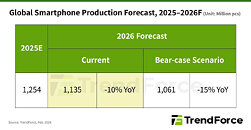 Taking a mainstream 8 GB + 256 GB memory configuration as an example, estimated contract prices in 1Q26 have surged nearly 200% YoY—roughly tripling from the same period last year. Memory, which historically accounted for around 10-15% of a smartphone's BOM, has now surged to 30-40%. TrendForce believes that raising end-product prices will become unavoidable for many brands seeking to protect margins, while product portfolios and specifications will also need to be adjusted to manage persistently elevated memory costs.
Assuming a 15% production decline under the bear-case scenario, TrendForce analyzed 2026 production trends among the world's top eight smartphone brands. Samsung, the global market leader and a major memory supplier, benefits from vertical integration and is therefore expected to see a smaller production decline than Chinese brands. However, overall volumes will still soften amid weaker market conditions.
Apple, which shares the top market position, is comparatively better positioned to absorb higher memory costs due to its higher proportion of premium models. Its customer base also shows greater tolerance for price increases, providing partial support for production stability.
In contrast, Xiaomi and Transsion, which rely heavily on entry-level models, are more vulnerable to cost volatility. Their price-sensitive target markets leave limited room to pass through higher costs, making them more likely to see significant downward revisions to production in 2026 if memory prices remain elevated.
Brands with a strong focus on the Chinese market, such as vivo, OPPO, Xiaomi, and Honor, are facing intensifying competition from Huawei, in addition to rising memory costs. Huawei is prioritizing the expansion of its HarmonyOS ecosystem and maintains relatively flexible pricing strategies. Combined with its unique market position and strong brand loyalty in China, Huawei is expected to exert substantial pressure on the market share and production volumes of other domestic brands.
Based on current projections, TrendForce believes Huawei is likely to experience the smallest production adjustment under the bear-case scenario, and could even post growth against the broader market trend.
TrendForce concludes that while the current downturn is being triggered by rising memory prices, deeper structural factors are also at play. Today's smartphones already offer functionality sufficient to meet most consumers' daily needs, meaning replacement cycles are lengthening and incentives to upgrade are weakening. Even if memory prices stabilize in the future, this structural shift in demand is unlikely to reverse in the near term.
Source:
TrendForce
Under a bear-case scenario, TrendForce warns that the annual contraction in global smartphone production could widen to 15% or more. The extent of the impact, however, will vary by brand, depending on differences in product mix and regional exposure.

Assuming a 15% production decline under the bear-case scenario, TrendForce analyzed 2026 production trends among the world's top eight smartphone brands. Samsung, the global market leader and a major memory supplier, benefits from vertical integration and is therefore expected to see a smaller production decline than Chinese brands. However, overall volumes will still soften amid weaker market conditions.
Apple, which shares the top market position, is comparatively better positioned to absorb higher memory costs due to its higher proportion of premium models. Its customer base also shows greater tolerance for price increases, providing partial support for production stability.
In contrast, Xiaomi and Transsion, which rely heavily on entry-level models, are more vulnerable to cost volatility. Their price-sensitive target markets leave limited room to pass through higher costs, making them more likely to see significant downward revisions to production in 2026 if memory prices remain elevated.
Brands with a strong focus on the Chinese market, such as vivo, OPPO, Xiaomi, and Honor, are facing intensifying competition from Huawei, in addition to rising memory costs. Huawei is prioritizing the expansion of its HarmonyOS ecosystem and maintains relatively flexible pricing strategies. Combined with its unique market position and strong brand loyalty in China, Huawei is expected to exert substantial pressure on the market share and production volumes of other domestic brands.
Based on current projections, TrendForce believes Huawei is likely to experience the smallest production adjustment under the bear-case scenario, and could even post growth against the broader market trend.
TrendForce concludes that while the current downturn is being triggered by rising memory prices, deeper structural factors are also at play. Today's smartphones already offer functionality sufficient to meet most consumers' daily needs, meaning replacement cycles are lengthening and incentives to upgrade are weakening. Even if memory prices stabilize in the future, this structural shift in demand is unlikely to reverse in the near term.
28 Comments on Memory Price Surge Intensifies Retail Pricing Pressure, Putting Global Smartphone Production at Risk of a Sharp Decline in 2026
Well done AI, you haven't reached singularity yet and still mange to f*** everything up.
Meanwhile, all that spending is pushing the price of anything they're using in to the stratosphere, so anyone who wants or needs anything containing RAM, Storage, a new GPU and probably other things, will have to pay hundreds of percent more.
I don't see how this can't end very, very badly.
Although it's a lot more difficult to do anything without a smartphone nowadays, the good thing is this will get people to replace their phone less often.
and I hope that He won't change phone in near future :P
Cause for now s23 ultra is to much for Me, and He has Vivo x200 ultra :D
AI ruins everything? Yep
Dont fall too far from your high horse there bud.
It's always amusing when the tech experts give such inane advice, especially on the forum known for people fighting the good fight and sticking it to the man. Paying through the nose for the latest smartphone models that offer zero advantage to normal users is peak irony, well done buddy.
How this hugely unbalanced situation is good?
The point was that it's not entirely bad that we might end up with fewer "smart" products that no-one really ever asked for in the first place.
Honestly, the fewer "smart" devices there are, the better.
Ah yes, my toaster needs to run an ML model to determine how long to reach a specific doneness, rather than just using a good old-fashioned thermocouple and capacitor.
Every smart TV OS is a compromise in a way, ads everywhere in the OS, or a laggy mess, I find it ridiculous to buy a high end TV and still need an HDMI stick to get any "smart" functionality out of it.
Samsung provides support for 7 years, Google Pixels have 7 years as well, device support on Android has gotten much better, with the exception of lower end devices which is all over with anything ranging from 2 years to 3 or 4 years, it would be nice if Google mandated every Android phone or tablet gets 7 years of OS updates.
TV's would be so much better with a full Android OS than everyone using their own operating system, I would much prefer a standardized UI as well.Yes because most people will run to the phone store to buy the latest model when the screen cracks, or the battery stops holding a charge, or worse starts to degrade and expand out of the phone casing. The average user isn't going to wait days without their phone while it's out for repair. And current gen models at reasonable prices won't be around for the next few years or however long until the AI bubble causing this massive mess pops. The used market will probably respond to new phones being more expensive also.Not just environmental waste, but simply not needing it in the first place.
I don't need my washing machine or dryer to send me a text when it's done.
Our toaster must connect to our servers to compute toasting times for different types of bread. But this AI model costs us a shit ton of money to run, so you'll pay us $15/mo.
If you don't pay the subscription, our toaster won't be able to get the required information and will always burn your bread.
The wife bought a new vacuum cleaner a few years ago, it has built in Wi-Fi and has an app, we've never used either and it works just fine. Those features just added cost for no reason.You're aware that product already exists, right?
revcook.com/?srsltid=AfmBOorRpWwLCgTAXzXHcJmY1qrRAAykbYXgqmPPkXeupaiNd5VcBpO2
It's a really good vacuum though.
The bubble needs to pop and the technological nuclear winter needs to start so we can go back to these things.
Sunbeam Radiant Control Toaster
No AI nonsense, no electronics, just clever mechanical engineering and exploitation of the laws of thermodynamics to create perfect toast every time.
But alas, I'm getting off topic. Sorry guys.
I'm punching myself for not upgrading to 128GB of memory when it was $200.