Wednesday, February 11th 2026

Intel "Nova Lake" Compute Tile Die-sizes Surface

Intel is preparing to launch its next generation Core Ultra Series 4 "Nova Lake" processors in the second half of 2026. We have some hint on what the sizes of the Compute tiles of these chips could measure. "Nova Lake" remains a tile-based disaggregated chip, just like the current "Arrow Lake," with the most advanced foundry node being allocated only to the components that can benefit the most from it, the CPU cores. The CPU complex of the processor is located in the Compute tile, while low-power island E-cores are located on the SoC tile that's built on a slightly older foundry node.

Intel is building the Compute tile of "Nova Lake" on the TSMC N2 (2 nm nanosheet) foundry node. There will be different types of Compute tiles based on the CPU core count and cache sizes. The two most popular ones for the desktop platform will be the mainstream tile with 8P+16E core configuration and a standard L3 cache size shared among the eight P-cores and four E-core clusters. The second, more premium Compute tile type will be 8P+16E with bLLC, or big last-level cache. bLLC is an enlarged L3 cache that's estimated to be 3-4 times the size of the regular L3 cache. This is Intel's answer to AMD's 3D V-Cache. Estimates put the regular Compute tile to measure around 110 mm², while the premium variant with bLLC is estimated to measure over 150 mm². This 36% increase in die-area is entirely from the enlarged last-level cache.
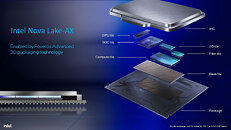
This isn't the entirety of the "Nova Lake" chip, there will be other components, such as the SoC tile that contains the low-power island E-cores, the DDR5 memory controllers, the 74 TOPS NPU, and the PCI-Express Gen 5 root complex, besides the System Agent, Management Engine, and security processor. Besides the SoC tile, are the Graphics tile, which is likely to be built on a more advanced node than the SoC, but less advanced than the Compute tile. Intel has plenty of options for the Graphics tile, including its own Intel 4 foundry node.
Source: HXL (Twitter)
Add your own comment

55 Comments on Intel "Nova Lake" Compute Tile Die-sizes Surface

#26
Hecate91
Zen 6 is a drop in upgrade, and if the rumors are true a Zen 6 CCD will be 76mm²,only 5mm² larger than Zen 5 71mm².
Nova Lake won't have a price advantage because of a new socket, and I expect Intel will price a 52 core CPU towards the very high end market.
Posted on Reply
#27
N/A
igormpSo the bLLC is actually part of the compute tile, instead of being another tile or stacked in some way?
That's disappointing in a way. This variant should be really expensive considering that SRAM scales awfully with node size and represents a lot of die area in such cases.
Considering that N3 3MB takes up 1.5mm². Therefore, 108MB takes up 54 m². So the cache can still be shrunk to N2.

oh my bad edited 3 MB instead of 1.5.
Posted on Reply
#28
AntiX3DGlazer
LastDudeALiveRight now the 245K and 265K are $100 cheaper than the Zen 5 CPUs they match in productivity (9700X and 9900X, respectively).
They have -500% market share due to the lack of generational improvement in gaming and negative coverage in the DIY space lol. Not saying I agree or support the hate but it's still something that must be considered.
Posted on Reply
#29
LastDudeALive
AntiX3DGlazerThey have -500% market share due to the lack of generational improvement in gaming and negative coverage in the DIY space lol. Not saying I agree or support the hate but it's still something that must be considered.
I don't think there's any reliable source that's able to provide even approximate comparisons on how Zen 5 and Arrow Lake have sold across all markets (and no, Mindfactory.de does not count lmao). DIY is by far the smallest part of the market, there's also prebuilts, laptops, and of course the enterprise market dwarfs all of those. Zen 5 isn't universally beloved either, it had a rough launch with high prices and almost no improvement over Zen 4 (because AMD nerfed power consumption to boost efficiency), and also had some software-related teething issues.
Posted on Reply
#30
igormp
N/AIt is impossible for 108MB to fit into 40mm² if you consider that N3 1.5 MB takes up 1.5mm². therefore 144 MB takes up to 150 m².
I saw something about N2 being way more efficient for SRAM scaling, but can't exactly pinpoint the source now. (I wrote this in response to your original comment)
N/AConsidering that N3 3MB takes up 1.5mm². Therefore, 108MB takes up 54 m². So the cache can still be shrunk to N2.

oh my bad edited 3 MB instead of 1.5.
But still, seems like a pretty inefficient use of die size and a modern node to spend such amount in SRAM, instead of a different tile/chiplet on an older node.
Posted on Reply
#31
Sol_Badguy
The two most popular ones for the desktop platform will be the mainstream tile with 8P+16E core configuration and a standard L3 cache size shared among the eight P-cores and four E-core clusters. [...] Estimates put the regular Compute tile to measure around 110 mm², while the premium variant with bLLC is estimated to measure over 150 mm².
Hmm that's almost the same size as Arrow Lake's compute tile.
www.techpowerup.com/336412/inside-arrow-lake-intels-die-exposed-and-annotated
The L3 cache has doubled that's true but given the smaller node I would've expected a larger difference.
TomorrowGaming - unlikely considering the kind of deficit they'll have to claw back to first match Zen 5 X3D and then Zen 6 and then Zen 6 X3D on top of that.
I doubt Zen6 vanilla matches let alone beats Zen5 X3D in gaming.
Right Arrow Lake is close to Zen5 vanilla in gaming, that means Nova Lake vanilla can be pretty close to Zen6 vanilla, it's not unrealistic.
If the bLLC Nova Lake can be just as close to Zen6 X3D remains to be seen but at worst I'd say it will match Zen5 X3D.
LastDudeALiveThe 285K essentially matches the 9950X in the entire application test suite. Doing so with 8 less threads (and no AVX-512) shows that e-cores are a much better way to get multi-threading power. If an 8P+16e CPU is matching a 16C/32t CPU, a 16P+36e processor will absolutely wipe the floor with a 24C/48t CPU (unless Zen 6 brings a miraculous IPC improvement).
Yes but that is with pretty much equal frequency. If Zen6 has significantly higher frequency that can offset quite a bit of the thread advantage.
Hecate91Zen 6 is a drop in upgrade
Yes, for the Zen5 crowd.
What about the people on LGA1700, LGA1851, AM4 or older platforms?
If they want to upgrade whichever side they choose they have to buy the full platform. True that some of those on LGA1700 and those on LGA1851 can reuse their DDR5 RAM.
It will be a battle to win these people over so both CPU makers have to work hard for it.
Posted on Reply
#32
Hecate91
Sol_BadguyYes, for the Zen5 crowd.
What about the people on LGA1700, LGA1851, AM4 or older platforms?
If they want to upgrade whichever side they choose they have to buy the full platform. True that some of those on LGA1700 and those on LGA1851 can reuse their DDR5 RAM.
It will be a battle to win these people over so both CPU makers have to work hard for it.
I think Zen 4 owners will be more excited than anyone with Zen 5, because of Zen 5 not being much of an upgrade from Zen 4 in most use cases.
LGA1700, or AM4 I can see, but anyone with LGA1851 I wouldn't recommend unless Nova Lake will be a significant upgrade.
Building a PC isn't very enjoyable unless an upgrade is needed because of skyrocketed RAM & SSD cost, both AMD and Intel competing for price will be interesting to see.
Posted on Reply
#33
Sol_Badguy
Hecate91I think Zen 4 owners will be more excited than anyone with Zen 5, because of Zen 5 not being much of an upgrade from Zen 4 in most use cases.
My mistake, I said Zen5 crowd when I meant AM5 crowd.
Posted on Reply
#34
LastDudeALive
Sol_BadguyYes but that is with pretty much equal frequency. If Zen6 has significantly higher frequency that can offset quite a bit of the thread advantage.
Equal boost frequency on the P cores (which is irrelevant in multi-core work), the ARL e-cores are a whole 1.1Ghz slower. And anyway, what makes you think Nova Lake won't increase clocks, esp. on the e-cores?
Posted on Reply
#35
Visible Noise
ThomasKFunny how Intel tounted 18A as the next big thing, yet it got relegated only to mobile parts. Guess TSMC will be running to the bank with the checks for fabbing both Intel's CPUs and GPUs after all.
Intel has been a TSMC customer for decades. Until AMD got out of that disastrous affiliation with GloFo, Intel was a larger customer of TSMC than AMD.

You’re welcome.
Hecate91Intel will price a 52 core CPU towards the very high end market.
Thank you for that incredible insight. How many hours of graduate level research did you have to put in to come to the determination that 52 CPU cores are expensive to produce?
Posted on Reply
#36
MondoMike
Good to see competition, I have a feeling Intel will be new best gaming chip with a higher price tag and AMD taking 2nd place with a slightly lower price tag and doing what AMD does best. But who knows AMD could keep top dog, just giving my input based on history of brands. Welcome to $700+ Gaming CPUs, everyone wants but no one wants to pay because it's just a CPU not the most important gaming component.
Posted on Reply
#37
Tomorrow
Sol_BadguyI doubt Zen6 vanilla matches let alone beats Zen5 X3D in gaming.
Right Arrow Lake is close to Zen5 vanilla in gaming, that means Nova Lake vanilla can be pretty close to Zen6 vanilla, it's not unrealistic.
If the bLLC Nova Lake can be just as close to Zen6 X3D remains to be seen but at worst I'd say it will match Zen5 X3D.
Zen 4 vanilla matched Zen 3 X3D. So it's not impossible. Especially considering Zen 6 already has increased L1, L2 and L3 due to increase in per-CCD core counts. Zen 4 didn't have this against Zen 3 X3D.

Zen 5 failed to impress against Zen 4 X3D, but that was true of vanilla Zen 5 universally. At least in consumer workloads.
The problem for Intel and gaming is price.

Even if we assume their top end 485K or whatever it ends up being called beats Zen 5 X3D with a decent margin and gives Zen 6 a run for it's money - it's still presumably a $700 chip. AMD will release Zen 6 gaming parts (single-CCD) below 500 and Zen 6 X3D presumably at 500.
Even if Intel somehow claims the throne it's a pyrrhic victory with much more expensive and power hungry part.

That means Intel's midrange 465K and 445K with reduced amount of bLLC wont be as competitive in gaming performance, even if they are competitive in price.
Posted on Reply
#38
MondoMike
TomorrowZen 4 vanilla matched Zen 3 X3D. So it's not impossible. Especially considering Zen 6 already has increased L1, L2 and L3 due to increase in per-CCD core counts. Zen 4 didn't have this against Zen 3 X3D.

Zen 5 failed to impress against Zen 4 X3D, but that was true of vanilla Zen 5 universally. At least in consumer workloads.
The problem for Intel and gaming is price.

Even if we assume their top end 485K or whatever it ends up being called beats Zen 5 X3D with a decent margin and gives Zen 6 a run for it's money - it's still presumably a $700 chip. AMD will release Zen 6 gaming parts (single-CCD) below 500 and Zen 6 X3D presumably at 500.
Even if Intel somehow claims the throne it's a pyrrhic victory with much more expensive and power hungry part.

That means Intel's midrange 465K and 445K with reduced amount of bLLC wont be as competitive in gaming performance, even if they are competitive in price.
With how popular the 9800x3d was I doubt next gen will be the same price. I would imagine Intel's top gaming chip will be like $700 and maybe a more competitive bLLC around $500 and the competing top gaming chip from AMD will probably be in the $600 range. I highly doubt next gen 9800x3d type chip will be under $550, I'm betting on a $579 MSRP. Regardless, I like to see Intel joining the high L3 cache game since the competition should be good. As always AMD will wait for Intel to release and price the CPU's based on their lineup. If AMD comes in at the same price point as the 9800 and 9850, that would be interesting. It all comes down to Intel at this point as they are the "leader".
Posted on Reply
#39
Tomorrow
MondoMikeWith how popular the 9800x3d was I doubt next gen will be the same price.
Why not?

5800X3D: $449
7800X3D: $449
9800X3D: $479
9850X3D: $499

Over the course of 3+ years and two new generations the top single-chiplet X3D price has risen by $50. And all of these were popular.
I fail to see how in two years with one new generation this price now suddenly jumps to $579 when the competition is closer than it has been in years?
I predict flat prices. Tho TSMC N2 is more expensive the Zen 6 chiplet size has remained largely the same.
MondoMikeI would imagine Intel's top gaming chip will be like $700 and maybe a more competitive bLLC around $500 and the competing top gaming chip from AMD will probably be in the $600 range.
But the $500 chip wont be more competitive, because of typical Intel segmentation that cuts the amount of bLLC there.
Posted on Reply
#40
MondoMike
TomorrowWhy not?

5800X3D: $449
7800X3D: $449
9800X3D: $479
9850X3D: $499

Over the course of 3+ years and two new generations the top single-chiplet X3D price has risen by $50. And all of these were popular.
I fail to see how in two years with one new generation this price now suddenly jumps to $579 when the competition is closer than it has been in years?
I predict flat prices. Tho TSMC N2 is more expensive the Zen 6 chiplet size has remained largely the same.

But the $500 chip wont be more competitive, because of typical Intel segmentation that cuts the amount of bLLC there.
I did say $579 which is a possibility, maybe $549 still not at or under $500. It's ultimately going to come down to where Intel puts their price, AMD will likely be around or under that price.

Depends.... the 14900k goes almost toe to toe with the 7800x3d even with almost 1/3 the L3 cache. Also, the 14600k is almost equivalent to the entire Zen 4 non-x3d lineup and the 14700k beats the entire Zen 4 lineup. I feel like it's a wait and see, even with lets say double the normal L3 cache there is a good chance Intel catches AMD but only time will tell. Not enough info is revealed yet to really give any real details of gaming performance...
Posted on Reply
#41
Sol_Badguy
LastDudeALiveEqual boost frequency on the P cores (which is irrelevant in multi-core work), the ARL e-cores are a whole 1.1Ghz slower. And anyway, what makes you think Nova Lake won't increase clocks, esp. on the e-cores?
Based on the following:
www.techpowerup.com/review/intel-core-ultra-9-285k/29.html
www.techpowerup.com/review/amd-ryzen-9-9950x/26.html
When the 285K reaches 24t the average clock speed is ~4900 MHz, but the P-Cores are at ~5400 MHz and E-Cores always at 4600 MHz.
For the 9950X when it reaches 32t the average clock speed is ~5300 MHz.
So not sure why you say that E-Cores are 1.1 GHz slower.

Anyway, Nova Lake could have higher E-Core clock speed compared to Arrow Lake but it all has to fit within a reasonable power draw unless Intel pulls another Raptor Lake when going for the crown.
That's why, also taking into account the core advantage/thread parity vs Zen6, I think the strategy with Nova Lake is to keep the clock speed rather tame and rely on core counts to win, keeping the clock speeds "moderate" ensures the chip won't go Super Nova.
Meanwhile Zen6 is rumored to aim for very high clock speeds, that doesn't mean it will be true, however AMD might be able to have a clock speed advantage and keep a similar maximum power draw. Depending on how much higher the clock speed will be in some workloads that don't scale all the way with thread count (still MT but not heavy MT) Zen6 can win.

Right now the 285K draws a bit more than the 9950X in heavy MT. Even though it's on a smaller node and with pretty much equal clock speed (on the P-Cores).
Apparently Nova Lake and Zen6 will be on the same node or a very similar one, some time ago it was rumored that Nova Lake will be N2P and Zen6 N2X but we'll see what exactly will happen.
But if the goal is to have a similar power draw behavior in heavy MT of the 485K vs 10950X compared to the 285K vs 9950X then realistically it seems that Nova Lake has to have somewhat lower clock speed than Zen6.
TomorrowZen 4 vanilla matched Zen 3 X3D. So it's not impossible. Especially considering Zen 6 already has increased L1, L2 and L3 due to increase in per-CCD core counts. Zen 4 didn't have this against Zen 3 X3D.
Definitely not impossible. Actually now that I think more about it I would reckon that Zen6 vanilla can match Zen5 X3D due to primarily higher clock speed (and IPC gains) not necessarily due to those increased caches. I would say that if you want to brute force performance past a certain ceiling then clock speed is the likely winning ticket compared to increasing cache. And once that is maxed out relative to power draw targets X3D-ing the new arch pushes things another step further.
TomorrowThe problem for Intel and gaming is price.

Even if we assume their top end 485K or whatever it ends up being called beats Zen 5 X3D with a decent margin and gives Zen 6 a run for it's money - it's still presumably a $700 chip. AMD will release Zen 6 gaming parts (single-CCD) below 500 and Zen 6 X3D presumably at 500.
Even if Intel somehow claims the throne it's a pyrrhic victory with much more expensive and power hungry part.

That means Intel's midrange 465K and 445K with reduced amount of bLLC wont be as competitive in gaming performance, even if they are competitive in price.
It was said that there will be a bLLC model with only one compute tile, same core config as the 285K, whether that will competitive enough remains to be seen. Price wise this will definitely be more affordable than the top part, still if the performance is lower than that of the 10800X3D then price has to be lower as well to at least match it in price to performance.

The point is that the performance gaps must be smaller than today, even if AMD still wins, Intel being a close second means a viable alternative, for the right price of course. If they trade blows and a stalemate is practically reached even better for us.
Posted on Reply
#42
Tomorrow
14900K was a technological dead end. Intel realized this thankfully and reset power with the Arrow Lake series. Consequently this also made it lose performance, but it had to be done. 14900K also had the same price problem as 485K will have (to a more severe degree). Yes, now it's cheaper, but it launched at $589 and consumed sometimes double, sometimes triple the power of 7800X3D.

Ideally Intel will price 265K competitively with Zen 6 and does not cut too much of bLLC on it.
Intel also needs to come out and say how many generations will their newest socket support.
A firm statement in this regard could go a long way to convince people to switch to Intel.
Posted on Reply
#43
N/A
One gen and a refresh maybe a razor refinement unless DDR6 4x24 bit is postponed..
Posted on Reply
#44
Youseethis
I wonder how expensive it's going to be. 300mm of tsmc 2nm will not come cheap.
Posted on Reply
#45
XeonsNOpterons
AntiX3DGlazerThat speaks to the power of the CPU cores in ARL, given the otherwise pretty piss-poor hand that the memory subsystem has to play.
To be clear, Zen cores are nearly half the size of comparable Coves, and the Monts are slower while taking up around the same die area (comparing half a Zen 5 8-core CCX with cache to an E-core cluster in Arrow Lake desktop). Intel is paying a price for its performance, and that's cost.
Considering that Intel and AMD have maintained pretty much the same top-SKU price... does not really seem to be a problem for Intel to have larger cores.
LastDudeALiveThe 285K essentially matches the 9950X in the entire application test suite. Doing so with 8 less threads (and no AVX-512) shows that e-cores are a much better way to get multi-threading power. If an 8P+16e CPU is matching a 16C/32t CPU, a 16P+36e processor will absolutely wipe the floor with a 24C/48t CPU (unless Zen 6 brings a miraculous IPC improvement).
Exactly, the E-cores are only going to get even better in Nova Lake. Hopefully they add AVX-512, but that it unlikely before Titan Lake reunification...
Posted on Reply
#46
LastDudeALive
XeonsNOpteronsConsidering that Intel and AMD have maintained pretty much the same top-SKU price... does not really seem to be a problem for Intel to have larger cores.


Exactly, the E-cores are only going to get even better in Nova Lake. Hopefully they add AVX-512, but that it unlikely before Titan Lake reunification...
It's rumored to support AVX10, which includes AVX-512.
www.techpowerup.com/342543/more-evidence-for-avx10-and-apx-support-in-intel-nova-lake-emerge

One possibility is that it'll only be in the P cores, since AVX-512 seems to be an extremely power-hungry and space-consuming feature. Now that Intel and Microsoft have improved scheduling, it wouldn't be a big hurdle to automatically put AVX-512 workloads only on the P cores. But that's just a guess, we'll have to wait and see.
Posted on Reply
#47
MufasaV
Sol_BadguyBased on the following:
www.techpowerup.com/review/intel-core-ultra-9-285k/29.html
www.techpowerup.com/review/amd-ryzen-9-9950x/26.html
When the 285K reaches 24t the average clock speed is ~4900 MHz, but the P-Cores are at ~5400 MHz and E-Cores always at 4600 MHz.
For the 9950X when it reaches 32t the average clock speed is ~5300 MHz.
So not sure why you say that E-Cores are 1.1 GHz slower.

Anyway, Nova Lake could have higher E-Core clock speed compared to Arrow Lake but it all has to fit within a reasonable power draw unless Intel pulls another Raptor Lake when going for the crown.
That's why, also taking into account the core advantage/thread parity vs Zen6, I think the strategy with Nova Lake is to keep the clock speed rather tame and rely on core counts to win, keeping the clock speeds "moderate" ensures the chip won't go Super Nova.
Meanwhile Zen6 is rumored to aim for very high clock speeds, that doesn't mean it will be true, however AMD might be able to have a clock speed advantage and keep a similar maximum power draw. Depending on how much higher the clock speed will be in some workloads that don't scale all the way with thread count (still MT but not heavy MT) Zen6 can win.

Right now the 285K draws a bit more than the 9950X in heavy MT. Even though it's on a smaller node and with pretty much equal clock speed (on the P-Cores).
Apparently Nova Lake and Zen6 will be on the same node or a very similar one, some time ago it was rumored that Nova Lake will be N2P and Zen6 N2X but we'll see what exactly will happen.
But if the goal is to have a similar power draw behavior in heavy MT of the 485K vs 10950X compared to the 285K vs 9950X then realistically it seems that Nova Lake has to have somewhat lower clock speed than Zen6.

Definitely not impossible. Actually now that I think more about it I would reckon that Zen6 vanilla can match Zen5 X3D due to primarily higher clock speed (and IPC gains) not necessarily due to those increased caches. I would say that if you want to brute force performance past a certain ceiling then clock speed is the likely winning ticket compared to increasing cache. And once that is maxed out relative to power draw targets X3D-ing the new arch pushes things another step further.

It was said that there will be a bLLC model with only one compute tile, same core config as the 285K, whether that will competitive enough remains to be seen. Price wise this will definitely be more affordable than the top part, still if the performance is lower than that of the 10800X3D then price has to be lower as well to at least match it in price to performance.

The point is that the performance gaps must be smaller than today, even if AMD still wins, Intel being a close second means a viable alternative, for the right price of course. If they trade blows and a stalemate is practically reached even better for us.
It's dual BLLC. None BLLC is reserved for non K varients
TomorrowProductivity - likely yes.
Gaming - unlikely considering the kind of deficit they'll have to claw back to first match Zen 5 X3D and then Zen 6 and then Zen 6 X3D on top of that.
If they were equal today then yes they would have a good chance, but they're not. They're far behind now. Double digit percentages. I forgot the exact number, but it is bad.

The gap will likely not be as big as 24 vs 52 would suggest considering more than half of these cores are far weaker than Zen 6 cores.
Also if AMD really wanted they could make a Zen 6c (dense) core available on AM5 by cutting some of the cache.
This will likely get close to the 52 core count of Intel.

Whether they'll do it or not remains to be seen as so far dense cores have only been used in server primarily and mobile occasionally.
Both Zen 6 and NovaLake have the same deficit to cover.

And BLLC is there to cover the outliers that made even 5800X3D 30% faster
LastDudeALiveIt's rumored to support AVX10, which includes AVX-512.
www.techpowerup.com/342543/more-evidence-for-avx10-and-apx-support-in-intel-nova-lake-emerge

One possibility is that it'll only be in the P cores, since AVX-512 seems to be an extremely power-hungry and space-consuming feature. Now that Intel and Microsoft have improved scheduling, it wouldn't be a big hurdle to automatically put AVX-512 workloads only on the P cores. But that's just a guess, we'll have to wait and see.
According to Raichu, Arctic Wolf has feature parity with the P core in client.

Speculation of others is that Arctic Wolf is closer to a zen4C core design with higher IPC
Posted on Reply
#48
AntiX3DGlazer
XeonsNOpteronsExactly, the E-cores are only going to get even better in Nova Lake. Hopefully they add AVX-512, but that it unlikely before Titan Lake reunification...
All cores present in Nova Lake contain AVX 10.2, a superset of AVX-512. Instruction-set wise, Intel is finally in the 2020s.
Posted on Reply
#49
XeonsNOpterons
AntiX3DGlazerAll cores present in Nova Lake contain AVX 10.2, a superset of AVX-512. Instruction-set wise, Intel is finally in the 2020s.
Amazing, that is fantastic! Ironic considering Intel was the pioneer for both AVX2 and AVX512, at which time AMD only adopted those after 3-4 years existing on Intel CPUs. Still waiting on AVX2048 to come out in 2048. The 52-core will be a monster then, I doubt the AMD 24-core will come anywhere close. I really wish Intel would offer at least 4-channel memory on it. Maybe this along with the new Granite Rapids-WS chips which are much more affordable than AMD counterparts will help bring the HEDT segment back in line with reality in the next 1-2 years (max price of top chip should be ~$3000)
Posted on Reply
#50
Youseethis
XeonsNOpteronsAmazing, that is fantastic! Ironic considering Intel was the pioneer for both AVX2 and AVX512, at which time AMD only adopted those after 3-4 years existing on Intel CPUs. Still waiting on AVX2048 to come out in 2048. The 52-core will be a monster then, I doubt the AMD 24-core will come anywhere close. I really wish Intel would offer at least 4-channel memory on it. Maybe this along with the new Granite Rapids-WS chips which are much more affordable than AMD counterparts will help bring the HEDT segment back in line with reality in the next 1-2 years (max price of top chip should be ~$3000)
On avx 10.2, the 512 part is optional.
www.phoronix.com/news/Intel-Diamond-Rapids-APX-AVX10

As far as I understand, due to the limitations of the e cores, nova lake will have avx2+many of the instructions of avx512 bit not fp/int 512. The e cores might use 2x 256 units like zen4, who knows.

Also you missed the news that intel is redirecting much of their cpu capacity to AI thus sending high end/workstation cpu prices to the moon. We should expect price increases by the end of the year, right?
www.techpowerup.com/345535/intel-reallocates-pc-production-capacity-to-server-cpus-amid-tight-wafer-supply

Two Nova lake p cores will be as strong as 4e cores allegedly (p cores are clusters of two now with shared l2 like e cores are clusters of four with shared cache) and they do not have ht. We have 16p+32e ≈ 32p cores (+4lpe) without HT VS 24 cores with smt. Intel will have the multithread advantage probably but will not come cheap and the power consumption will be insane. (probably not that hard to cool though because the dies are large)

Zen 6 vs nova lake is going to be interesting because both architectures address the main weaknesses of the previous 4. For zen is the infinity fabric latency and ram speed and for nova is the low p core count and instruction set (maybe?)
Posted on Reply
Add your own comment
Nov 17th, 2026 13:49 CST change timezone

New Forum Posts

Popular Reviews

TPU on YouTube

Controversial News Posts