Monday, November 3rd 2025

More Evidence for AVX10 and APX Support in Intel "Nova Lake" Emerge

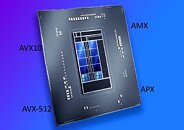
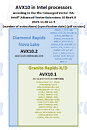
Intel's advanced features like AVX10, APX, and AMX instruction sets—designed for 512-bit acceleration and fast vector/matrix multiplication for tasks such as content creation, encoding/decoding, and AI—may not be exclusive to Intel Xeon processors. We could potentially see them in consumer "Nova Lake" processors. According to the Netwide Assembler (NASM), an assembler for the x86 CPU, Nova Lake might introduce these features in consumer PCs once again. A few weeks ago, it was believed that Nova Lake wouldn't include any of Intel's advanced x86 extensions. The latest GCC compiler patch indicated that the initial Nova Lake enablement does not incorporate AVX10, AMX, or APX. This suggested that support for these new x86 instructions might be absent from the next-generation CPU.

Initially, Intel chose to disable AVX-512 for the "Alder Lake" and "Raptor Lake" client-oriented CPU lineups, meaning that only server-grade Xeon CPUs benefited from the accelerated 512-bit data paths. With the release of NASM 3.0 and its subsequent 3.1 update, we are once again optimistic that Nova Lake will bring 512-bit acceleration to its client CPUs. Rumored to feature up to 52 cores, including 16 P-Cores, 32 E-Cores, and 4 LPE-Cores, Nova Lake could be an ideal CPU for gaming and workstation tasks, covering a wide range of scenarios and workloads, except for server applications, which are reserved for Xeon. Additionally, it could take advantage of the extensive ecosystem of AVX-accelerated software available today.
For reference, AMD introduced full AVX-512 support with its "Zen 5" cores across its product range, providing a performance boost in optimized applications for both desktop and server CPUs. This marked the first time AMD did not emulate 512-bit AVX, which previously required splitting 512-bit data into two 256-bit units to be processed over two cycles. If Intel reintroduces full AVX-512 acceleration in its client SoCs, it will mark the first time both companies offer 512-bit vector acceleration in their consumer CPUs simultaneously.
Source: @InstLatX64 on X
Add your own comment

36 Comments on More Evidence for AVX10 and APX Support in Intel "Nova Lake" Emerge

#1
dgianstefani
TPU Proofreader
Hopefully this means both the P and E cores support these instructions. Previously only the P cores did, so Intel disabled the instructions in case the OS scheduled the work on E cores then errored.
Posted on Reply
#2
ncrs
There's no mention of Nova Lake, or Diamond Rapids for that matter, in NASM source that I could find so I don't know how is this newest rumor "evidence".
Posted on Reply
#3
AleksandarK
News Editor
ncrsThere's no mention of Nova Lake, or Diamond Rapids for that matter, in NASM source that I could find so I don't know how is this newest rumor "evidence".
Check out the source tweet. @InstLatX64 is always spot on.
Posted on Reply
#4
qcmadness
The possibility of 512-bit data bus for e-cores is really low.

Does that mean "emulating" ABX-512 in author's view?
Posted on Reply
#5
ncrs
AleksandarKCheck out the source tweet. @InstLatX64 is always spot on.
I have checked it out, it's just instructions listings. We know they apply to Diamond Rapids already, but Intel hasn't officially confirmed that Nova Lake will support AVX10/APX (it for sure won't do AMX).
The documents quoted in that tweet (Intel® Advanced Vector Extensions 10.2 (Intel® AVX10.2) Architecture Specification version 5.0and The Converged Vector ISA: Intel® Advanced Vector Extensions 10 Technical Paper version 3.0) do not mention Nova Lake by name either.
Edit: maybe there are unpublished versions of those documents supporting this rumor, in that case we'll see it as soon as Intel publishes them.
qcmadnessThe possibility of 512-bit data bus for e-cores is really low.

Does that mean "emulating" ABX-512 in author's view?
The latest AVX10.2 specification removed 256-bit-only mode, so every core supporting AVX10.2 will do 512-bit. The question is whether Nova Lake will support it. According to Intel's changes to the GCC compiler it won't.
Posted on Reply
#6
kondamin
dgianstefaniHopefully this means both the P and E cores support these instructions. Previously only the P cores did, so Intel disabled the instructions in case the OS scheduled the work on E cores then errored.
Other than the large local caches the main reason why P cores are so large is the number of registers and processing hardware like FMA's needed to do everything in one clock cycle.
e cores are small because they don't have that.

Jim Keller had the idea of a "royal core" basically a setup where a bunch of e-cores would be combined to act like one big core which could process large instructions like AVX in one go.
stuff didn't pan out that way. now intel has e-cores and p-cores.

Not that it matters all that much, after all this time there still is very little consumer software that actually uses those massive instructions and most is running just fine on e-cores.
Posted on Reply
#7
dgianstefani
TPU Proofreader
kondaminOther than the large local caches the main reason why P cores are so large is the number of registers and processing hardware like FMA's needed to do everything in one clock cycle.
e cores are small because they don't have that.

Jim Keller had the idea of a "royal core" basically a setup where a bunch of e-cores would be combined to act like one big core which could process large instructions like AVX in one go.
stuff didn't pan out that way. now intel has e-cores and p-cores.

Not that it matters all that much, after all this time there still is very little consumer software that actually uses those massive instructions and most is running just fine on e-cores.
Royal Core was such a loss. Ambitious and interesting.
Posted on Reply
#8
_roman_
Just to be clear this notice comes 3 months to late. GCC 15.2 released [2025-08-08]

I read a few hours ago the stable release notes of gcc
For reference, AMD introduced full AVX-512 support with its "Zen 5" cores across its product range, providing a performance boost in optimized applications for both desktop and server CPUs. This marked the first time AMD did not emulate 512-bit AVX, which previously required splitting 512-bit data into two 256-bit units to be processed over two cycles. If Intel reintroduces full AVX-512 acceleration in its client SoCs, it will mark the first time both companies offer 512-bit vector acceleration in their consumer CPUs simultaneously.
In the old days most instructions were split and executed over several cpu cycles. That is up to discussion to determine if zen4 has full avx-512 or not.


gcc.gnu.org/gcc-15/changes.html
  • New ISA extension support for Intel AMX-AVX512 was added. AMX-AVX512 intrinsics are available via the -mamx-avx512 compiler switch.
  • New ISA extension support for Intel AMX-FP8 was added. AMX-FP8 intrinsics are available via the -mamx-fp8 compiler switch.
  • New ISA extension support for Intel AMX-MOVRS was added. AMX-MOVRS intrinsics are available via the -mamx-movrs compiler switch.
  • New ISA extension support for Intel AMX-TF32 was added. AMX-TF32 intrinsics are available via the -mamx-tf32 compiler switch.
  • New ISA extension support for Intel AMX-TRANSPOSE was added. AMX-TRANSPOSE intrinsics are available via the -mamx-transpose compiler switch.
  • All of new feature support for Intel APX except for CFCMOV was added, including CCMP/CTEST, NF and ZU. APX support is available via the -mapxf compiler switch.
  • New ISA extension support for Intel AVX10.2 was added. AVX10.2 intrinsics are available via the -mavx10.2 compiler switch.
  • New ISA extension support for Intel MOVRS was added. MOVRS intrinsics are available via the -mmovrs compiler switch. MOVRS vector intrinsics are available via the -mmovrs -mavx10.2 compiler switches.
  • EVEX version support for Intel SM4 was added. New 512-bit SM4 intrinsics are available via the -msm4 -mavx10.2 compiler switches.
  • GCC now supports the Intel CPU named Diamond Rapids through -march=diamondrapids. Based on ISA extensions enabled on Granite Rapids D, the switch further enables the AMX-AVX512, AMX-FP8, AMX-MOVRS, AMX-TF32, AMX-TRANSPOSE, APX_F, AVX10.2, AVX-IFMA, AVX-NE-CONVERT, AVX-VNNI-INT16, AVX-VNNI-INT8, CMPccXADD, MOVRS, SHA512, SM3, SM4, and USER_MSR ISA extensions.
  • Support for Xeon Phi CPUs (a.k.a. Knight Landing and Knight Mill) were removed in GCC 15. GCC will no longer accept -march=knl, -march=knm, -mavx5124fmaps, -mavx5124vnniw, -mavx512er, -mavx512pf, -mprefetchwt1, -mtune=knl, and -mtune=knm compiler switches.
  • -mavx10.1-256, -mavx10.1-512, and -mevex512 are deprecated. Meanwhile, -mavx10.1 enables AVX10.1 intrinsics with 512-bit vector support, while in GCC 14.1 and GCC 14.2, it only enables 256-bit vector support. GCC will emit a warning when using these compiler switches. -mavx10.1-256, -mavx10.1-512, and -mevex512 will be removed in GCC 16 together with the warning for the behavior change on -mavx10.1.
  • With the -mveclibabi compiler switch GCC is able to generate vectorized calls to external libraries. GCC 15 newly supports generating vectorized math calls to the math library from AMD Optimizing CPU Libraries (AOCL LibM). This option is available through -mveclibabi=aocl. GCC still supports generating calls to AMD Core Math Library (ACML). However, that library is end-of-life and AOCL offers many more vectorized functions.
Intel can not make silicion with avx512. They do the workaround to make a worse not common instruction. So few packages already utilise avx512, this will not make it better. Other platform will get the advandage wiht such intel actions.

When they just "added" those features and just changing those features, it implies htey are years behind.

--

It would be more news worthy to discuss those march=gfx1101 and how to utilise it and it potential. (I assume i remembered it correctly what i red yesterday)

The legacy 14 branch does not paint a better intel picture: gcc.gnu.org/gcc-14/changes.html
Posted on Reply
#9
Six_Times
I've been waiting nearly 10 years for Nova Lake. My hair has since turned all gray. :laugh:
Posted on Reply
#10
kondamin
_roman_Just to be clear this notice comes 3 months to late. GCC 15.2 released [2025-08-08]

I read a few hours ago the stable release notes of gcc


In the old days most instructions were split and executed over several cpu cycles. That is up to discussion to determine if zen4 has full avx-512 or not.


gcc.gnu.org/gcc-15/changes.html


Intel can not make silicion with avx512. They do the workaround to make a worse not common instruction. So few packages already utilise avx512, this will not make it better. Other platform will get the advandage wiht such intel actions.

When they just "added" those features and just changing those features, it implies htey are years behind.

--

It would be more news worthy to discuss those march=gfx1101 and how to utilise it and it potential. (I assume i remembered it correctly what i red yesterday)

The legacy 14 branch does not paint a better intel picture: gcc.gnu.org/gcc-14/changes.html
Avx is still on Xeon where the bulk of the software that uses it is actually run upon.
Posted on Reply
#11
Space Lynx
Astronaut
Completely off-topic, but Nova was my favorite Starcraft 2 co-op character.

Anyways, just glad there will be competition for AMD.
Posted on Reply
#12
ToTTenTranz
What's using AVX512 nowadays? Honest question. It's faster for some ML workloads, but those are completely offloaded to NPUs and GPUs nowadays.
Space LynxCompletely off-topic, but Nova was my favorite Starcraft 2 co-op character.

Anyways, just glad there will be competition for AMD.
20 years ago we were close to getting a 3rd person shooter where Nova was the main character:


It could have been the start of a new franchise from Blizzard.

Too much money from WoW screwed up all other projects from Blizzard, though. That's why it took another 10 years for Starcraft 2, Warcraft never got any RTS ever again except for a mediocre remaster, and Ghost got cancelled.
Posted on Reply
#13
Lianna
This marked the first time AMD did not emulate 512-bit AVX, which previously required splitting 512-bit data into two 256-bit units to be processed over two cycles. If Intel reintroduces full AVX-512 acceleration in its client SoCs
If doing 512-bit ops by teaming ports or execution units is "emulation" (which it is not) then Intel never had "client SOC" without "emulation" of AVX-512 as Ice Lake Client and Tiger Lake (and, reportedly, Alder Lake P before firmware changes) are doing (most?) FP 512-bit ops on port 0 only, teaming with port 1 (which can be used for 128 and 256-bit ops as an independent port). This depends on whether you count Skylake-X as a client SOC or not; and (most?) server parts are doing "half-emulation" where port 0 teams with port 1 for one 512-bit op and port 5 gets another 512-bit op by itself.
There's no mention of Nova Lake, or Diamond Rapids for that matter, in NASM source that I could find so I don't know how is this newest rumor "evidence".
Check out the source tweet. @InstLatX64 is always spot on.
Can't see anything in his post outside "supports the full ISA of #DiamondRapids and #NovaLake:" which still does not mean these instructions are for both implementations.
No Intel document he's quoting supports this, either.
The lack of #APX and #AVX10 from #Intel #NovaLake would be quite a disappointment, but I don't think that's the case.
It contradicts
- the x86 EAG announcement of future AVX10 support [1]
- the AVX10.2 specification [2]
- the "The Converged Vector ISA" white paper [3]
No image in his post contradicts Nova Lake missing AVX-512/AVX10.*, "portability across client, workstation and server CPUs" does not mean it happens in Nova Lake (maybe later), neither does "all Intel products" nor "Supported on P-cores, E-cores".
Posted on Reply
#14
windwhirl
ToTTenTranzWhat's using AVX512 nowadays?
Three things come to my mind:
RPCS3, the PS3 emulator
Blender
SVT-AV1 (AV1 encoder)
Posted on Reply
#15
Nhonho
AVX-512 instructions have been present in all Core and Xeon CPUs since the Skylake generation (Core 6000 series), released in 2015! But Intel intentionally disables them in Core CPUs.

The core design of Core and Xeon CPUs is the same; it's impossible to magically remove AVX-512 instructions in Core CPUs, since the core design is identical. That's why they are present in both the Xeon and Core lines, but they (and other server features) have been intentionally disabled in the Core line since 2015.

This and other arrogant decisions are the reason Intel is suffering huge losses today.

AVX-512 instructions should have been included in all x86 CPUs since 2015, in both Intel and AMD CPUs. Today, we should be discussing the implementation of the 4th generation of AVX-512 instructions, not the 1st.
Posted on Reply
#16
Rulumi
I mentioned this in the other report discussion, but right now I think this is the only (at least public) source from Intel explicitely mentioning Nova Lake as supporting AVX 10.2, someone correct me if wrong: github.com/uxlfoundation/oneDNN
future Intel Core processor with Intel AVX10.2 instruction set support (code name Nova Lake)
NhonhoAVX-512 instructions have been present in all Core and Xeon CPUs since the Skylake generation (Core 6000 series), released in 2015! But Intel intentionally disables them in Core CPUs.

The core design of Core and Xeon CPUs is the same; it's impossible to magically remove AVX-512 instructions in Core CPUs, since the core design is identical. That's why they are present in both the Xeon and Core lines, but they (and other server features) have been intentionally disabled in the Core line since 2015.

This and other arrogant decisions are the reason Intel is suffering huge losses today.

AVX-512 instructions should have been included in all x86 CPUs since 2015, in both Intel and AMD CPUs. Today, we should be discussing the implementation of the 4th generation of AVX-512 instructions, not the 1st.
I'm sure Intel doesn't want to disable them intentionally, specially now that AMD supports it. Skylake-S and all its derivates physically have the block where AVX-512 hardware would have gone empty, it was supossed to be followed and replaced by Cannon Lake in 10nm with AVX-512 in 2017 across the board, but that turned in the mess it turned of only one limited release messy mobile dual core that released in 2018 due to 10nm. A lot of mismanagement and something new didn't see light in 14nm until Rocket Lake, too late as 10nm will finally be ready for desktop client in a few months, but such delays made it a choose between a maximum of 10 or 12 cores with AVX-512 to compete with 16 AMD cores or the E-cores, it seems it was better to compete and as a client product with the E-cores.

AVX-512 in specific doesn't seem to be in the current situation Intel has because actual planified segmentation, but rather remnants of all the 10nm falling, bad management and stubborness of it to release actually evolved main architecture designs in 14nm and so and so. Though the final result is the same in a segmented support for AVX-512 in consumer segments products because of the whole mess situation that happened with Intel and that AMD took a while to support it and none supported them on the consumer segments at the same time as a result.
Posted on Reply
#17
kondamin
NhonhoAVX-512 instructions have been present in all Core and Xeon CPUs since the Skylake generation (Core 6000 series), released in 2015! But Intel intentionally disables them in Core CPUs.

The core design of Core and Xeon CPUs is the same; it's impossible to magically remove AVX-512 instructions in Core CPUs, since the core design is identical. That's why they are present in both the Xeon and Core lines, but they (and other server features) have been intentionally disabled in the Core line since 2015.

This and other arrogant decisions are the reason Intel is suffering huge losses today.

AVX-512 instructions should have been included in all x86 CPUs since 2015, in both Intel and AMD CPUs. Today, we should be discussing the implementation of the 4th generation of AVX-512 instructions, not the 1st.
AVX512 requires a lot of power, so much so that the moment they hit the cpu has to throttle.
And it's not like the supporting hardware is sitting idle wasting die space.
other extensions make use of the infrastructure in place that could do avx512.

There is hardly any popular software that uses avx512, intel made the right move disabling it if that was the thing that was causing issues on 12th gen alderlake.
it would have been better if they offered p core only chips that did do avx 512 for the fans.

No one cared for avx512 when they were available, linus (torvalds) shat upon it when it was still around.
www.phoronix.com/news/Linus-Torvalds-On-AVX-512
Intel tried...

Intel did a lot of things wrong, scrapping avx512 which would have melted wires in your home for raptor lake while it's getting it's act together isn't one of them.
Posted on Reply
#18
MufasaV
ncrsI have checked it out, it's just instructions listings. We know they apply to Diamond Rapids already, but Intel hasn't officially confirmed that Nova Lake will support AVX10/APX (it for sure won't do AMX).
The documents quoted in that tweet (Intel® Advanced Vector Extensions 10.2 (Intel® AVX10.2) Architecture Specification version 5.0and The Converged Vector ISA: Intel® Advanced Vector Extensions 10 Technical Paper version 3.0) do not mention Nova Lake by name either.
Edit: maybe there are unpublished versions of those documents supporting this rumor, in that case we'll see it as soon as Intel publishes them.


The latest AVX10.2 specification removed 256-bit-only mode, so every core supporting AVX10.2 will do 512-bit. The question is whether Nova Lake will support it. According to Intel's changes to the GCC compiler it won't.
According to ONEAPI documentation, NovaLake supports AVX 10
Posted on Reply
#19
ToTTenTranz
windwhirlThree things come to my mind:
RPCS3, the PS3 emulator
Blender
SVT-AV1 (AV1 encoder)
And today I noticed the FAISS embedding library for LLMs uses AVX512. I've been using it every day at work. I don't know if it makes any real difference to a 256bit version, though.
Posted on Reply
#20
Lianna
MufasaVAccording to ONEAPI documentation, NovaLake supports AVX 10
Can you please share a link to the documentation you mention?
Posted on Reply
#22
Nhonho
In reality, it's pointless for an x86 CPU to have thousands of AVX instructions, since programmers don't study them and continue developing their apps with only 6 basic instructions from the Intel 386 era.
Posted on Reply
#23
windwhirl
NhonhoIn reality, it's pointless for an x86 CPU to have thousands of AVX instructions, since programmers don't study them and continue developing their apps with only 6 basic instructions from the Intel 386 era.
To be honest, I don't think it's pointless, but from what I've read around, you kinda have to put in some good effort to really make AVX shine. For software that doesn't really need to perform ultra fast, that's just a waste of the developer's time...

And if you don't have the time to spend for that, then you'd just make use of compiler optimizations to do stuff for you, which would be the low-hanging fruit here.
Posted on Reply
#24
stevegalaxius
NhonhoAVX-512 instructions have been present in all Core and Xeon CPUs since the Skylake generation (Core 6000 series), released in 2015! But Intel intentionally disables them in Core CPUs.

The core design of Core and Xeon CPUs is the same; it's impossible to magically remove AVX-512 instructions in Core CPUs, since the core design is identical. That's why they are present in both the Xeon and Core lines, but they (and other server features) have been intentionally disabled in the Core line since 2015.

This and other arrogant decisions are the reason Intel is suffering huge losses today.

AVX-512 instructions should have been included in all x86 CPUs since 2015, in both Intel and AMD CPUs. Today, we should be discussing the implementation of the 4th generation of AVX-512 instructions, not the 1st.
avx-512 was first introduced with skylake-X with the X series of processors, in late 2016. They were rebadged xeons. skylake consumer chips and skylake server chips actually have a completely different core architecture with significant differences, the most notably being an entirely different mesh topography that has the cores arranged in a large grid so they can communicate with each other faster. this was to get around the latency issues that high core count broadwell server chips with higher core counts using a traditional ring topography. The core design in the server chips also has a completely different caching structure to feed the large data throughput of avx-512, which is why they have a large l2 cache and a small l3 cache and the l3 cache isn't inclusive.

Part of the reason the core design is different is also because the first implementation of avx-512 was an extension of their cpu-as-a-gpu project called Knights Landing (which is where the mesh topography came from) and extremely experimental. the massive dual execution units take up a large amount of the die area and required very beefy power delivery to keep the ridiculous number of transistors active, which meant that they downclocked heavily when avx-512 was active.

There is very little software that takes advantage of these instructions, and half of that software is also heavily dependent on the implementation because the first generation of chips was basically geared toward research use.
Posted on Reply
#25
Dr. Dro
This is a convenient support matrix for AVX-512 subsets, as mentioned earlier, Skylake doesn't support it. Alder Lake does, but it is disabled in MCU and was fused off in newer manufacture CPUs, since they were not intended to support the feature (artificially). Raptor Lake and Arrow Lake CPUs have the extension set fused off from the factory.

That leaves Rocket Lake (11900K) and Ryzen 7000/9000 as the only client segment CPUs that can support it in some form.

Posted on Reply
Add your own comment
Nov 15th, 2026 05:12 CST change timezone

New Forum Posts

Popular Reviews

TPU on YouTube

Controversial News Posts