Tuesday, March 31st 2026

NVIDIA Launches Auto Shader Compilation for Faster Game Loading and Less Stuttering
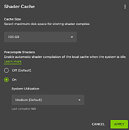
The NVIDIA App update today introduced some interesting features, such as DLSS 4.5 dynamic multi-frame generation and a 6x mode. Additionally, the app now includes a new beta version of NVIDIA Auto Shader Compilation (ASC). This feature takes DirectX 12 shaders from games and quietly compiles them while the system is idle or not running any graphically intensive tasks. Typically, when you start a game, you have to wait for all assets to load and shaders to compile before you can begin playing. However, with ASC, NVIDIA aims to shorten this process by pre-compiling shaders to reduce loading times and, interestingly, decrease in-game stuttering, which can occur when shaders don't load properly. NVIDIA states that this feature is opt-in within the NVIDIA App and can be enabled by navigating to the Graphics Tab > Global Settings > Shader Cache. Once in the menu, users can access a range of settings, including the option to turn on Auto Shader Compilation.
Since ASC uses a separate folder, users will need to allocate sufficient disk space to store the shaders that ASC will access. In the NVIDIA App, gamers can choose the "Compile Now" option to pre-compile all game shaders immediately by clicking on three dots, or they can wait for the system to do it automatically when it becomes idle. As compiling shaders requires some computing power, there are settings to control system utilization, with the default set to medium. The NVIDIA App will also display the date of the last compilation. Interestingly, ASC will perform its functions once a game is downloaded and after a new driver update is installed for optimal performance. NVIDIA requires GeForce Game Ready Driver 595.97 WHQL or newer for ASC to work, and more optimizations are expected as the beta testing concludes in the coming weeks.
 It's worth noting that NVIDIA is not the first to explore this idea, as both Intel and Microsoft have been working on similar solutions. For instance, Intel recently expanded its precompiled shader delivery to more GPUs. However, Intel's service is cloud-based, gathering game shaders in the company's private cloud infrastructure, where they are processed and precompiled. When you install the Intel Graphics Software App, it identifies the games you play and downloads the precompiled shaders for those games, using the Intel app as a distribution service and creating a folder for the precompiled shaders. Microsoft has a program called Advanced Shader Delivery, part of its Agility SDK, which performs a similar function. Intel has built an entirely custom framework this time but also plans to update its precompiled shader delivery with Microsoft Advanced Shader Delivery later this year. It remains to be seen whether NVIDIA is using Microsoft's Advanced Shader Delivery or if, like Intel, they have developed a custom solution.
Source:
NVIDIA
Since ASC uses a separate folder, users will need to allocate sufficient disk space to store the shaders that ASC will access. In the NVIDIA App, gamers can choose the "Compile Now" option to pre-compile all game shaders immediately by clicking on three dots, or they can wait for the system to do it automatically when it becomes idle. As compiling shaders requires some computing power, there are settings to control system utilization, with the default set to medium. The NVIDIA App will also display the date of the last compilation. Interestingly, ASC will perform its functions once a game is downloaded and after a new driver update is installed for optimal performance. NVIDIA requires GeForce Game Ready Driver 595.97 WHQL or newer for ASC to work, and more optimizations are expected as the beta testing concludes in the coming weeks.


30 Comments on NVIDIA Launches Auto Shader Compilation for Faster Game Loading and Less Stuttering
Only really meaningful method would be delivering precompiled shaders with the game update. Not sure how that would work when driver updates.
Besides, most games these days precompile shaders on game start. Marvel Rivals do this and it has been a single smoothest UE5 game in existence because of it, Killing Floor 3 also compiles them before launching, ensuring shaders are compiled. Overwatch 2 but now 1 without number again seems to still compile them on runtime.
Just compile it for everyone as Intel do and ms suggested.
For the love of God, you are swimming in money
Regards,
Fred.
If you don’t see why Nvidia has quietly surpassed them both then you haven’t been paying attention.Which has nothing to do with shader compilation. Did venting make you feel better?
Since I dont want this app, hopefully a 3rd party tool implements it.
Its a shame they require a driver from a branch that has broken VRR though.
GPU manufacturers have the documentation for every architecture and source code for the drivers, and so they can compile shaders without even using the actual hardware.
The solution that Microsoft has created, and that Intel (and likely Nvidia) are adopting, is called Advanced Shader Delivery. Game devs submit snippets of code extracted from the game engine to Microsoft, which can be used to compile shaders. GPU vendors have access to this code, and can compile all the shaders for all of their hardware for any driver they choose. These pre-compiled shaders can then be delivered to consumers. These vendor apps are the initial method of delivery, as Intel and Nvidia beta-test this process. Eventually, it will probably be through Windows directly, or possibly even through Steam or other storefronts where the game was purchased. The framework is finally in place, all that's left is implementation.
I am talking about local pre compilation for reference, not the cloud version from Intel and Microsoft.
Having the GPU vendor compile shaders and deliver them over the internet is the best option for gamers, especially once this becomes opt-out instead of opt-in.
I love it when someone on the internet solves a decade long issue in a paragraph.
Question: Have you ever tried to gather every PSO in a game? How’d it go? Why do games that have a pre-compilation step still have shader compilation stutters?
Games that suffer from #StutterStruggle are already compiling shaders before gameplay. How does doing it while I browse Youtube supposed to produce a better result? It's not like its compiling more shaders than the game would already... so what, I save myself a loading screen before the Main Menu? Why is pre-loading shaders that cause stutter supposed to reduce stutter?
If it doesn't remove stutters during gameplay, this is equivalent to skipping intro movies.
Compiling shaders from games quietly in the background while the system/graphics card is idle, hopefully means the pre-compiling shaders process can be more comprehensive and reduced the likelihood they need to be done while the game is running.