Tuesday, March 31st 2026

NVIDIA Launches Auto Shader Compilation for Faster Game Loading and Less Stuttering
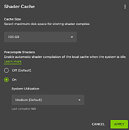
The NVIDIA App update today introduced some interesting features, such as DLSS 4.5 dynamic multi-frame generation and a 6x mode. Additionally, the app now includes a new beta version of NVIDIA Auto Shader Compilation (ASC). This feature takes DirectX 12 shaders from games and quietly compiles them while the system is idle or not running any graphically intensive tasks. Typically, when you start a game, you have to wait for all assets to load and shaders to compile before you can begin playing. However, with ASC, NVIDIA aims to shorten this process by pre-compiling shaders to reduce loading times and, interestingly, decrease in-game stuttering, which can occur when shaders don't load properly. NVIDIA states that this feature is opt-in within the NVIDIA App and can be enabled by navigating to the Graphics Tab > Global Settings > Shader Cache. Once in the menu, users can access a range of settings, including the option to turn on Auto Shader Compilation.
Since ASC uses a separate folder, users will need to allocate sufficient disk space to store the shaders that ASC will access. In the NVIDIA App, gamers can choose the "Compile Now" option to pre-compile all game shaders immediately by clicking on three dots, or they can wait for the system to do it automatically when it becomes idle. As compiling shaders requires some computing power, there are settings to control system utilization, with the default set to medium. The NVIDIA App will also display the date of the last compilation. Interestingly, ASC will perform its functions once a game is downloaded and after a new driver update is installed for optimal performance. NVIDIA requires GeForce Game Ready Driver 595.97 WHQL or newer for ASC to work, and more optimizations are expected as the beta testing concludes in the coming weeks.
 It's worth noting that NVIDIA is not the first to explore this idea, as both Intel and Microsoft have been working on similar solutions. For instance, Intel recently expanded its precompiled shader delivery to more GPUs. However, Intel's service is cloud-based, gathering game shaders in the company's private cloud infrastructure, where they are processed and precompiled. When you install the Intel Graphics Software App, it identifies the games you play and downloads the precompiled shaders for those games, using the Intel app as a distribution service and creating a folder for the precompiled shaders. Microsoft has a program called Advanced Shader Delivery, part of its Agility SDK, which performs a similar function. Intel has built an entirely custom framework this time but also plans to update its precompiled shader delivery with Microsoft Advanced Shader Delivery later this year. It remains to be seen whether NVIDIA is using Microsoft's Advanced Shader Delivery or if, like Intel, they have developed a custom solution.
Source:
NVIDIA
Since ASC uses a separate folder, users will need to allocate sufficient disk space to store the shaders that ASC will access. In the NVIDIA App, gamers can choose the "Compile Now" option to pre-compile all game shaders immediately by clicking on three dots, or they can wait for the system to do it automatically when it becomes idle. As compiling shaders requires some computing power, there are settings to control system utilization, with the default set to medium. The NVIDIA App will also display the date of the last compilation. Interestingly, ASC will perform its functions once a game is downloaded and after a new driver update is installed for optimal performance. NVIDIA requires GeForce Game Ready Driver 595.97 WHQL or newer for ASC to work, and more optimizations are expected as the beta testing concludes in the coming weeks.


30 Comments on NVIDIA Launches Auto Shader Compilation for Faster Game Loading and Less Stuttering
This is a sloppy job on Nvidia's part, but the problem is that, for some reason, some of you have the mentality of a 4-year-old and are incapable of criticizing your beloved company just because you have an Nvidia graphics card plugged into your PC.
Get over it already. If they do something wrong, you call it out and that's it; your PC is still going to turn on tomorrow anyway. Don't worry.
I ultimately think this is a problem which should be solved at the game side. The fact that this has become a problem in the first place is due to misuse of shaders. I mean, probably shaders which are "auto generated", bloated and partly duplicated. Which may make sense during early game development, but they should replace them with proper handcrafted shaders which would reduce the quantity and size of the shaders and in most cases remove the problem all together. Like anything in engineering, we should attack the source of the problem instead of creating elaborate contraptions to deal with the consequences of bad design in the first place.